
TL;DR:
- Forecasting investment returns involves understanding a range of possible outcomes rather than predicting specific results, which improves long-term planning. Probabilistic and distributional forecasts help investors build resilient portfolios by accounting for uncertainty, downside risks, and market variability. Using return ranges effectively guides strategic asset allocation, stress testing, and risk management, avoiding reliance on single-point predictions.
Most investors understand that returns vary. What fewer appreciate is that forecasting investment returns is not about predicting the future with precision — it is about understanding the range of futures you might face. Treating a single-point forecast as a reliable promise is one of the most common and costly mistakes self-directed investors make. The importance of investment forecasting lies not in pinpoint accuracy, but in building a planning framework that holds up across multiple possible market environments. This article explains why forecast investment returns matter, where forecasts genuinely help, and how to use them without falling into the traps that catch even experienced investors off guard.
Table of Contents
- The role of forecasting in strategic investment planning
- Limits of single-point return forecasts and common misconceptions
- Using a distributional approach to forecast returns and manage risks
- Long-horizon asset return expectations for Australian investors
- Applying return forecasts to optimise your investment strategy
- Our perspective: forecasting is about preparation, not prediction
- See your investment scenarios clearly with AlphaIQ
- Frequently asked questions
Key Takeaways
| Point | Details |
|---|---|
| Forecasts support long-term planning | Investment return forecasts provide vital guidance for making strategic, not short-term, decisions. |
| Avoid relying on single-point estimates | Single forecast numbers can mislead; it’s better to consider a range of possible outcomes. |
| Use probabilistic forecasts | Range-based forecasts help stress-test portfolios for downside risk and volatility. |
| Australian return ranges are benchmarks | Long-term return and volatility ranges for local assets help set realistic expectations. |
| Practical use improves outcomes | Applying forecasts thoughtfully in portfolio construction and regular reviews enhances investment resilience. |
The role of forecasting in strategic investment planning
Having introduced why forecasting matters, let us explore specifically how it fits within strategic investment planning.
Forecasting is not a tool for timing markets. It is a tool for building resilient portfolios that can weather a wide range of conditions. When you know that Australian equities might return anywhere between 4.9% and 6.9% annualised over the next decade, you can make informed decisions about how much of your wealth to allocate there — and how much to hold in bonds, property, or cash to balance that exposure.
The importance of investment forecasting becomes clearest when you consider what happens without it. Investors who rely on recent performance as a guide often overweight assets that have already run hard and underweight those positioned to recover. That is recency bias in action, and it is expensive.
Long-term return forecasts are mainly useful for planning, particularly strategic asset allocation, because well-constructed models describe uncertainty as a distribution of outcomes rather than a single expected return. This is the core insight behind tools like Vanguard's Capital Markets Model (VCMM), which generates probabilistic return distributions across asset classes.
Here is what good investment return forecasting strategies actually deliver when applied to long-term planning:
- Clearer asset allocation decisions based on expected return ranges rather than guesswork
- More realistic retirement projections that account for both upside and downside scenarios
- Better diversification choices informed by how different asset classes are likely to behave relative to each other
- Reduced emotional decision-making because you have already considered what a bad year looks like
- Greater alignment between your risk tolerance and your actual portfolio construction
None of these benefits require you to be right about the future. They require you to have thought carefully about the range of possibilities.
Limits of single-point return forecasts and common misconceptions
To better appreciate these limitations, let us look closer at why forecasting is more valuable as probabilistic planning rather than precise prediction.
A single-point forecast — "Australian equities will return 7% next year" — sounds useful. It is not. That figure collapses an enormous range of possibilities into a single number, and in doing so it strips out the very information you need to plan well. Single-point estimates can mislead decision-making because valuations are often poor predictors of returns over short to intermediate time horizons.

Consider a practical example. An investor in late 2021 saw elevated valuations in global equity markets and concluded that a correction was coming. They reduced their equity exposure significantly. The correction did come — but not until 2022, meaning the investor missed substantial gains in the intervening period, then faced the difficult question of when to re-enter. This is a textbook example of why even a directionally correct forecast can produce poor outcomes without precise timing.
Market turning points require precise timing, which is why forecasts are often of no practical use for achieving better than average results. This applies to professional forecasters just as much as individual investors. The research is consistent: most active strategies built on short-term return predictions underperform simple index-based approaches over time.
Here is a numbered breakdown of the most common misconceptions about forecasting returns:
- Forecasts are promises. They are not. They are probability-weighted estimates subject to constant revision as new data arrives.
- Higher expected returns mean lower risk. Higher forecast returns typically come with higher forecast volatility and wider outcome ranges.
- If I can spot overvalued markets, I can time my exit. Valuations can remain stretched for years. Timing the exit and the re-entry both need to be correct.
- A model that has worked recently will keep working. Return forecasting models are calibrated on historical relationships that shift over time.
- Short-term forecasts are as useful as long-term ones. For planning purposes, the opposite is true. Uncertainty compounds in the short term in ways that make near-term forecasts far less reliable.
Pro Tip: The next time you read a market outlook from a major institution, look for the confidence interval or range around the headline number. If there is no range given, treat the figure with significant scepticism. A forecast without a margin of uncertainty is incomplete by definition.
Understanding the pitfalls of relying on forecasts and the investment strategy nuances that separate good planning from poor planning is fundamental to making forecasts genuinely useful.
Using a distributional approach to forecast returns and manage risks
With this foundation, let us review actual Australian asset return forecasts to see these concepts in practice.
A distributional or probabilistic forecast does not give you a single number. It gives you a range of outcomes, each associated with a likelihood. Think of it less like a weather forecast that says "23 degrees tomorrow" and more like one that says "there is a 70% chance of temperatures between 19 and 27 degrees, with a small but real chance of reaching 32." The second version is actually more useful for planning, even though it feels less definitive.
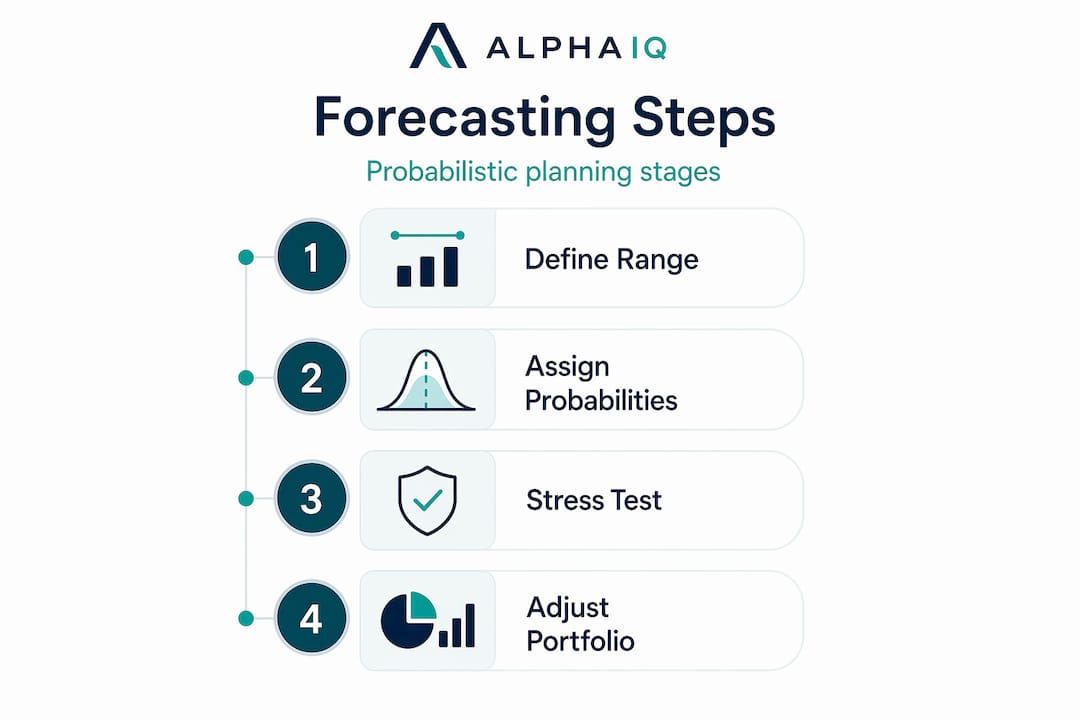
Forecasting in ranges is a practical way to stress-test outcomes against downside risks, including fat tails and skewness in return distributions. "Fat tails" simply means that extreme events — market crashes, sustained periods of low returns — happen more often than traditional bell-curve models predict. A good distributional forecast acknowledges that.
Key features of distributional forecasting that matter for Australian investors:
- Median return estimates give you the midpoint of the expected distribution, not a guarantee
- Volatility figures show how wide the range of outcomes is — higher volatility means a wider spread of possible results
- Tail risk analysis highlights the worst-case scenarios you should be able to withstand without abandoning your strategy
- Skewness considerations account for the fact that return distributions are often not symmetrical — bad years can be worse than good years are good
Here is a simplified illustration of how distributional outputs might look for a balanced Australian portfolio:
| Scenario | Annualised return (10-year) | Probability weighting |
|---|---|---|
| Optimistic | 8.5% | 15% |
| Base case | 6.0% | 55% |
| Cautious | 3.5% | 25% |
| Adverse | 0.5% | 5% |
This kind of table does not predict the future. What it does is force you to ask: "Can my plan survive the cautious or adverse scenario?" If the answer is no, that is valuable information.
Portfolio optimisation techniques built around distributional thinking are considerably more resilient than those built around single expected return figures. You can explore more on stress testing investments and how scenario modelling applies to your specific situation.
Pro Tip: When reviewing any forecast, pay attention to the skewness of the distribution. If downside scenarios are significantly worse than the upside scenarios are good — which is common in equity markets — your planning should weight the downside more heavily than simple averages suggest. For more on probabilistic forecasting strategies, this is a useful starting point.
Long-horizon asset return expectations for Australian investors
Now that we see what forecasts look like in practice, let us explore how these insights translate into building your investment strategy.
Understanding what realistic return ranges look like for Australian asset classes helps you calibrate your own expectations rather than working from vague assumptions. A 2026 Australian investment outlook provides 10-year nominal return ranges and median volatility estimates that are directly relevant to Australian portfolio construction.
| Asset class | 10-year return range (annualised) | Median volatility |
|---|---|---|
| Australian equities | 4.9% to 6.9% | 20.3% |
| Australian aggregate bonds | 4.4% to 5.4% | 6.4% |
| Global bonds (hedged, ex-Australia) | 4.2% to 5.2% | 5.4% |
Several points worth noting about these figures:
- Equities carry far higher volatility than bonds. That 20.3% volatility figure for Australian equities means in any given year, actual returns could fall well outside the long-term average range.
- The return differential between equities and bonds has narrowed compared to historical norms, reflecting starting valuations and the interest rate environment as of late 2025.
- These are nominal figures. After accounting for inflation, real returns are lower. For retirement planning, this distinction matters considerably.
- These forecasts reflect starting conditions. As market conditions shift, these ranges will be revised. They are a snapshot, not a permanent truth.
For Australian investment returns data that extends to property and other asset classes, the picture becomes more nuanced, particularly given the regional variation in Australian real estate performance.
Applying return forecasts to optimise your investment strategy
To conclude the body, let us reflect on common misunderstandings and summarise practical wisdom about forecasting returns.
Knowing how to forecast investment returns is only useful if that knowledge changes what you do with your money. The benefits of predicting returns are realised through deliberate, structured decision-making rather than reactive portfolio changes. Capital market assumptions are most valuable when used to build strategic allocations based on structural drivers rather than short-term predictions.
Here is a practical framework for applying forecast return ranges to your own portfolio:
- Define your return requirement. Work backwards from your retirement income goal. What annualised return does your portfolio need to get you there, given your current balance and time horizon?
- Map asset class return ranges to your requirement. If you need 6% annually and Australian equities are forecast at 4.9% to 6.9%, you understand both the opportunity and the risk.
- Build scenario analysis into your plan. Model at least three paths: an optimistic scenario, a base case, and a more challenging one. Ensure your retirement income plan is viable across all three.
- Avoid timing shifts based on short-term forecasts. If your strategic allocation is sound, tactical changes based on near-term return predictions will almost certainly cost you more than they save.
- Account for sequence-of-returns risk. For investors approaching or in retirement, a string of poor returns early in the drawdown phase is far more damaging than average returns suggest. Your forecast needs to model this specifically.
- Review your assumptions annually. Market conditions shift. A forecast calibrated in 2024 may look quite different by 2026. Regular portfolio reviews help you catch these shifts before they become problems.
The impact of forecasting on investments is not felt in any single decision. It accumulates over years of making slightly better-informed choices, avoiding expensive mistakes, and staying aligned with a plan that was built on realistic expectations rather than wishful thinking. Optimising investment strategies using this approach is what separates investors who achieve their goals from those who fall short despite putting in consistent effort.
Pro Tip: Sequence-of-returns risk is one of the most underappreciated factors in retirement planning. Even if your long-term average return is exactly what you forecast, a bad first five years in retirement can permanently reduce your sustainable drawdown rate. Model this explicitly rather than relying on average return assumptions alone.
Our perspective: forecasting is about preparation, not prediction
Here is the uncomfortable truth about investment return forecasting: most investors use it the wrong way. They look for the number that tells them what is about to happen. They want a forecast to be a signal — a reason to act. That is precisely the wrong way to use it.
The genuine value of forecasting is not in identifying what will happen. It is in understanding what could happen, including the scenarios you would prefer not to think about. We have seen investors build technically sound portfolios that collapse under a specific sequence of events they never bothered to model. Not because they lacked information, but because they used that information to confirm what they already believed rather than to challenge it.
The investors who use forecasting well tend to share one habit: they model the scenarios they are hoping will not occur first. They ask, "What does my plan look like if equities deliver 1% annually for the next seven years?" before they ask what happens if markets perform well. That question is uncomfortable, but it is the one that actually improves your planning.
The other thing worth saying plainly is this: if a forecast does not change any decision you would make, it was not worth the time spent reading it. Forecasting only has value when it is connected to action, and the most useful actions it should drive are structural — how you allocate, how you drawdown, when you rebalance — not tactical calls about what to buy or sell this month.
See your investment scenarios clearly with AlphaIQ
Understanding why you should forecast investment returns is one thing. Having the tools to actually model those scenarios across your full financial picture is another.
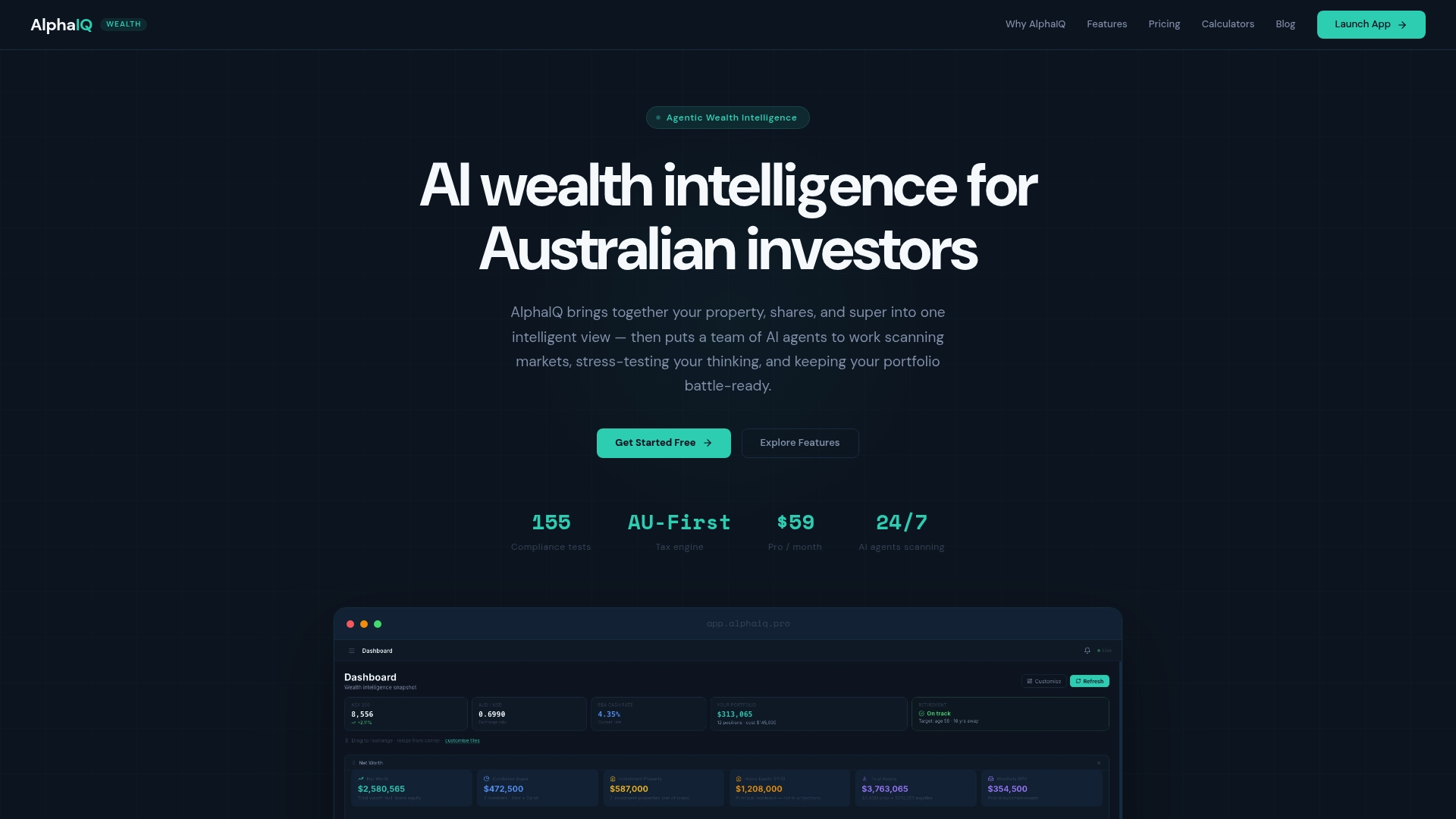
AlphaIQ is built for exactly this kind of planning. As an Australian wealth intelligence platform, it lets you model return scenarios across your investments, superannuation, property, and retirement income in one place, with tax-aware calculations that account for franking credits, capital gains, and debt recycling. Rather than working from a single expected return figure, you can model multiple financial scenarios to see how your plan holds up across optimistic, base, and adverse outcomes. No ongoing advice fees. No guesswork. Just your numbers, clearly mapped.
Frequently asked questions
Why is forecasting investment returns important for long-term investors?
Forecasting allows long-term investors to plan strategic asset allocations and understand potential risks by considering a range of possible outcomes. Long-term forecasts are most valuable when they describe uncertainty as distributions rather than single figures, giving investors a more realistic basis for planning.
Can return forecasts guarantee investment success?
No, forecasts cannot guarantee success because markets are uncertain and short-term returns can vary widely from any projection. Major market turning points require precise timing, which is why forecasts are planning tools rather than reliable predictors of near-term outcomes.
How do probabilistic forecasts help manage investment risk?
Probabilistic forecasts provide a range of possible outcomes, enabling investors to stress-test portfolios against downside risks and prepare for unlikely but impactful events. Forecasting in ranges specifically addresses fat tails and skewness in return distributions, which simple average-based planning ignores.
Why should Australian investors focus on long-term return ranges instead of single figures?
Long-term return ranges better represent the genuine uncertainty in markets and help investors align their portfolios with realistic performance expectations. A 2026 Australian outlook illustrates this directly, showing 10-year annualised return ranges for equities and bonds that reflect the inherent uncertainty in any forward projection.