
TL;DR:
- Asset allocation explains over 90% of long-term investment returns and risk.
- Strategic asset allocation with periodic rebalancing is recommended over tactical timing efforts.
- Discipline and regular review of your asset mix are more impactful than precise percentage tweaks.
Most investors spend their energy researching individual shares, watching market news, and debating when to buy or sell. Yet over 90% of return variation in a portfolio is explained not by which shares you pick, but by how you divide your money across asset classes. That single insight changes everything. Asset allocation, the way you split your investments between shares, bonds, property, cash, and alternatives, is the most powerful lever you have as a self-directed investor. Get it right, and you build a portfolio that can weather market shocks, grow steadily, and support the retirement you want.
Table of Contents
- What is asset allocation and why does it matter?
- The main types of asset allocation strategies
- How asset allocation shapes outcomes: Historical performance in Australia
- SMSF and regulatory considerations for asset allocation
- A smarter way to think about asset allocation
- Get the tools to optimise your asset allocation
- Frequently asked questions
Key Takeaways
| Point | Details |
|---|---|
| Allocation drives outcomes | How you divide assets explains most portfolio returns and volatility. |
| Strategy matters | Sticking to a disciplined allocation beats frequent changes for most investors. |
| Adjust with life changes | Review allocation after major events or as your retirement nears. |
| SMSF requires documentation | Trustees must document and regularly review strategies to stay compliant. |
What is asset allocation and why does it matter?
Asset allocation is the process of deciding what proportion of your portfolio sits in each major asset class. The main categories are:
- Shares (equities): Ownership stakes in companies, offering growth potential and, in Australia, franking credits on dividends
- Bonds (fixed income): Loans to governments or corporations that pay regular interest, generally lower risk than shares
- Property: Direct real estate or listed property trusts (REITs), providing income and inflation protection
- Cash and cash equivalents: Term deposits, high-interest savings accounts, and money market funds
- Alternatives: Infrastructure, commodities, private equity, and hedge funds
The mix you choose determines both your expected return and the level of risk you carry. A portfolio sitting 90% in shares will behave very differently from one split evenly across shares, bonds, and property.
The landmark Brinson studies, conducted in the 1980s and 1990s, measured what actually drives portfolio returns. Their conclusion was striking: strategic allocation explains the overwhelming majority of long-term return variability, not stock selection or market timing.
'Strategic asset allocation explains over 90% of portfolio return variability.'
For practical context, consider what this means for explaining investment returns in an Australian portfolio. Two investors with identical share picks but different allocations will end up with very different outcomes over 20 years. The one who holds 70% in growth assets during a strong bull market will accumulate far more, while the one holding 70% in cash will lag significantly, regardless of which individual shares they chose.
| Portfolio type | Approx. allocation | Typical annual return (long-run) | Volatility level |
|---|---|---|---|
| Conservative | 30% shares, 70% defensive | 4 to 5% | Low |
| Balanced | 60% shares, 40% defensive | 6 to 7% | Moderate |
| Growth | 80% shares, 20% defensive | 7 to 9% | High |
| Aggressive | 100% shares | 8 to 10%+ | Very high |
These figures are illustrative averages. The key takeaway is that the allocation decision, not the individual securities within each bucket, is what shapes your long-run result.
The main types of asset allocation strategies
Now that you understand why asset allocation matters, let's explore the main strategies Australians use to structure their portfolios.
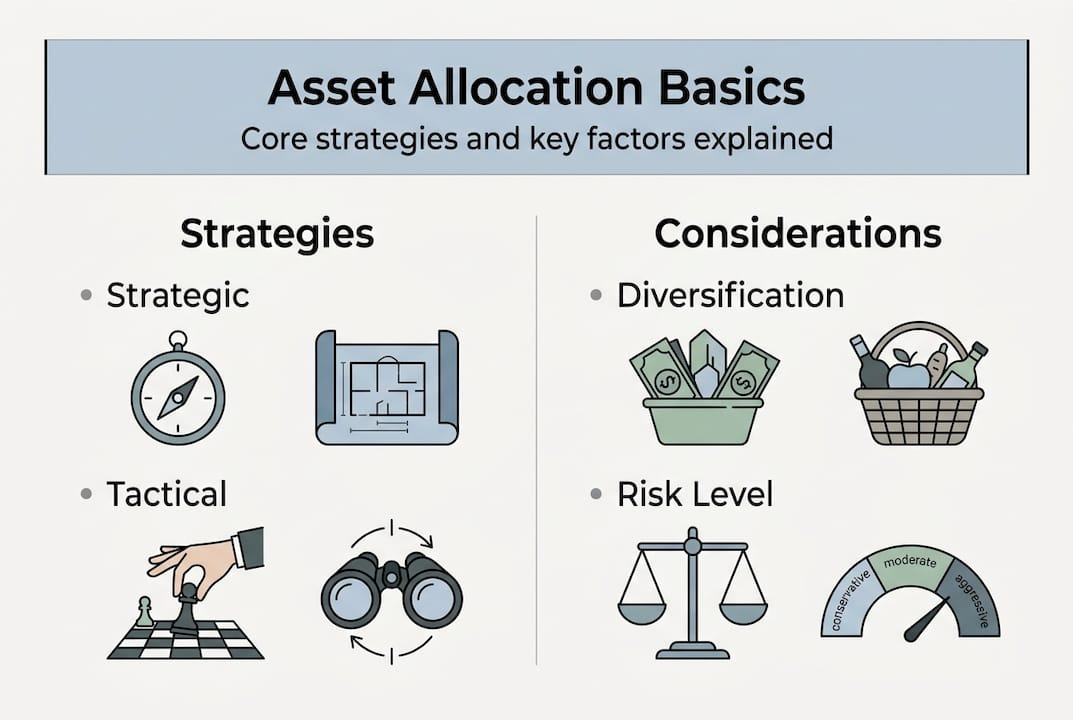
Strategic asset allocation sets a fixed target mix, say 60% shares and 40% defensive assets, and rebalances back to that mix periodically. It is rules-based, disciplined, and grounded in your long-term goals and risk tolerance. Tactical asset allocation involves actively shifting the mix based on short-term market forecasts, perhaps increasing cash ahead of an expected downturn or tilting toward resources during a commodity boom.
| Feature | Strategic allocation | Tactical allocation |
|---|---|---|
| Approach | Fixed targets, periodic rebalance | Active shifts based on forecasts |
| Time horizon | Long-term (5 to 30+ years) | Short to medium term |
| Complexity | Low to moderate | High |
| Cost | Lower | Higher (trading, research) |
| Risk | Market risk only | Market risk plus timing risk |
| Best suited to | Most self-directed investors | Experienced active investors |
Empirical data supports strategic allocation as the foundation, with tactical adjustments adding only modest benefit while increasing timing risk considerably. Most investors who attempt tactical shifts end up buying high and selling low, the opposite of what they intend.
Beyond strategic versus tactical, you also have static versus dynamic approaches. Static allocation keeps the same target mix regardless of life stage. Dynamic allocation shifts the mix over time, typically moving from growth-oriented to more defensive as you approach retirement.
Key considerations for Australian investors:
- Franking credits favour a higher domestic share weighting for tax-effective income
- Superannuation structure already provides some asset allocation through your fund's investment options
- Property exposure may already be significant through your home, so avoid portfolio concentration risk by over-weighting property further
- Inflation protection matters more as you near retirement and draw on your savings
Pro Tip: Chasing tactical trends can backfire. Most investors are better served with a solid strategic base, reviewed annually, than by trying to time market rotations.
How asset allocation shapes outcomes: Historical performance in Australia
Understanding the theory is helpful, but the proof is in real-world results. Here is what historical performance data reveals for Australians.

Statistic callout: Australian shares averaged 8% p.a. above inflation over 63 years from 1959 to 2022. That is a remarkable long-run record, but it came with significant volatility along the way.
Here is how asset allocation affects outcomes across decades:
- Compounding amplifies allocation decisions. A 1% difference in annual return, driven purely by allocation, compounds into tens of thousands of dollars over 20 to 30 years. Starting with $500,000 at 6% versus 7% per year produces a gap of over $190,000 after 25 years.
- Risk reduction through diversification. Holding multiple asset classes means that when shares fall sharply, bonds or cash often hold their value or rise. This smooths the ride and protects capital at critical moments.
- Volatility management protects behaviour. Investors who experience severe drawdowns often panic and sell at the worst time. A well-allocated Australian portfolio returns profile reduces the emotional temptation to exit the market.
- Sequencing risk is real near retirement. A major market fall in your first few years of drawing down can permanently impair your portfolio, even if markets recover later. A more defensive allocation in early retirement reduces this risk significantly.
- Crisis resilience matters. During the GFC, a 100% share portfolio lost around 50% of its value. A balanced 60/40 portfolio lost considerably less and recovered faster. During COVID-19, diversified portfolios again showed greater resilience than concentrated equity positions.
60/40 portfolios perform well over time, particularly when paired with prudent withdrawal rates in retirement. The evidence supports maintaining meaningful growth exposure even in retirement, rather than retreating entirely to cash.
Avoiding portfolio concentration risk in downturns is especially important for investors who hold large positions in a single sector, such as Australian banks or resources.
Pro Tip: A balanced allocation is not only about returns. It also lets you sleep at night during market shocks, which means you are less likely to make costly emotional decisions.
SMSF and regulatory considerations for asset allocation
Beyond personal investing, asset allocation also comes with obligations for SMSF trustees in Australia. This is an area where many trustees underestimate the compliance requirements.
SMSF trustees must document their investment rationale, review their strategy regularly, and address specific risks including liquidity, diversification, and the ability to pay benefits as they fall due. The ATO takes this seriously, and vague or outdated strategies are a common audit concern.
A compliant SMSF investment strategy must address:
- Risk and return objectives: What level of return are you targeting, and what risk are you willing to accept?
- Diversification: How are assets spread across classes and geographies to avoid concentration?
- Liquidity: Can the fund meet member benefit payments and expenses without forced asset sales?
- Insurance: Have trustees considered whether members need life or disability cover inside the fund?
- Review frequency: When and under what circumstances will the strategy be reviewed?
For trustees thinking about optimising SMSF asset allocation, property is a popular choice but requires careful attention to liquidity and diversification rules. A fund heavily weighted in a single property may struggle to meet liquidity requirements if a member needs to access benefits.
If you are weighing up whether an SMSF is right for you, understanding the structural differences through SMSF vs industry super comparisons is a sensible starting point. And once you have your structure sorted, planning retirement income from your SMSF requires a clear allocation framework that balances growth and income needs.
Pro Tip: The ATO expects more than vague allocations. Document specific rationale for each asset class and revisit your strategy after significant market events or changes in member circumstances.
A smarter way to think about asset allocation
Here is where we want to offer a perspective that most allocation guides miss entirely.
Many self-directed investors spend enormous energy trying to optimise their allocation to the last percentage point. Should it be 62% shares or 65%? Should bonds be 15% or 18%? This precision is largely an illusion. The difference between a 60/40 and a 65/35 portfolio over 20 years is trivial compared to the difference between having a clear, documented strategy and not having one.
What actually moves the needle is discipline and regular review. Investors who stick to their allocation through market cycles, rebalance when they drift, and review after major life events consistently outperform those who constantly tinker in search of the perfect mix.
Review your allocation after meaningful events: a market correction of 20% or more, a change in employment, a significant inheritance, or approaching your preservation age. Not randomly, and not because a commentator suggested a new trend.
'Allocation discipline matters more than allocation precision.'
For a broader framework on how allocation fits into your overall financial picture, personal wealth optimisation brings together super, property, tax, and investment strategy in a way that allocation alone cannot.
Get the tools to optimise your asset allocation
Understanding asset allocation is one thing. Seeing exactly how different mixes would affect your specific financial position is where real clarity begins.

AlphaIQ is built for self-directed Australian investors who want to model their own numbers without paying for ongoing advice. On the AlphaIQ platform, you can stress-test a 60/40 strategy, model how your SMSF allocation holds up through a market downturn, and project your retirement income across different scenarios. Use the superannuation calculator to see how allocation changes affect your super balance at retirement, or explore the debt recycling calculator to understand how borrowing to invest interacts with your asset mix. Take control of your allocation decisions with real numbers behind them.
Frequently asked questions
Why is asset allocation more important than picking shares?
The way you split investments between asset classes explains the vast majority of returns and risk in your portfolio, while individual share selection plays a much smaller role in long-term outcomes.
How often should I review my asset allocation?
At least once a year, and always after major market events or life changes. SMSF trustees must regularly review their investment strategy, particularly after significant market movements or changes in member circumstances.
What is the 60/40 portfolio and is it still effective?
A 60/40 portfolio holds 60% in shares and 40% in bonds. It remains effective for many investors, though prudent withdrawal rates and individual retirement goals should guide whether adjustments are needed.
What are the SMSF asset allocation documentation rules?
SMSF trustees must clearly document their investment strategy, including rationale for each asset class, and review strategies regularly to meet ATO compliance requirements.
Can I change my asset allocation as I approach retirement?
Yes, and many Australians shift toward more conservative allocations to reduce risk, while still maintaining enough growth assets to support a retirement that may last 25 to 30 years.