
TL;DR:
- Property within SMSFs offers tax benefits, growth, income, and diversification but involves strict compliance and risks.
- Over-concentration and illiquidity are common pitfalls, requiring careful management and regular portfolio review.
- Strategic exit planning and understanding tax implications are vital for maximizing property benefits in retirement.
More than one million Australians now hold property inside a self-managed super fund (SMSF), yet many are unsure whether their strategy is actually working for them. Property can be a powerful retirement asset, offering capital growth, rental income, and tax advantages that other asset classes struggle to match. But the rules are strict, the risks are real, and the old assumption that property always delivers has been tested more than once. This guide walks you through how to use property effectively as part of your retirement plan, covering compliance, risk management, tax efficiency, and smart exit strategies.
Table of Contents
- Why consider property in your retirement plan?
- Key rules and compliance: SMSF property investment explained
- Balancing return, risk, and liquidity in retirement portfolios
- Tax efficiency and exit strategies for property in retirement
- The hidden risks most guides ignore
- Take the next step: smarter, more strategic property investment
- Frequently asked questions
Key Takeaways
| Point | Details |
|---|---|
| Diversify your assets | Avoid putting more than 20–30% of your portfolio in one property to reduce risk. |
| Focus on liquidity | Plan for enough cash reserves to meet obligations, especially if markets turn or in retirement drawdown. |
| Comply with SMSF rules | Document your investment strategy and ensure all transactions are arm’s length to stay in the ATO’s good books. |
| Maximise tax efficiency | Leverage SMSF and pension phase rules to reduce capital gains tax when selling property. |
Why consider property in your retirement plan?
Property has long held a special place in the Australian investment psyche. For self-directed investors approaching retirement, it represents something tangible: a physical asset that generates income and, historically, grows in value over time. That appeal is well-founded, but it needs to be balanced against some real-world limitations.
Australians increasingly use both direct property and SMSFs for retirement income and portfolio diversification. SMSF investing is commonly used to incorporate property into retirement portfolios while adhering to regulatory requirements. When structured correctly, the benefits can be significant:
- Capital growth: Well-located property has delivered strong long-term appreciation in most Australian markets.
- Rental income: A tenanted property provides a regular cash flow stream to support pension payments.
- Inflation hedging: Property values and rents tend to rise with inflation, protecting your purchasing power over time.
- Tax efficiency: Inside an SMSF, rental income is taxed at just 15% in accumulation phase, and potentially 0% in pension phase.
- Diversification: Property behaves differently to shares and bonds, which can smooth out overall portfolio volatility.
However, the risks deserve equal attention. Property is illiquid, meaning you cannot sell a portion of a house to meet a cash shortfall. Market downturns can erode values, sometimes for extended periods. Regulatory complexity inside an SMSF adds another layer of responsibility. And a single property can represent a dangerously large slice of your total retirement savings.
Consider the example of a self-directed investor in their late 50s who held one commercial property inside their SMSF. During a regional market slowdown, the property sat vacant for eight months. With no rental income and ongoing fund expenses, they were forced to draw down cash reserves faster than planned. A more diversified approach would have cushioned that blow.
If you are weighing up whether an SMSF is the right structure for your situation, it is worth reading about SMSF vs industry super to understand the trade-offs. And if you are still shaping your broader retirement income picture, planning retirement income is a logical next step.
Key rules and compliance: SMSF property investment explained
Investing in property through an SMSF is entirely legal, but it comes with strict compliance obligations. Getting these wrong can trigger ATO audits, penalties, or even fund disqualification. Understanding the rules upfront saves you from costly mistakes later.
Three pillars govern SMSF property investment. SMSF investing rules require adherence to the sole purpose test, arm's length transactions, and a documented investment strategy. Here is what each means in practice:
- Sole purpose test: Every investment decision must be made solely to provide retirement benefits to fund members. You cannot buy a property and then live in it, holiday in it, or let a family member use it.
- Arm's length requirement: All transactions must be conducted at market value, as if between unrelated parties. Buying a property from a related party at below-market price, or charging below-market rent, breaches this rule.
- Investment strategy document: Your SMSF must have a written investment strategy that considers risk, return, liquidity, and diversification. This document must be reviewed regularly and updated when circumstances change.
Common ATO audit triggers include an undefined or outdated investment strategy, related-party deals that do not meet arm's length standards, and over-concentration in a single asset. These are not rare edge cases. The ATO actively monitors SMSF compliance, and property investments attract particular scrutiny.
| Feature | SMSF | Industry super | Retail super |
|---|---|---|---|
| Direct property ownership | Yes | No | No |
| Tax rate (accumulation) | 15% | 15% | 15% |
| Tax rate (pension phase) | 0% | 0% | 0% |
| Compliance responsibility | Trustee | Fund manager | Fund manager |
| Flexibility | High | Low | Medium |
| Cost | Higher | Lower | Medium |
For a deeper look at how SMSF compliance rules compare across fund types, it is worth reviewing the key differences before committing to a structure. And if you want to understand how tax on SMSF properties affects your overall returns, that context matters when building your strategy.
Balancing return, risk, and liquidity in retirement portfolios
Once you understand the rules, the next challenge is building a portfolio that actually performs well across different market conditions. This means thinking carefully about how much of your SMSF is allocated to property, and what that means for your cash flow and risk exposure.
The table below illustrates how different property allocations affect a hypothetical $800,000 SMSF:
| Property allocation | Estimated annual yield | Liquidity risk | Concentration risk |
|---|---|---|---|
| 20% ($160,000) | Moderate | Low | Low |
| 50% ($400,000) | Higher | Medium | Medium |
| 80% ($640,000) | Potentially high | High | Very high |
A higher allocation to property can boost income, but it also concentrates risk and reduces your ability to respond quickly to fund needs. Leverage can magnify both returns and losses, and over-concentration combined with insufficient liquidity is one of the most common ways SMSF investors run into trouble.
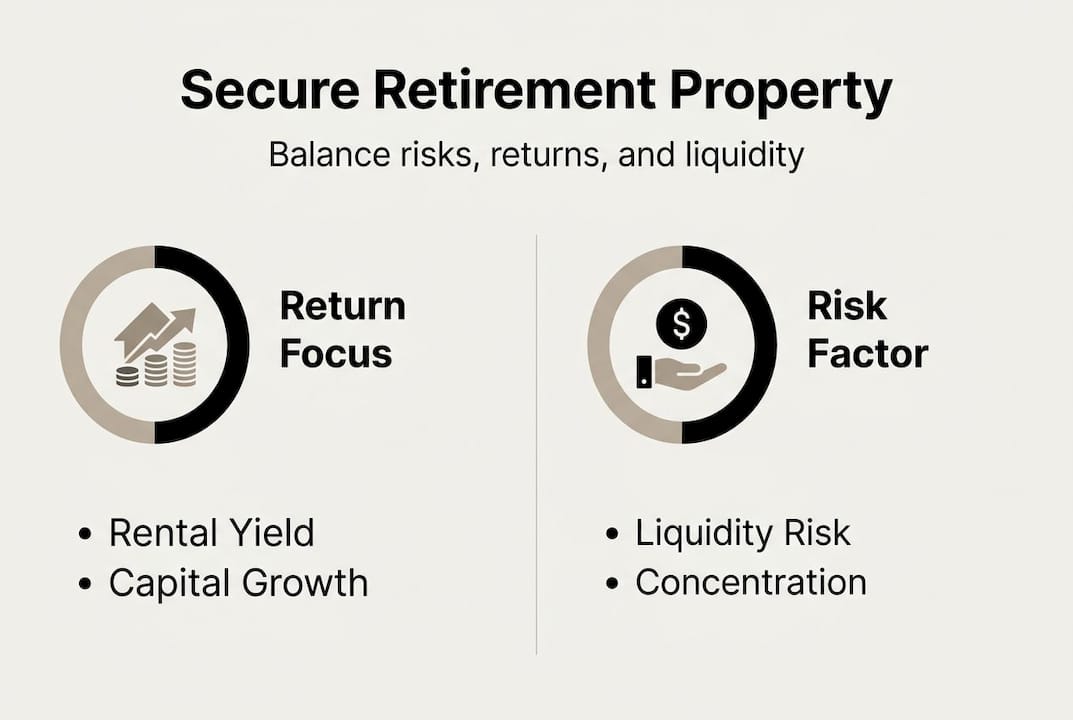
Liquidity deserves special attention in retirement. If your fund is paying a pension, you need reliable cash flow to meet those payments. Property does not always cooperate: vacancies, maintenance costs, and settlement delays can all disrupt income at inconvenient times.
Signs you may have over-concentration risk:
- More than 50% of your SMSF is in a single property
- Your fund has less than three months of pension payments in cash or liquid assets
- You have borrowed to buy the property and the loan repayments consume most of the rental income
- You have not reviewed your investment strategy in more than 12 months
- Your property is in a single geographic market or sector
Understanding portfolio concentration risk is essential before making large property commitments inside your fund. It is also worth modelling how interest rate changes affect your borrowing costs and net returns if you are using a limited recourse borrowing arrangement.
Pro Tip: Maintain a liquidity buffer equal to at least 6 to 12 months of pension payments in cash or near-cash assets. This gives you breathing room if your property is vacant or if an unexpected expense arises.
Tax efficiency and exit strategies for property in retirement
Property inside an SMSF is not just about income and growth. The tax treatment of your property, particularly when you sell it, can make a substantial difference to your final retirement outcome.

During the accumulation phase, rental income is taxed at 15% and capital gains on assets held for more than 12 months attract a one-third discount, effectively reducing the tax rate to 10%. Once your fund moves into pension phase, the tax treatment improves dramatically. In pension phase, assets may be sold tax-free subject to certain conditions, meaning a property held in pension phase could be disposed of with zero capital gains tax. That is a significant advantage that many investors underutilise simply because they do not plan their exits far enough in advance.
Here are the key exit strategies worth considering:
- Sell before retirement: Disposing of the property while still in accumulation phase may suit investors who want to simplify their portfolio or rebalance before drawing a pension.
- Transition to pension phase first: If you are approaching retirement, waiting until your fund is in pension phase before selling can eliminate capital gains tax entirely on that asset.
- In-specie transfer: In some circumstances, property can be transferred out of the SMSF to a member directly, though this triggers capital gains and stamp duty considerations that need careful modelling.
- Staged drawdown: Rather than selling all at once, some investors retain the property for ongoing rental income while drawing down other assets first.
For a thorough understanding of capital gains tax strategies that apply to SMSF investors, the timing of your exit is one of the most powerful levers you have. The CGT discount in super is another layer worth understanding before you finalise any disposal plan.
Pro Tip: Start planning your property exit at least two to three years before you intend to sell. This gives you time to transition your fund into pension phase, satisfy any holding period requirements, and avoid being forced into a sale at the wrong time.
The hidden risks most guides ignore
Most property investment guides focus on the upside. We think it is more useful to be direct about what can go wrong, because that is where the real planning value lies.
The belief that property always goes up is genuinely dangerous, particularly in retirement. You no longer have decades to wait for a market recovery. A poorly timed downturn, a prolonged vacancy, or a sudden need for liquidity can force decisions that permanently damage your retirement income.
SMSF property buyers often overlook liquidity traps. When a market turns, selling quickly is rarely possible, and selling at a loss to meet pension obligations is a painful outcome that proper planning can prevent. Over-concentration or liquidity missteps can undermine a lifetime of saving, and we have seen this happen even to experienced investors.
The lesson is straightforward: a well-diversified, liquid fund survives market surprises far better than one that is heavily weighted to a single illiquid asset. Understanding concentration risk and reviewing your portfolio at least annually gives you the best chance of staying on track when conditions shift.
Take the next step: smarter, more strategic property investment
Understanding the rules and risks is one thing. Seeing exactly how your numbers stack up is another.

AlphaIQ is built for self-directed investors who want real clarity on their retirement position. Our superannuation calculator lets you model how property fits into your overall super strategy, while the debt recycling calculator helps you optimise how you structure debt around your investments. Whether you are stress-testing your SMSF allocation, planning an exit strategy, or simply trying to understand your after-tax position, AlphaIQ gives you the modelling tools to make confident, informed decisions without the cost of ongoing advice.
Frequently asked questions
What is the sole purpose test for SMSF property investment?
The sole purpose test requires all SMSF investments, including property, to be made solely for providing retirement benefits to members. This means you cannot personally use or benefit from the property while it is held inside your fund.
How much property is too much in my SMSF?
Experts recommend limiting any single asset to no more than 20 to 30% of your total SMSF balance to avoid over-concentration risk. The ATO's investment strategy guidance requires trustees to actively consider diversification as part of their documented strategy.
Can I borrow inside my SMSF to buy property for retirement?
SMSFs can borrow under limited recourse borrowing arrangements (LRBAs), but leverage amplifies risk significantly in a downturn, and the rules around LRBAs are strict and complex.
When is property in an SMSF sold tax-free?
If the SMSF is in pension phase, assets may be sold with no capital gains tax, subject to conditions including the transfer balance cap rules that apply from 2026 onwards.