
TL;DR:
- Australians need significant savings and proper planning to achieve a comfortable retirement income.
- Balancing super contributions and Age Pension considerations optimizes total income and asset resilience.
- Ongoing review and data-driven tools are essential for adapting retirement strategies effectively.
Most Australians want a retirement that feels comfortable, not just survivable. Yet the ASFA Retirement Standard shows that singles need $54,840 and couples $77,375 per year to live comfortably in retirement, and a large proportion of retirees fall well short of those figures. The good news is that with the right benchmarks, a clear understanding of your super and Age Pension entitlements, and a sensible drawdown strategy, you can build a retirement income plan that lasts. This guide walks you through the practical steps, the real numbers, and the strategies that make the biggest difference, without the cost of ongoing financial advice.
Table of Contents
- Understanding retirement income needs and benchmarks
- Calculating your superannuation and Age Pension mix
- Setting your drawdown strategy for sustainable income
- Verifying, optimising and adapting your plan
- Why the 'sweet spot' strategy beats maximising super
- Next steps: tools and smarter strategies for your retirement income
- Frequently asked questions
Key Takeaways
| Point | Details |
|---|---|
| Know your benchmarks | Retirement standards show exactly how much income and super you need for a comfortable lifestyle in Australia. |
| Maximise your income mix | Blending superannuation and Age Pension can yield higher total income than maximising super alone. |
| Use flexible withdrawal | Dynamic drawdown strategies, not just minimum rules, help your savings last and stretch further. |
| Review and adapt regularly | Your plan must adjust for inflation, life changes, and health costs—regular checks keep you on track. |
Understanding retirement income needs and benchmarks
Before you can plan effectively, you need a clear target. Working backwards from what you want to spend each year is one of the most practical ways to structure a retirement income plan.
The ASFA Retirement Standard sets two tiers of income for retirees aged around 67 who own their home:
| Lifestyle | Single (per year) | Couple (per year) |
|---|---|---|
| Comfortable | $54,840 | $77,375 |
| Modest | $33,134 | $47,731 |
These figures assume you own your home outright. If you rent, your income needs are substantially higher. Renters require an additional $10,000 to $15,000 per year to cover housing costs, which is a significant gap that many plans overlook entirely.
Several other factors push income needs beyond the base figures:
- Longevity: A 67-year-old woman today has a 50% chance of living past 88. Your money needs to last 20 to 25 years, sometimes longer.
- Health costs: Private health insurance, dental care, and medications are not fully covered by Medicare and tend to increase sharply after age 75.
- Lifestyle inflation: Travel, hobbies, and family support in early retirement often cost more than people expect.
- Inflation: Even modest inflation of 3% per year erodes purchasing power meaningfully over a 20-year retirement.
The comfortable standard is not a luxury target. It covers a reasonable car, occasional travel, private health insurance, and regular social activities. The modest standard, by contrast, covers only basic needs with very little flexibility.
Knowing how much super to retire with is the foundation of any solid plan. Once you know your income target, you can reverse-engineer the super balance and pension mix required to sustain it.
Key insight: Most Australians underestimate their retirement income needs by focusing only on essential expenses. Factor in health, housing tenure, and longevity from the start.
Calculating your superannuation and Age Pension mix
With your income target established, the next step is assessing where your current super balance sits and how the Age Pension might supplement it.
Median super balances by age give a useful reality check:
| Age | Median balance (men) | Median balance (women) |
|---|---|---|
| 45 | $120,000 | $87,000 |
| 55 | $200,000 | $148,000 |
| 60 | $240,000 | $175,000 |
| 67 | $270,000 | $200,000 |
These medians are well below the ASFA comfortable target of $630,000 for singles and $730,000 for couples. That gap is real, and it means the Age Pension will play a role for most Australians, whether they plan for it or not.

The Age Pension is means-tested through both an assets test and an income test. Understanding the taper rates and thresholds is essential because the pension reduces by $3 per fortnight for every $1,000 of assets above the lower threshold. This taper can significantly reduce your entitlement if your super balance is high.
Here is how to optimise your combined income:
- Model your assets test position. Calculate your total assessable assets, including super, savings, and investment properties, and compare them against the current thresholds.
- Consider your super balance relative to the taper. A balance just above the threshold may reduce your pension more than it adds in income.
- Review your super fund structure. Whether you use an SMSF or industry super fund can affect flexibility and estate planning, which in turn affects your pension eligibility.
- Use a superannuation calculator to project your balance at retirement and model different contribution scenarios.
Pro Tip: Keeping some assets in your spouse's name or in non-assessable forms, such as prepaid funeral bonds up to the exempt limit, can legitimately reduce your assessable assets and increase your Age Pension entitlement.
Use the AlphaIQ superannuation calculator to model how different balances and contribution rates affect your projected income at retirement.
Setting your drawdown strategy for sustainable income
Once you retire, the way you draw down your super is just as important as how much you have saved. A poor drawdown strategy can exhaust your balance years before you need it.
The Australian Government sets minimum drawdown rates for account-based pensions, which increase with age:
- Age 65 to 74: 5% minimum per year
- Age 75 to 79: 6% minimum per year
- Age 80 to 84: 7% minimum per year
- Age 85 to 89: 9% minimum per year
These are minimums, not recommendations. Many retirees draw only the minimum, which can actually leave them with more money than they need in early retirement and too little flexibility later.
Morningstar research suggests that given current market valuations, a safe withdrawal rate of around 3.9% to 4% per year is appropriate for a 30-year retirement. Dynamic strategies, where you draw more in good market years and less in poor ones, can allow rates of 5% to 6% without significantly increasing the risk of running out of money.
Here is a practical approach to setting your drawdown strategy:
- Start with your income target. Calculate the annual amount you need and work out what percentage of your balance that represents.
- Compare to minimum rates. If your income need is below the minimum drawdown, you will need to invest or reinvest the excess.
- Build a cash buffer. Holding one to two years of living expenses in cash or term deposits protects you from being forced to sell growth assets during a market downturn.
- Reassess annually. Review your balance, spending, and market conditions each year and adjust your drawdown accordingly.
Pro Tip: Drawing slightly more in your early retirement years, when you are healthy and active, often produces better life outcomes than hoarding capital for a later stage you may not fully enjoy.
Understanding your financial independence number is a useful starting point for setting a drawdown rate that aligns with your actual lifestyle needs.
Verifying, optimising and adapting your plan
A retirement income plan is not a set-and-forget document. Markets shift, legislation changes, and your own circumstances evolve. Regular verification is what keeps your plan working.
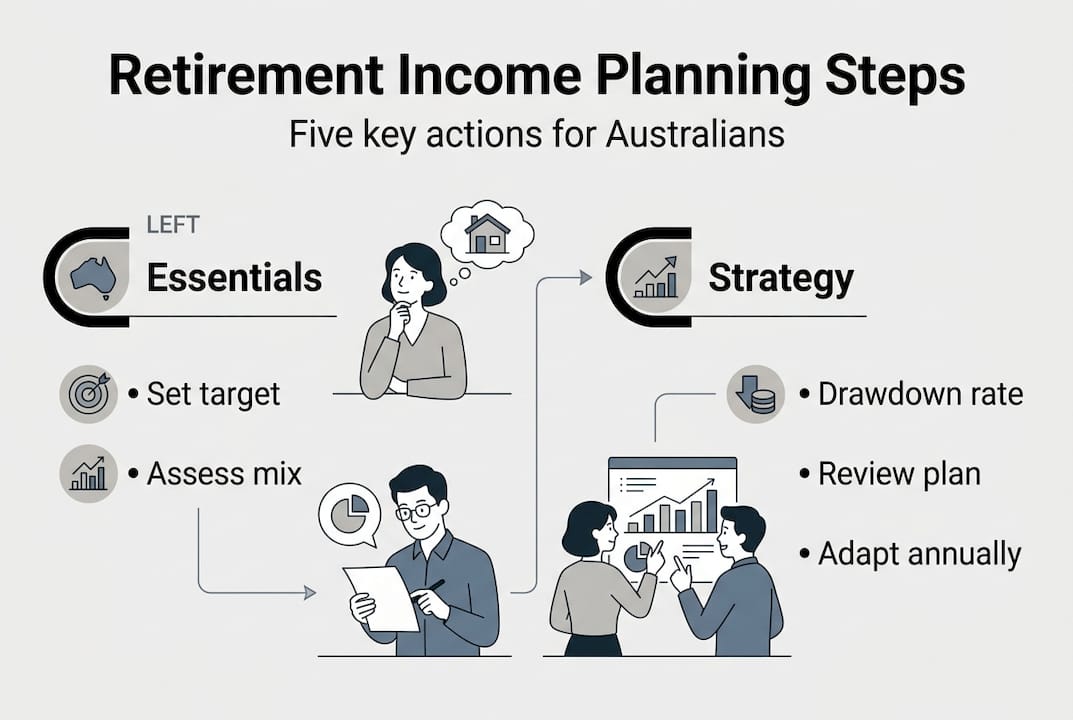
Start by checking your plan against the ASFA benchmarks. Most Australians fall below the comfortable income target, but a large proportion can achieve the modest standard with proper planning. Knowing where you sit gives you a clear picture of what adjustments are needed.
For specific cohorts, additional steps matter:
- Renters: Budget for an additional $10,000 to $15,000 per year in housing costs and consider whether downsizing or relocating is viable.
- Women and low-balance savers: Salary sacrificing into super in the years before retirement can close the gap significantly. Use the AlphaIQ salary sacrifice calculator to model the impact.
- Those with investment debt: Strategies like debt recycling can convert non-deductible debt into tax-deductible debt, freeing up more cash for super contributions. The debt recycling calculator can show you the numbers.
- Late starters: Maximising concessional and non-concessional contributions in your final working years can make a material difference to your balance at retirement.
Pro Tip: Review your plan at least once a year, ideally around tax time, when you have a full picture of your income, contributions, and investment performance. Small annual adjustments are far easier to manage than large corrections later.
Adapting for inflation means increasing your income target by roughly 2.5% to 3% per year in your projections. Health cost inflation tends to run higher, so build in a buffer for medical expenses from age 75 onwards. The AlphaIQ wealth intelligence blog covers many of these scenarios in detail, with practical tools to help you model your own position.
Why the 'sweet spot' strategy beats maximising super
Conventional advice almost always points in one direction: maximise your super balance. Contribute as much as you can, as early as you can, and let compounding do the work. It is sound advice in isolation, but it misses something important.
The Age Pension assets test creates a situation where having more super can actually reduce your total retirement income. If your balance sits above the taper threshold, every extra dollar in super reduces your pension entitlement by $3 per fortnight per $1,000. At a certain point, accumulating more in super produces diminishing returns on your combined income.
The optimal strategy for many Australians is not maximum super. It is the sweet spot where partial Age Pension plus a moderate super balance produces a higher and more resilient total income than a large super balance alone. This is especially true for couples, where asset-splitting strategies can keep both partners below the full taper threshold.
The practical implication is that you should model your retirement income annually, not just accumulate and hope. Whether you hold assets in an SMSF or industry super fund, the structure and drawdown timing matter as much as the balance itself. Flexible withdrawal combined with regular review is what turns a good plan into a great one.
Next steps: tools and smarter strategies for your retirement income
Planning retirement income is not a one-time exercise. It rewards ongoing attention, precise modelling, and the right tools.

AlphaIQ is built specifically for Australians who want to take control of their retirement planning without paying for ongoing financial advice. The platform lets you model your super projections, benchmark your income against ASFA standards, and simulate different drawdown scenarios in one place. Start with the superannuation calculator to see where your balance is heading, then use the salary sacrifice calculator to find contribution strategies that close any gaps. The AlphaIQ platform gives you the clarity to make confident, well-informed decisions about your retirement income, backed by real numbers.
Frequently asked questions
What is a comfortable retirement income for Australians in 2026?
According to the ASFA Retirement Standard, singles need $54,840 and couples $77,375 per year to retire comfortably in Australia, assuming they own their home.
How much superannuation do I need to reach the comfortable income target?
Homeowner singles require around $630,000 in super by age 67, while couples need approximately $730,000 to sustain a comfortable retirement income.
What is the best age to start planning retirement income?
Ideally, start in your late 30s or early 40s, but even those in their 50s can make meaningful improvements. Median super balances show that targeted contributions in your final working decade can significantly close the gap.
How does the Age Pension factor into retirement income strategy?
The Age Pension can supplement your super income, particularly if your assets are structured to stay within or near the taper thresholds. Optimal positioning of assets can increase your combined income beyond what super alone provides.
What is a safe retirement portfolio withdrawal rate?
Morningstar recommends a safe withdrawal rate of around 3.9% to 4% for a 30-year retirement, with flexible dynamic strategies allowing up to 5% to 6% depending on your balance and market conditions.