
TL;DR:
- Actual investment returns depend on fees, taxes, and inflation, not just gross figures.
- Growth and income strategies each have unique tax benefits and risk profiles suited to different goals.
- Discipline and patience are crucial, as behavioral mistakes erode long-term investment gains more than asset choice.
Two investors hold identical portfolios for a decade. One walks away with significantly more wealth than the other. Same assets, same market conditions, completely different outcomes. How? The difference often comes down to factors like franking credits, capital gains timing, fees, and tax treatment — things that rarely appear on a standard performance report. Understanding investment returns is not just about reading a number on a screen. It is about knowing what that number actually means after the real-world costs are stripped away. This guide breaks down how returns truly work for Australian investors, so you can make stronger, more confident decisions with your portfolio.
Table of Contents
- What does 'investment return' actually mean?
- Growth versus income: Common strategies for building returns
- Comparing returns: Shares versus property and other asset classes
- Risk, patience, and the real investor's returns
- How to use this knowledge for stronger returns
- The uncomfortable truth: It's patience, not just knowledge, that pays
- Ready to optimise your investment returns?
- Frequently asked questions
Key Takeaways
| Point | Details |
|---|---|
| Understand return types | Know the difference between capital growth and income to avoid surprises in your results. |
| Factor in tax and costs | After-tax and after-cost returns are what really matter—always check these numbers. |
| Patience beats prediction | Staying the course and avoiding emotional decisions are the true keys to lasting returns. |
| Use smart tools | Online calculators and evidence-based strategies take the guesswork out of portfolio decisions. |
What does 'investment return' actually mean?
Most investors think of return as a simple figure: you put money in, you get more back. But the reality is layered, and the gap between what is reported and what you actually keep can be significant.
Total return is the complete picture. It combines two sources of earnings:
- Income return: Dividends, distributions, interest, and rental income paid out over the period
- Capital growth: The increase in the value of the asset itself
Add these together and you have your total return. But that gross figure is rarely what ends up in your pocket.
The next layer is understanding gross versus net returns. Gross return is before fees, tax, and inflation are applied. Net return is what remains after those deductions. For most self-directed investors, the difference between gross and net is surprisingly large. A fund reporting 9% per annum might deliver closer to 6% after management fees, tax on income distributions, and the eroding effect of inflation.
Where Australians often get caught out is ignoring franking credits and capital gains tax when calculating returns. Two investors in the same shares can end up with different after-tax outcomes based purely on their individual tax rates or whether they held assets long enough to access the 50% capital gains tax discount.
As the ASX investment strategy insights note, growth strategies prioritise capital gains while income strategies focus on dividends with franking benefits. Each has a very different tax profile, and neither approach is universally better.
Statistic to note: The difference between gross and net returns over 20 years can amount to hundreds of thousands of dollars for a typical Australian investor, depending on the fee and tax structure of their portfolio.
Pro Tip: Every time you see a return figure, ask yourself: net of what? Fees? Tax? Inflation? Until you know the answer, the number means very little.
Growth versus income: Common strategies for building returns
Now that you understand what returns mean, you will see why different investors pursue very different strategies to achieve them.
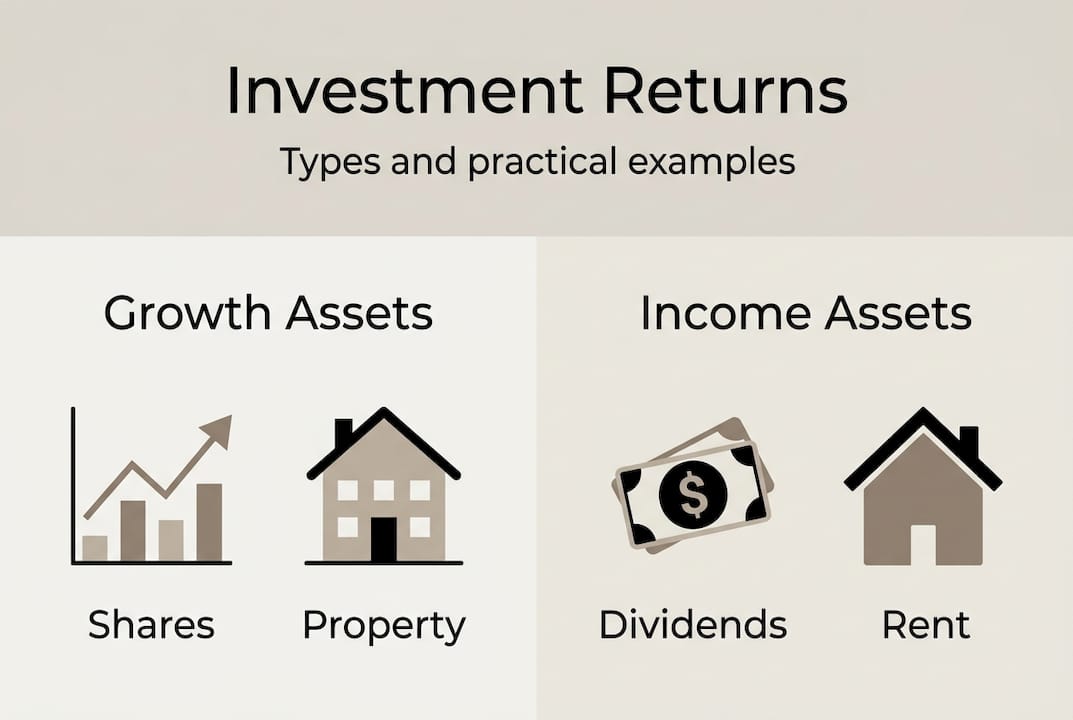
Growth investing focuses on assets expected to rise in value over time. Think Australian and international shares, property, and growth-oriented managed funds. The goal is capital appreciation, and the primary return driver is the eventual sale of the asset at a higher price.
Income investing prioritises regular cash flow. Dividends from Australian shares, distributions from listed investment companies, bond interest, and rental income all fall into this category. For Australian investors, income strategies carry a powerful advantage: franking credits.
Franking credits are tax offsets attached to dividends paid by Australian companies that have already paid corporate tax. If you are in a lower tax bracket, or holding shares inside superannuation, you may receive a cash refund on those credits. This effectively boosts your after-tax return well beyond the stated dividend yield. You can explore how this works in detail through real dividend returns and dividend investing metrics.
| Strategy | Primary return | Risk level | Tax consideration |
|---|---|---|---|
| Growth | Capital gains | Higher | CGT discount if held 12+ months |
| Income | Dividends/distributions | Moderate | Franking credits offset tax |
| Balanced | Both | Moderate | Mix of both tax treatments |
| Fixed income | Interest | Lower | Taxed as ordinary income |
The ASX investment strategies framework highlights that growth and income strategies each carry different risk and reward profiles. Neither is superior in isolation.
"Investors who prioritise stable income often overlook long-term capital growth, and vice versa. The strongest portfolios tend to blend both, calibrated to where you are in your wealth journey."
For investors approaching retirement, income strategies with franking benefits can be particularly powerful. For those with a longer horizon, growth assets typically outperform over time, though capital gains strategies need careful planning to minimise tax drag.
Comparing returns: Shares versus property and other asset classes
Strategy means little without understanding what different assets can actually deliver. Here is how the major Australian asset classes compare in practice.
Shares offer high liquidity. You can buy and sell on the ASX within seconds, and your portfolio value is updated in real time. This transparency is useful, but it also exposes you to short-term volatility that can tempt poor decisions.
Property works differently. It is leveraged, meaning most investors borrow a significant portion of the purchase price, which magnifies both gains and losses. Returns can be lumpy: long flat periods followed by sharp rises. Understanding property return factors such as interest rate movements is critical to assessing real performance.

As the ASX investment strategies resource confirms, shares are more liquid while property is leveraged and lumpy, requiring long-term patience despite volatility.
| Asset class | Approx. 10-year avg. return | Liquidity | Leverage typical? |
|---|---|---|---|
| Australian shares | ~8-9% p.a. (total) | High | No |
| Residential property | ~6-8% p.a. (total) | Low | Yes |
| Term deposits | ~2-4% p.a. | Medium | No |
| Australian bonds | ~3-5% p.a. | Medium | No |
Here is a practical process for comparing risk-adjusted returns across these assets:
- Identify the gross total return for each asset over your chosen period
- Subtract fees, interest costs, and management expenses
- Apply your marginal tax rate to income components
- Factor in the capital gains tax discount if assets were held over 12 months
- Adjust for inflation to get the real return
Using a negative gearing calculator can also help you model property returns more accurately, particularly when debt is involved.
Risk, patience, and the real investor's returns
Having compared investment vehicles, it is time to face what really separates top investors from the rest. It is rarely the asset they chose. It is how they behaved while holding it.
Behaviour traps destroy returns far more often than poor asset selection. Panic selling during a market downturn locks in losses that would have recovered naturally. Chasing last year's best-performing sector often means buying at the peak. These patterns are well-documented and devastatingly common.
The ASX investment strategies data consistently shows that long-term patience is needed despite volatility. Markets reward those who stay the course.
Key investor behaviours that erode returns include:
- Overtrading: Each transaction incurs brokerage and potential capital gains tax events
- Ignoring costs: A 1% difference in ongoing fees compounds dramatically over 20 years
- Chasing performance: Rotating into hot sectors after the gains have already occurred
- Concentration risk: Holding too much in a single stock, sector, or geography
- Ignoring portfolio risk factors: Failing to review exposure regularly
Understanding your risk tolerance is a foundational step. Risk tolerance is not just about how much loss you can absorb financially. It is about how you will behave emotionally when your portfolio drops 20% in a month.
Pro Tip: Before you invest in anything, write down your investment plan. Include your goal, your time horizon, and the conditions under which you would sell. Refer to it the next time markets move sharply. It is the single most effective tool against emotional decision-making.
How to use this knowledge for stronger returns
You now understand what shapes true investment returns. Here is how to put it all into practice for yourself.
A simple four-step process for reviewing your portfolio:
- Set clear goals: Define whether you are targeting growth, income, or a blend. Specify your time horizon and the after-tax return you need to meet your retirement income target.
- Audit your asset mix: Review what you actually hold versus what your goals require. Are you overexposed to property? Underweight in income-generating assets? Is your super allocation aligned with your stage of life?
- Check net returns: For every asset, calculate the return after fees, tax, and inflation. Gross figures flatter performance. Net figures tell the truth.
- Adjust for after-tax outcomes: Use tools like franking credit calculators and retirement projections to model your real position. The difference between a gross and net return calculation can change your strategy entirely.
The question of financial advice versus DIY investing is worth considering here. For many self-directed investors, the right tools remove the need for ongoing advice costs while still delivering rigorous, personalised modelling.
Regular review, not constant tinkering, is what wins over time. Reviewing your portfolio quarterly and rebalancing annually is sufficient for most investors. The ASX investment strategies framework reinforces that long-term discipline consistently outperforms reactive management.
Pro Tip: Use a superannuation calculator and a franking credit calculator together to see your real net position across both your investment portfolio and super. The combined picture is often very different from what each account statement shows individually.
The uncomfortable truth: It's patience, not just knowledge, that pays
Here is something most financial content will not tell you plainly: knowing more does not automatically make you a better investor. The AlphaIQ wealth intelligence blog covers strategy and tools extensively, but tools only work when the person using them stays disciplined.
Markets reward resilience more than raw intelligence. The investor who holds a diversified portfolio through a downturn and does nothing often outperforms the investor who reads every report, reacts to every headline, and adjusts constantly. Consistency is rare. That rarity is precisely why it is so valuable.
Australian investors have unique levers available to them: franking credits, the capital gains tax discount, debt recycling, and superannuation tax concessions. These are structural advantages that compound over time. But they only work if you control what you can control and resist chasing what you cannot. Decision discipline beats the insight of the month, every single time. The hardest part of investing is not understanding the mechanics. It is trusting your plan when everything around you feels uncertain.
Ready to optimise your investment returns?
Understanding returns is one thing. Seeing exactly how they apply to your specific situation is where real progress happens.

The AlphaIQ platform brings together tax-aware modelling, scenario simulation, and portfolio analysis in one place, built specifically for self-directed Australian investors. Whether you are focused on growing your super, managing property debt, or building a balanced income portfolio, AlphaIQ gives you the numbers you need without the ongoing advice fees. Start with the Super calculator to model your retirement position, or use the Debt Recycling Calculator to see how restructuring your debt could improve your after-tax returns. Real clarity, real numbers, and real confidence in your next move.
Frequently asked questions
What's the difference between total return and capital gain?
Total return combines all sources of earnings including income (dividends, interest, rent) and capital growth, whereas capital gain only counts the increase in the asset's value. As ASX investment strategies note, growth and income strategies each contribute differently to total return.
How do franking credits affect Australian investment returns?
Franking credits reduce the tax payable on dividends, effectively boosting after-tax returns for Australian investors, particularly those in lower tax brackets or holding shares inside superannuation. The ASX investment strategies framework highlights franking benefits as a key advantage of income-focused strategies.
Is property always a better investment than shares?
No. Property and shares have differing risks, liquidity profiles, and return patterns, and the best choice depends entirely on your goals, time horizon, and risk comfort. The ASX investment strategies data shows shares are more liquid while property is leveraged and lumpy, each requiring a different approach.
How can I estimate my personal investment return after tax?
Add up all income and capital gains, subtract fees and costs, then apply your marginal tax rate to income and the capital gains tax discount to eligible gains. Tools like franking credit and capital gains calculators make this process straightforward and accurate.
Recommended
- AlphaIQ Blog — Wealth Intelligence for Australian Investors
- AlphaIQ — AI Wealth Intelligence Platform for Australian Investors
- ASX Dividend Investing: Key Metrics Every Australian Should Know | AlphaIQ
- Retirement calculators: Why they matter for Australian investors
- How to Backtest a Portfolio: Easy Guide for Traders - My Framer Site