
TL;DR:
- Australian retirees often have unoptimized super, leading to missed opportunities and financial stress.
- Regularly assessing assets, liabilities, and comparing against benchmarks helps close the retirement savings gap.
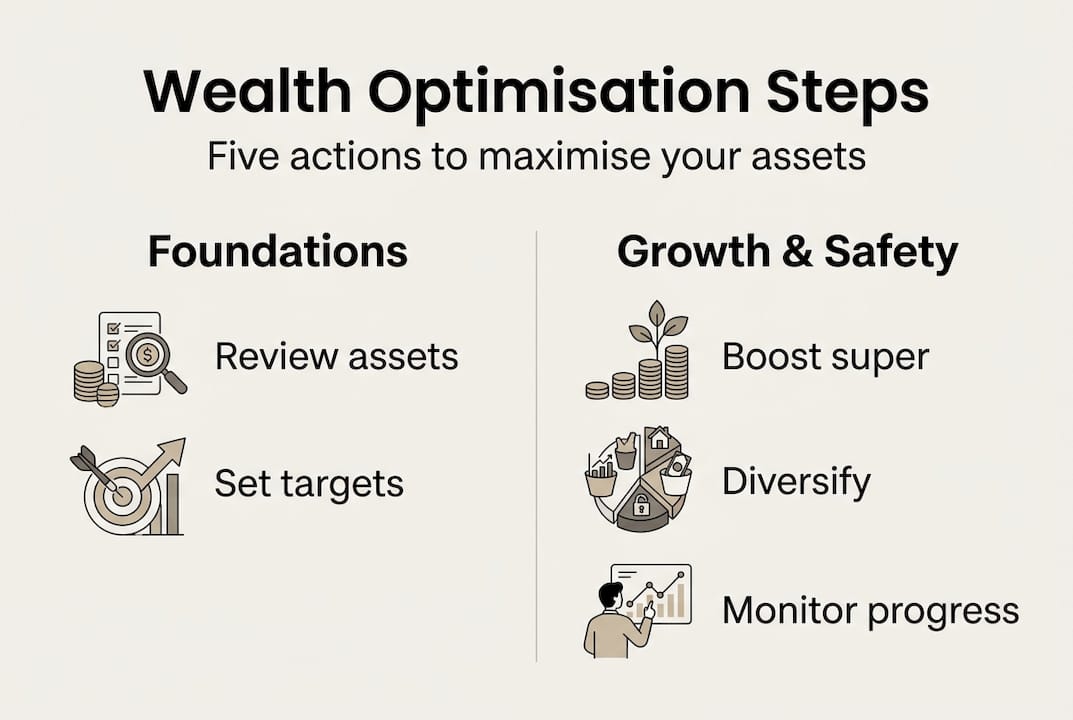
- Focus on maximizing super contributions, strategic investment diversification, and ongoing progress monitoring.
Many Australians approach retirement only to realise their super and investments are not optimised, leading to missed opportunities and real financial stress. The gap between where you are and where you want to be is rarely about income. It is almost always about strategy. Whether you are 15 years from retirement or five, the decisions you make now about superannuation, investment allocation, and spending targets will shape your financial future more than any single market return. This guide walks you through a clear, evidence-based process to audit your wealth, sharpen your super contributions, invest strategically, and monitor your progress so you can retire with genuine confidence.
Table of Contents
- Assessing your financial foundations
- Optimising superannuation contributions and strategies
- Strategic investment allocation and diversification
- Monitoring progress and avoiding common pitfalls
- What most investors overlook about personal wealth optimisation
- Smart tools to take your wealth optimisation further
- Frequently asked questions
Key Takeaways
| Point | Details |
|---|---|
| Know your retirement targets | Understand how much super and assets you’ll need for a comfortable or modest retirement using current standards. |
| Leverage contribution tactics | Use the latest super caps and rules to maximise your annual and lifetime contributions. |
| Embrace diversification | Allocate investments wisely across asset classes to reduce risk and enhance return stability. |
| Monitor and adjust regularly | Review your wealth plan and make adjustments to avoid costly mistakes and keep on track. |
| Use smart tools | Utilise calculators and AI platforms for more efficient and accurate wealth management. |
Assessing your financial foundations
Before you can optimise anything, you need a clear picture of where you stand. This means going beyond a rough sense of your super balance and actually documenting every major asset, liability, and income stream you hold.
Start by listing the following:
- Superannuation balance across all funds (including any lost super)
- Investment portfolio including shares, managed funds, and ETFs
- Property including your primary residence and any investment properties
- Liquid savings such as offset accounts, term deposits, and cash holdings
- Liabilities including your mortgage, investment loans, and any personal debt
Once you have this snapshot, you can compare your position against established benchmarks. The ASFA Retirement Standard provides the most widely used reference point in Australia. For 2026, a comfortable retirement at age 67 requires approximately $630,000 in super for a single homeowner and $730,000 for a couple. A modest retirement requires far less at $110,000 and $120,000 respectively. The annual spending targets are equally useful: a comfortable lifestyle costs a single person around $54,840 per year and a couple around $77,375.
These figures give you a target to work backwards from. If your current super balance is $350,000 at age 50, you now know the gap you need to close and how many years you have to close it. You can explore super requirements at 60 to see how your timeline affects the numbers.
Understanding your financial independence number is equally important. This is the total capital you need to sustain your desired annual spending indefinitely. Learning about calculating your FI number can sharpen this calculation considerably.
Pro Tip: Build a simple one-page financial snapshot that lists your assets, liabilities, and net position. Update it every six months. This single habit keeps your strategy grounded in reality rather than assumption.
| Asset category | Example value | Notes |
|---|---|---|
| Superannuation | $420,000 | Combined across all funds |
| Investment property | $650,000 | Net of mortgage |
| Share portfolio | $85,000 | Including ETFs |
| Cash and savings | $40,000 | Offset and term deposits |
| Total net assets | $1,195,000 | Excluding primary residence |
Using a superannuation calculator to project your balance forward under different contribution scenarios makes this exercise far more actionable.
Optimising superannuation contributions and strategies
With your financial baseline established, focus next on optimising your superannuation contributions for maximum impact. Super remains the most tax-effective vehicle available to Australian investors, and the rules around contributions offer more flexibility than most people realise.
Here is a step-by-step approach to maximising your contributions in 2026:
-
Maximise concessional contributions first. The concessional cap for 2025-26 is $30,000, rising to $32,500 from July 2026. These include employer contributions, salary sacrifice, and personal deductible contributions. They are taxed at just 15% inside super, which is significantly lower than most marginal tax rates.
-
Use carry-forward contributions if eligible. If your total super balance was below $500,000 at the prior 30 June, you can carry forward any unused concessional cap amounts from the previous five years. This is a powerful catch-up tool for those who took career breaks or had lower incomes in earlier years.
-
Consider non-concessional contributions. The non-concessional cap sits at $120,000 for 2025-26, rising to $130,000 from July 2026. These are after-tax contributions with no additional tax on entry, and they grow in a concessional tax environment inside super.
-
Activate the bring-forward rule. If you are under 75 and meet the balance thresholds, you can bring forward up to three years of non-concessional contributions in a single year. That is up to $360,000 now, or $390,000 from July 2026. This is particularly useful if you receive an inheritance, sell an investment property, or have a windfall to shelter.
Key thresholds for 2026: Concessional cap $30,000 (rising to $32,500 in 2026-27). Non-concessional cap $120,000 (rising to $130,000 from July 2026). Bring-forward maximum $360,000 (rising to $390,000). Carry-forward available if super balance under $500,000.
| Contribution type | 2025-26 cap | 2026-27 cap | Tax treatment |
|---|---|---|---|
| Concessional | $30,000 | $32,500 | 15% contributions tax |
| Non-concessional | $120,000 | $130,000 | Nil on entry |
| Bring-forward (3yr) | $360,000 | $390,000 | Nil on entry |
Salary sacrifice is often the most straightforward way to boost concessional contributions. You redirect pre-tax salary into super, reducing your taxable income and growing your balance simultaneously. Explore salary sacrifice strategies to see how this works in practice alongside your employer contributions.

Pro Tip: Check your total super balance on 30 June each year before making large non-concessional contributions. Exceeding the caps triggers excess contribution tax, which can be costly and administratively complex to unwind.
Once inside super, your money can also generate tax-free retirement income after you reach preservation age and meet a condition of release, making the compounding effect even more powerful.
Strategic investment allocation and diversification
Once your super is optimised, the next priority is ensuring your broader investment portfolio is structured to support your retirement goals. This means aligning your asset allocation with your time horizon and risk tolerance, not just chasing the highest recent return.
A useful starting point is the growth-to-defensive spectrum:
- Growth assets (shares, property, infrastructure) generate higher long-term returns but carry more short-term volatility
- Defensive assets (bonds, cash, fixed income) provide stability and income but lower growth
- Balanced allocations typically hold 60-70% in growth assets and 30-40% in defensive assets
Balanced options have historically delivered returns of 6 to 7% per annum over the long term, with diversification playing a key role in smoothing out volatility. That long-run average masks some very rough years in between, which is exactly why your allocation should shift as retirement approaches.
Sequence-of-returns risk is one of the most underappreciated threats to retirement wealth. This is the risk that a significant market downturn occurs in the years just before or after you retire, forcing you to sell assets at low prices to fund living expenses. Reducing your growth allocation progressively from around age 55 onwards is a practical way to manage this risk without sacrificing all growth potential.
Diversification across asset classes and geographies also matters. Consider:
- Australian and international equities
- Listed and unlisted property
- Fixed income across different maturities and credit qualities
- Infrastructure and alternatives for income stability
For those with investment properties, understanding how to be optimising property investments within your overall retirement plan is worth careful attention. And if you are weighing up a self-managed super fund, the comparison between SMSF vs industry super is a decision that deserves thorough modelling before you commit.
Pro Tip: Resist the urge to switch to a conservative option during a market downturn. Locking in losses and missing the recovery is one of the most common and costly mistakes self-directed investors make.
Monitoring progress and avoiding common pitfalls
To ensure your optimisations achieve lasting results, ongoing monitoring and vigilance are essential. A strategy that is set and forgotten quickly drifts out of alignment with your goals.
Here is a practical review schedule to follow:
- Annually: Review your super balance, contribution levels, and investment allocation. Compare your position against the ASFA Retirement Standard benchmarks, including the comfortable annual budgets of $54,840 for singles and $77,375 for couples.
- Every two to three years: Reassess your asset allocation relative to your retirement timeline. As you age, your risk tolerance and income needs change.
- After major life events: Redundancy, inheritance, property sale, divorce, or a significant salary change all warrant an immediate strategy review.
Watch out for these wealth-eroding mistakes: Holding multiple super funds and paying duplicate fees. Ignoring insurance inside super that you no longer need. Failing to update beneficiary nominations. Letting cash sit idle outside super when it could be contributing to tax-effective growth.
| Review trigger | Action required | Tool to use |
|---|---|---|
| Annual review | Check balance vs target, update contributions | Super calculator |
| Market shift of 15%+ | Review allocation, avoid panic selling | Investment tracker |
| Major life event | Full strategy reassessment | Retirement planner |
| New financial year | Check contribution caps and eligibility | Tax modelling tool |
Using a retirement planning checklist keeps you accountable across all areas of your plan. A reliable super calculator tool lets you model different contribution and return scenarios so you can see the impact of changes before you make them. For a broader view of income in retirement, working through retirement income planning steps helps you connect your super projections to your actual spending needs.
What most investors overlook about personal wealth optimisation
Most self-directed investors spend their energy focused on returns. Which fund performed best last year? Which sector is trending? It is an understandable instinct, but it is often the wrong focus.
The investors who consistently build and preserve wealth tend to obsess over three things that rarely make headlines: fees, allocation discipline, and emotional control. A 0.5% difference in annual fees might seem trivial, but over 20 years it can erode hundreds of thousands of dollars in compounding returns. Balanced portfolios delivering 6 to 7% annually only realise that potential if you stay invested through the volatility.
Emotional discipline is the least discussed but most consequential skill in wealth management. The investor who holds their allocation through a 25% drawdown and recovers with the market will almost always outperform the one who switched to cash and waited for certainty. Certainty never arrives.
We also see many investors underestimate how much their property investment decisions interact with their super and tax position. Treating each asset class in isolation is a structural blind spot that costs real money over time.
Smart tools to take your wealth optimisation further
Knowing the strategy is one thing. Executing it with precision and confidence is another.

AlphaIQ is an Australian wealth intelligence platform built specifically for self-directed investors who want to model and optimise their financial position without paying for ongoing advice. You can run super projections, stress-test your investment allocation, model debt recycling scenarios, and map your retirement income all in one place. The AlphaIQ platform combines tax-aware modelling with scenario simulation so you can see the real numbers behind every decision. Start with the super calculator to see where your balance is headed and what changes would make the biggest difference.
Frequently asked questions
What is the minimum superannuation needed for a comfortable retirement in Australia?
The ASFA Retirement Standard (2026) states that a single homeowner needs $630,000 and a couple needs $730,000 in super to retire comfortably at age 67.
How can I maximise my super contributions in 2026?
You can use the $30,000 concessional cap, carry forward unused caps if your balance is under $500,000, and apply the bring-forward rule to contribute up to $360,000 in non-concessional contributions in a single year if you are under 75 and eligible.
What is the best way to diversify investments for retirement?
Diversify across asset classes and geographies, including Australian and international equities, property, fixed income, and alternatives, aligning your choices with your retirement timeline and risk tolerance.
How often should I review my wealth strategy?
Review your wealth plan at least annually and after any major financial event, using tools like a super calculator and a retirement planning checklist to ensure your strategy stays on track.