
TL;DR:
- Nearly half of pre-retirees fear running out of money but only 18% have a clear plan.
- Setting specific retirement goals and assessing needs is essential for effective planning.
- Regularly reviewing and consolidating super and other assets helps optimize retirement preparedness.
Nearly 48% of pre-retirees fear running out of money in retirement, yet only 18% have a clear plan in place. That gap between anxiety and action is where financial stress takes root. A structured retirement planning checklist changes that. It gives you a practical framework to assess where you stand, identify what's missing, and take deliberate steps toward a retirement you can actually afford. Whether you're 15 years out or counting down the final few, working through a checklist helps you move from guesswork to genuine confidence. Here's how to do it.
Table of Contents
- Set retirement goals and estimate needs
- Check, consolidate and grow your superannuation
- Assess other investments and income sources
- Understand government support and pension eligibility
- What most Australians miss: The ongoing power of checklists
- Take the next step: Tools to simplify your retirement planning
- Frequently asked questions
Key Takeaways
| Point | Details |
|---|---|
| Know your benchmarks | ASFA standards clarify how much superannuation is needed for comfortable and modest retirement. |
| Keep super in check | Regular ATO health reviews can uncover lost super and improve your balance. |
| Factor all assets | Shares, property and savings play major roles in retirement planning alongside superannuation. |
| Government support matters | Pension eligibility and application steps are crucial in bridging retirement funding gaps. |
| Checklists reduce stress | Structured planning helps Australians overcome common anxieties about running out of money. |
Set retirement goals and estimate needs
Every solid retirement plan starts with a clear picture of what you actually want. Not a vague idea of "enough money," but a specific vision: where you'll live, how often you'll travel, what your weekly spending will look like. Working backwards from what you want to spend is far more effective than guessing a lump sum figure.
The ASFA Retirement Standard provides a useful benchmark. As of 2026, a comfortable retirement for a single person requires around $52,085 per year, while couples need approximately $73,337. A modest retirement costs considerably less, around $33,134 for singles and $47,731 for couples.
| Retirement style | Single (annual) | Couple (annual) |
|---|---|---|
| Comfortable | $52,085 | $73,337 |
| Modest | $33,134 | $47,731 |
These figures assume you own your home outright and are in reasonably good health. If you're renting or have ongoing medical costs, your target will be higher.
To estimate your personal needs, consider:
- Daily living costs: Groceries, utilities, transport, insurance
- Lifestyle expenses: Travel, dining out, hobbies, entertainment
- Healthcare: Private health cover, out-of-pocket medical costs
- Housing: Maintenance, rates, or rent if applicable
- Contingency buffer: Unexpected costs, car replacement, home repairs
Once you have a rough annual figure, multiply it by the number of years you expect to be retired. Most Australians now live well into their 80s, so planning for 20 to 25 years of retirement is prudent. Reviewing retirement income planning steps can help you structure this process clearly.
You can also use a net worth calculator to compare your current assets against your projected needs. Understanding how much super you need at 60 gives you a concrete milestone to aim for, and working out your financial independence number adds further precision. The MoneySmart retirement plan guide also walks through this step-by-step.
Pro Tip: Revisit your retirement goals every two to three years. Life changes, and so do costs. A goal set at 45 may look very different at 55.
Check, consolidate and grow your superannuation
Once you know your goals, it's vital to assess and improve your main retirement asset: superannuation. Many Australians have multiple super accounts accumulated across different jobs, quietly eroding their balance through duplicate fees.
The ATO's Super Health Check outlines five key steps to manage your super effectively:
- Update your personal details with your fund to avoid lost super
- Check your balance and investment options to ensure they match your risk tolerance and timeline
- Find any lost or unclaimed super using the ATO's online services via myGov
- Consolidate multiple accounts into one to reduce fees and simplify management
- Nominate or update your beneficiaries so your super goes where you intend
An annual super review is one of the simplest ways to protect your retirement savings. Lost super balances across Australia total billions of dollars each year.
Beyond the health check, consider active contribution strategies to accelerate your balance:
- Salary sacrifice: Pre-tax contributions reduce your taxable income and boost your super simultaneously
- Personal deductible contributions: If you're self-employed or have variable income, you can claim a tax deduction on personal contributions
- Spouse contributions: If your partner earns less than $40,000, contributing to their super may attract a tax offset
- Catch-up contributions: If your balance is below $500,000, you can carry forward unused concessional cap amounts from prior years
When reviewing your super balance, it's also worth comparing fund types:
| Feature | Industry super fund | SMSF |
|---|---|---|
| Control | Limited | Full |
| Fees | Generally lower | Variable, can be high |
| Admin burden | Minimal | Significant |
| Investment choice | Moderate | Extensive |
| Best for | Most Australians | Balances above $500,000 |
For a detailed breakdown, explore SMSF vs industry super to decide which structure suits your situation.
Pro Tip: Even small additional contributions made consistently in your 40s and 50s can add tens of thousands to your final balance, thanks to compounding returns over time.
Assess other investments and income sources
Superannuation is critical, but most Australians have other assets. Shares, investment property, savings accounts, and business interests all contribute to your retirement picture. Knowing what you have, and what each asset can realistically deliver, is essential for sound planning.
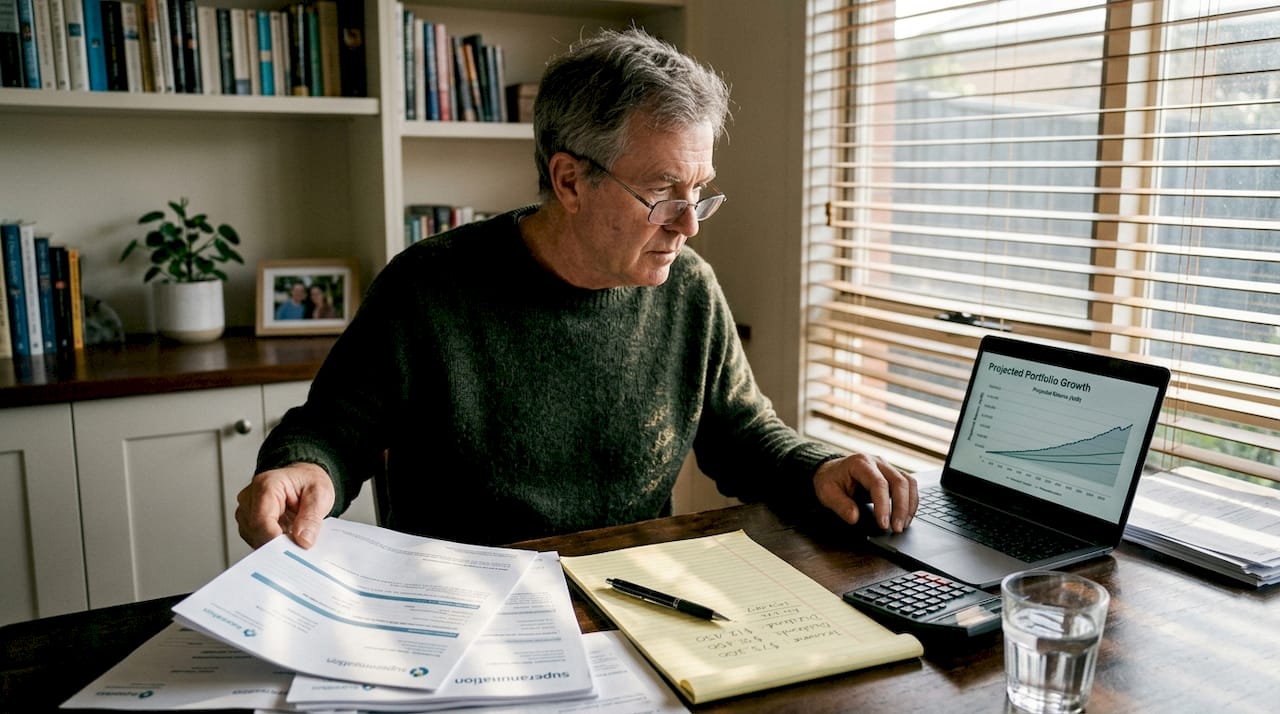
A retirement plan gap analysis compares your projected income from all sources against your target spending. If there's a shortfall, you have time to address it through additional saving, adjusted investment strategies, or planned asset sales.
Common investment assets and their general characteristics:
| Asset type | Potential return | Risk level | Liquidity |
|---|---|---|---|
| Australian shares | Medium to high | Medium to high | High |
| Investment property | Medium | Medium | Low |
| Term deposits | Low | Very low | Medium |
| Bonds | Low to medium | Low | Medium |
| Managed funds | Variable | Variable | High |
For your checklist, review each asset with these questions:
- What income will it generate in retirement? Rental yield, dividends, interest
- What are the associated costs? Maintenance, management fees, taxes
- When can you access it? Liquidity matters if you need funds quickly
- How does it fit your overall risk profile? As you approach retirement, reducing concentrated risk is wise
If you hold investment property, reviewing property investment tips can help you assess whether to hold, sell, or restructure. For shares, understanding capital gains tax strategies is especially relevant when planning asset sales near or in retirement.
Pro Tip: Diversify across at least three asset classes with different risk levels. Relying heavily on a single asset, even property, creates vulnerability if that market shifts at the wrong time.
Using retirement calculators to model different scenarios helps you stress-test your plan against market downturns, longevity risk, and unexpected costs.
Understand government support and pension eligibility
To fill any shortfall, government support adds important income. The Age Pension remains a significant financial resource for many Australians, yet eligibility rules are often misunderstood or ignored until retirement is imminent.
Key eligibility criteria for the Age Pension in 2026:
- Age: You must be 67 or older
- Residency: You must be an Australian resident and have lived in Australia for at least 10 years
- Asset test: For singles, assets below $314,000 (homeowner) qualify for the full pension
- Income test: For singles, income below $204 per fortnight qualifies for the full pension
The full Age Pension currently pays around $1,144 per fortnight for singles and $1,725 combined for couples, providing a meaningful income base for many retirees.
Steps to apply for the Age Pension:
- Check your eligibility using the Services Australia online estimator
- Gather your documents: Proof of age, residency, assets, and income
- Submit your application through myGov up to 13 weeks before you turn 67
- Declare all assets and income accurately to avoid overpayment issues
- Review your entitlement annually as assets and income change over time
Integrating the pension into your broader income plan matters. Even a partial pension, combined with super drawdowns and investment income, can significantly reduce the pressure on your own savings. Explore planning retirement income to see how different income streams work together.
For those with higher super balances, understanding tax-free income strategies can help you structure withdrawals to maximise the pension entitlement you receive. Running scenarios through a superannuation calculator shows exactly how your balance interacts with the pension asset test over time.
What most Australians miss: The ongoing power of checklists
Here's a perspective worth sitting with. Most people treat retirement planning as a one-time event, something to sort out in the final year or two before stopping work. That's a costly assumption. The only 18% with a clear plan aren't necessarily smarter or wealthier. They simply started earlier and kept reviewing.
A checklist isn't a document you complete and file away. It's a living tool that surfaces problems before they become expensive. It catches the forgotten super account, the outdated beneficiary nomination, the investment that no longer fits your risk profile. These are the details that quietly cost people thousands.
The real value of a checklist is that it forces you to confront specifics rather than vague intentions. "I'll sort out my super later" becomes "I need to consolidate two accounts and update my investment option by June." That shift from intention to action is where financial outcomes actually change. Reviewing insights on retirement calculators can reinforce how modelling specific numbers, rather than guessing, sharpens your planning considerably.
Pro Tip: Treat your retirement checklist as an ongoing project. Schedule a review every year, ideally after the financial year ends in July, when your super statement arrives and tax returns are fresh.
Take the next step: Tools to simplify your retirement planning
Working through a retirement checklist is far easier when you have the right tools doing the heavy lifting.

AlphaIQ brings together tax-aware modelling, scenario simulation, and real-time projections across super, investments, property, and retirement income, all in one place. You can run your super projection calculator to see exactly where your balance is headed, or use the debt recycling calculator to explore strategies for converting non-deductible debt into wealth-building assets. The AlphaIQ platform is built for self-directed Australians who want clarity backed by real numbers, without the ongoing cost of financial advice. Turn your checklist into a concrete, modelled plan today.
Frequently asked questions
How much superannuation do I need to retire comfortably in Australia?
The ASFA Retirement Standard suggests singles need approximately $630,000 and couples around $730,000 at age 67 for a comfortable retirement, though a modest lifestyle requires considerably less.
What are the key steps in an ATO superannuation health check?
The ATO Super Health Check recommends updating your personal details, checking your balance, finding lost super, consolidating accounts, and nominating beneficiaries to keep your super working effectively.
When and how should I apply for the Age Pension?
You can submit your application through myGov up to 13 weeks before you turn 67, and pension eligibility depends on passing both the asset and income tests at the time of application.
How can I assess if I will have enough money for retirement?
A gap analysis using retirement calculators compares your projected income and assets against your desired lifestyle costs, clearly showing whether you're on track or need to adjust your strategy.