
TL;DR:
- Australians aged 60 or over can access tax-free income from super if they meet certain rules. The transfer balance cap increases to 2.1 million dollars in 2026, allowing more funds to be tax-free. Strategies like maximizing contributions and blending income sources can further enhance tax efficiency in retirement.
Many Australians assume that once they start drawing down their retirement savings, tax will take a significant cut. That assumption is wrong for a large number of people. If you are aged 60 or over and drawing from a taxed superannuation source, your income can be completely tax-free, provided you stay within the rules. This guide explains exactly how that works, who qualifies, and the practical strategies you can use to maximise your tax-free retirement income across both super and non-super investments. Whether you are still working and building your balance, or already in retirement, there are real opportunities here worth understanding.
Table of Contents
- Understanding tax-free retirement income in Australia
- How superannuation income streams deliver tax-free payments
- Maximising your tax-free income: Key strategies before and after retirement
- Beyond super: Alternative options for tax-efficient retirement income
- What most guides miss about tax-free retirement income
- Get personalised help with your retirement plan
- Frequently asked questions
Key Takeaways
| Point | Details |
|---|---|
| Eligibility begins at 60 | Australians aged 60 and over can receive super income streams tax-free if they meet the rules. |
| Transfer balance cap is vital | Stay within the transfer balance cap—$2.1 million in 2026—for maximum tax-free income. |
| Strategy boosts outcomes | Smart pre-retirement contributions and timing can substantially increase your tax-free retirement income. |
| Other options for excess | If you hit the cap, investment bonds or annuities can help manage further retirement income tax efficiently. |
Understanding tax-free retirement income in Australia
Tax-free retirement income refers to income you receive in retirement that carries no personal income tax liability. In Australia, the primary source of this income is superannuation. Super income streams from taxed sources are tax-free for individuals aged 60 and over, provided minimum pension standards are met and payments fall within the transfer balance cap.
The transfer balance cap (TBC) is the maximum amount you can move from your superannuation accumulation account into a tax-free retirement phase income stream. The general TBC is currently $2 million, increasing to $2.1 million from 1 July 2026. Any amount above this cap cannot move into the tax-free retirement phase and remains subject to tax in accumulation.
Key insight: The $2.1 million cap from July 2026 means a couple could collectively shelter up to $4.2 million in tax-free retirement phase super.
The main sources of tax-free retirement income include:
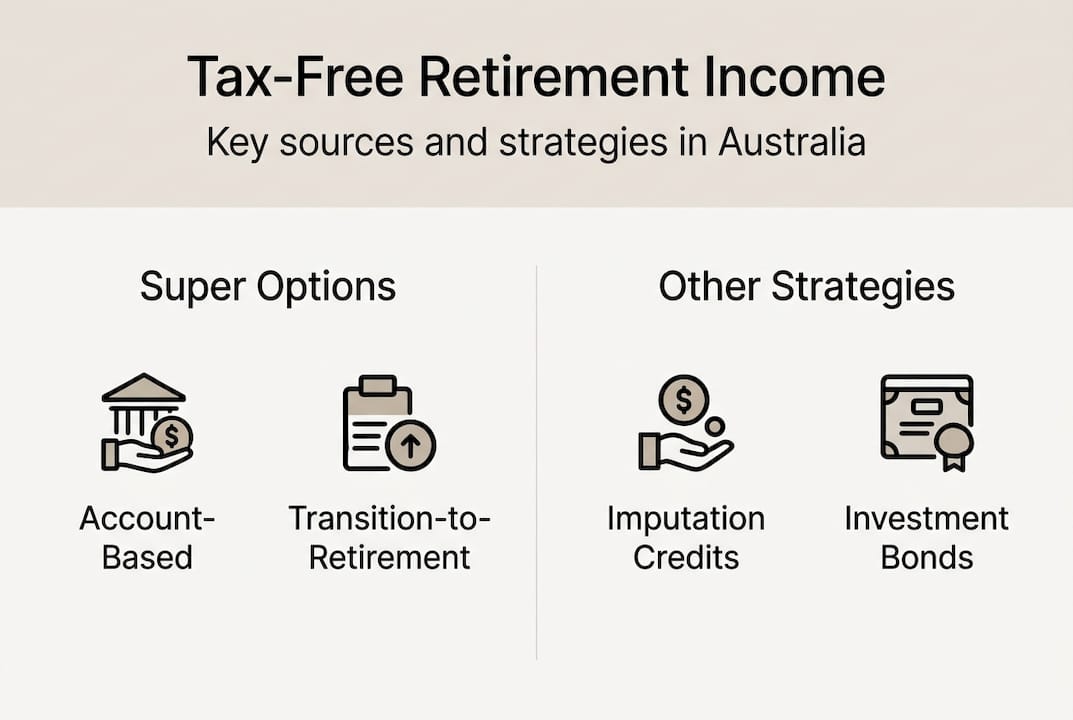
- Account-based pensions: Regular drawdowns from your super fund once you meet a condition of release, such as reaching age 60 and retiring
- Transition-to-retirement (TTR) pensions: Available from preservation age (currently 60 for most people), though earnings are not tax-free at the fund level until full retirement
- Lump sum withdrawals: Tax-free for those aged 60 and over from taxed super sources, up to applicable limits
To qualify, your fund must meet minimum annual pension payment standards. These are set as a percentage of your account balance and increase with age. For example, those aged 65 to 74 must draw at least 5% of their balance each year. Staying compliant with these rules is essential to maintaining your tax-free status.
If you are still in the planning retirement income phase, understanding how much super you will need is a useful starting point. A common question is how much super is needed to retire at 60, and the answer depends heavily on your lifestyle goals and income structure. Using a retirement income calculator can help you model different scenarios with real numbers.
How superannuation income streams deliver tax-free payments
Once you understand who qualifies, the next question is how the tax-free benefit actually works inside the super system.
When you retire and commence an account-based pension, your super fund moves your balance into what is called the retirement phase. At that point, investment earnings on assets supporting retirement-phase income streams are exempt from tax at the fund level under the Exempt Current Pension Income (ECPI) rules. This is a significant advantage over the accumulation phase, where fund earnings are taxed at 15%.

Here is a quick comparison:
| Feature | Accumulation phase | Retirement phase |
|---|---|---|
| Fund earnings tax | 15% | 0% (ECPI) |
| Member withdrawals (age 60+) | Tax-free | Tax-free |
| Capital gains (held 12+ months) | 10% effective | 0% |
| Minimum drawdown required | No | Yes |
To start a tax-free income stream after age 60, follow these steps:
- Confirm eligibility: You must have met a condition of release, such as retiring after age 60
- Contact your super fund: Request to commence an account-based pension and nominate your starting balance
- Stay within the TBC: Ensure the amount transferred does not exceed your personal transfer balance cap
- Set your drawdown amount: Choose a payment frequency and amount that meets the minimum annual pension standard
- Review annually: Check your balance, drawdown rate, and compliance with pension standards each financial year
Transition-to-retirement pensions work differently. They allow you to access super while still working from preservation age, but the fund earnings on TTR assets are not tax-free until you fully retire. They can still be useful for financial independence calculation purposes and salary sacrifice strategies.
Pro Tip: If your super balance is close to the current $2 million cap, consider delaying your pension commencement until after 1 July 2026. The cap rises to $2.1 million, giving you an extra $100,000 in tax-free retirement phase capacity.
For those weighing up fund structures, the comparison between SMSF vs industry super is worth exploring, as each has different ECPI administration requirements. A good retirement calculators guide can also help you stress-test your income projections.
Maximising your tax-free income: Key strategies before and after retirement
Knowing the rules is one thing. Using them strategically is another. Here are the most effective ways to increase your tax-free retirement income.
Before retirement:
- Maximise concessional contributions: Pre-tax contributions (employer and salary sacrifice) are taxed at just 15% going in, then become tax-free on the way out after age 60. The concessional cap is $30,000 per year, with carry-forward provisions allowing up to $32,500 in catch-up contributions if your balance is below $500,000
- Use salary sacrifice: Redirecting pre-tax salary into super is one of the most efficient ways to build your balance. Our guide on salary sacrifice for super explains how to structure this effectively
- Make personal deductible contributions: If you are self-employed or have variable income, you can claim a tax deduction on personal super contributions up to the concessional cap
- Contribution splitting: You can split up to 85% of concessional contributions with your spouse, helping both partners build their individual TBC capacity
After retirement:
- Time your pension start date: If you are near the TBC, starting after 1 July 2026 gives you access to the higher $2.1 million cap
- Watch for Division 296: From 1 July 2026, super balances over $3 million attract a 15% tax on earnings above that threshold. This is called Division 296 tax and affects a smaller group, but it is worth planning around if your balance is growing toward that level
- Blend income sources: Combining tax-free super income with other low-tax income can keep your overall tax position very efficient
Pro Tip: Consider splitting contributions with your spouse if one partner has a significantly lower super balance. This spreads the tax-free benefit across two TBCs and can double your household's tax-free retirement phase capacity.
Using a salary sacrifice calculator can show you exactly how much extra super you could accumulate by adjusting your contributions in the years before retirement. And if you want a full picture, planning your retirement strategy with scenario modelling helps you see the numbers clearly.
Beyond super: Alternative options for tax-efficient retirement income
If your super balance exceeds the transfer balance cap, or you simply want to diversify your income sources, there are other tax-efficient options worth considering.
When your super exceeds the TBC, the excess must remain in the accumulation phase, where fund earnings are taxed at 15%. That is still relatively low compared to personal income tax rates, but it is not tax-free. Excess super over the TBC remains taxable at 15%, and alternatives such as lifetime annuities and investment bonds can offer further tax efficiency for that portion of your wealth.
Here are the main options:
- Investment bonds: These are insurance-based investment structures that become tax-free after 10 years of continuous investment. They are particularly useful for holding assets outside super in a tax-effective way, especially for those who have maximised their TBC
- Lifetime annuities: Purchased with super or non-super money, these provide a guaranteed income stream for life. When purchased with money outside super, the tax treatment is different but can still be efficient for retirees in lower tax brackets
- Franked Australian shares: Dividends from Australian companies often come with franking credits attached, which represent tax already paid at the company level. Franking credit refunds are valuable for low-tax retirees, though policy risk around their future remains a consideration
Worth noting: Franking credit refunds have been subject to political debate in recent years. While currently available, it is wise not to build your entire retirement income strategy around them without a backup plan.
For those with significant assets outside super, understanding capital gains tax strategies is equally important. Managing when and how you realise gains can make a meaningful difference to your after-tax income each year.
What most guides miss about tax-free retirement income
Most articles on this topic focus on the rules as they stand today. What they underestimate is how quickly those rules can change, and how much that matters to your long-term plan.
The introduction of Division 296 tax is a clear example. It was not on most retirees' radar a few years ago. Now it is a real consideration for anyone with a growing super balance. Franking credit policy has also shifted in the political conversation more than once. The lesson is not to panic, but to build flexibility into your strategy.
Another common gap is the failure to integrate super and non-super assets into a single view. Many people optimise their super beautifully but leave their share portfolio, investment property, or investment bonds working inefficiently alongside it. Blending strategies across all your assets often produces better outcomes than optimising each in isolation.
Finally, customisation matters more than most guides acknowledge. What is tax-free for one person may not be for another, depending on age, fund type, balance size, and personal circumstances. Holistic retirement planning that accounts for your full financial picture, not just your super balance, is where the real gains are found. Review your strategy every year and after any major life event.
Get personalised help with your retirement plan
Understanding the theory is a strong start. Seeing how these strategies apply to your specific numbers is where real confidence comes from.

AlphaIQ gives you the tools to model your retirement income in real time, across super, investments, and property, all in one place. Use our superannuation calculator to project your balance and tax-free income potential, or run the numbers on salary sacrifice with our salary sacrifice calculator. If you want to see your full financial picture and stress-test different retirement scenarios, explore the AlphaIQ platform and take control of your retirement planning with clarity and confidence.
Frequently asked questions
What is considered tax-free retirement income in Australia?
Super income streams from taxed sources are tax-free for individuals aged 60 and over, within the transfer balance cap. Certain lump sum withdrawals from super after age 60 are also tax-free.
What is the transfer balance cap for retirement phase super in 2026?
The general TBC increases to $2.1 million from 1 July 2026, up from the current $2 million, giving retirees more capacity to hold assets in the tax-free retirement phase.
Can I have more than $2.1 million in super and still get tax-free income?
Only the first $2.1 million (from July 2026) can move into the tax-free retirement phase. Excess above the TBC remains in accumulation, where fund earnings are taxed at 15%.
What are alternatives if my super exceeds the TBC?
Alternatives include lifetime annuities outside super or investment bonds, both of which can offer tax efficiency for retirees who have reached their transfer balance cap limit.