
TL;DR:
- AI-powered platforms now enable self-directed Australian investors to access detailed modelling, scenario analysis, and personalised insights.
- Building wealth intelligence involves developing data literacy, scenario thinking, tax awareness, and tool fluency for better financial decisions.
- Combining AI analysis with personal judgment and human verification enhances the accuracy and effectiveness of wealth management.
Wealth intelligence used to be the domain of private banks, hedge funds, and the ultra-wealthy. If you didn't have a team of analysts behind you, the assumption was that sophisticated financial modelling simply wasn't within reach. That assumption is now outdated. AI-powered platforms and data-driven tools are reshaping what's possible for self-directed Australian investors, giving you access to scenario simulation, tax-aware modelling, and personalised insights that were once reserved for institutional players. This article explains what wealth intelligence actually means, how today's technology makes it work in practice, and the concrete steps you can take to build a stronger financial future.
Table of Contents
- Defining wealth intelligence: Beyond the buzzword
- How AI-powered platforms drive smarter investing
- Human-verified data vs. pure AI: What really matters for wealth building?
- Building your wealth intelligence: Tools, skills, and next steps
- Why wealth intelligence isn't a silver bullet (and what actually works))
- Take your wealth intelligence to the next level
- Frequently asked questions
Key Takeaways
| Point | Details |
|---|---|
| Wealth intelligence defined | It blends advanced analytics, AI, and data to unlock deeper investing insights. |
| AI meets human expertise | The best results come from combining machine-driven analysis with human skill and verification. |
| Practical tools available | Australians can access AI-powered platforms and calculators to model financial scenarios and grow wealth. |
| Skills are still essential | Critical thinking and understanding your goals matter as much as the tools you use. |
Defining wealth intelligence: Beyond the buzzword
The term "wealth intelligence" gets used in several different ways, and that can create confusion. At one end of the spectrum, it describes AI-powered platforms that deliver actionable insights, personalised strategies, and scenario analysis from vast datasets. At the other end, it refers to the personal analytical skills an individual investor develops over time, the ability to read financial data critically, model outcomes, and make decisions grounded in evidence rather than emotion.
Both definitions share a common thread: turning raw information into better financial decisions. For Australian self-directed investors, that means understanding how your superannuation, property, investments, and tax position interact, and being able to model what happens when any one of those variables changes.
"No single universal definition exists for wealth intelligence; it ranges from proprietary AI and data platforms to refined personal analytical skills."
Here's what wealth intelligence looks like in practice for everyday investors:
- Data literacy: Reading and interpreting financial reports, portfolio performance metrics, and market data without needing a professional to translate them for you.
- Scenario thinking: Running "what if" models, such as what happens to your retirement income if interest rates rise 1%, or if you salary sacrifice an extra $10,000 into super.
- Tax awareness: Understanding how capital gains, franking credits, and debt recycling affect your net returns, not just your gross figures.
- Tool fluency: Knowing which platforms and calculators to use, and how to interpret the outputs they generate.
- Critical evaluation: Questioning assumptions baked into any model, whether it's a platform's projection or your own spreadsheet.
The AlphaIQ blog covers each of these themes in depth, which reflects how interconnected these skills really are. Building wealth intelligence isn't a one-time event. It's an ongoing process of refining your understanding as markets, tax laws, and your personal circumstances evolve.
How AI-powered platforms drive smarter investing
AI changes investing analysis in a fundamental way. Traditional analysis relies on a finite set of data points, usually historical prices, earnings reports, and macroeconomic indicators. AI can simultaneously process thousands of variables, identify non-obvious correlations, and update recommendations in near real time.
HSBC's Wealth Intelligence platform, for example, analyses over 10,000 data sources to deliver tailored, timely insights to its clients. That scale of data processing simply isn't possible through manual research, no matter how diligent you are.
For Australian self-directed investors, the practical benefit is access to modelling that accounts for your specific situation: your super balance, your marginal tax rate, your property equity, and your target retirement income. Rather than generic projections, you get numbers that reflect your actual position.
Here's a comparison of how leading platforms serve different investor needs:
| Platform | Primary focus | Key features | Best suited for |
|---|---|---|---|
| AlphaIQ | Australian personal wealth | Tax-aware modelling, super projections, debt recycling, scenario simulation | Self-directed investors aged 35 to 65 |
| HSBC Wealth Intelligence | Institutional and HNW clients | 10,000+ data sources, AI-driven personalisation | Professional and high-net-worth clients |
| Sharesight | Portfolio tracking | Performance reporting, tax reports, dividend tracking | Active share investors |
| Stockspot | Automated investing | Robo-advice, ETF portfolios, goal tracking | Passive, hands-off investors |
Choosing the right platform comes down to your goals. If you want to model retirement scenarios, optimise super contributions, or understand the tax impact of selling an investment property, you need a tool built for that level of specificity.
Pro Tip: Don't choose a platform based on features alone. Ask yourself: "Does this tool model my actual situation, including my super, my tax position, and my property?" A platform that covers all three will give you far more useful outputs than one that focuses on a single asset class. Explore personal wealth platforms designed for Australian investors to compare your options.
The AlphaIQ platform is built specifically for this integrated approach, combining tax-aware financial modelling with scenario simulation across investments, superannuation, and property.
Human-verified data vs. pure AI: What really matters for wealth building?
AI is powerful, but it has limits. Algorithms learn from historical data, which means they can struggle with genuinely novel situations, regulatory changes, or the kind of qualitative context that only a human can provide.

Altrata's Verified Wealth Intelligence is a useful illustration. Their platform provides human-verified details on 16 million high-net-worth individuals, offering context and accuracy that pure AI analysis may miss. The human verification layer catches errors, resolves ambiguities, and adds nuance that automated systems often overlook.
For self-directed investors, the same principle applies. AI tools can model your financial position with impressive precision, but they can't account for factors like your risk tolerance, your family situation, or a career change you're planning. Those inputs have to come from you.
Here's a practical breakdown of when each approach adds the most value:
| Situation | AI-driven analysis | Human judgement |
|---|---|---|
| Modelling super projections | Excellent: fast, accurate, scenario-ready | Needed to set realistic contribution assumptions |
| Evaluating a property purchase | Good for price trends and rental yield data | Essential for local knowledge and personal fit |
| Tax optimisation strategies | Strong for rule-based calculations | Critical for interpreting grey areas and recent changes |
| Retirement income planning | Excellent for drawdown modelling | Needed to factor in lifestyle goals and health considerations |
The key takeaways for your own decision-making:
- Use AI platforms to generate projections and run scenarios quickly.
- Apply your own judgement to validate the assumptions those projections rely on.
- Seek human expertise (from a financial adviser or accountant) when you're dealing with complex tax structures or significant one-off decisions.
- Review AussieQuant alternatives if you're looking for platforms that combine modelling with analytical depth.
The question of DIY investing vs advisors isn't binary. The most effective approach for most self-directed investors is to use AI tools for the heavy lifting and apply human critical thinking to interpret and act on the results.
Building your wealth intelligence: Tools, skills, and next steps
Advanced analytical skills combined with the right modelling tools are what separate investors who genuinely understand their financial position from those who are guessing. The good news is that building this capability is more achievable than it's ever been.
Start with this skills checklist for 2026:
- Scenario planning: Can you model at least three different retirement outcomes based on different contribution rates or market returns?
- Tax literacy: Do you understand how franking credits, capital gains discounts, and concessional super contributions affect your net position?
- Tool selection: Are you using a platform that reflects your actual financial structure, not just a generic calculator?
- Data interpretation: Can you read a portfolio performance report and identify what's driving returns, not just what the total return figure says?
Here's a practical framework to start building your scenario simulation capability:
- Define your financial goals clearly. Write down your target retirement income, your expected retirement age, and your current asset base. Vague goals produce vague models.
- Gather your baseline data. Pull together your super balance, investment portfolio value, property equity, outstanding debts, and current income. You can't model accurately without accurate inputs.
- Choose a scenario to test. Start with something concrete, such as: "What happens to my retirement income if I increase my super contributions by $500 per month for the next ten years?"
- Run the model and review the outputs. Use a tool like the retirement calculators designed for Australian investors to generate projections.
- Stress-test your assumptions. Change one variable at a time. What if returns average 5% instead of 7%? What if you retire two years earlier?
- Calculate your FI number. Understanding your financial independence number gives you a concrete target to model towards.
- Review and repeat quarterly. Your financial position changes. Your model should too.
Pro Tip: The most common mistake in scenario modelling is using overly optimistic return assumptions. Check your assumptions against long-run historical averages for Australian assets. Resources that explain investment return benchmarks for Australian portfolios can help you set realistic baselines.
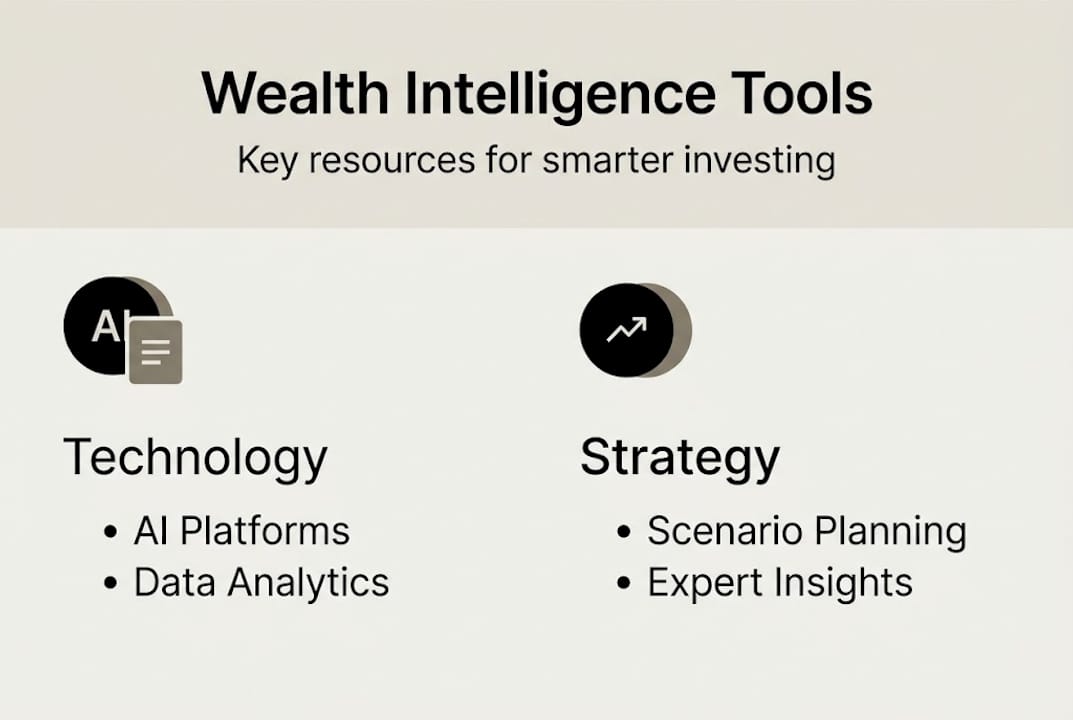
Why wealth intelligence isn't a silver bullet (and what actually works)
Here's an uncomfortable truth: the best AI platform in the world won't make you a better investor if you don't engage critically with what it tells you. We've seen investors run sophisticated models and then ignore the outputs because the results weren't what they hoped for. That's not wealth intelligence. That's confirmation bias with better software.
The real differentiator between investors who build genuine wealth and those who stagnate isn't access to tools. It's the discipline to run honest scenario tests, question their own assumptions, and act on the results even when it's uncomfortable. A model that tells you your current savings rate won't support your retirement lifestyle is only useful if you do something about it.
Personal context also matters enormously. Generic "best advice" from any system, whether AI or human, is calibrated to an average investor. You are not average. Your tax position, your family structure, your risk tolerance, and your goals are specific to you. The true cost of financial advice versus doing it yourself comes down to how well you can contextualise the outputs you're getting. Tools give you the numbers. You have to supply the wisdom.
Take your wealth intelligence to the next level
Understanding wealth intelligence is one thing. Putting it into practice with tools built for your actual situation is where the real progress happens.
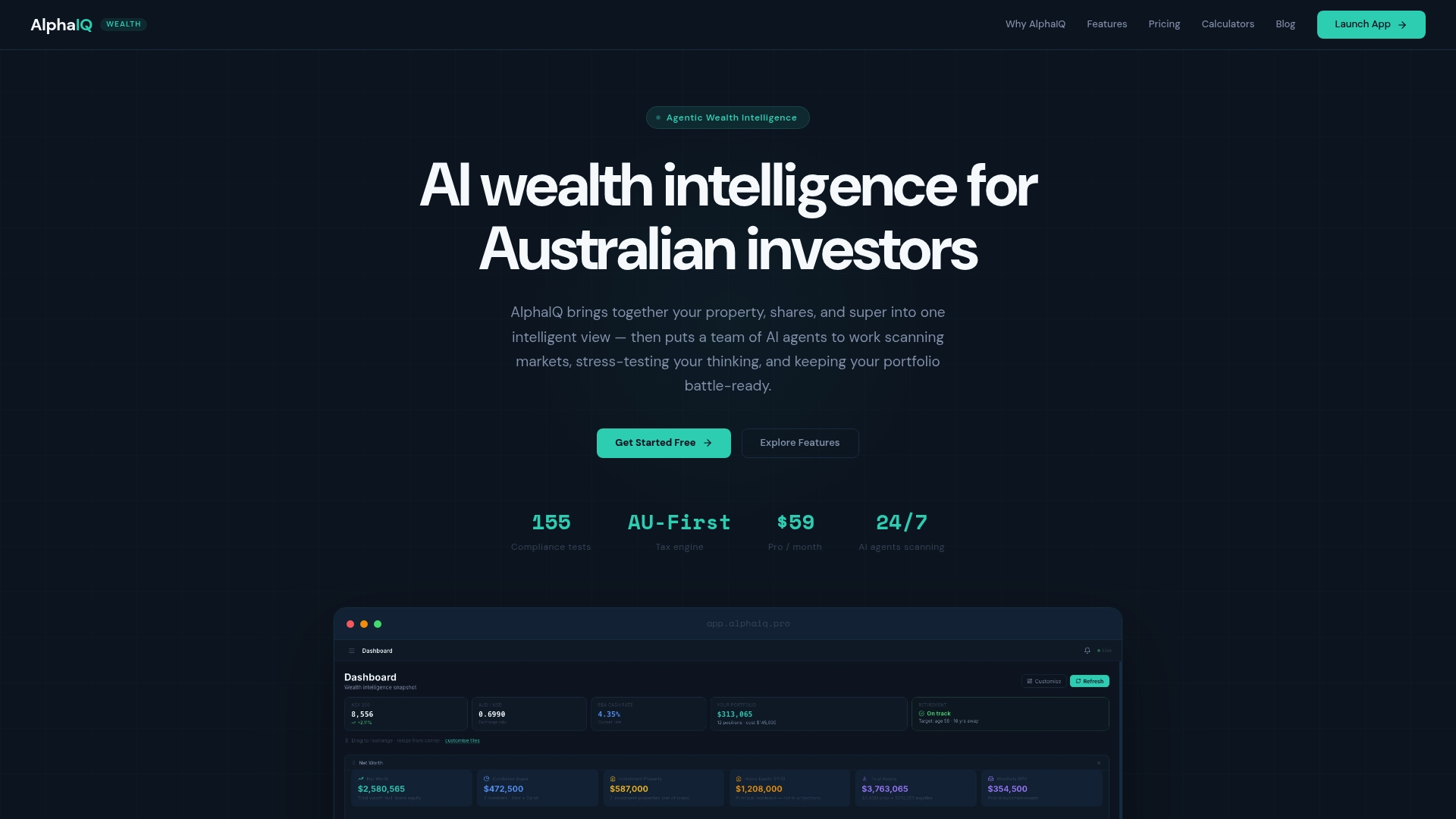
AlphaIQ is designed for self-directed Australian investors who want to model their complete financial picture, including super, investments, property, and retirement income, without the cost of ongoing financial advice. You can explore scenario simulations, run the debt recycling calculator to understand how to convert non-deductible debt into a tax-effective investment strategy, and use the superannuation calculator to project your super balance across different contribution scenarios. The AlphaIQ platform gives you the modelling capability to turn insights into informed decisions, backed by real numbers.
Frequently asked questions
What's the difference between wealth intelligence and financial intelligence?
Wealth intelligence integrates AI, big data, and sophisticated modelling tools for strategic scenario planning, while financial intelligence refers more broadly to everyday money management skills. No single universal definition exists for wealth intelligence, but it consistently involves data-driven analysis at a deeper level than basic budgeting or savings habits.
Can self-directed investors access AI-powered wealth intelligence tools?
Yes, many platforms now offer AI-driven analytics and modelling features that were previously only available to institutional clients. AI-powered platforms are increasingly accessible to individual Australian investors, with tools tailored to superannuation, property, and retirement planning.
Does human-verified data outperform AI in wealth management?
Neither approach is universally superior. Human-verified data provides critical context and quality control, while AI enables faster and broader analysis across thousands of data points. Using both in combination tends to produce the most reliable outcomes.
What skills do I need to boost my wealth intelligence?
Focus on scenario modelling, tax literacy, critical evaluation of data outputs, and fluency with relevant investing platforms. Advanced analytical skills combined with the right tools are what allow self-directed investors to make genuinely informed decisions rather than educated guesses.
Recommended
- AlphaIQ — AI Wealth Intelligence Platform for Australian Investors
- Personal wealth platforms for Australian investors 2026
- Explaining investment returns: Build smarter Australian portfolios
- AlphaIQ Blog — Wealth Intelligence for Australian Investors
- Master Trading Success: Strategies & Tools 2026 - My Framer Site
- 12 essential trading strategies to boost your edge in 2026