
TL;DR:
- Retirement planning in Australia requires personalized strategies based on goals, super balance, and asset positioning.
- Key benchmarks like ASFA standards provide targets, but individual circumstances and inflation impact needed savings.
- Flexibility and regular reviews are crucial, as changing rules and life events demand adaptive retirement plans.
There is a persistent belief among Australians approaching retirement that a single, balanced investment template will serve everyone equally well. The reality is far more nuanced. Your retirement outcome depends on a combination of your spending goals, your super balance today, how much you can still contribute, and how well your investments are positioned across different asset classes. This guide works through the practical strategies, benchmarks, and super rules that matter most so you can build a retirement plan grounded in real numbers rather than assumptions.
Table of Contents
- Understanding your retirement spending benchmarks
- Key investment vehicles for pre-retirees
- Super strategies: Contribution caps, carry-forward rule and timing
- Avoiding the pitfalls of asset allocation myths
- What most retirement guides miss: Flexibility is your greatest asset
- Plan your next step towards a confident retirement
- Frequently asked questions
Key Takeaways
| Point | Details |
|---|---|
| Benchmarks matter | Using ASFA’s figures can help you set a realistic retirement target that matches your lifestyle goals. |
| Super rules evolve | Contribution caps and carry-forward allowances change, so timing your extra contributions is crucial. |
| Diversification is not one-size-fits-all | Standard asset splits like 60/40 are not always best; consider risk, goals, and when you’ll need each dollar. |
| Prioritise flexibility | Regularly reviewing your investment and withdrawal strategy keeps you on track as rules and markets change. |
| Leverage digital tools | Calculators and planning platforms help you test scenarios and make informed moves without relying solely on advisers. |
Understanding your retirement spending benchmarks
Now that you know a one-size-fits-all approach doesn't work, let's start by defining what "enough" really means for your retirement.
Before you can optimise your investment mix, you need a clear target. Many pre-retirees guess at a number or simply aim to "have enough," but that ambiguity can lead to either undersaving or unnecessarily delaying retirement. The ASFA Retirement Standard offers target lump sums for a comfortable or modest lifestyle at age 67, giving you a concrete starting point.
As of 2026, ASFA estimates the following lump sums required at retirement for homeowners:
| Retirement lifestyle | Single | Couple |
|---|---|---|
| Comfortable (at 67) | $630,000 | $730,000 |
| Modest (at 67) | $100,000 | $100,000 |
The "comfortable" standard assumes you own your home outright and can afford a broad range of activities, private health insurance, and occasional overseas travel. Annual spending at this level sits at approximately $52,000 for a single person and $73,000 for a couple. The "modest" standard reflects a more basic lifestyle, largely supplemented by the Age Pension.
When you're planning retirement income, it's easy to misuse these figures. Here are the most common errors to avoid:
- Targeting the "average" without considering your own lifestyle expectations or non-housing costs
- Ignoring the homeowner assumption embedded in ASFA's figures (if you're still paying off a mortgage, your required balance is substantially higher)
- Forgetting inflation, which erodes purchasing power over a retirement that could span 25 to 30 years
- Overlooking healthcare costs, which typically rise sharply in the final decade of life
"ASFA's figures are a starting point for conversation, not a guaranteed finish line. They assume full home ownership and no outstanding debts at retirement."
These benchmarks work best when you treat them as a floor, then layer your own spending assumptions on top. If you want to know how much super to retire at 60, for example, your required balance will be noticeably higher because you're drawing down over a longer period and may not yet qualify for the Age Pension.
Understanding tax-free retirement strategies is equally important at this stage. Structuring withdrawals correctly from the beginning can meaningfully extend how long your savings last.
Key investment vehicles for pre-retirees
With your spending benchmark in mind, let's unpack the basic building blocks most Australians use to achieve their retirement targets.
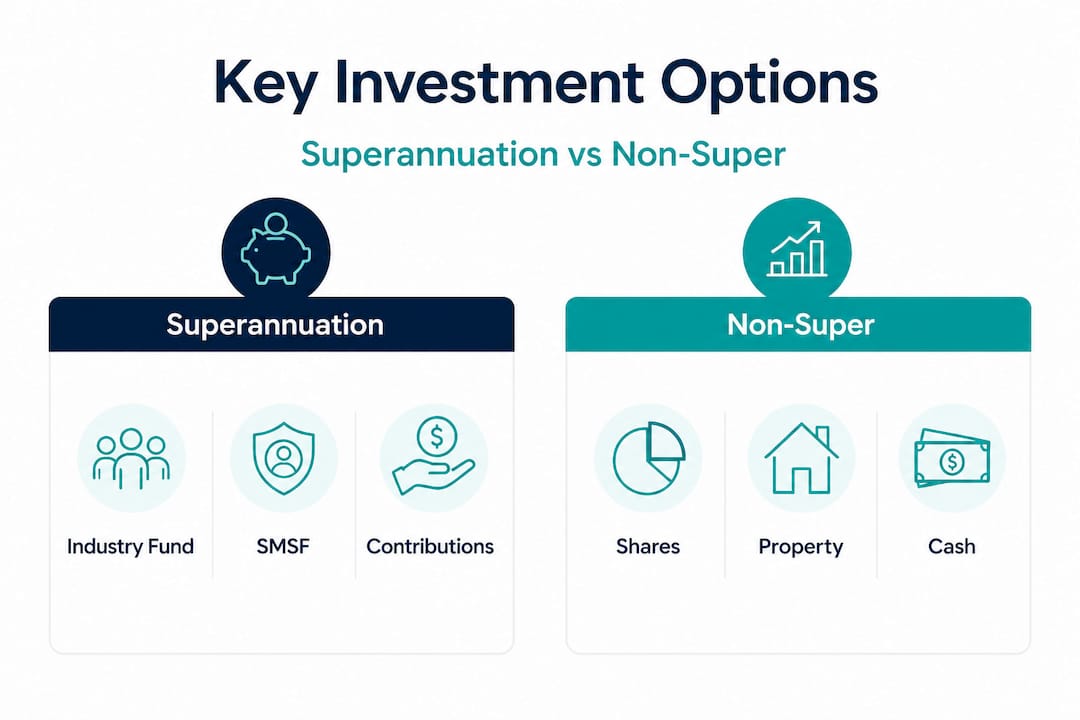
Australian pre-retirees have access to a range of investment vehicles, and each comes with different tax treatment, accessibility rules, and risk profiles. Understanding how these interact is essential before you decide how to allocate your savings.
The three primary categories are:
- Superannuation (inside super): Tax-concessional, preserved until you reach your preservation age (currently 60 for most), and subject to strict contribution caps. Once you're in pension phase, earnings and withdrawals can be entirely tax-free.
- Direct investments outside super: Shares, exchange-traded funds (ETFs), property, and term deposits held in your own name or a trust. These are fully accessible at any time but attract income tax on earnings and capital gains tax on any growth when sold.
- Annuities and guaranteed income products: A less common but growing option, these provide predictable income in exchange for a lump sum, reducing longevity risk (the risk of outliving your savings).
Here's a side-by-side comparison of the key features:
| Feature | Superannuation | Outside super (shares/ETFs) | Investment property |
|---|---|---|---|
| Tax on earnings | 15% (accumulation); 0% (pension phase) | Marginal tax rate | Marginal tax rate |
| Capital gains discount | 33% after 1 year in fund | 50% after 12 months (personal) | 50% after 12 months |
| Accessibility | Preserved until 60 (or retirement) | Anytime | Requires sale or refinance |
| Contribution rules | Annual caps apply | No limits | No limits |
| Estate considerations | Not automatically part of estate | Part of estate | Part of estate |
One practical approach is the "bucket" strategy, where you divide your savings across three timeframes:
- Short-term bucket (0 to 3 years of living expenses): Cash or term deposits for immediate income needs, reducing the need to sell growth assets during a market downturn
- Medium-term bucket (3 to 10 years): Diversified bonds, balanced funds, or income-focused ETFs
- Long-term bucket (10 years plus): Growth assets like Australian and international shares or property that can ride out market volatility
Decisions around fund structure also matter. Comparing SMSF vs industry super options can reveal meaningful differences in fees, control, and flexibility depending on your balance and investment preferences. Similarly, property investment for retirement carries specific cash flow and tax implications worth modelling carefully before committing.
Superannuation contribution and access rules shape your choices and timing more than most investors realise, especially in the final decade before retirement when every additional dollar in super can grow tax-effectively.

Pro Tip: Check your super fund's published investment option fact sheets. Most industry funds publish their actual asset allocations for each option, giving you a reliable benchmark for your own portfolio mix before you adjust anything.
Super strategies: Contribution caps, carry-forward rule and timing
Understanding each investment bucket's access rules is only half the story; how and when you contribute matters just as much, especially as caps rise.
The years between 50 and 65 are often the highest-earning years for many Australians, making them the best window to accelerate super contributions. Yet a large proportion of pre-retirees leave significant tax advantages on the table by not maximising their caps.
Current and upcoming contribution caps:
From 1 July 2026, super contribution caps increase meaningfully:
- Concessional contributions (pre-tax, including employer and salary sacrifice): Rising from $30,000 to $32,500 per year
- Non-concessional contributions (after-tax): Rising from $120,000 to $130,000 per year, with the three-year bring-forward rule allowing up to $390,000 in a single year if eligible
Statistic callout: If your super balance is below $500,000, you may be eligible to carry forward up to five years of unused concessional cap space. This means someone who has contributed well below the cap for several years could potentially contribute well over $100,000 in a single year on a concessional basis, generating a substantial tax deduction.
Here is a numbered checklist to help you time contributions effectively:
- Check your current super balance before 30 June each year. The carry-forward rule is only available if your total super balance is below $500,000.
- Review your unused cap history through your MyGov account under the ATO section, which shows unused concessional cap amounts going back five years.
- Calculate your available cap space by adding unused amounts from prior years to the current year's cap.
- Decide on salary sacrifice or personal deductible contributions before year end. Personal contributions require a "notice of intent to claim a deduction" form to be lodged with your fund.
- Check the ATO website for the latest confirmed cap amounts before 30 June each year, particularly in years when indexation is due.
- Model the after-tax impact of making large contributions to ensure you're not triggering excess contributions tax, which applies at your marginal rate plus an interest charge.
You can use a super calculator to model how additional contributions affect your projected balance at retirement. For a broader look at tools available, this guide to retirement calculators outlines what to look for when comparing your options.
Pro Tip: Always confirm the current year's caps directly on the ATO website before making catch-up or bring-forward contributions. Rule changes and indexation adjustments can affect eligibility, and errors can trigger tax penalties that are difficult to reverse.
Avoiding the pitfalls of asset allocation myths
Having explored contributions, it's equally critical not to fall for simplistic asset allocation formulas that might miss your real needs.
The 60/40 portfolio (60% growth assets like shares, 40% defensive assets like bonds) has been a standard recommendation for decades. It carries an intuitive appeal: growth to build wealth, bonds to cushion downturns. But the reality for pre-retirees is more complicated.
"The 60/40 allocation is not universally effective for all retirees; outcomes depend on personal factors like withdrawal needs and market volatility." — Monash University research on the future of 60/40 investing
The problem with defaulting to a formula is that it ignores the factors that actually determine whether your money lasts. Consider the following practical variables:
- Retirement horizon: Someone retiring at 60 may need their portfolio to sustain them for 30 or more years, requiring more growth exposure than someone who retires at 67
- Sequence of returns risk: Poor market returns in the first few years of retirement can permanently reduce your balance, even if markets recover later. This is distinct from long-term average return risk.
- Lump sum vs pension income needs: If you're converting super to an account-based pension and drawing a regular income, you need a different allocation than someone living off investment dividends
- Liquidity requirements: Unexpected health costs, helping adult children, or early retirement can all create sudden cash needs that a growth-heavy portfolio can't meet without forced selling
- Inflation sensitivity: A retiree on a fixed income stream from bonds can see their purchasing power erode significantly if inflation runs above the yield
Rather than defaulting to a formula, use a retirement planning checklist to identify your personal constraints and goals before selecting an asset mix. Scenario testing is far more useful than any static formula. Ask yourself: "What happens to my plan if markets fall 25% in year one of retirement?" or "What if I live to 95?" Running those numbers in advance shifts your thinking from hope-based planning to evidence-based planning.
Some pre-retirees also benefit from adding diversifiers beyond the traditional share/bond split, including listed property trusts (A-REITs), infrastructure funds, or a small allocation to an annuity product that guarantees a base income floor regardless of market conditions.
What most retirement guides miss: Flexibility is your greatest asset
Most retirement guides deliver their value through formulas. They offer you a target balance, an allocation percentage, and a drawdown rate (the percentage you withdraw each year), and they imply that if you follow the numbers, you're done. That framing misses something important.
Your circumstances change. Markets change. Tax rules change. The strategies available to you in your mid-fifties may look completely different at 62, particularly as new contribution indexation rules, Age Pension thresholds, or investment market cycles shift the numbers. The real advantage you have right now is time and optionality, meaning you can still adjust.
True financial security in retirement doesn't come from locking in the right formula today. It comes from building a plan you revisit every year and adjust as your situation evolves. A mid-year financial review, even a brief one, can reveal whether you've used your concessional cap, whether your asset mix has drifted due to market movements, or whether a rule change creates a new opportunity.
Consider real-life retirement planning scenarios: a couple who planned to retire at 65 might find that one partner receives an inheritance at 62, changing their super contribution strategy entirely. Or someone who expected to sell an investment property might decide to retain it for rental income, shifting their super drawdown timing. No formula anticipates those moments. Only a flexible, regularly reviewed plan does.
The other thing most guides underemphasise is the value of acting early on new rules. The carry-forward contribution rule, for example, rewards people who check their eligibility before the end of the financial year, not after. Waiting until you "have time to sort it out" typically means leaving tax advantages unclaimed.
Pro Tip: Schedule a 30-minute mid-year review in January each year. Check your super balance against the $500,000 threshold, confirm available carry-forward cap space, review your asset allocation drift, and note any rule changes announced in the Federal Budget. It takes less time than most people expect and catches opportunities that are otherwise missed.
Plan your next step towards a confident retirement
Flexibility is the edge, and the right tools make it practical to act on.
AlphaIQ is built specifically for Australians who want to model their retirement position without the cost of ongoing financial advice. Whether you're testing the impact of additional super contributions, modelling a debt recycling strategy, or projecting how long your savings will last under different withdrawal rates, the platform gives you real numbers to work with.

Start by running your numbers through the superannuation calculator to see how your projected balance at retirement changes with different contribution levels and timelines. If you hold investment property with a mortgage, the debt recycling calculator can show you how to convert non-deductible debt into tax-deductible debt in a structured, evidence-based way. For a broader view of your entire wealth position across super, property, and investments, explore AlphaIQ's wealth tools and see how scenario modelling puts the decision-making back in your hands.
Frequently asked questions
What is the comfortable retirement savings benchmark for 2026?
ASFA estimates you'll need about $630,000 for a single person or $730,000 for a couple at age 67 for a comfortable lifestyle, assuming you own your home outright.
How do super contribution caps change from July 2026?
The concessional cap rises from $30,000 to $32,500, and the non-concessional cap increases from $120,000 to $130,000 from 1 July 2026 due to indexation.
Is a 60/40 portfolio always the best for pre-retirees?
No. Research shows that the 60/40 approach is not universally suited to all retirees, with outcomes varying significantly based on personal withdrawal needs, health costs, and market timing at retirement.
Who can use the super carry-forward rule?
You can use catch-up concessional contributions if your total super balance is below $500,000 at 30 June of the prior financial year and you have unused cap space from any of the past five years.