
TL;DR:
- The pension phase converts super into a tax-free income stream with 0% investment earnings tax. From July 2025, the transfer balance cap increases to $2 million, limiting tax-free assets; excess funds remain taxed at 15%. Active management of withdrawal rates, investment strategy, and transfer cap compliance is crucial for maintaining retirement income security.
The pension phase is defined as the stage where your superannuation converts from an accumulation account into a retirement income stream. This shift triggers one of the most significant tax advantages available to Australian retirees: investment earnings taxed at 0%, compared to 15% in the accumulation phase. From 1 July 2025, the Australian Taxation Office (ATO) applies a $2 million transfer balance cap to limit how much super can move into this tax-free environment. Understanding pension phase rules, withdrawal requirements, and the transfer balance cap is the foundation of any sound retirement income plan.
What is pension phase and how does it work?
The pension phase, formally called the retirement phase, begins when you meet a condition of release and convert your super balance into an income stream. The most common conditions of release are retiring after reaching your preservation age, or simply turning 65. Your preservation age is currently 60 for anyone born after 30 June 1964.

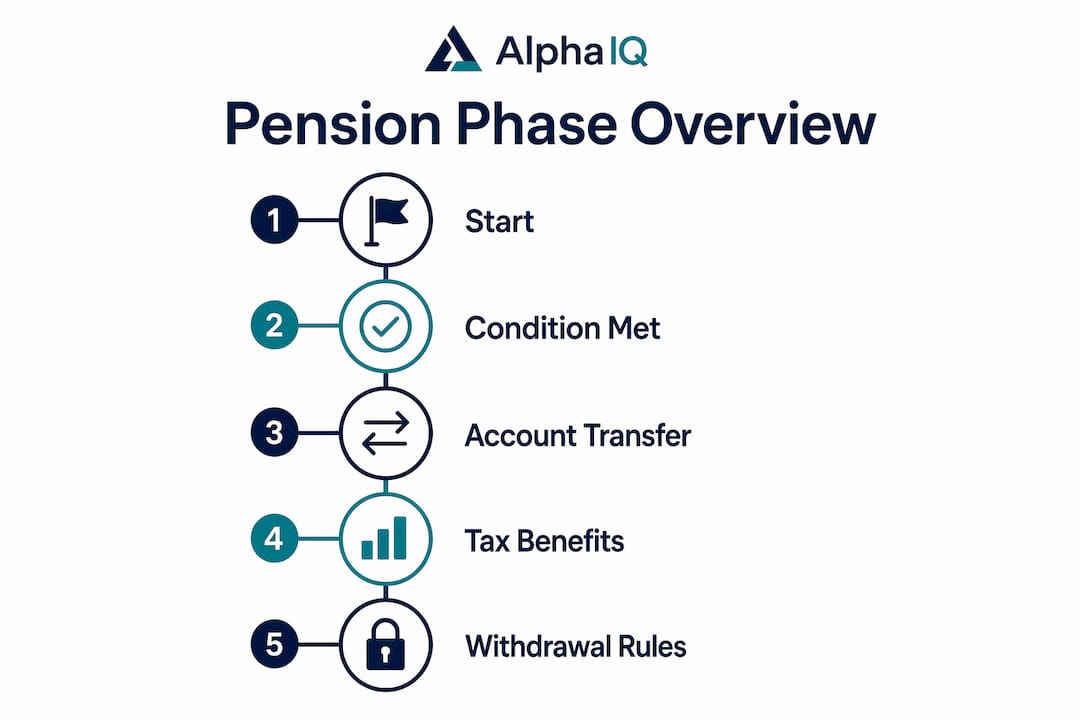
Once you meet a condition of release, your super fund moves your balance from an accumulation account into a pension account. From that point, the fund pays you regular income, and the earnings on your investments inside the pension account attract no tax. That 0% tax rate on earnings is the defining feature of the retirement phase, and it applies for as long as your account holds a balance.
An account-based pension is the most common structure used in pension phase. You draw income from your own super balance, and the account grows or shrinks based on investment returns and your withdrawal rate. The balance is yours to manage, which means the decisions you make about drawdown rates and investment allocation directly affect how long your money lasts.
What conditions must you meet to enter pension phase?
Eligibility for the full pension phase depends on meeting one of the following conditions of release:
- Retirement after preservation age. You have reached your preservation age (age 60 for most Australians) and have permanently left the workforce.
- Reaching age 65. You can access your super in full pension phase at age 65, regardless of whether you are still working.
- Permanent incapacity or terminal illness. These are additional conditions that allow early access.
A common misconception is that reaching preservation age automatically triggers pension phase. It does not. You must also satisfy the retirement condition, meaning you have genuinely ceased employment with no intention of returning to work.
Transition to retirement income streams
If you have reached preservation age but have not yet retired, you can access a Transition to Retirement Income Stream (TRIS). A TRIS lets you supplement your income and potentially reduce your working hours before full retirement. The key difference is that TRIS withdrawals are capped at 10% of your account balance annually, and investment earnings inside a TRIS are taxed at 15%, not 0%. The full tax-free benefit only applies once you move into the retirement phase proper.
Pro Tip: If you are approaching 60 and considering a TRIS, model the difference in net income between a TRIS and waiting until full retirement. The tax saving on earnings in full pension phase can be substantial over even a few years.
How does the transfer balance cap affect pension phase?
The transfer balance cap limits the total amount you can move from accumulation into pension phase to receive tax-free earnings. From 1 July 2025, the cap increased to $2 million. This is a significant increase from the previous $1.6 million cap, and it opens up more planning options for Australians with larger super balances.
| Scenario | Amount in pension phase | Amount remaining in accumulation | Tax on earnings |
|---|---|---|---|
| Balance below cap | Up to $2,000,000 | $0 | 0% on pension portion |
| Balance above cap | $2,000,000 | Excess amount | 15% on accumulation portion |
| TRIS (pre-retirement) | Up to 10% withdrawal | Full balance in TRIS | 15% on all earnings |
Any super above the $2 million cap must remain in accumulation phase, where earnings are taxed at 15%. The ATO tracks your cap usage through a Transfer Balance Account, which records every dollar you move into pension phase. If you exceed the cap, the ATO applies an excess transfer balance tax until you remove the excess from pension phase.
Multiple pension accounts count toward the same cap. If you have a self-managed super fund (SMSF) pension and a retail fund pension running simultaneously, the combined value counts against your $2 million limit.
Pro Tip: Use Alphaiq's super projection tool to model how your current super balance tracks against the transfer balance cap. Knowing your projected balance at retirement helps you plan whether to hold excess funds in accumulation or consider other strategies.
What are the mandatory withdrawal rules during pension phase?
The government requires you to withdraw a minimum amount from your pension account each financial year. The minimum is calculated as a percentage of your account balance on 1 July each year, and the percentage increases with age. Failing to meet the minimum means the pension ceases for tax purposes, and your balance reverts to the accumulation environment.
The minimum withdrawal rates by age group are:
- Under 65: 4% of account balance per year
- Age 65–74: 5% of account balance per year
- Age 75–79: 6% of account balance per year
- Age 80–84: 7% of account balance per year
- Age 85–89: 9% of account balance per year
- Age 90–94: 11% of account balance per year
- Age 95 and over: 14% of account balance per year
For a retiree aged 68 with a $1,500,000 pension account balance, the minimum annual withdrawal is $75,000. That amount must be paid out during the financial year, regardless of market conditions or personal preference.
Once you are fully retired, there is no maximum withdrawal limit. You can draw down as much as you need. The practical risk is drawing too much too early, which reduces the balance available to generate future earnings and may deplete the account before you need it most.
What are the key benefits and risks of the pension phase?
The pension phase delivers clear financial advantages, but it also carries risks that require active attention.
The main benefits are:
- Tax-free investment earnings. The 0% tax rate on earnings inside pension phase creates a compounding advantage over time. Every dollar of return stays in the account and continues to grow.
- Tax-free pension payments after age 60. Pension payments from a taxed fund are generally tax-free once you turn 60. This applies to both lump sum withdrawals and regular income payments.
- Flexible income. You choose how much to withdraw above the minimum, and you can adjust the frequency of payments to match your cash flow needs.
- Integration with broader retirement income. The pension phase works alongside the Age Pension, rental income, and other investments as part of a retirement income plan.
The key risks are:
- Account depletion. An account-based pension is not guaranteed for life. If you withdraw too much or markets perform poorly, the balance can run out.
- Market risk. Your pension account remains invested. A significant market downturn early in retirement can permanently reduce your income capacity, a phenomenon known as sequence of returns risk.
- Administrative risk. Missing the minimum withdrawal in any financial year triggers the pension ceasing for tax purposes. This is a straightforward rule, but it catches retirees who do not actively monitor their accounts.
"Many retirees treat pension phase as a set-and-forget arrangement, but active management of withdrawals and investment allocation is what separates those who maintain their income throughout retirement from those who run short. The rules are clear. The discipline to follow them is what matters."
Pairing retirement tax strategies with your pension phase structure gives you the best chance of maintaining income across a long retirement.
Key takeaways
The pension phase is the most tax-efficient stage of superannuation, offering 0% tax on investment earnings, tax-free income after age 60, and flexible withdrawals, provided you meet the ATO's minimum drawdown rules each year.
| Point | Details |
|---|---|
| 0% tax on earnings | Investment earnings in pension phase attract no tax, compared to 15% in accumulation phase. |
| $2 million transfer balance cap | From 1 July 2025, you can move up to $2 million into pension phase for tax-free earnings. |
| Minimum withdrawals are mandatory | Missing the annual minimum causes the pension to cease for tax purposes and funds revert to accumulation. |
| TRIS is not full pension phase | A Transition to Retirement Income Stream caps withdrawals at 10% and still taxes earnings at 15%. |
| Active management is required | Account-based pensions are not guaranteed for life and require regular review of drawdown rates and investment mix. |
Why pension phase rewards the prepared, not the passive
I have seen many Australians arrive at retirement with a solid super balance and then make avoidable mistakes in the first two years of pension phase. The most common one is treating the minimum withdrawal as a target rather than a floor. Drawing only the minimum each year sounds conservative, but if your actual living costs are higher, you end up supplementing from other savings while leaving super to compound. That is often the right call, but it needs to be a deliberate decision, not a default.
The second mistake I see regularly is ignoring the transfer balance cap until it is too late to plan around it. The increase to $2 million from 1 July 2025 gives more Australians room to move their full balance into pension phase, but if your balance is projected to exceed that cap, you need a strategy for the excess well before you retire. Holding excess funds in accumulation is not a disaster, but it is a 15% tax drag on earnings that could have been avoided.
The third issue is sequence of returns risk. Retiring into a market downturn and drawing the same income as planned can permanently impair your account. A simple rule: in years where your portfolio falls more than 10%, consider drawing closer to the minimum and supplementing with cash reserves if you have them. This preserves the account balance for recovery.
Pension phase is not complicated, but it does require you to stay engaged. Review your drawdown rate annually, check your Transfer Balance Account with the ATO, and model your projected balance against your expected lifespan. The retirees who do this consistently are the ones who maintain their income and their options.
— Jonathan
How Alphaiq supports your pension phase planning
Alphaiq is built for Australians who want clear numbers behind their retirement decisions, without paying for ongoing financial advice.

The platform models your super balance against the transfer balance cap, projects your pension account balance across different drawdown rates, and shows the tax impact of moving funds between accumulation and pension phase. You can run scenarios based on different retirement ages, market return assumptions, and withdrawal strategies, all in one place. If you are approaching retirement and want to see exactly where you stand, Alphaiq's wealth platform gives you the modelling tools to plan with confidence.
FAQ
What is the pension phase in Australian superannuation?
The pension phase is when your super balance converts from an accumulation account into a retirement income stream. Investment earnings in pension phase are taxed at 0%, compared to 15% in accumulation phase.
What is the transfer balance cap for 2025–26?
The transfer balance cap is $2 million from 1 July 2025. Any super above this amount must remain in accumulation phase, where earnings are taxed at 15%.
What happens if I don't meet the minimum withdrawal?
If you fail to withdraw the required minimum in a financial year, the ATO treats the pension as having ceased for tax purposes. Your balance reverts to the accumulation environment and loses the 0% tax rate on earnings.
Can I access pension phase while still working?
You can access a Transition to Retirement Income Stream (TRIS) once you reach preservation age, even while still working. TRIS withdrawals are capped at 10% annually, and earnings remain taxed at 15% until you fully retire.
Are pension payments tax-free after age 60?
Pension payments from a taxed super fund are generally tax-free once you turn 60. This applies to both regular income payments and lump sum withdrawals from your pension account.