
TL;DR:
- Superannuation is Australia's compulsory, employer-funded retirement savings scheme that helps build wealth for retirement. Most Australians benefit from its tax advantages and should actively review their investment options and beneficiary nominations to maximize their final balance.
Superannuation is defined as Australia's compulsory, employer-funded retirement savings scheme, where a set percentage of your ordinary earnings is paid into an investment fund on your behalf. Known simply as "super," it is the primary vehicle most Australians use to build wealth for retirement. Employers must pay a 12% Superannuation Guarantee (SG) contribution based on your ordinary time earnings, effective from 1 july 2025. Super's tax-effective structure, regulated by the Australian Taxation Office (ATO), means your savings grow faster inside super than they typically would in a standard investment account. Understanding superannuation basics now, regardless of your age, gives you a clear advantage in building the retirement you actually want.
How does superannuation work with contributions and growth?

Superannuation explained simply comes down to two things: money going in, and money growing. Your employer's SG contributions form the foundation, but voluntary contributions can significantly accelerate your balance.
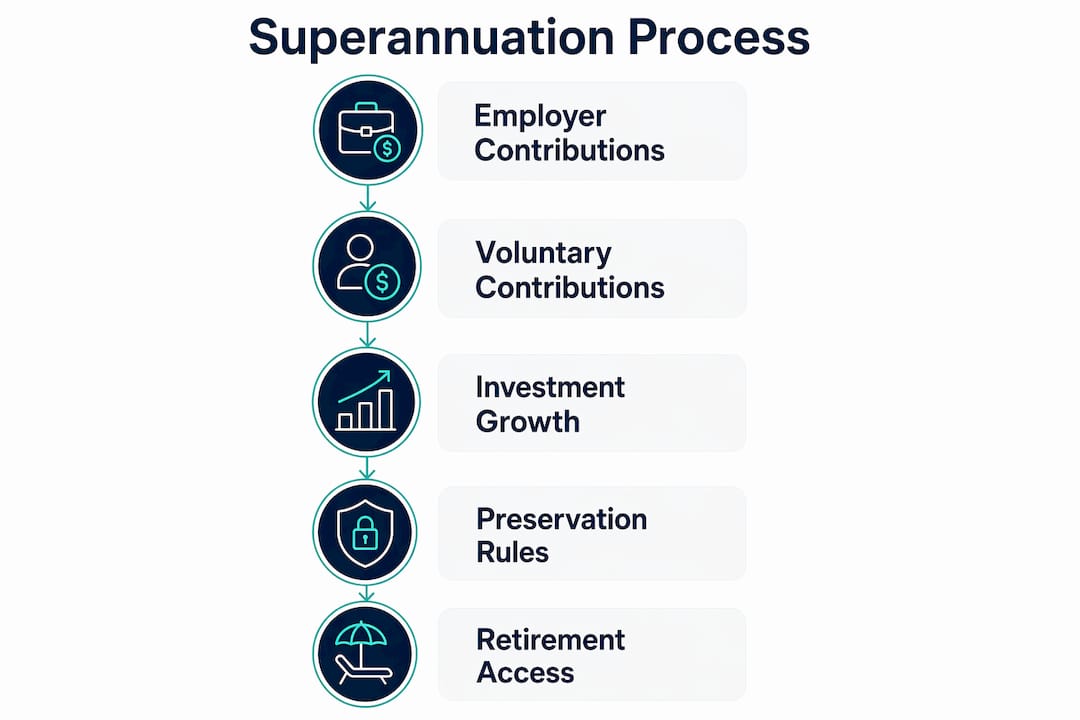
Employer contributions
Your employer pays the SG directly into your nominated super fund. The rate reached 12% of ordinary time earnings from 1 july 2025, and this excludes overtime payments. That means if you earn $80,000 per year in ordinary time, your employer contributes $9,600 annually to your super fund.
Voluntary contributions
You can add to your super in two main ways:
- Salary sacrifice: You direct pre-tax salary into super. These contributions are taxed at 15% inside the fund rather than at your marginal rate, which can be as high as 47%. The difference is real money compounding over decades.
- After-tax contributions: You contribute from your take-home pay. These are called non-concessional contributions and are not taxed again inside the fund.
- Government co-contributions: Low to middle income earners who make after-tax contributions may qualify for a government co-contribution, adding further to their balance.
- Spouse contributions: You can contribute to a spouse's super account and may receive a tax offset.
Once contributions land in your fund, the fund invests them across asset classes such as shares, property, bonds, and cash. Most funds offer a default "balanced" option, but you can choose your own investment mix. Compounding growth inside super is especially powerful for younger workers, because decades of reinvested returns multiply the effect of every dollar contributed.
Pro Tip: Review your super fund's investment option at least once a year. A growth option suits most people under 50, while a more conservative mix may suit those within five years of retirement.
What are the tax benefits of superannuation?
Super's tax treatment is one of the most generous structures available to ordinary Australians. Understanding it clearly helps you use the system to your full advantage.
The core tax benefits work across three stages:
- Contributions: Concessional contributions (employer SG and salary sacrifice) are taxed at 15% inside the fund. Compare that to a marginal tax rate of 32.5% for incomes between $45,001 and $120,000, or 47% at the top. The saving is substantial.
- Earnings: Investment earnings inside your super fund are also taxed at 15% during the accumulation phase. This is far lower than the tax you would pay on equivalent earnings in a personal investment account.
- Withdrawals: Once you reach age 60 and retire, withdrawals from a taxed super fund are completely tax-free. This includes both lump sums and regular pension payments from an account-based pension.
Preservation age and access rules
You cannot access super whenever you choose. Preservation age ranges from 55 to 60 depending on your birth year, and you must also satisfy a condition of release, such as retiring or reaching age 65. At age 65, you can access super regardless of whether you have retired. Early access outside these rules is restricted to specific circumstances including severe financial hardship or terminal illness. Many Australians incorrectly assume they can access super before preservation age without consequence. That assumption can lead to unexpected penalties or forced delays in retirement plans.
Pro Tip: Use salary sacrifice to direct extra pre-tax income into super while you are in a higher tax bracket. The tax saving on salary sacrifice compounds over time and can add tens of thousands to your final balance.
Common mistakes Australians make with their super
Most Australians spend more time choosing a mobile phone plan than reviewing their super fund. That inattention costs real money over a working life.
The most damaging mistakes include:
- Assuming the default is best: Default investment options are not necessarily the cheapest or highest-performing. Fees compound over decades, and small percentage differences in annual fees can materially reduce your final balance over a 30–40 year career.
- Ignoring insurance premiums: Super funds automatically enrol members in life, total and permanent disability, and income protection insurance. 57% of Millennials surveyed were unaware of this default enrolment past age 25. Those premiums reduce your balance every year, whether you need the cover or not.
- Not nominating a beneficiary: Without a binding death benefit nomination, the fund trustee decides who receives your super when you die. That decision may not reflect your wishes or your family's needs.
- Reacting emotionally to market falls: Financial planners consistently caution against switching investment options during market downturns. Locking in losses and missing the recovery is one of the most reliable ways to damage long-term returns.
- Leaving multiple accounts open: Each account charges fees. Consolidating multiple super accounts into one reduces costs and simplifies management.
Only 51% of Gen Z workers have engaged with their super at all. Low engagement early in a career compounds into significant shortfalls by retirement.
Pro Tip: Log into your super account every six months. Check your balance, confirm your investment option still suits your age and risk tolerance, and verify your beneficiary nomination is current.
How does super fit into your broader retirement plan?
Super is the cornerstone of retirement income for most Australians, but it works best as part of a wider plan rather than a standalone solution. Relying solely on the age pension is often insufficient for a comfortable retirement. The full age pension currently provides a modest income that covers basic living costs but leaves little room for travel, healthcare, or lifestyle spending.
At retirement, your super gives you several income options. The table below compares the three main structures:
| Retirement income option | How it works | Key advantage |
|---|---|---|
| Account-based pension | Draw a regular income from your super balance | Tax-free income after age 60; balance remains invested |
| Lump sum withdrawal | Take all or part of your super as a single payment | Flexibility; tax-free after age 60 |
| Annuity | Exchange a lump sum for guaranteed regular payments | Certainty of income regardless of market performance |
Most retirees combine an account-based pension with partial lump sum withdrawals, adjusting their drawdown rate as their needs change. Setting a retirement income target before you reach retirement gives you a concrete number to work towards and helps you identify gaps early enough to close them.
Super also interacts with the age pension through means testing. A higher super balance reduces your age pension entitlement, so tax-effective withdrawal strategies become important in the years leading up to and during retirement. Working backwards from what you want to spend in retirement is the most practical way to set your super savings target.
Pro Tip: Start modelling your retirement income at least ten years before you plan to stop working. The earlier you identify a shortfall, the more options you have to address it through additional contributions or adjusted spending plans.
Key takeaways
Superannuation is Australia's most tax-effective savings vehicle, and consistent engagement throughout your working life is the single biggest factor in building a comfortable retirement balance.
| Point | Details |
|---|---|
| Employer SG rate | Employers must contribute 12% of ordinary time earnings to your super fund from 1 july 2025. |
| Tax advantage | Contributions and earnings inside super are taxed at 15%, compared to marginal rates up to 47%. |
| Access rules | You can access super from preservation age (55–60 depending on birth year) after satisfying a condition of release. |
| Common mistakes | Ignoring fees, insurance premiums, and beneficiary nominations costs Australians significantly over time. |
| Retirement income options | Account-based pensions, lump sums, and annuities each offer different benefits; most retirees combine them. |
Why I think most Australians are leaving money on the table
After years of watching people engage with their finances, the pattern with super is consistent. Younger workers treat it as invisible money, and older workers suddenly panic when retirement is five years away. Both responses are costly.
The engagement gap is not a knowledge problem. Most people understand super exists. The problem is that super feels abstract until it becomes urgent. By then, the compounding years are gone.
The single most underrated move is reviewing your investment option in your 30s and 40s. A default balanced fund is not wrong, but it is rarely optimal. Fee differences that look trivial on paper, say 0.3% versus 0.7% annually, translate into meaningful dollar differences over 30 years. That is not a rounding error. That is a holiday, a car, or a year of retirement income.
The other thing I see consistently undervalued is the role of superannuation as a tax shelter for investment growth. Australians who understand this use salary sacrifice deliberately, not just as a default. They treat super as an active part of their wealth plan, not a passive deduction on their payslip.
My honest view: the Australians who retire comfortably are not necessarily the highest earners. They are the ones who checked their super regularly, kept fees low, and made a few deliberate decisions at the right times.
— Jonathan
Model your super with Alphaiq
Knowing the rules of superannuation is the first step. Seeing how those rules apply to your specific numbers is where real planning begins.

Alphaiq's super projection calculator lets you model your retirement balance based on your current super, contribution rate, investment option, and expected retirement age. You can run scenarios, adjust salary sacrifice amounts, and see the impact of fees on your final balance, all without paying for ongoing financial advice. The Alphaiq wealth platform connects your super projections with your broader financial position, including property, investments, and tax, so you can plan with complete clarity.
FAQ
What is the superannuation guarantee rate in 2025–26?
The Superannuation Guarantee rate is 12% of ordinary time earnings, effective from 1 july 2025. This rate excludes overtime payments.
When can I access my superannuation?
You can access super from your preservation age, which ranges from 55 to 60 depending on your birth year, provided you satisfy a condition of release such as retiring. At age 65, you can access super regardless of employment status.
Are superannuation withdrawals taxed?
Withdrawals from a taxed super fund are tax-free once you are aged 60 or over and have retired. Before age 60, withdrawals may be subject to tax depending on the components of your balance.
What happens to my super if I die without nominating a beneficiary?
Without a binding death benefit nomination, the fund trustee decides who receives your super. This may not align with your wishes, making a valid nomination one of the most important steps in managing your super.
How do fees affect my superannuation balance?
Small differences in annual fees compound significantly over a 30–40 year career. Choosing a fund with lower fees, while maintaining suitable investment performance, can materially increase your final retirement balance.