
TL;DR:
- An income stream refers to recurring payments from sources like superannuation, employment, or investments, which are taxed differently in Australia. Building diverse income streams, including super, active, passive, and investment income, helps ensure financial resilience and tax efficiency in retirement planning. Proper reporting and understanding tax rules, especially for capital gains and crypto assets, are essential for maximizing net income and avoiding compliance issues.
An income stream is a series of regular, recurring payments received from a specific source over time. In Australian financial and tax law, the term carries a precise meaning: the ATO defines income streams as at least annual payments from a super fund after a member meets a condition of release. Beyond superannuation, the concept covers salary, rental income, dividends, interest, and capital gains. For Australians aged 30–60 building wealth, understanding what is an income stream and how each type is taxed is the foundation of every sound financial plan.
What are the main types of income streams in Australia?
Income streams fall into four broad categories: superannuation, active, passive, and investment income. Each category behaves differently under Australian tax law, and combining them is the most reliable way to build financial resilience.
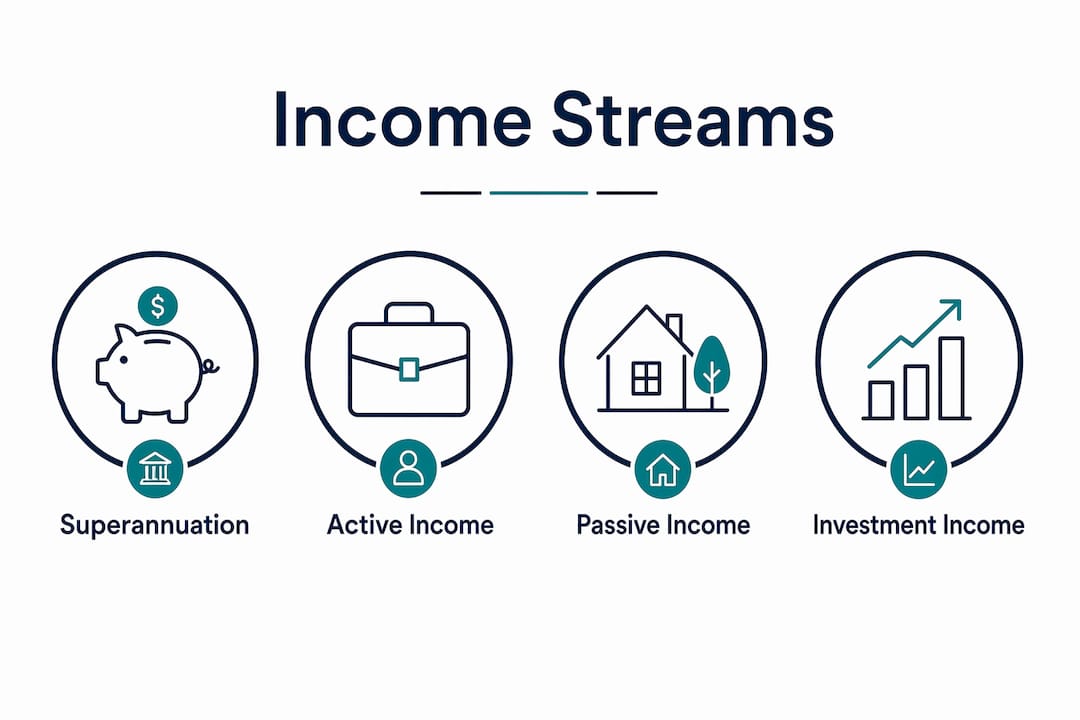
Superannuation income streams
Superannuation income streams are payments from your super fund once you meet a condition of release, such as reaching preservation age or retiring. The three main forms are:
- Account-based pensions: Drawdowns from your super balance, with a minimum annual percentage set by the ATO.
- Transition to retirement income streams (TRIS): Available from preservation age while you are still working, allowing you to supplement your salary with super payments.
- Lifetime income streams: Guaranteed payments for life, purchased with a lump sum from super or savings, designed to address longevity risk.
Understanding superannuation's role in retirement is critical before choosing which income stream structure suits your circumstances.
Active income
Active income is money you earn by working. Salary, wages, and business profits all qualify. This is the income most Australians rely on during their working years, and it is taxed at your marginal rate with no discounts applied.

Passive and investment income
Passive income arrives without ongoing work. Rental income, dividends, interest, and royalties are the most common examples. Investment income overlaps with passive income but also includes capital gains from selling shares or property. Each type carries its own tax treatment, which the next section covers in detail.
Pro Tip: Diversifying across at least three income categories, for example salary, dividends, and rental income, reduces your exposure if any single source is disrupted.
How does investment income generate income streams?
Investment income is the most tax-nuanced category of income sources. Getting the reporting right protects your returns and keeps you on the right side of the ATO.
Interest and dividends
Interest earned on savings accounts or bonds is added to your assessable income and taxed at your marginal rate. Dividend income works differently. Dividends are grossed up with franking credits attached, which represent tax already paid at the company level. If your marginal rate is at or below the corporate tax rate, those franking credits reduce your tax bill, sometimes to zero.
Rental income
Rental income is assessable in the year you receive it. You can deduct eligible expenses such as interest on the investment loan, property management fees, and depreciation. The net figure is added to your other income and taxed at your marginal rate.
Capital gains
Capital gains arise when you sell an asset for more than you paid. Assets held over 12 months qualify for a 50% CGT discount, meaning only half the gain is added to your taxable income. This discount is one of the most valuable concessions available to Australian investors.
A critical compliance point: the ATO pre-fills interest and dividend data in your tax return, but capital gains are not pre-filled. You must calculate them manually using your cost base records and sale proceeds. Errors here are a common audit trigger.
| Investment income type | Tax treatment | Key concession |
|---|---|---|
| Interest | Marginal rate | None |
| Dividends | Marginal rate, grossed up | Franking credits offset tax |
| Rental income | Marginal rate | Deductible expenses reduce net income |
| Capital gains (assets held over 12 months) | Marginal rate on 50% of gain | 50% CGT discount |
| Crypto staking rewards | Marginal rate at receipt | None; every disposal triggers CGT |
Crypto adds another layer of complexity. The ATO treats crypto as property, not currency. Staking rewards must be declared as income at market value when received, and every crypto-to-crypto swap triggers a CGT event. Detailed records of every transaction are not optional.
Pro Tip: Use Alphaiq's CGT calculator to model the tax impact of selling an asset before you execute the trade. Knowing your after-tax gain in advance changes the decision entirely.
What are lifetime income streams and their role in retirement planning?
Lifetime income streams are a specific financial product designed to pay you a guaranteed income for as long as you live. Moneysmart describes them as typically purchased with a lump sum from super or personal savings, with payments continuing regardless of how long you live.
The core benefit is certainty. A retiree who lives to 95 receives the same income as one who lives to 75, removing the risk of outliving your savings. Many products also include:
- Reversionary beneficiary provisions: Payments continue to a surviving spouse after your death.
- Guaranteed periods: If you die early, payments continue to your estate for a set period, protecting against the worst-case scenario.
- Indexed payments: Some products increase payments annually in line with inflation.
The main drawback is capital access. Once you purchase a lifetime income stream, you generally cannot withdraw the lump sum. This makes them unsuitable as your only retirement asset. The most practical approach is to pair a lifetime income stream with an account-based pension, giving you guaranteed income plus flexible access to capital for larger expenses.
Learning how to generate tax-free retirement income alongside a lifetime product can significantly improve your after-tax position in retirement.
What practical strategies can you use to create income streams?
Building multiple income sources is not about complexity for its own sake. It is about making sure a single disruption, such as losing a job or a property sitting vacant, does not derail your financial position.
-
Start with your super. Understand your projected account-based pension balance at retirement. Use a projection tool to see what annual income your super will generate at different drawdown rates. This is your baseline.
-
Add a dividend income stream. Investing in Australian shares through a diversified portfolio generates franked dividends. These are tax-efficient, particularly for investors whose marginal rate is close to the 30% corporate rate.
-
Consider property for rental income. Residential or commercial property generates regular rental income. Factor in vacancy risk, maintenance costs, and the impact of negative gearing on your tax position before committing.
-
Reinvest capital gains strategically. Rather than spending capital gains, reinvesting them into income-producing assets compounds your income over time. The 50% CGT discount makes this especially powerful for assets held long term.
-
Monitor passive income if you run a company. If your business operates through a company structure, the passive income test is a cliff edge. If passive income exceeds 80% of your assessable income, your company loses access to the 25% base rate entity tax and pays 30% instead. A single large dividend or rental income event can push you over the threshold.
Pro Tip: Tax-aware investing means choosing assets not just for their gross return but for their after-tax yield. Franked dividends and the CGT discount are two of the most powerful tools available to Australian investors. Read more on tax-aware investing to see how they interact.
How does Australian tax law affect income streams?
Tax law shapes how much of each income stream you actually keep. Getting the basics right is not optional.
Ordinary income versus statutory income
Tax professionals distinguish between ordinary income, which flows from everyday transactions like salary and rent, and statutory income, which includes capital gains and certain other amounts brought into the tax net by specific legislation. The distinction matters because different rules, timing, and concessions apply to each.
Company tax rates and the passive income test
Australian companies with turnover under $50 million and less than 80% passive income pay tax at 25%. All other companies pay 30%. Passive income for this purpose includes rent, dividends, interest, and net capital gains. Small business owners who hold investment portfolios inside their company structure must track this ratio carefully. Misapplying the rate affects both the tax payable and the franking credits attached to any dividends the company pays out.
ATO compliance and reporting
The ATO uses data-matching to verify interest and dividend income. Undeclared overseas income and joint account income are actively scrutinised. Capital gains, however, require your own calculation and proof. Keeping records of purchase price, acquisition costs, and sale proceeds for every asset is the minimum standard. For crypto, records must capture the market value in Australian dollars at the time of every transaction.
Key takeaways
Diversifying across superannuation, investment, and passive income streams is the most reliable way to build financial security in Australia.
| Point | Details |
|---|---|
| Income stream definition | Regular payments from super, investments, or employment, each taxed differently under Australian law. |
| CGT discount value | Assets held over 12 months attract a 50% CGT discount, halving the taxable gain. |
| Lifetime income streams | Guarantee income for life but remove lump sum access, so pair them with flexible assets. |
| Passive income test risk | Companies with over 80% passive income lose the 25% tax rate and pay 30% instead. |
| Capital gains compliance | The ATO does not pre-fill capital gains; you must calculate and report them manually with full records. |
Why income streams matter more than most people realise
I have spent years working through the financial plans of Australians in their 40s and 50s who assumed their salary was enough. It rarely is, and the reason is not income level. It is concentration risk.
The most financially secure people I have seen are not necessarily the highest earners. They are the ones who built a second and third income source early, often through dividend-paying shares or an investment property, and let those compound quietly alongside their super. By the time they reached their late 50s, their super was not their only plan. It was one of several.
The tax dimension is where most people leave money on the table. Franking credits, the CGT discount, and the difference between ordinary and statutory income are not obscure concepts. They are the rules of the game. Knowing them changes which assets you buy, when you sell, and how you structure your affairs. Ignoring them means paying more tax than the law requires.
Lifetime income streams are underused by people who fear losing access to capital. That fear is legitimate, but it should not be a reason to avoid the product entirely. A modest allocation to a lifetime product alongside a flexible account-based pension gives you the best of both: certainty and access. The combination is more powerful than either product alone.
If you are between 35 and 60 and have not yet mapped out what your income will look like in retirement from every source, that is the most useful thing you can do this year.
— Jonathan
Plan your super income stream with Alphaiq
Knowing what income streams exist is one thing. Seeing exactly what your superannuation will generate in retirement, year by year, is another.

Alphaiq's superannuation calculator lets you model your projected super balance and annual income at retirement, adjusting for contributions, investment returns, and drawdown rates. You can test different scenarios, such as retiring at 60 versus 65, or increasing your voluntary contributions now, and see the dollar impact immediately. For self-directed investors who want clarity without paying for ongoing advice, it is a practical starting point for planning retirement income with real numbers.
FAQ
What is an income stream in superannuation?
An income stream in superannuation is a series of at least annual payments from a super fund after you meet a condition of release, such as retirement or reaching preservation age. Common forms include account-based pensions, transition to retirement income streams, and lifetime income streams.
What are the main types of passive income streams in Australia?
Passive income streams in Australia include rental income from property, dividends from shares, interest from savings accounts or bonds, and royalties from intellectual property. Each is taxed at your marginal rate, though dividends carry franking credits that can reduce your tax liability.
How are capital gains taxed as an income stream?
Capital gains are not a recurring income stream in the traditional sense, but they are assessable income in the year you sell an asset. Assets held for more than 12 months attract a 50% CGT discount, meaning only half the gain is added to your taxable income.
What is the passive income test for Australian companies?
The passive income test determines whether a company qualifies for the 25% base rate entity tax rate. If passive income, including rent, dividends, interest, and capital gains, exceeds 80% of assessable income, the company pays 30% tax instead.
Do I need to declare crypto income as part of my income streams?
Yes. The ATO treats crypto as property, so staking rewards must be declared as income at market value when received. Every crypto-to-crypto transaction also triggers a CGT event, requiring detailed records of the Australian dollar value at the time of each transaction.