
TL;DR:
- Regular superannuation reviews are essential to protect and enhance your retirement savings as personal circumstances and laws change.
- Failing to review can lead to multiple fees, outdated investment choices, and insufficient insurance, costing tens of thousands at retirement.
Reviewing your superannuation regularly is the most effective way to protect and grow your retirement savings. Super is not a set-and-forget asset. Your life changes, markets shift, and legislation evolves, each of which can quietly erode your balance if left unchecked. The ATO recommends an annual super health check to avoid lost accounts, missed contributions, and unnecessary fees. For Australians aged 35–65, understanding why review superannuation matters is the first step toward a retirement you can actually afford.
Why reviewing superannuation is critical for your retirement
Superannuation is typically the largest financial asset most Australians will ever accumulate outside of property. Yet the majority of people spend more time reviewing their phone plan than their super. The consequence is real and measurable: fees compound, insurance becomes mismatched, and investment allocations drift away from your actual goals.
The importance of superannuation review comes down to one core truth: super is dynamic. Personal circumstances, financial markets, and laws change frequently, and your super strategy must keep pace. A review done once at age 35 and ignored until 60 is not a strategy. It is a gamble.

Three areas demand attention every year. First, fees and costs, which silently reduce your balance over decades. Second, investment allocation, which must reflect your current risk tolerance, not the one you had when you first opened the account. Third, insurance cover, which should match your actual debt levels and family responsibilities today, not five years ago.
What happens if you don't review your super regularly?
Neglecting your super creates a cascade of avoidable problems. Each one is manageable on its own, but together they can cost you tens of thousands of dollars by retirement.
- Multiple fees on multiple accounts. Holding two or more super accounts means paying two sets of administration fees, insurance premiums, and investment costs. These fees compound over time, and the damage is far greater than most people realise.
- Outdated investment choices. The investment option you selected at 30 may be far too aggressive or far too conservative at 50. Neither extreme serves your retirement well.
- Irrelevant or insufficient insurance. Insurance inside super is not automatically adjusted as your life changes. A single person with no dependants may be paying for death cover they do not need, while a parent with a mortgage may be dangerously underinsured.
- Missed legislative opportunities. Contribution caps, tax thresholds, and super rules change. An outdated approach means you may be leaving legal tax advantages on the table.
Pro Tip: Set a calendar reminder each july to review your super. Aligning your review with the start of the financial year means you can act on any legislative changes immediately.
Behavioural finance research from Morningstar's Mind the Gap studies shows that investors lose returns over a decade due to poor timing decisions driven by emotion. A regular review habit replaces reactive decisions with deliberate ones.
How does consolidating super accounts improve your retirement balance?
About 4 million Australians hold two or more super accounts, often without realising it. This typically happens when people change jobs and a new employer opens a default fund rather than contributing to an existing account. The result is duplicate fees and fragmented management.
Consolidation is one of the highest-impact steps you can take, but it requires care. The process is straightforward, but the decision is not always simple.
- Locate all your accounts. Use the ATO's online services through myGov to find every super account linked to your tax file number.
- Compare fees and investment options. The account with the largest balance is not automatically the best one to keep. A smaller account with lower fees and better investment choices may be the right home for your money.
- Check insurance cover before transferring. Closing an account cancels any insurance attached to it. If one account holds valuable life, total and permanent disability, or income protection cover, you need a plan before you consolidate.
- Review exit fees. Some older funds charge exit fees when you transfer out. Factor these into your decision.
- Complete the rollover through myGov or your chosen fund. The process is free and typically takes a few days.
Consolidation decisions should balance fee savings with insurance preservation and pension arrangements. There is no universal right answer, which is why comparing the full picture matters more than simply merging accounts.
| Factor | What to check |
|---|---|
| Administration fees | Annual dollar fee plus percentage-based fee |
| Investment options | Range, performance history, and asset allocation |
| Insurance cover | Type, amount, and cost of existing cover |
| Exit fees | Any charges for transferring out |
| Fund performance | Returns over 5 and 10 years against benchmarks |
How do life changes affect your super investment strategy?
Your super investment strategy should reflect who you are today, not who you were when you first joined the workforce. Risk tolerance and investment needs evolve with age, income, family structure, and health, and your super allocation must keep pace.
Major life events that signal a need for review include:
- A career change or significant income shift that affects your contribution capacity
- Marriage, separation, or the arrival of children, each of which changes your financial obligations
- A health diagnosis that affects your insurance needs or your timeline to retirement
- Paying off a mortgage, which reduces your debt exposure and may allow greater risk in your investment mix
- Approaching your preservation age, which is the age at which you can begin accessing your super
Pro Tip: If you are within 10 years of retirement, consider whether your current investment option still matches your timeline. Moving from a high-growth option to a balanced or conservative option too late, or too early, can both cost you significantly.
Small adjustments made consistently compound into large differences at retirement. Reviewing your super investment options every year and adjusting after major life events keeps your strategy aligned with your actual goals. Ignoring this alignment is how people arrive at retirement with a balance that does not match their expectations.
One detail that catches many people off guard: two funds can both call their option "Balanced" while holding very different asset mixes. Fund comparisons must go beyond labels and examine the actual underlying allocation between growth and defensive assets.
What 2026 legislative changes make a super review essential?
From 1 july 2026, new legislation increases contribution caps and raises the Total Superannuation Balance threshold to $2.1 million. These changes create real opportunities for Australians aged 35–65 to accelerate their super growth and reduce their tax burden, but only if they act on them.
The increased concessional contribution cap means you can now direct more pre-tax income into super through salary sacrifice, reducing your taxable income while boosting your retirement balance. The higher non-concessional cap allows greater after-tax contributions for those who have surplus savings outside super. The raised Total Superannuation Balance threshold of $2.1 million determines eligibility for certain contribution strategies, including the bring-forward rule for non-concessional contributions.
| Contribution type | What changed from july 2026 | Why it matters |
|---|---|---|
| Concessional (pre-tax) | Cap increased | More salary sacrifice capacity, lower taxable income |
| Non-concessional (after-tax) | Cap increased | Greater ability to move savings into the tax-advantaged super environment |
| Total Super Balance threshold | Raised to $2.1 million | Affects eligibility for bring-forward rule and government co-contribution |
Regulatory changes in 2026 heighten the importance of reviewing contribution strategies to take advantage of increased caps and minimise tax leakage. Effective super reviews now need to integrate super alongside personal investments, debts, and estate planning as interconnected components rather than in isolation. Use Alphaiq's salary sacrifice calculator to model how the new caps affect your specific situation.
How to review your superannuation: practical steps
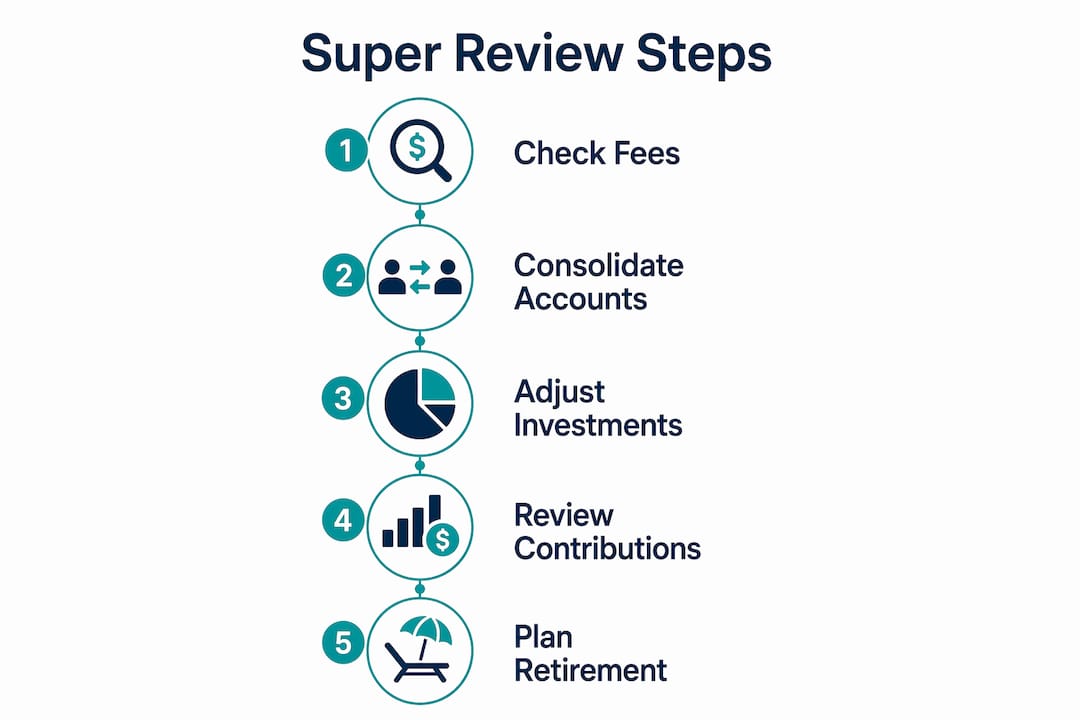
A thorough super review covers five areas. Working through each one annually gives you a complete picture of where you stand and what needs to change.
- Find all your accounts. Log into myGov and check the ATO's super section. Any account linked to your tax file number will appear there, including accounts you may have forgotten.
- Assess fees against performance. Long-term performance matters more than short-term results. Compare your fund's returns over 5 and 10 years against relevant benchmarks, not just last year's figures. AustralianSuper's Balanced option, for example, returned 7.9% per annum over 5 years and 9.04% per annum over 10 years, which gives a useful reference point for comparison.
- Review your asset allocation. Check whether your current investment option still matches your risk tolerance and time horizon. If you have never changed your option, you are likely still in the fund's default, which may not be right for you now.
- Check your insurance cover. Insurance cover inside super can be adjusted and should reflect your current debt levels and family responsibilities. Cover limits can reach up to $5 million for total and permanent disability and $10 million for death cover, so there is room to tailor your protection.
- Model your retirement projection. Use a reliable calculator to see whether your current balance and contribution rate will produce the retirement income you want. If the numbers do not add up, you have time to adjust.
Pro Tip: When reviewing performance, always compare your fund against its stated benchmark and against similar options in other funds. A fund that returns 6% in a year where the benchmark returned 8% is underperforming, even if 6% sounds acceptable in isolation.
For a broader view of how super fits into your overall retirement plan, the guide on planning retirement income in Australia covers the five key steps in detail.
Key takeaways
Reviewing your superannuation annually is the single most effective habit for protecting your retirement balance against fees, legislative changes, and misaligned investment risk.
| Point | Details |
|---|---|
| Annual review is non-negotiable | The ATO recommends a yearly super health check to catch lost accounts and reduce unnecessary fees. |
| Consolidation requires care | Merging accounts saves fees but can cancel insurance cover, so compare the full picture before transferring. |
| Life events trigger strategy changes | Career shifts, family changes, and approaching retirement all require an investment allocation review. |
| 2026 caps create new opportunities | Increased contribution caps and the $2.1 million Total Super Balance threshold open new tax-saving strategies. |
| Performance needs context | Assess fund returns over 5–10 years against benchmarks, not short-term figures, to judge suitability accurately. |
The habit that separates confident retirees from anxious ones
Most people I speak with who feel uncertain about their retirement have one thing in common: they have not looked at their super in years. They know it exists, they know contributions are going in, and they assume it is fine. That assumption is expensive.
Super is not a passive savings account. It is an investment portfolio with fees, insurance, tax implications, and legislative rules that change regularly. Treating it as passive means you are effectively letting someone else make all the decisions, including decisions about your money that may not suit your life at all.
The people I see arrive at retirement with confidence are not necessarily the ones who earned the most. They are the ones who reviewed their super consistently, made small adjustments when their circumstances changed, and used the available tools to model their outcomes before they needed the money. They did not react to market noise. They had a plan, and they checked it regularly.
Building a review habit does not require a financial adviser for every step. It requires setting aside an hour each year, knowing what to look for, and being willing to act on what you find. The role of superannuation in retirement planning is too significant to leave to chance. Start the habit now, and your future self will have far fewer surprises to manage.
— Jonathan
See your super numbers clearly with Alphaiq
Knowing you should review your super and knowing what the numbers actually mean are two different things. Alphaiq gives you the tools to close that gap.

The Alphaiq Super Calculator models your projected retirement balance based on your current super, contributions, investment option, and timeline. You can test different scenarios, including the impact of the new 2026 contribution caps, to see exactly how each decision affects your outcome. The Alphaiq platform also covers salary sacrifice modelling, investment option analysis, and retirement income planning, all in one place, without the cost of ongoing advice. If you want to know where you actually stand, the numbers are waiting for you.
FAQ
How often should I review my superannuation?
The ATO recommends reviewing your super at least once a year. A review after any major life event, such as a job change, marriage, or health shift, is also advisable.
Is it worth consolidating multiple super accounts?
Consolidating super accounts reduces duplicate fees and simplifies management, but you must check for insurance implications before closing any account. The account with the largest balance is not always the best one to keep.
What should I look for when reviewing my super fund's performance?
Compare your fund's returns over 5 and 10 years against its stated benchmark and against similar options in other funds. Short-term returns are a poor indicator of long-term suitability.
How do the 2026 super changes affect my contributions?
From 1 july 2026, both concessional and non-concessional contribution caps have increased, and the Total Superannuation Balance threshold has risen to $2.1 million. These changes allow eligible Australians to contribute more to super and reduce their tax burden.
Can I review my super without a financial adviser?
Yes. You can locate all your accounts through myGov, compare fees and performance using publicly available data, and model your retirement projections using tools like the Alphaiq Super Calculator. For complex situations involving insurance or estate planning, professional advice adds value.