
TL;DR:
- Clinging to the traditional 60/40 portfolio may no longer be suitable for modern Australian retirees living 25 to 30 years beyond their preservation age. Increasing allocation to growth assets like shares and property can better combat inflation, enhance long-term returns, and reduce the risk of outliving savings. Regularly reviewing and adjusting your asset mix based on your personal circumstances and time horizon is essential for maintaining financial resilience.
The classic 60/40 portfolio split has guided Australian investors for decades, but clinging to this model in 2026 may actually be working against you. Some experts now argue that the traditional 60% growth and 40% defensive split is too conservative for modern retirements, where Australians routinely live 25 to 30 years beyond their preservation age. If your portfolio isn't generating real returns above inflation, you risk eroding your purchasing power at precisely the time you need it most. This guide will walk you through what growth assets are, why they matter more than ever, and how to find the right blend for your personal circumstances.
Table of Contents
- What are growth assets, and why do they matter?
- How growth assets shape your long-term wealth
- Pros and cons: Should you prioritise growth assets?
- Finding your ideal blend: Growth assets in your portfolio
- Our take: Why the old 60/40 rule is no longer enough
- Explore smarter ways to manage your growth portfolio
- Frequently asked questions
Key Takeaways
| Point | Details |
|---|---|
| Growth assets explained | Shares and property offer higher long-term returns but require a higher risk tolerance. |
| Why higher allocations matter | A larger growth portion is often necessary to outlive inflation and fund longer retirements. |
| Weigh risks and rewards | Investors should balance potential upside with the reality of short-term market swings. |
| Personalisation is vital | Your ideal mix depends on personal goals, time frame, and comfort with volatility. |
| Regular reviews required | Update your portfolio as your circumstances or market outlook changes to stay on track. |
What are growth assets, and why do they matter?
Growth assets are investments that primarily aim to increase in value over time, rather than simply generating regular income. The most common examples include Australian and international shares, residential and commercial property, infrastructure assets, and certain alternatives like private equity. These contrast with defensive assets such as cash, term deposits, and fixed interest bonds, which prioritise capital stability and predictable income over capital appreciation.
The distinction matters because investment returns from growth and defensive assets behave very differently across market cycles. Defensive assets preserve what you have. Growth assets build on what you have. Over short periods, defensive assets can feel safer because they don't swing in value the same way shares or property do. Over the long run, however, the maths tells a very different story.
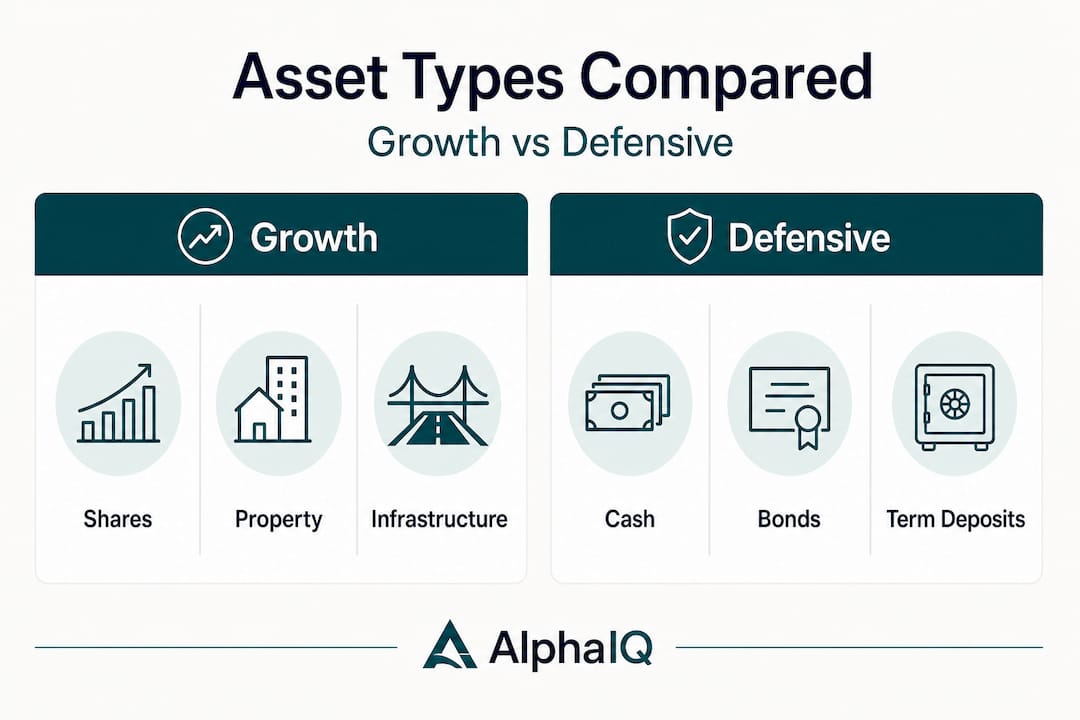
Growth assets include shares and property, seeking higher returns alongside higher risk. This trade-off is fundamental to understanding why so many self-directed investors hesitate to increase their growth exposure. The volatility is real and visible. A 15% market correction feels confronting. But the opportunity cost of avoiding that volatility, particularly over a 20 or 30-year retirement, can be far more damaging to your financial security than any short-term market dip.
Here's why Australian investors cannot afford to ignore growth assets:
- Inflation erodes cash and bonds over time. With inflation averaging around 3% annually, defensive assets often deliver negligible real returns after tax.
- Longevity is increasing. An Australian aged 60 today has a reasonable probability of living to 90 or beyond, meaning their money needs to last 30 years or more.
- Superannuation drawdown rates matter. A portfolio that earns 3% per year will deplete far faster under a 5% annual drawdown than one earning 7%.
- Compounding requires time and growth. The longer your investment horizon, the more powerfully growth assets can compound in your favour.
Understanding your asset allocation is the foundational step. Most investors know they should diversify, but fewer realise that under-exposure to growth assets is itself a form of risk.
Pro Tip: Investors who avoid growth assets entirely often miss decades of compounding. Even a modest 10% shift toward shares or property in your 50s can produce materially different retirement outcomes by your 70s.
How growth assets shape your long-term wealth
The compounding effect of growth assets over extended periods is difficult to overstate. Consider a straightforward comparison. An investor who places $500,000 in defensive assets earning an average of 3% per year will have approximately $604,000 after 10 years, $728,000 after 20 years, and $876,000 after 30 years. An investor who places the same amount in a growth-oriented portfolio averaging 7% per year will have $983,000 after 10 years, over $1.93 million after 20 years, and more than $3.8 million after 30 years. The gap is staggering.
| Time horizon | Defensive portfolio (3% p.a.) | Growth portfolio (7% p.a.) |
|---|---|---|
| 10 years | $604,000 | $983,000 |
| 20 years | $728,000 | $1,930,000 |
| 30 years | $876,000 | $3,806,000 |
Starting capital: $500,000. Returns are illustrative and do not account for taxes or fees.
These figures illustrate why pre-retiree investment options increasingly favour higher growth exposures. The historical performance of Australian equities has supported an average annual return of approximately 9 to 10% over the long run, including dividends and franking credits. This is significantly above the long-term inflation rate, making shares one of the most powerful tools for protecting purchasing power in retirement.

Longevity risk is the term used to describe the risk of outliving your money. It is one of the most underappreciated financial risks facing Australians today. A person who retires at 65 and draws down on an overly conservative portfolio may find their funds depleted by their mid-80s, precisely when medical and aged care expenses tend to rise.
A higher allocation to growth assets of 70% or more is often needed to outpace inflation and sustain income over longer retirements. The practical impacts of embracing growth assets include:
- Greater ability to maintain your lifestyle without reducing drawdowns in your later years.
- Higher capacity to fund aged care costs, which are rising faster than general inflation.
- More flexibility to leave a financial legacy for family members if that is part of your plan.
- Stronger alignment between your retirement income streams and the actual cost of living.
Key insight: Experts across Australia's financial sector are shifting the consensus from the traditional 60/40 split to portfolios where 70% or more sits in growth assets, particularly for investors who are still 10 or more years from their expected end of retirement.
Pros and cons: Should you prioritise growth assets?
Increasing your growth allocation is not a universal prescription. The right answer depends on your personal circumstances, your time horizon, your income needs, and your psychological relationship with market volatility. Here is a clear comparison to help you weigh your options.
| Factor | Growth-focused portfolio | Defensive-focused portfolio |
|---|---|---|
| Average long-term return | Higher (7-10% p.a.) | Lower (2-4% p.a.) |
| Short-term volatility | Higher, more noticeable fluctuations | Lower, more stable day-to-day |
| Inflation protection | Strong over long periods | Weak, often negative in real terms |
| Longevity risk | Lower if managed well | Higher, funds may deplete faster |
| Psychological comfort | Can be challenging during downturns | Easier to maintain emotionally |
| Income predictability | Variable, depends on dividends and distributions | More predictable fixed income |
To assess whether a growth tilt makes sense for you, work through these steps:
- Clarify your time horizon. How many years until you expect to fully retire? How many years do you expect your retirement to last? The longer both of these periods, the stronger the case for higher growth exposure.
- Calculate your income needs. Work out your expected annual spending in retirement. Then model whether a conservative portfolio can actually sustain that level of drawdown over 25 to 30 years.
- Assess your emotional tolerance. Can you stay the course through a 20% market correction without selling? Your honest answer to this question matters more than any spreadsheet.
- Review your current allocation. Many Australians are surprised to find their super fund has defaulted them into a balanced or conservative option that doesn't match their actual time horizon.
- Consider concentration risk carefully. A common pitfall is over-weighting a single growth asset class, such as residential property, while neglecting shares or international diversification. Explore portfolio concentration risk before making changes.
Some super funds are sticking to overly conservative models, but experts warn that retirees may outlive their money unless they embrace more growth. This is not a fringe view. It reflects a growing body of evidence that the old rules of thumb were designed for an era when retirements lasted 10 to 15 years, not 30.
Common fears about growth assets, such as market volatility, drawdown risk, and the discomfort of abandoning familiar habits, are real but manageable. The key is not to eliminate risk entirely but to manage it intelligently. Reviewing wealth management best practices for Australian investors can help you develop a framework that keeps you confident through inevitable market cycles.
Pro Tip: Time horizon is the single most powerful tool for managing the volatility of growth assets. The longer your runway, the more short-term fluctuations become irrelevant noise rather than genuine threats to your outcome.
Finding your ideal blend: Growth assets in your portfolio
Knowing the principles is one thing. Applying them to your actual portfolio requires a structured approach. Before you make any changes, ask yourself these questions:
- What is my actual investment time horizon, accounting for the full length of my expected retirement, not just until I stop working?
- Am I currently holding growth assets inside superannuation, outside super, or both, and do these align with my overall strategy?
- Is my current allocation the result of an active decision, or has it drifted due to market movements or a default fund setting?
- Do I have sufficient liquidity in defensive assets to cover two to three years of living expenses, so I'm not forced to sell growth assets during a downturn?
- Have I accounted for the tax implications of adjusting my allocation, particularly capital gains on assets held outside super?
Traditional splits are increasingly being challenged in favour of more dynamic, personalised mixes based on individual goals and time horizons. This is where self-directed investors have a genuine advantage. Rather than accepting a one-size-fits-all fund option, you can tailor your exposure based on your actual needs.
Here is a practical process for adjusting your portfolio responsibly:
- Document your current allocation. List every asset class you hold and its approximate percentage of your total wealth, including property, super, shares, and cash.
- Set a target allocation. Based on your time horizon and income needs, decide on a target percentage for growth versus defensive assets. For most pre-retirees in their 40s and 50s, this is likely to sit between 65% and 80% in growth.
- Identify the gaps. Compare your current position to your target. Note where you are under-exposed to growth and where you may be holding excess cash or defensive assets.
- Plan a transition strategy. Rather than shifting everything at once, consider gradually moving into growth assets over 12 to 24 months to reduce timing risk.
- Build in a review schedule. Commit to reviewing your allocation at least once a year and after any major life event such as an inheritance, property sale, or change in income.
Exploring rebalancing portfolio strategies for growth can help you understand the mechanics of moving between asset classes without creating unnecessary tax events. Looking at Australian strategy examples from investors in similar situations can also provide useful context for your own decisions. A well-structured, diversified portfolio across multiple asset classes remains your strongest defence against any single market shock.
Our take: Why the old 60/40 rule is no longer enough
Here is the honest reality. The 60/40 model was designed for a different era. It assumed retirements lasted a decade, not three. It was built around a world where bonds delivered meaningful real returns. Neither of those conditions holds true today. Experts now advocate shifting to greater growth asset exposures to meet future retirement needs, and we think this shift is not just sensible but essential for most Australian investors in the 35 to 65 age bracket.
What we observe consistently is that the greatest financial risk for modern retirees is not market volatility. It is the slow, quiet erosion of purchasing power that happens when a portfolio is too defensive for too long. A 5% market correction is visible and uncomfortable. A 3% annual shortfall in real returns over 20 years is invisible until it's too late.
"The investors who tend to reach retirement with the most financial flexibility are those who stayed committed to their growth allocation through several market cycles, not those who retreated to cash at the first sign of turbulence."
We also want to be clear that embracing growth assets does not mean ignoring risk. It means understanding which risks actually threaten your long-term outcome and which are simply short-term discomfort. Reviewing your modern asset allocation in light of your specific retirement timeline is not a one-time task. It is an ongoing practice.
Pro Tip: Treat portfolio review as a non-negotiable annual event, the same way you would review your insurance or update your will. The market changes. Your circumstances change. Your allocation should reflect both.
Explore smarter ways to manage your growth portfolio
Taking control of your growth asset strategy requires more than good intentions. It requires clear data, accurate modelling, and tools that reflect your actual financial position.

AlphaIQ is built for exactly this kind of work. Whether you want to model the impact of shifting your super to a higher growth option, assess the tax implications of selling a property to redeploy into shares, or simply understand where you stand today, the AlphaIQ platform brings it all together in one place. Use the superannuation calculator to project how different growth allocations affect your super balance at retirement, or explore the debt recycling calculator to see how leveraging growth assets more strategically could accelerate your wealth position. These are the kinds of precise, personalised insights that help you make confident decisions without the cost of ongoing financial advice.
Frequently asked questions
What exactly counts as a growth asset?
Growth assets include shares and property, seeking higher returns alongside higher risk, and typically also encompass infrastructure, real estate investment trusts, and private equity. These assets aim primarily for capital appreciation over time rather than stable income.
Why are experts recommending a higher growth allocation now?
Because Australians are living significantly longer, a higher allocation to growth of 70% or more is increasingly needed to outpace inflation and reduce the risk of depleting retirement savings before the end of life. Defensive assets simply cannot generate the real returns needed to sustain a 25 to 30-year retirement.
What risks come with prioritising growth assets?
Growth assets can be more volatile than defensive alternatives, meaning the value of your portfolio may fluctuate significantly in the short term. The key is maintaining a long enough time horizon and sufficient liquidity so you are never forced to sell during a downturn.
How often should I review my asset allocation?
It's wise to review your allocation at least annually, and immediately after any major life change such as a job loss, inheritance, property transaction, or significant shift in your retirement timeline. Your ideal growth allocation is not fixed. It should evolve as your circumstances do.