TL;DR:
- Regular rebalancing is essential for Australian investors to maintain their desired risk profile amidst market fluctuations. Ignoring this discipline exposes portfolios to sector concentration, reduced diversification, and misalignment with retirement goals, increasing long-term risks. Utilizing automated tools, tax-efficient strategies, and disciplined schedules helps investors stay on track and optimize wealth at retirement.
Your portfolio looked great when you built it. You had a clear target mix, a sensible spread across asset classes, and a plan that matched your risk tolerance. Then the market moved, as it always does, and that carefully constructed balance quietly shifted. Most self-directed Australian investors don't notice this drift until it's already working against them. Rebalancing is the discipline that brings your portfolio back into alignment, and for those approaching retirement, it's one of the most important habits you can build.
Table of Contents
- Why portfolio rebalancing matters for Australian investors
- When and how often should you rebalance?
- Step-by-step: How to rebalance your investment portfolio
- Common mistakes and how to avoid them
- How rebalancing fits Australian retirement goals
- Our perspective: What most self-directed investors miss about rebalancing
- Take the next step in optimising your investments
- Frequently asked questions
Key Takeaways
| Point | Details |
|---|---|
| Rebalancing prevents risk drift | Regularly adjusting your investments ensures your risk levels remain consistent with your goals. |
| Timing affects outcomes | Set a clear schedule, such as annual reviews or trigger thresholds, to optimise results and avoid costly mistakes. |
| Be mindful of costs | Consider fees and taxes before rebalancing to maximise long-term returns. |
| Leverage digital tools | Technology can simplify and automate rebalancing for more effective portfolio management. |
| Tailor for retirement | Adjust your approach as you near retirement to focus on stable income and protect wealth. |
Why portfolio rebalancing matters for Australian investors
Markets don't move evenly. Australian equities might surge while bonds lag, or international shares might outperform domestic property trusts for a period. When one asset class grows faster than others, it takes up more space in your portfolio than you originally intended. Over time, this shifts your risk profile in ways that may not suit your circumstances.
Consider a straightforward example. You set a target allocation of 60% growth assets and 40% defensive assets. After two years of strong share market performance, your portfolio has drifted to 75% growth and 25% defensive. You haven't made a single active decision, yet you're now carrying significantly more risk than you planned. If a correction hits, the impact on your wealth will be larger than your original plan accounted for.
Periodic rebalancing ensures a portfolio stays consistent with your risk profile. This is especially relevant for Australian investors who often hold a mix of direct shares, managed funds, superannuation, investment properties, and cash. Each component moves independently, making drift more pronounced over time.
The risks of ignoring rebalancing include:
- Overexposure to a single sector or asset class, which increases concentration risk and the potential for large losses if that sector underperforms
- Reduced diversification across your portfolio, which defeats a core purpose of building a spread of assets in the first place
- Misalignment with your retirement timeline, meaning you could be holding too much growth risk close to retirement, or too much cash drag in earlier years
- Missed income opportunities, such as not holding enough dividend-yielding shares or bonds to fund living costs in retirement
Rebalancing isn't about predicting the market. It's about making sure your portfolio continues to reflect your intentions, not just the market's most recent movements.
Conducting regular portfolio reviews gives you the information you need to rebalance effectively. Without a clear picture of where your allocations actually sit, you're flying blind.

When and how often should you rebalance?
There is no universal answer on timing, but there are three common approaches that Australian investors use, each with its own advantages depending on your circumstances.
| Approach | How it works | Best suited for |
|---|---|---|
| Annual rebalancing | Review and adjust once per year, typically at financial year end | Investors with lower transaction activity |
| Semi-annual rebalancing | Review every six months regardless of drift | Those with more complex portfolios |
| Threshold-based rebalancing | Trigger rebalancing when an asset class drifts by 5% or more from target | Active investors who monitor markets regularly |
| Life-stage triggered | Rebalance when a major change occurs, such as nearing retirement | Those who prefer event-driven decisions |
For most self-directed Australian investors approaching retirement, a combination of annual and threshold-based rebalancing works well. You set your targets, check in once a year, and also act when a major market move pushes allocations significantly off course.
Regular rebalancing helps keep your investments aligned with your long-term strategy. This is particularly relevant in Australian conditions, where franking credits from domestic shares, rental income from property, and compulsory super contributions all add variables that shift your overall position regularly.
Transaction costs are a real consideration. Brokerage fees, managed fund entry and exit costs, and potential buy-sell spreads all eat into returns. The goal is to balance the cost of rebalancing against the risk of letting your portfolio drift too far. If your portfolio is large enough, the cost of a few trades is far less damaging than carrying excess risk into a market downturn.
Pro Tip: Instead of selling assets to rebalance, consider directing new contributions, dividends, and distributions towards underweight asset classes first. This reduces transaction costs and may help manage capital gains tax (CGT) events, which is a common strategy used by Australians using Australian rebalancing strategies to preserve wealth efficiently.
Step-by-step: How to rebalance your investment portfolio
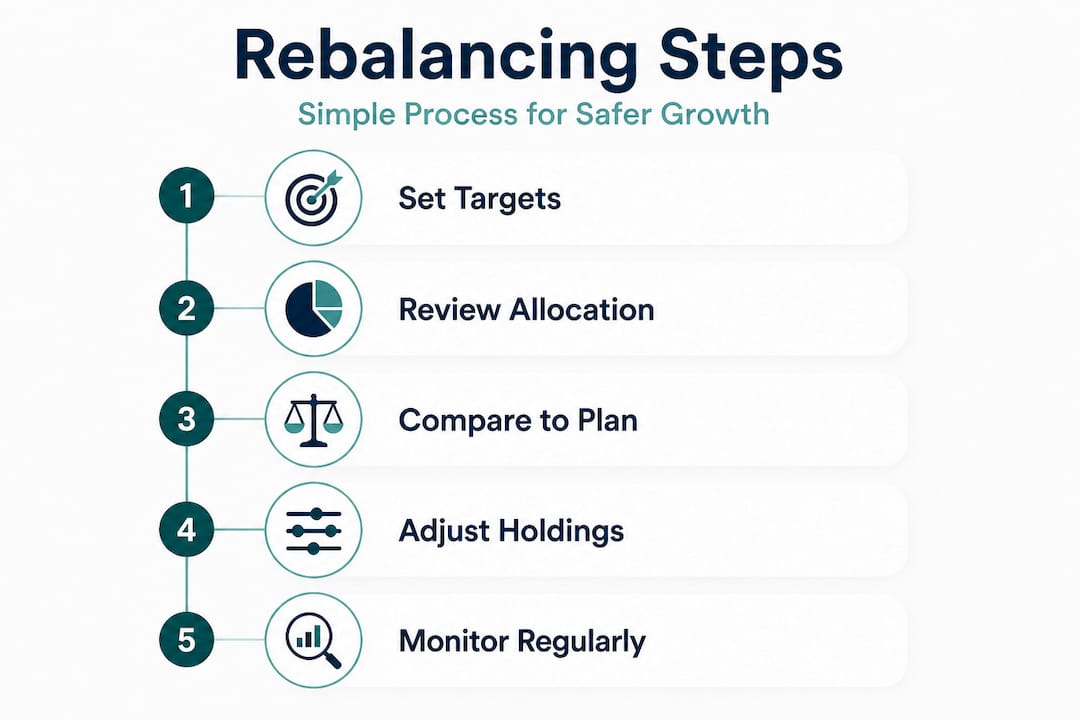
Rebalancing sounds technical, but the actual process is straightforward when you break it into clear steps. Here's how to approach it.
-
Review your current allocations. Pull together a complete picture of your portfolio. This includes direct shares, managed funds, ETFs, cash, property holdings, and your superannuation balance. Use a spreadsheet or a digital platform to see what percentage of your total wealth sits in each asset class.
-
Confirm your target asset mix. Your target mix should reflect your risk tolerance, investment horizon, and income needs. A 55-year-old pre-retiree might target 50% growth and 50% defensive. A 45-year-old still building wealth might sit at 70% growth and 30% defensive. Be specific, not approximate.
-
Calculate the gap between current and target. For each asset class, note the difference between where you are and where you want to be. For example, if Australian equities are at 42% versus a target of 35%, you need to reduce that exposure by 7%.
-
Identify the trades or adjustments needed. Decide which assets to reduce and which to increase. Where possible, use new contributions or reinvested income to top up underweight areas before selling anything.
-
Review the tax implications before acting. Any sale of assets held outside of superannuation may trigger a CGT event. If you've held the asset for more than 12 months, you're entitled to the 50% CGT discount. Timing sales across financial years can also spread your tax liability. For smarter portfolio optimisation, tax awareness at this stage is non-negotiable.
-
Execute the trades and record everything. Place your trades through your broker or platform. Keep clear records of purchase prices, sale prices, and dates for tax purposes.
-
Set your next review date. Don't let the calendar slide. Lock in your next review before you close out this one.
| Method | Key advantage | Key limitation |
|---|---|---|
| Manual rebalancing | Full control over timing and tax outcomes | Time-consuming and requires discipline |
| Automated platforms | Efficient and consistent | May not account for individual tax situations |
| Financial adviser-led | Personalised and tax-optimised | Higher cost for ongoing service |
Digital platforms and wealth management tools can simplify the rebalancing process considerably. The key is choosing a tool that reflects Australian tax rules, including CGT, franking credits, and superannuation contribution limits, rather than a generic international platform that may not account for local nuances.
Common mistakes and how to avoid them
Even disciplined investors make avoidable errors when it comes to rebalancing. Knowing what to watch for can save you real money and unnecessary stress.
-
Over-reacting to short-term market noise. A 10% market correction does not necessarily mean you need to rebalance. If your targets are still within acceptable ranges, hold your course. Rebalancing too frequently in volatile markets leads to higher costs and potentially poor timing decisions.
-
Ignoring capital gains tax. Every sale outside of super can create a taxable event. Many self-directed investors rebalance without checking their tax position first, only to find themselves with an unexpected CGT liability at tax time. Tax consequences and transaction costs should always be factored in when rebalancing, before you execute any trade.
-
Forgetting to account for brokerage and fees. On a $500,000 portfolio, even modest rebalancing activity can generate hundreds of dollars in transaction costs. These costs reduce your net return and should be weighed against the benefit of correcting a modest allocation drift.
-
Letting emotions drive the process. Behavioural finance research consistently shows that investors tend to buy high and sell low when emotions take over. You might be tempted to hold onto a winning asset class longer than your plan dictates, or to dump a defensive position after a strong equity run. Discipline beats instinct almost every time.
-
Failing to review your target mix itself. Your target allocation from five years ago may not reflect your current risk tolerance or retirement timeline. Rebalancing to an outdated target is just as problematic as not rebalancing at all. Review your targets at least annually alongside your allocations.
Pro Tip: Consider isolating any tax pitfalls in rebalancing by rebalancing primarily inside your superannuation fund where possible. Within a complying super fund, investment earnings are taxed at just 15% in accumulation phase, and capital gains on assets held for more than 12 months are taxed at only 10%. This makes super an ideal environment for rebalancing activity.
How rebalancing fits Australian retirement goals
As you move through your 50s and into your early 60s, rebalancing takes on a different character. It's no longer just about managing risk in the abstract. It's about making sure your portfolio can actually deliver the income you need in retirement, when you need it.
Special approaches apply to retirement accounts like superannuation, and these deserve careful thought. Inside your super, rebalancing may involve shifting from high-growth options to balanced or conservative options as you approach your preservation age (currently between 55 and 60 depending on your birth year). This shift reduces volatility at the time when you're least able to recover from a major market loss.
Key considerations for pre-retirees rebalancing with retirement in mind:
- Shift gradually from growth to income-producing assets. Australian shares with strong dividend histories, fixed interest securities, and listed infrastructure assets can all provide relatively reliable income streams in retirement.
- Rebalance within superannuation as a priority. The tax advantages inside super make it the most efficient environment for managing asset allocation changes as you age.
- Account for the sequence of returns risk. A significant market drop in the first few years of retirement can permanently reduce your portfolio's longevity, even if markets recover later. Rebalancing to a more defensive mix before retirement reduces this risk substantially.
- Coordinate your super and personal investment portfolio together. Many Australians treat these as separate buckets, but your combined position is what matters. A heavily growth-oriented super fund combined with a defensive personal portfolio may be fine in aggregate, but you need to see the full picture.
- Plan your retirement income planning alongside your allocation decisions. The drawdown rate (the rate at which you spend your portfolio in retirement) determines how much volatility your portfolio can absorb. The closer you are to retirement, the more precise this planning needs to be.
Our perspective: What most self-directed investors miss about rebalancing
Here's the uncomfortable truth: most self-directed investors understand rebalancing intellectually but fail to do it consistently. The gap between knowing and doing is where retirement wealth is quietly lost.
Behavioural biases are the core problem. Loss aversion makes investors reluctant to sell assets that have grown, even when logic says they're now overweight. Recency bias causes people to assume that what performed well recently will continue to do so. These aren't character flaws. They're hardwired human tendencies, and they systematically work against disciplined portfolio management.
The second issue is a reluctance to adopt modern tools. The value of regular reviews is well established, yet many investors still track their holdings in a spreadsheet built five years ago, if they track them at all. Today's financial modelling platforms can show you your exact drift in real time, model the tax impact of proposed trades, and help you decide whether it's worth rebalancing or better to wait. That capability exists, and it's not being used enough.
Finally, there's the market-timing trap. Many investors delay rebalancing because they're waiting for a better moment. The market feels too volatile, or it feels like things are about to turn around. This thinking leads to indefinite postponement. Sticking to a schedule, whether annual, semi-annual, or threshold-based, consistently outperforms attempts to time the perfect rebalancing window.
Discipline, a clear plan, and the right tools are what separate investors who reach retirement with the portfolio they intended from those who arrive with something they never planned for.
Take the next step in optimising your investments
Managing your own rebalancing process takes clarity and the right support. The steps above give you the framework, but bringing it all together with accurate, tax-aware modelling is where the real advantage lies.

The AlphaIQ platform is built specifically for self-directed Australian investors who want to model their full financial position across investments, super, and property in one place. You can run scenario simulations to see how rebalancing decisions affect your long-term outcomes, and use tools like the superannuation calculator to project your balance through to retirement. If you're also managing debt alongside your portfolio, the debt recycling calculator helps you understand how to use investment debt strategically, all without the ongoing cost of financial advice.
Frequently asked questions
How often should you rebalance your portfolio?
Most experts recommend rebalancing annually or when your asset allocation shifts meaningfully from your targets. Regular rebalancing helps keep your investments aligned with your long-term strategy, without over-trading.
Is portfolio rebalancing taxable in Australia?
Yes, selling assets outside of superannuation to rebalance can trigger capital gains tax. Tax consequences and transaction costs should always be factored in before you execute any trades.
What is the fastest way to rebalance a portfolio?
Using a dedicated digital platform is the most efficient approach for most self-directed investors. Digital platforms and wealth management tools can simplify the rebalancing process by automating calculations and surfacing tax considerations in real time.
Should you rebalance within your superannuation fund?
Yes, and it's often the most tax-efficient place to rebalance. Special approaches apply to retirement accounts like superannuation, making it important to review and adjust your asset allocation inside super as retirement approaches.