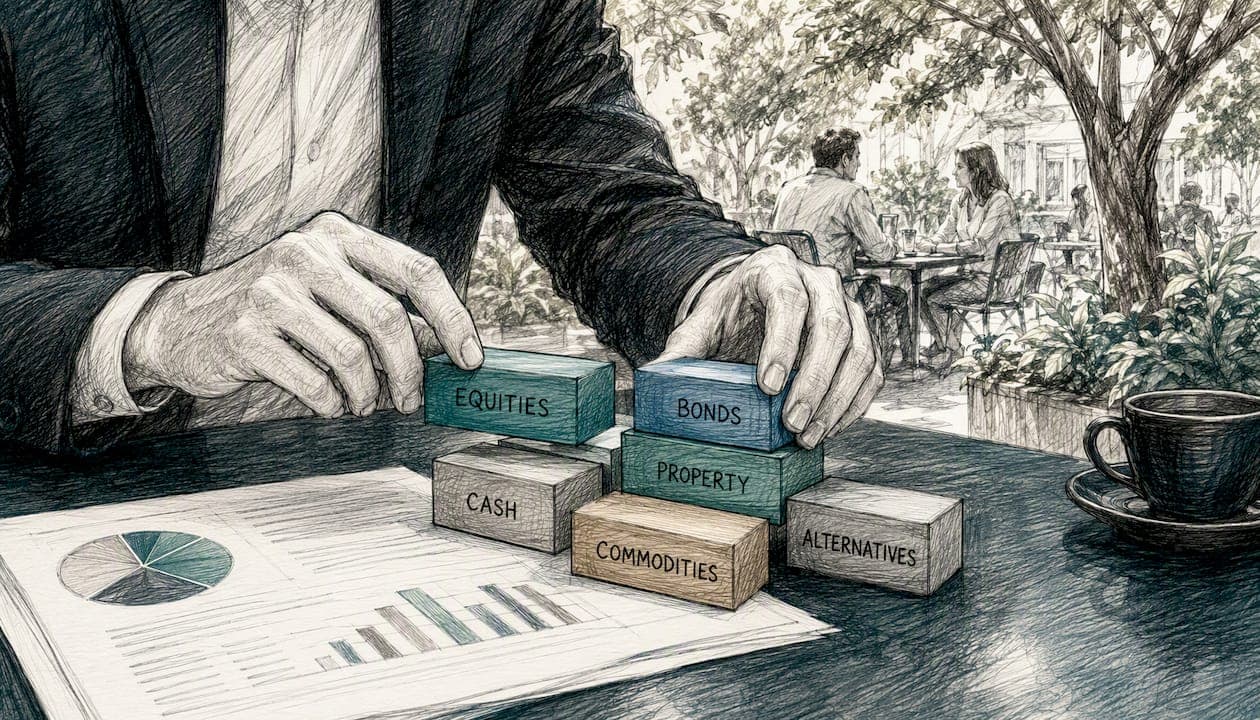
A balanced stock portfolio combines growth assets (primarily shares) with defensive assets (bonds, cash, and sometimes property) to pursue steady long-term returns while limiting the severity of market downturns. A classic starting point is a 60% growth / 40% defensive split. Here, the equity portion drives capital growth and the defensive sleeve cushions volatility. You can implement this in a single afternoon using a diversified managed fund or a small set of broad ETFs.
Key reference points for Australian investors building a balanced portfolio:
- ASIC MoneySmart provides free, regulator-backed guidance on diversification and asset allocation
- Vanguard Australia offers low-cost diversified index funds and ETFs suited to each risk profile
- Alphaiq provides tax-aware modelling and scenario simulation to show how your specific allocation performs after CGT, franking credits, and super are factored in
Key takeaways
A balanced stock portfolio works best when the allocation is chosen deliberately, maintained consistently, and reviewed with an eye on after-tax outcomes rather than headline returns.
| Point | Details |
|---|---|
| Start with a clear allocation | Balanced portfolios typically hold 50–70% in growth assets and 30–50% in defensive assets; choose based on your time horizon and risk tolerance. |
| Keep the core simple | A 3–5 fund structure covering Australian equities, global equities, and bonds delivers broad diversification at low cost. |
| Rebalance with tax in mind | Use new contributions to rebalance first; sell only when necessary, and time disposals to qualify for the 50% CGT discount where possible. |
| Watch fees and franking credits | MERs, brokerage, and platform fees compound over time; franking credits on Australian shares can materially improve after-tax income. |
| Model before you commit | Alphaiq's tax-aware scenario simulation shows how different allocations perform after CGT, franking credits, and super are factored in. |
Table of Contents
- What does "balanced" actually mean in practice?
- The major asset classes and what each one does for you
- Common allocation templates and how to implement them in Australia
- How to build your balanced portfolio step by step
- How to diversify properly inside your equity allocation
- When and how to rebalance your portfolio
- Fees, tax, and super: what to check before you invest
- What to expect from different asset mixes over time
- How Alphaiq's modelling supports a balanced portfolio in practice
- My honest view on balanced portfolios for Australian DIY investors
- Alphaiq gives you the numbers to invest with confidence
- Sources
What does "balanced" actually mean in practice?
The word "balanced" is a label, not a legal definition. ASIC MoneySmart confirms there is no single, standard formula: one fund manager's "balanced" option might hold 55% equities, while another's holds 70%. The label is shorthand, and it can hide meaningfully different risk profiles.
The practical distinction between the three common labels is this:
- Conservative portfolios lean heavily defensive, typically 30% or less in growth assets, and suit investors with short time horizons or low tolerance for paper losses
- Balanced portfolios sit in the middle, with growth assets usually making up 50–70% of the total, targeting medium-term investors who can accept moderate volatility
- Growth portfolios hold 70–90% in equities and suit investors with long horizons who can ride out significant drawdowns
What matters more than the label is the actual asset allocation. Before you invest in any "balanced" product, check three things:
- The growth percentage (equities, listed property, infrastructure) — this drives your long-run return
- The defensive percentage (bonds, cash, fixed interest) — this cushions drawdowns
- The international vs Australian bias — a fund heavy in Australian shares concentrates your risk in one small market
Pro Tip: Download the product's PDS or look at the fund's holdings page before investing. The label on the tin rarely tells you what's inside.
For a deeper look at how different allocation models compare, the Alphaiq blog covers the mechanics in plain terms.
The major asset classes and what each one does for you
Every balanced portfolio is built from a small number of building blocks. Understanding what each one contributes helps you make deliberate choices rather than just accepting whatever a fund happens to hold.
Shares (equities) are ownership stakes in companies. They offer the highest long-run return potential of any mainstream asset class, but they also carry the most volatility. For Australian investors, domestic shares carry an additional benefit: franking credits attached to dividends can significantly boost after-tax income, particularly for investors in lower tax brackets or those drawing income in retirement.
Bonds and fixed interest are loans to governments or corporations that pay regular interest. They tend to move differently from shares, which is the key point. When equity markets fall sharply, high-quality bonds often hold their value or rise, softening the overall portfolio drawdown. Diversification works precisely because different asset classes respond differently to the same economic conditions, so losses in one area can be partly offset by gains in another.

Cash and term deposits provide stability and liquidity. Returns are modest, but cash never falls in nominal value, which matters when you need to draw on your portfolio or rebalance without selling equities at a loss.
Property (typically accessed via listed real estate investment trusts, or A-REITs, in a balanced portfolio) offers income and some inflation protection. Direct property is illiquid and lumpy, so most balanced portfolios use listed property funds or ETFs to get the exposure without the concentration risk.
Alternatives (infrastructure, commodities, hedge strategies) appear in some managed funds but are rarely necessary for a straightforward balanced portfolio. They add complexity without always adding proportionate benefit for retail investors.
The practical takeaway: ETFs and managed funds give you clean, low-cost access to all of these classes without needing to buy individual bonds or properties. Broad index ETFs covering Australian equities, global equities, and a bond index cover the core of most balanced portfolios.
Common allocation templates and how to implement them in Australia
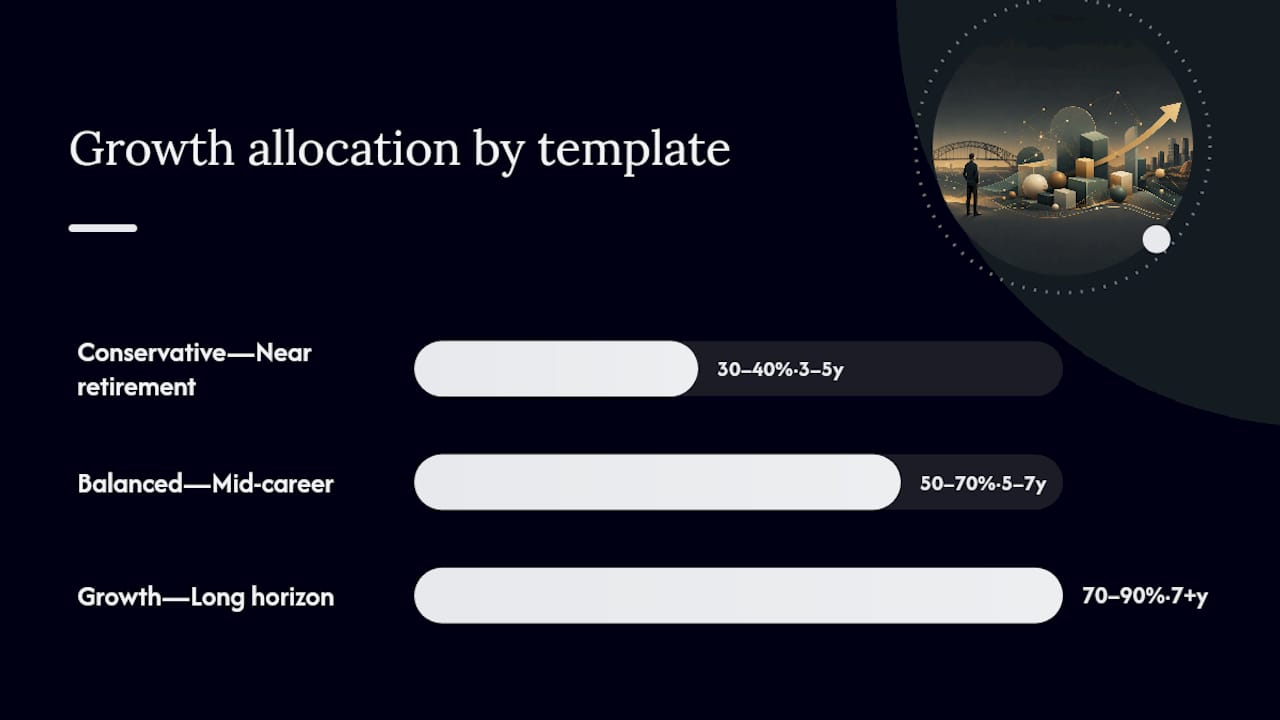
Australian investors typically structure balanced portfolios around a 50–70% equities and 30–50% defensive split, depending on their risk profile. Three templates cover most situations:
| Template | Growth assets | Defensive assets | Typical investor | Minimum time horizon |
|---|---|---|---|---|
| Conservative | 30–40% | 60–70% | Near retirement, low risk tolerance | 3–5 years |
| Balanced | 50–70% | 30–50% | Mid-career, moderate risk tolerance | 5–7 years |
| Growth | 70–90% | 10–30% | Long horizon, higher risk tolerance | 7+ years |
For each template, the growth sleeve typically combines a broad Australian equity ETF (covering ASX 200 or ASX 300 companies) with a global developed market ETF (covering US, European, and Asian large caps). The defensive sleeve uses a broad investment-grade bond ETF and a cash or term deposit allocation. Vanguard Australia's diversified ETF range (such as its Diversified Balanced Index ETF) packages these components into a single fund, which suits investors who prefer simplicity over control.
Single balanced fund vs DIY ETF portfolio: the honest trade-off
A single diversified fund is the simpler path. It rebalances automatically, requires one transaction to implement, and removes the temptation to tinker. The trade-off is less control over the exact allocation, slightly higher management fees in some cases, and no ability to tilt toward franking-credit-generating Australian shares.
A DIY approach using 3–5 ETFs gives you control over each component, often at a lower combined management expense ratio (MER), and lets you weight Australian equities to capture franking credits. The cost is complexity: you need to monitor drift, rebalance manually, and track each holding separately for tax purposes.
For most investors starting out, a single diversified fund or a three-ETF core (Australian equities, global equities, bonds) is the right starting point. You can add complexity later once you understand how each piece behaves.
How to build your balanced portfolio step by step
Building a well-structured portfolio is a sequential process. Skipping steps, particularly the goal-setting and risk-tolerance stages, leads to allocations that feel wrong the first time markets drop.
-
Set your goal and time horizon. Are you building wealth for retirement in 20 years, or funding a property purchase in seven? The answer shapes everything. Longer horizons support more equities; shorter ones demand more defensive assets.
-
Assess your risk tolerance honestly. Risk tolerance is not just how much loss you can mathematically absorb. It is how you will actually behave when your portfolio drops 20% in three months. If you would sell in a panic, a growth allocation will hurt you even if it is theoretically appropriate for your age.
-
Choose your target allocation. Use the template table above as a starting point, then adjust based on your specific circumstances. Super investment options follow the same logic: growth options suit longer horizons, balanced or conservative options suit those closer to drawing down.
-
Select your instruments. For most self-directed investors, a combination of broad index ETFs or a single diversified managed fund covers the core. Keep it to 3–5 funds maximum.
-
Open a brokerage account or use your super fund's investment options. In Australia, platforms such as CommSec, Stake, or Pearler allow you to buy ETFs directly. Many super funds also offer member-directed investment options where you can hold ETFs inside your super.
-
Set up regular contributions. Dollar-cost averaging, contributing a fixed amount at regular intervals regardless of market conditions, removes the temptation to time the market and builds your portfolio steadily over time.
-
Implement and record your cost base. Keep a record of every purchase price and date. This is your cost base for capital gains tax purposes and becomes important when you rebalance or sell.
-
Automate tracking and set a rebalancing schedule. Calendar a review at least annually. Tools like Alphaiq can automate drift detection and show you the tax impact of rebalancing before you act.
Pro Tip: If you are new to investing, start with a single diversified ETF or managed fund. Get comfortable with how it moves before adding individual components. Complexity is a feature you earn, not a starting requirement.
A detailed portfolio diversification workflow covering each of these steps is available on the Alphaiq blog.
How to diversify properly inside your equity allocation
The equity portion of your portfolio deserves its own diversification strategy. Holding one Australian equity ETF is a start, but it concentrates you in a single country that represents a small fraction of global market capitalisation.
Home-country bias is a well-documented trap for Australian investors. That concentration means your portfolio is heavily exposed to the performance of a handful of sectors, particularly banks and resources, which dominate the ASX.
Some investors add a small allocation to emerging markets for additional diversification, though this adds volatility.
Within the equity sleeve, broad index ETFs naturally provide sector and market-cap diversification. A global total market ETF covers thousands of companies across technology, healthcare, consumer goods, financials, and industrials. An Australian large-cap ETF covers the ASX 200 or 300. Adding a small-cap ETF (Australian or global) can improve diversification further, though it is not necessary for a core balanced portfolio.
On franking credits: Australian shares held in a taxable account generate dividend income with attached franking credits, which reduce your tax liability or generate a refund if your marginal rate is below the company tax rate. This is a genuine advantage of tilting toward Australian equities, but it should not override the diversification argument entirely. The tax benefit of franking credits rarely compensates for the concentration risk of an all-Australian equity portfolio.
For practical diversification tips tailored to Australian investors, including how to think about home bias, the Alphaiq blog covers this in detail.
When and how to rebalance your portfolio
Portfolios drift. Rebalancing restores your target allocation and keeps your portfolio aligned to the risk level you chose deliberately.
Two practical methods work well for retail investors:
- Calendar rebalancing: Review your allocation annually or biannually and rebalance back to target if any asset class has drifted. Simple, predictable, and easy to schedule.
- Threshold rebalancing: Set a band, commonly 5%, around each asset class. If Australian equities drift from 40% to 46% of your portfolio, you rebalance. This responds to market moves rather than the calendar.
Tax-aware rebalancing matters in Australian taxable accounts. Selling an asset that has appreciated triggers a capital gains tax event. Timing a rebalancing sale to fall after the 12-month mark, where possible, reduces your tax bill.
Inside superannuation, CGT rules are different and generally more favourable. This makes super an efficient place to hold assets you expect to rebalance frequently.
Pro Tip: Before selling to rebalance, check whether new contributions or reinvested dividends can do the job instead. Directing new money to underweight asset classes avoids triggering CGT events and achieves the same result.
A step-by-step guide to rebalancing your Australian portfolio is available if you want to go deeper on the mechanics.
Fees, tax, and super: what to check before you invest
The fees and tax treatment of your portfolio have a larger impact on long-run wealth than most investors realise.
Fees to check on every product:
- MER (management expense ratio): The annual percentage fee charged by a fund or ETF. Broad index ETFs typically charge 0.05–0.20% per year; actively managed funds often charge 0.50–1.50% or more
- Brokerage: The transaction cost each time you buy or sell an ETF. Ranges from $0 to $20 per trade depending on your platform
- Bid-ask spread: The difference between the buy and sell price of an ETF on the exchange. Wider spreads on less-liquid ETFs add a hidden cost
- Platform fees: Some investment platforms charge a flat monthly fee or a percentage of assets under administration
Australian tax considerations:
- Franking credits attach to dividends paid by Australian companies that have already paid corporate tax. You receive a tax offset equal to the tax already paid, which reduces your personal tax liability or generates a refund if your marginal rate is below 30%
- Capital gains tax (CGT) applies when you sell an asset at a profit. Assets held for more than 12 months attract a 50% CGT discount for individuals, meaning only half the gain is added to your taxable income
- Superannuation is the most tax-efficient vehicle for long-term investing in Australia. Contributions are taxed at 15%, earnings within super are taxed at 15% (or 10% for assets held more than 12 months), and withdrawals after age 60 are generally tax-free
Tax-aware investing means choosing where to hold each asset class based on its tax treatment, not just its expected return. Holding high-yield, franking-credit-generating Australian shares in a taxable account and growth-oriented international shares inside super (where you cannot use franking credits as efficiently) is one example of this thinking in practice.
What to expect from different asset mixes over time
Return expectations should be calibrated to your allocation, not to what markets happened to do last year. More equities means higher expected long-run returns and larger potential drawdowns. More defensive assets means smoother short-term performance and lower long-run growth.
A balanced allocation sits between these outcomes. It will not protect you fully in a crash, and it will not capture the full upside of a bull market. What it does is reduce the probability that you will panic-sell at the bottom, because the drawdowns are less severe.
Inflation is a genuine risk for balanced portfolios, particularly for the defensive sleeve. Cash and short-duration bonds lose real value when inflation runs above their yield. Equities, property, and inflation-linked bonds provide better protection against sustained inflation. Holding some real assets (shares, listed property) in your balanced portfolio is the practical mitigation.
Rather than forecasting a single return figure, think in scenario ranges. A balanced portfolio might return anywhere from negative in a bad year to strongly positive in a good one. What matters is whether the long-run average, net of fees and tax, is sufficient to meet your goal. Modelling a range of scenarios, rather than a single point estimate, gives you a more honest picture of the outcomes you might face.
How Alphaiq's modelling supports a balanced portfolio in practice
Building a balanced portfolio is straightforward in theory. The complexity comes from the interaction between your allocation, your tax position, your super balance, and your cash flow, all of which change over time. Alphaiq is built to model exactly this.
The platform runs tax-aware projections that account for CGT, franking credits, super contributions, and retirement income, giving you an after-tax picture of your portfolio rather than a pre-tax one. For a self-directed investor managing both a taxable account and a super fund, this distinction matters considerably.
Typical outputs Alphaiq generates for a balanced portfolio include:
- After-tax return projections across different allocation scenarios
- Rebalancing alerts when your portfolio drifts beyond your chosen threshold
- CGT impact modelling before you sell, so you can time disposals to minimise tax
- Retirement income sensitivity analysis, showing how different drawdown rates affect how long your portfolio lasts
- Franking credit tracking across your Australian equity holdings
To illustrate the practical difference: consider two investors, both targeting a 60/40 balanced allocation. One holds a single diversified managed fund in a taxable account. The other holds a DIY ETF mix split between a taxable account and super, with Australian equities in the taxable account to capture franking credits and international growth assets inside super. The after-tax outcome of these two approaches can differ meaningfully over a decade, but the difference is invisible without modelling.
Alphaiq's scenario simulation lets you compare these two structures side by side, showing projected after-tax wealth, rebalancing costs, and retirement income under each approach, before you commit to either one.
You can trial Alphaiq's modelling on the Alphaiq platform to see how your current or planned allocation holds up across different tax and market scenarios.
My honest view on balanced portfolios for Australian DIY investors
The most common mistake I see in DIY balanced portfolios is not the allocation itself. It is the gap between the allocation someone chose and the one they actually maintain when markets move.
It is a reactive one, and the investor has locked in losses and missed the recovery.
For different investor profiles, my practical view:
- Starters (building wealth, 20-plus years to retirement): A single diversified growth or balanced ETF is enough. Add complexity only when you have a specific reason, not because it feels more sophisticated.
- Intermediate investors (10–20 years to retirement): A 3–5 ETF core with deliberate Australian equity weighting for franking credits, reviewed annually and rebalanced with new contributions where possible.
- Pre-retirees (within 10 years of drawing down): Shift toward a balanced or conservative allocation, model your drawdown rate against your super balance and taxable assets, and use a tool like Alphaiq to stress-test your income projections before you stop working.
The investors who do best are rarely the ones with the most sophisticated portfolios. They are the ones who chose a sensible allocation, kept costs low, rebalanced without drama, and did not change course every time a commentator predicted a crash.
Alphaiq gives you the numbers to invest with confidence
Most Australians building a balanced portfolio do the hard work of choosing an allocation, then leave the tax and super modelling to guesswork. Alphaiq closes that gap.
The platform is built for self-directed Australian investors aged 35–65 who want to see their real financial position, not just a pre-tax portfolio balance. Alphaiq models your investments, super, property, and cash flow in one place, with tax-aware projections that account for CGT, franking credits, and super rules specific to Australia.
Three ways Alphaiq supports a balanced portfolio:
- Rebalancing alerts when your allocation drifts beyond your target threshold, so you act deliberately rather than reactively
- After-tax projections across different allocation scenarios, including the impact of selling to rebalance versus using new contributions
- Retirement income modelling that shows how your balanced portfolio translates into sustainable drawdown income, accounting for super preservation rules and tax
You can start a trial at Alphaiq and model your current allocation against alternatives in minutes, without the cost of a financial adviser.
Sources
Authoritative Australian sources to consult alongside this guide:
- Moneysmart
- Investing between the flags (MoneySmart PDF)
- Building a simple portfolio to suit you
- Balanced investment strategy: Definition and examples
- The Best Balanced Funds and ETFs - Morningstar
This article is general information, not a substitute for advice from a qualified financial advisor. Consult a qualified financial professional about your own circumstances before acting on anything here.