
TL;DR:
- Putting most of your savings into a single sector or asset class creates a fragile financial position vulnerable to sharp market corrections. Genuine diversification depends on asset relationships and low correlations across different classes and geographies to reduce risk effectively. Regularly reviewing and model-testing your portfolio helps ensure resilience under various market conditions and compliance with regulatory requirements.
Putting the bulk of your savings into a single stock, sector, or property can feel rewarding when conditions are good, but it creates a fragile financial position that one sharp correction can shatter. Australian investors are increasingly exposed to this kind of concentrated risk, with many portfolios leaning heavily on resources, financials, or residential property without realising it. This article walks you through what genuine diversification actually means, how to build it step by step, what the rules say for SMSF trustees, how diversification holds up under real market pressure, and the tools that help you keep it working over time.
Table of Contents
- Understanding diversification: More than just more holdings
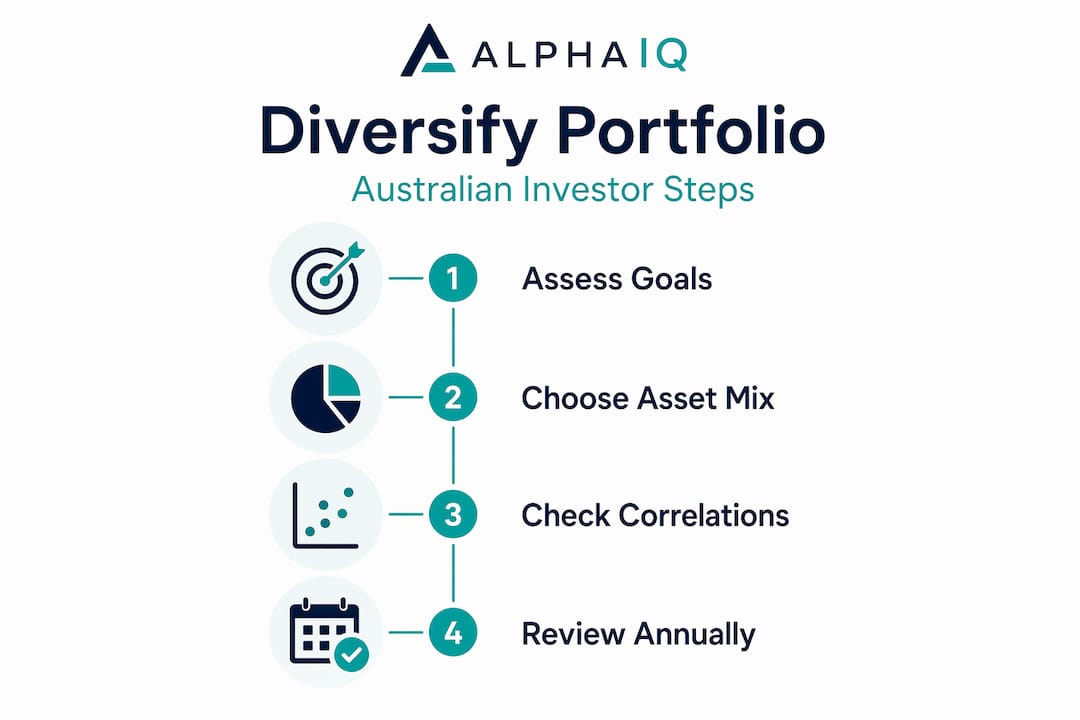
- How to build a diversified investment portfolio: Step-by-step guide
- SMSFs and regulatory requirements for diversification
- How diversification performs in different market conditions
- The uncomfortable truth about diversification most investors forget
- Tools to simplify and strengthen your diversification approach
- Frequently asked questions
Key Takeaways
| Point | Details |
|---|---|
| Quality over quantity | True diversification comes from mixing different types of assets, not just increasing holdings. |
| Watch for concentration | Avoid putting most of your wealth into one asset class or region to lower large-scale loss risk. |
| Stay compliant with SMSFs | Self-managed super funds must document and manage diversification to meet ATO rules and avoid penalties. |
| Stress-test your mix | Test allocations under different market scenarios, especially during volatile and inflationary periods. |
| Leverage smart tools | Financial calculators and ongoing reviews help keep your portfolio resilient and in line with your goals. |
Understanding diversification: More than just more holdings
A surprisingly common belief is that owning 30 or 40 individual stocks makes a portfolio well diversified. In reality, if those 30 stocks all sit within the same sector or the same country, you are still carrying concentrated risk. True diversification is about how your assets relate to each other, not how many you hold.
Asset allocation basics form the real foundation here. Mixing asset classes, such as shares, bonds, property, cash, and alternatives, means that when one class falls sharply, another may hold steady or even rise. This is what financial professionals call low correlation, meaning two assets do not typically move in the same direction at the same time.
As one Australian investment guide explains, true diversification is primarily achieved through asset allocation, not simply by adding more holdings. The goal is to ensure different parts of your portfolio do not all move together during a crisis.
Key insight: Correlation is the number that really matters. Two assets with a correlation close to zero or negative provide genuine diversification benefit. Two assets with a correlation close to one will fall together in a downturn, no matter how many of them you hold.
Here is a simple comparison of approaches that look diversified but are not, versus those that genuinely reduce risk:
| Approach | What it looks like | Actual risk level |
|---|---|---|
| 30 ASX mining stocks | Broad holding | High concentration risk |
| 10 ASX stocks across 5 sectors | Somewhat spread | Moderate, still AU-heavy |
| Shares, bonds, property, cash | Multi-asset mix | Significantly reduced |
| Global equities + bonds + alternatives | Full diversification | Lowest correlation risk |
Watch for these common concentration traps in Australian portfolios:
- Sector concentration: Overweighting financials and resources, which dominate the ASX
- Geographic concentration: Holding mostly Australian assets in a market that represents only about 2% of global equities
- Asset class concentration: Treating investment property as the only real investment and ignoring liquid markets
- Currency concentration: Holding all assets in Australian dollars, removing any natural hedge against AUD weakness
Identifying portfolio concentration risk early is far easier than managing the fallout from it later.
How to build a diversified investment portfolio: Step-by-step guide
Good diversification does not require complexity. In fact, simpler portfolios with robust strategic asset allocation (SAA) tend to outperform complicated ones over time, partly because they are easier to maintain and less prone to behavioural mistakes.
Here is a practical sequence to follow:
-
Define your investment objectives and time horizon. Are you building wealth for retirement in 15 years, or drawing income now? Your horizon shapes how much volatility you can tolerate and therefore how much growth versus defensive exposure you need.
-
Choose your strategic asset allocation. This is your core framework. Decide the percentage weighting you want in each asset class: for example, 50% growth assets (shares, property) and 50% defensive assets (bonds, cash) for a balanced investor.
-
Diversify within each asset class. Within shares, split between Australian equities and global equities. Within bonds, consider short and intermediate duration, and a mix of government and corporate bonds. Within property, consider both direct and listed real estate investment trusts (REITs).
-
Add geographic diversification. Australian shares alone expose you to a narrow, resource-heavy market. Adding exposure to US, European, and Asian markets reduces both sector and currency concentration.
-
Minimise overlapping exposures. Vanguard's adviser portfolio analysis found that many adviser-managed portfolios carry excessive satellite concentration and overlapping exposures, which effectively cancel out the diversification intent. Before adding a new fund or ETF, check what it holds and whether it duplicates existing positions.
-
Set a rebalancing schedule. Over time, strong-performing assets grow to a larger share of your portfolio, shifting your actual allocation away from your target. Rebalancing, typically once or twice a year, restores your intended risk level.
Here is a sample allocation table for different investor profiles:
| Investor profile | Australian shares | Global shares | Bonds | Property | Cash/alternatives |
|---|---|---|---|---|---|
| Conservative | 10% | 15% | 45% | 15% | 15% |
| Balanced | 20% | 25% | 30% | 15% | 10% |
| Growth | 30% | 35% | 20% | 10% | 5% |
| Aggressive growth | 35% | 45% | 10% | 10% | 0% |
These are starting points, not prescriptions. Your personal tax position, income needs, and risk tolerance all affect the right mix for you.
Pro Tip: Before buying additional managed funds or ETFs, map out the underlying holdings. Two funds labelled "diversified" can hold 70% of the same stocks. Using a multi-asset core solution with automatic rebalancing can remove this problem entirely while keeping costs low.
Reviewing practical investment strategies designed specifically for Australians can help you identify which structure fits your situation best.
SMSFs and regulatory requirements for diversification
If you run a self-managed super fund (SMSF), diversification is not just a strategy. It is a legal obligation. The Australian Taxation Office (ATO) expects every SMSF trustee to actively consider the composition of the fund's investments and document how that composition manages risk appropriately.
The ATO's SMSF investment strategy guidelines make clear that trustees must explicitly address the risks of inadequate diversification in their written investment strategy. This means your strategy document must go beyond general statements and actually explain how different asset classes serve the fund's objectives, cash flow requirements, and member risk profiles.
Regulatory reminder: An SMSF investment strategy that says "we may invest in various assets" without addressing concentration risk is unlikely to satisfy ATO scrutiny. Trustees have faced penalties for holding poorly documented and heavily concentrated portfolios, particularly during audits.
The most common diversification mistakes seen in SMSFs include:
- Overexposure to residential property: Some funds hold a single investment property representing 80% or more of total assets, leaving the fund with illiquidity risk and no meaningful spread
- Overweighting direct shares in one sector: Concentrated positions in ASX-listed financials or mining companies without any offsetting defensive assets
- Neglecting to update the investment strategy: Markets shift and life circumstances change, but many trustees set and forget their written strategy for years
- Ignoring liquidity requirements: A fund concentrated in property may struggle to pay pensions or meet lump-sum withdrawals without selling assets at unfavourable prices
- Failing to consider insurance needs: Super law requires trustees to consider whether life and total and permanent disability insurance is appropriate for members
Understanding whether an SMSF structure is right for you in the first place is worth exploring, including comparing it against industry fund options. Our comparison of SMSF vs industry super covers the trade-offs in detail. For those already running an SMSF, following wealth management best practices will help you stay compliant and effective.
How diversification performs in different market conditions
Knowing what diversification can and cannot do across different market environments saves you from being caught off guard. Most investors learn its limits the hard way.

The classic argument for diversification rests on the historically low correlation between shares and government bonds. Over the very long run, stock-bond correlations have averaged around 0.08 since 1960, meaning shares and bonds have moved largely independently of each other, providing a reliable cushion during equity downturns.
However, inflation changes this relationship significantly. When inflation is elevated or uncertain, stock-bond correlations rise, weakening one of the primary benefits of holding bonds alongside shares. Morningstar data shows that correlations for intermediate-term government bonds reached around 0.3 over the trailing 12 months through April 2025, well above the long-run average. During that period, bonds provided far less protection than investors accustomed to pre-2022 conditions might have expected.
Market reality check: In 2022, both global shares and bonds fell sharply at the same time as central banks raised rates aggressively to fight inflation. A classic 60/40 portfolio, which holds 60% shares and 40% bonds, delivered one of its worst calendar-year returns in decades. Diversification did not fail entirely, but it worked less effectively than historical averages suggested it should.
Here is how to stress-test your portfolio against different conditions:
- Rising inflation scenario: Check how much of your portfolio is in nominal bonds versus inflation-linked securities, real assets like property and commodities, and equities with pricing power
- Recession scenario: Test whether your defensive assets, such as investment-grade bonds and cash, are large enough to sustain withdrawals or income needs for 12 to 24 months without selling growth assets
- Currency shock scenario: Assess what portion of your portfolio is unhedged in foreign currency. A falling Australian dollar benefits unhedged global equity exposure, while a rising AUD reduces those returns
- Liquidity stress scenario: Identify which assets can be sold quickly at close to fair value and which cannot. Property, private equity, and some alternative investments carry significant liquidity risk
The lesson is not to abandon bonds or dismiss the 60/40 split entirely. It is to understand the conditions under which each element of your portfolio provides its intended benefit. Managing investment risk effectively means knowing both the strengths and the limitations of every position you hold.
Pro Tip: Running scenario analysis on your portfolio at least once a year, testing how it performs under a severe sharemarket fall, a sustained inflation period, and a property market correction simultaneously, gives you far better insight than simply reviewing past returns.
The uncomfortable truth about diversification most investors forget
Here is what most articles on diversification will not tell you: ticking the multi-asset box is not the same as being genuinely diversified. Many investors hold what looks like a well-spread portfolio on paper but have never tested whether it would actually behave the way they expect under real market stress.
Overdiversification is a real and underappreciated problem. When you hold too many funds across too many categories without a clear framework, you end up with a portfolio that tracks the market average, charges multiple layers of fees, and provides no clear structural advantage. Worse, the complexity makes it harder to monitor and easier to ignore. Complacency is one of the biggest risks in investing, and a sprawling, difficult-to-read portfolio breeds it.
The Australian market has specific characteristics that generic diversification templates do not account for. The ASX is heavily concentrated in financials, resources, and real estate. If your "diversified" Australian share fund is tracking the ASX 200, you likely have more exposure to the big four banks and BHP than you realise. Adding a second Australian equity fund rarely solves this. It usually amplifies it.
Currency exposure is another layer that Australian investors often underestimate. A global equity allocation held in unhedged foreign currency is actually a dual bet: one on international equity markets and one on the Australian dollar. That can work in your favour or against you, depending on conditions, and it should be a deliberate choice rather than an oversight.
The most resilient investors we observe are not those with the most complex portfolios. They are those who understand exactly what they own, why they own it, and what conditions would cause it to underperform. Reviewing strategy examples built around Australian realities, including tax treatment, superannuation structures, and franking credits, helps you move from a generic template to a genuinely tailored approach.
Scenario planning and stress-testing are not optional extras. They are the difference between a portfolio that looks resilient in a spreadsheet and one that actually holds up when markets get difficult.
Tools to simplify and strengthen your diversification approach
Understanding the principles of diversification is one thing. Modelling how they apply to your actual financial position is where the real work happens.

AlphaIQ gives self-directed Australian investors the tools to do exactly that, without the cost of ongoing financial advice. You can model different asset allocation scenarios and see how they affect your projected retirement income, tax position, and superannuation balance in real terms. Whether you are reviewing a debt recycling strategy with our debt recycling calculator or projecting how changes to your super contributions affect your long-term position with our superannuation calculator, the platform brings together your full financial picture in one place. Initial setup is one thing. Ongoing monitoring, supported by real numbers and scenario modelling, is what keeps your diversification strategy working as your life and the markets evolve.
Frequently asked questions
Why does holding more stocks not always reduce risk?
Simply owning more stocks in the same sector or country can still leave you exposed to large losses if those groups fall together, so true diversification requires mixing assets with low correlation across different classes and geographies.
What is the biggest diversification mistake Australian SMSFs make?
The most common SMSF diversification mistake is concentrating savings in a single asset or property, which creates audit risks and can breach the ATO's requirement for trustees to explicitly address concentration risk in their written investment strategy.
Do bonds always hedge sharemarket risk?
Bonds generally lower portfolio risk, but during high-inflation periods their diversification benefits weaken as stock-bond correlations rise and returns become more correlated with equities.
How often should you review your diversification strategy?
It is best to review your portfolio diversification at least once a year and after any major market event or life change, such as a job transition, inheritance, or approaching retirement, to keep your allocation aligned with your current objectives.
What is the best simple portfolio for most Australians?
A core multi-asset allocation covering Australian and global shares, bonds, and property through low-cost diversified funds suits most investors seeking resilience, simplicity, and automatic rebalancing without the complexity of managing many individual positions.