
TL;DR:
- A 30% portfolio loss requires a 43% gain to recover, impacting long-term wealth.
- Managing risks like diversification and bucketing helps protect retirement savings and supports growth.
- Regular review and documentation of investment strategies are essential for compliance and long-term financial security.
A 30% drop in your portfolio does not just mean you need a 30% gain to recover. It means you need a 43% gain to break even. That asymmetry is one of the most important financial realities every self-directed investor needs to understand, particularly if you are within a decade of retirement. For Australians managing their own super through an SMSF, the stakes are even higher. Contribution limits mean there is no easy way to top up a depleted balance. This article walks you through what investment risk really means, what happens when it is ignored, and the practical strategies that protect and grow your wealth over the long term.
Table of Contents
- What does investment risk really mean for Australian investors?
- The consequences of ignoring investment risk
- How to manage investment risk: Proven strategies for Australians
- ATO requirements and compliance for SMSF risk management
- The overlooked edge: Why real risk management powers long-term financial freedom
- Take control of your investment strategy with the right tools
- Frequently asked questions
Key Takeaways
| Point | Details |
|---|---|
| Losses hurt more than gains help | Recovering from a large investment loss needs much bigger gains, so prevention is key for SMSFs. |
| Risk management preserves retirement | Using strategies like diversification and bucketing protects your retirement income from nasty surprises. |
| Legal rules demand active oversight | ATO requires annual SMSF risk reviews covering asset allocation, liquidity, liabilities, and insurance. |
| Practical tools enhance success | Using calculators and regular reviews makes executing risk management easier and more accurate. |
What does investment risk really mean for Australian investors?
Most people think of investment risk as simply the chance of losing money. The reality is more layered than that. Risk comes in several distinct forms, and each one can affect your wealth in a different way depending on where you are in your financial journey.
Market risk is the most visible: the value of your shares or property falls due to broader economic conditions. Inflation risk is quieter but just as damaging, eroding the real purchasing power of your savings over time. Timing risk refers to when you buy or sell, which can have an outsized effect on returns. Sequence of returns risk is particularly relevant for retirees, because a string of poor returns early in retirement can permanently damage a portfolio even if long-term averages look fine. Concentration risk arises when too much of your wealth is tied to a single asset, sector, or geography.
If you are still in the accumulation phase, you have time to ride out downturns. But if you are approaching or already in retirement, a major loss can force you to sell assets at the worst possible time, locking in those losses permanently.
Risk-averse households allocate less to growth assets, which can limit long-term wealth but also reduce exposure to catastrophic drawdowns.
SMSF members face a unique challenge here. Once you reach your late 50s or 60s, the window for making large concessional contributions narrows significantly. A major loss at this stage is not just a setback. It can permanently alter your retirement outcome. That is why aligning asset allocation to your specific life stage is so important.
Common misconceptions investors hold about risk include:
- Believing diversification means owning many shares in the same sector
- Assuming a long-term horizon eliminates all risk
- Thinking conservative investments are always safer in retirement
- Confusing volatility with permanent loss of capital
- Believing past performance reliably predicts future risk levels
The consequences of ignoring investment risk
Unmanaged risk does not just mean lower returns. It can set off a chain of consequences that fundamentally changes your retirement timeline and lifestyle.
Here is how the effects typically unfold:
- A significant market downturn reduces your portfolio value. A 30% fall, which is not uncommon in a sharp correction, requires a 43% recovery gain just to return to where you started.
- You are forced to sell assets at depressed prices. If you need income during the downturn, you lock in those losses rather than waiting for recovery.
- Your retirement date gets pushed back. With a smaller balance, your drawdown rate (the percentage you withdraw annually) becomes unsustainable at the same lifestyle level.
- Contribution limits prevent rapid recovery. For SMSF trustees, capital preservation is crucial because legal caps on contributions mean you cannot simply inject more money to rebuild quickly.
- Compounding works in reverse. Every dollar lost today is not just a dollar less. It is all the future growth that dollar would have generated.
The portfolio losses impact on retirement income can be severe and lasting, particularly when losses occur in the five years before or after you retire. This window is sometimes called the "retirement risk zone" because your balance is typically at its peak and your capacity to recover is at its lowest.

For those focused on protecting retirement savings, the lesson is clear: the cost of ignoring risk is not abstract. It shows up in real dollars and real years.
Pro Tip: Review your risk exposure at least once a year, and always before major life events such as transitioning to retirement, starting a pension, or making a large investment. Do not wait for a market event to prompt the review.
How to manage investment risk: Proven strategies for Australians
Knowing the risks is one thing. Having a practical toolkit to manage them is another. There are several proven risk management techniques that work well for self-directed investors and SMSF trustees.
Diversification means spreading your investments across different asset classes, sectors, and geographies so that a loss in one area does not sink the whole portfolio. Asset allocation is the deliberate decision about how much of your portfolio sits in growth assets versus defensive ones, adjusted as you age. Stop-losses are predetermined price points at which you sell a holding to limit further losses. Bucketing is a strategy where you divide your retirement savings into separate pools based on when you will need the money. One bucket holds cash for near-term income, another holds medium-term bonds, and a third holds long-term growth assets. This means a market crash does not force you to sell growth assets before they recover. Regular reviews ensure your strategy stays aligned with your goals and market conditions.
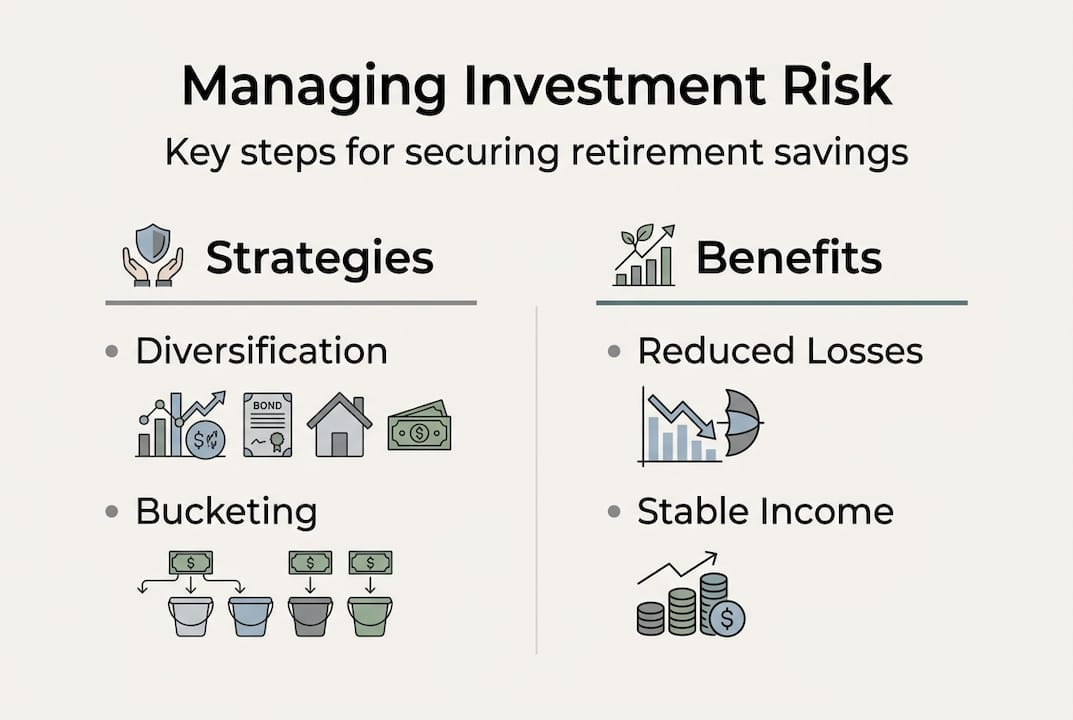
The ATO requires SMSF investment strategies to explicitly consider diversification, liquidity, and risk. This is not just a compliance box. It is sound financial practice.
| Strategy | Ease of use | Impact on SMSF | Compliance relevant? |
|---|---|---|---|
| Diversification | Moderate | High | Yes |
| Asset allocation | Moderate | High | Yes |
| Stop-losses | Requires monitoring | Medium | No |
| Bucketing | Moderate setup | Very high | Indirectly |
| Regular reviews | Low effort | High | Yes |
When to use each approach:
- Use diversification as a baseline at all times, across all life stages
- Shift asset allocation toward defensive assets as you near preservation age (currently 60 for most Australians)
- Apply stop-losses selectively on higher-risk individual holdings
- Implement bucketing when you transition to the pension phase
- Schedule reviews annually or after any significant market or personal change
For strategies for SMSF stability, bucketing is particularly powerful because it removes the emotional pressure to sell during downturns. When you know your next two years of income are sitting in cash, you can let your growth assets recover. Understanding matching investments to goals is also a useful starting point for building a structured approach.
Pro Tip: If you are in or near retirement, consider diversifying across assets so that no single holding represents more than 20% of your total portfolio. Concentration is one of the most common and most avoidable risks in self-managed funds.
ATO requirements and compliance for SMSF risk management
If you run an SMSF, risk management is not optional. It is a legal obligation. The ATO mandates that SMSF strategies be documented in writing, reviewed at least annually, and address five specific areas.
| Compliance element | What it means | How to address it |
|---|---|---|
| Risk and return | Investments must match the fund's risk appetite | Document your target allocation and rationale |
| Diversification | Assets should be spread across types and sectors | Record how holdings are spread and why |
| Liquidity | Fund must meet cash flow needs at all times | Maintain a cash buffer for pension payments |
| Liabilities | Strategy must account for known outgoings | Factor in tax obligations and member withdrawals |
| Insurance | Consider whether members need life or TPD cover | Document the decision, even if cover is declined |
For optimising SMSF property strategy, liquidity is a particularly important consideration. Property is illiquid, meaning it cannot be sold quickly if cash is needed. Your documented strategy should explain how you will manage cash flow if a large property holding cannot be sold in time.
Practical steps for SMSF trustees to stay compliant:
- Review and update your investment strategy document every year, ideally before 30 June
- Keep records of every investment decision and the reasoning behind it
- Ensure the strategy reflects the current ages, risk profiles, and retirement timelines of all members
- Engage a licensed auditor annually as required by law
- Revisit insurance cover for all members at least once every two years
When you are adjusting portfolios in line with ATO rules, the documentation process itself forces clarity. It makes you articulate your strategy rather than act on instinct, which is one of the most underrated benefits of compliance.
The overlooked edge: Why real risk management powers long-term financial freedom
Here is something most financial commentary gets wrong. Risk management is framed as defensive, as if it is purely about avoiding bad outcomes. But the investors who build the most wealth over decades are not the ones who chased the highest returns. They are the ones who stayed in the game longest.
Avoiding a catastrophic loss in your late 50s does not just preserve your capital. It preserves your compounding runway. Every year you avoid a major drawdown is a year where your money keeps working at full capacity. That is a genuine multiplier effect, and it is one that rarely gets the attention it deserves.
The compliance requirements around SMSF strategies are often treated as administrative burdens. We see them differently. The annual review process, the documentation of risk appetite, the liquidity checks. These are prompts to think clearly about your financial position at least once a year. That habit alone separates investors who drift from those who stay on course.
There is also a personal dimension here. Investors who have a documented, tested strategy sleep better. They make fewer reactive decisions during downturns. They are less likely to sell at the bottom or chase returns at the top. When you are building smarter portfolios, the psychological benefit of a clear plan is just as real as the financial one. The long-term mindset is not just wise. It is the actual edge.
Take control of your investment strategy with the right tools
Understanding risk is the first step. Modelling it with real numbers is where the real clarity comes from. AlphaIQ is an Australian wealth intelligence platform built specifically for self-directed investors who want to see the full picture before making decisions.

With AlphaIQ, you can run scenario simulations to test how different risk events would affect your retirement timeline, super balance, and income. Use the superannuation calculator to project your SMSF balance under different return assumptions, or explore the debt recycling calculator to model tax-efficient strategies alongside your investment risk plan. The AI Wealth Intelligence platform brings your investments, super, property, and retirement projections together in one place, without the cost of ongoing financial advice.
Frequently asked questions
What is the number one reason to manage investment risk in Australia?
The main reason is to protect your capital, especially in SMSFs where contribution limits make recovery from big losses very difficult once you are close to or in retirement.
Which strategies are most effective for managing risk in retirement?
Diversification, asset allocation, stop-losses, and bucketing are the most effective approaches for retirees, because they protect income in the short term while allowing growth assets to recover over time.
How often must SMSF risk management strategies be reviewed?
The ATO requires SMSF investment strategies to be reviewed at least annually to ensure they remain current and compliant with the fund's objectives.
If I am risk-averse, can I avoid losses entirely?
Avoiding risk completely is not possible. As risk-averse households show, reducing exposure to growth assets lowers volatility but also limits long-term returns, so the goal is to manage risk in a way that supports your specific retirement objectives.