
TL;DR:
- Effective portfolio diversification involves structured asset allocation, goal setting, and regular rebalancing to manage risk. Australian investors should diversify globally due to the limited market coverage of the ASX 200 and its sector concentrations. Keeping allocations simple, disciplined rebalancing, and aligning superannuation with overall targets enhance long-term investment outcomes.
A portfolio diversification workflow is the structured process you use to allocate investments across asset classes, sectors, and geographies to manage risk and pursue returns aligned with your goals. Asset allocation decisions explain between 90% and 94% of the variability in long-term portfolio returns. That single finding makes a disciplined, repeatable workflow the most consequential investment decision you will make. For Australian investors aged 35–65, this process also needs to account for superannuation, tax, and the realities of the ASX 200's narrow sector composition. This guide walks you through each phase of an investment diversification workflow, from goal setting through to ongoing rebalancing.
What prerequisites must you define before starting a portfolio diversification workflow?

The first step in any diversification strategy workflow is clarity on what you are trying to achieve. Without defined goals, every allocation decision becomes arbitrary.
Start by answering three questions:
- What is the money for? Retirement income, a property purchase, school fees, or financial independence each require different time horizons and risk profiles.
- When do you need it? A 45-year-old targeting retirement at 65 has a 20-year horizon. A 60-year-old planning to retire in five years needs a very different allocation.
- How much loss can you absorb? Risk tolerance is psychological. Risk capacity is financial. Both matter, and they are not always the same.
Your investment horizon directly shapes your growth-to-defensive asset split. Investors closer to retirement typically shift toward capital preservation, while those with longer runways can accept more short-term volatility for higher long-term growth.
Risk profiling questionnaires, offered by most Australian financial platforms and regulators including ASIC's Moneysmart, help you quantify your tolerance. They are a useful starting point, but they are not a substitute for thinking carefully about your actual financial position.
Pro Tip: Write your goals down with specific dollar amounts and target dates. "Retire comfortably" is not a goal. "$85,000 per year in today's dollars by age 65" is.
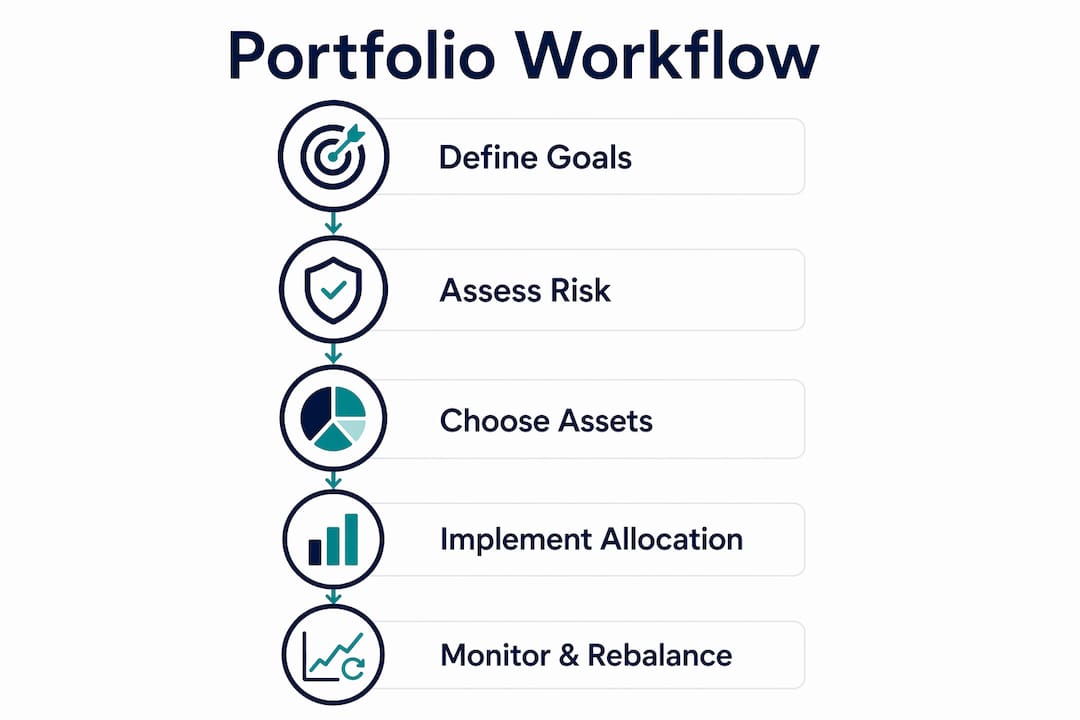
Asset allocation is not a one-time decision. It is a living framework that shifts as your circumstances change. Revisit your goals and risk profile at least every two years, or after any major life event.
How do you design your asset allocation and diversification strategy?
Strategic asset allocation is the long-term target mix of growth and defensive assets defined by your goals and risk tolerance. It often involves a glide path, gradually shifting toward defensive assets as retirement approaches, while retaining enough growth exposure to counter inflation.
For investors aged 35–65, research points to clear benchmarks. A growth profile typically allocates 70% to growth assets and 30% to defensive assets, with a minimum seven-year investment horizon. An aggressive profile moves toward 90% growth with a minimum nine-year horizon. These are starting points, not prescriptions.
Choosing your asset classes
A well-structured allocation spreads across multiple asset classes:
| Asset class | Role in portfolio | Key consideration |
|---|---|---|
| Australian shares | Growth, franking credits | Concentration risk in banking and mining |
| International shares | Growth, global diversification | Currency exposure, broader sector access |
| Property | Growth, inflation hedge | Illiquidity, geographic concentration risk |
| Bonds and fixed income | Defensive, income | Interest rate sensitivity |
| Cash | Capital preservation, liquidity | Inflation erosion over long periods |
| Alternatives | Diversification, low correlation | Complexity, fees |
The ASX concentration problem
The ASX 200 represents only about 2% of global market capitalisation. The big four banks alone account for approximately 25% of the index. An investor holding only Australian shares is not diversified. They are heavily exposed to domestic financials and resources. Adding international shares through a broad global ETF addresses this directly.
Geographic clustering creates hidden concentration risk in property too. Owning three investment properties in the same suburb is not diversification. True property diversification spreads across types and locations.
Pro Tip: Check your superannuation fund's underlying holdings. Many default options are already weighted toward Australian shares. Your total portfolio, including super, may be far less diversified than you think.
What are the practical steps to implement your diversification workflow?
Implementation is where most investors either get it right or introduce unnecessary cost and complexity. The core principle is simple: use low-cost, broad-market vehicles to capture the asset classes you have targeted.
Key implementation decisions include:
- ETFs vs managed funds. Low-cost index ETFs listed on the ASX give you access to Australian shares, global shares, bonds, and property in a single trade. Holding 1–3 broad-market ETFs often suffices for retail investors to achieve global diversification. More funds add complexity with little additional benefit.
- Core-satellite structure. A core of broad index ETFs (80–90% of the portfolio) provides stable, low-cost diversification. A satellite of individual shares, sector ETFs, or alternatives (10–20%) allows for targeted positions without distorting the overall risk profile.
- Direct shares. Suitable for investors who want specific exposures, franking credit management, or tax-loss harvesting. Requires more active monitoring and a larger portfolio to achieve meaningful diversification.
- Superannuation. Your super is part of your total investment portfolio. Align your super investment option with your overall asset allocation target, not in isolation.
Watch for the overlap trap. Investors risk holding multiple ETFs with heavy concentration in the same top holdings, which nullifies diversification benefits. Before adding a new fund, check its top 10 holdings against what you already own.
Document your allocation rationale. Write down why you chose each asset class, what percentage you are targeting, and what would trigger a change. This discipline protects you from reactive decisions during market downturns.
For investors thinking about high income diversification, the same principle applies: spread income sources across asset classes rather than concentrating in a single high-yield sector.
How do you maintain and rebalance your portfolio over time?
Portfolio drift is what happens when market movements push your actual allocation away from your target. A portfolio that started at 70% growth and 30% defensive can drift to 80/20 after a strong equity market run. That drift increases your risk exposure without any deliberate decision on your part.
Regular reviews and rebalancing restore your target allocation and keep your risk profile intact. Three common rebalancing approaches work well for self-directed investors:
- Time-based rebalancing. Review and rebalance on a fixed schedule, typically every six or twelve months. Simple and predictable.
- Threshold-based rebalancing. Rebalance when any asset class drifts more than 5% from its target. More responsive to market movements, but requires regular monitoring.
- Cash-flow rebalancing. Direct new contributions or dividend reinvestments toward underweight asset classes. Tax-efficient and avoids selling costs.
Pro Tip: Use cash-flow rebalancing first. Directing new money to underweight assets avoids triggering capital gains tax events that selling would create.
Emotional decision-making is the biggest threat to a long-term diversification strategy. Diversification manages risk by spreading exposure across asset classes, sectors, and geographies, but it does not eliminate volatility. Selling during a downturn locks in losses and breaks the compounding effect you have been building.
Common mistakes that undermine a well-designed workflow include chasing recent performance, adding complexity without purpose, ignoring fees, and failing to account for tax consequences when rebalancing. Review your goals and risk profile at each rebalancing point. If your circumstances have changed, update your allocation deliberately rather than reactively.
For investors approaching retirement, the focus of asset allocation shifts from maximising returns to managing portfolio behaviour during downturns and ensuring income sustainability. That shift should be planned, not triggered by a market event.
Key takeaways
A disciplined portfolio diversification workflow, grounded in clear goals, strategic asset allocation, and regular rebalancing, is the primary driver of long-term investment outcomes for Australian investors aged 35–65.
| Point | Details |
|---|---|
| Asset allocation drives outcomes | Allocation decisions explain 90–94% of long-term return variability, making them your most important choice. |
| Define goals before allocating | Set specific dollar targets and time horizons before choosing any asset class or investment vehicle. |
| Address ASX concentration risk | The ASX 200 covers only 2% of global markets, so international shares are a necessary diversification tool. |
| Keep implementation simple | One to three broad-market ETFs typically deliver sufficient global diversification for most retail investors. |
| Rebalance with discipline | Use time-based or cash-flow rebalancing to restore target allocations and avoid emotional drift during volatility. |
Why discipline matters more than complexity
The investors I see struggle most with diversification are not the ones who know too little. They are the ones who know enough to overcomplicate things. They hold twelve ETFs, three managed funds, two direct share portfolios, and an investment property, and they still feel uncertain because they have never written down a clear allocation target.
A workflow does not need to be elaborate to be effective. What it needs is clarity. You need to know your target allocation, your rebalancing trigger, and your review schedule. Everything else is detail.
The hardest part of a long-term diversification strategy is not the design. It is sitting still during a market correction when every instinct tells you to act. The workflow exists precisely for that moment. When you have a written plan, you have something to return to instead of reacting.
I have also seen investors ignore their superannuation when thinking about diversification. Your super is not separate from your portfolio. It is often your largest asset. If your super default option holds 60% Australian shares and your personal portfolio adds another 30% in ASX-listed ETFs, your combined exposure to domestic equities is far higher than either account suggests on its own.
The investors who build real wealth over 20 to 30 years are not the ones who found the best stock. They are the ones who built a clear diversification strategy, stuck to it through multiple market cycles, and reviewed it regularly without overreacting.
— Jonathan
How Alphaiq supports your investment diversification workflow
Alphaiq is built for Australian investors who want to model their financial position with real numbers rather than rough estimates.

The platform brings together your investments, superannuation, property, and retirement projections in one place, so you can see your true total portfolio allocation rather than managing each account in isolation. Alphaiq's scenario modelling lets you test different asset allocation splits, run capital gains projections, and assess how your current diversification aligns with your retirement income goals. The super calculator helps you project retirement savings and identify whether your current allocation will deliver the income you need. For self-directed investors who want clarity without the cost of ongoing advice, Alphaiq provides the tools to make informed, confident decisions at every stage of your workflow.
FAQ
What is a portfolio diversification workflow?
A portfolio diversification workflow is a structured process for allocating investments across asset classes, sectors, and geographies to manage risk and pursue returns aligned with your goals. It covers goal setting, asset allocation, implementation, and regular rebalancing.
How much does asset allocation affect investment returns?
Asset allocation decisions explain between 90% and 94% of the variability in long-term portfolio returns, making it the single most influential factor in investment outcomes.
What is a good asset allocation for investors aged 35–65?
A growth profile typically allocates 70% to growth assets and 30% to defensive assets with a minimum seven-year horizon. An aggressive profile moves toward 90% growth for longer horizons. The right split depends on your specific goals and risk capacity.
How often should you rebalance your portfolio?
Most self-directed investors rebalance annually or when any asset class drifts more than 5% from its target. Cash-flow rebalancing, directing new contributions to underweight assets, is a tax-efficient alternative to selling.
Why is international diversification important for Australian investors?
The ASX 200 represents only about 2% of global market capitalisation and is heavily concentrated in banking and mining. Holding only Australian shares creates significant sector concentration risk that international exposure directly reduces.