
TL;DR:
- Wealth simulation uses probabilistic models to assess how your retirement plan withstands diverse market conditions, surpassing simplistic average-return assumptions. It reveals sequence risk, improves stress-testing, and helps optimize strategies by analyzing thousands of potential futures. Proper inputs and advanced tools enable more accurate, personalized projections, empowering better financial decisions and confidence.
Most financial plans rest on a single assumption: that your investments will return a steady average each year. That assumption feels logical. It is also dangerously incomplete. What is wealth simulation, and why does it matter for your financial future? Wealth simulation replaces fixed-return guesswork with probabilistic modelling, running thousands of possible market scenarios to show you how your plan holds up under real conditions, not idealised ones. If you are between 30 and 55 and serious about your retirement readiness, this guide explains exactly how it works, why it matters, and how to use it.
Table of Contents
- Key takeaways
- What is wealth simulation and how does it work?
- Why wealth simulation matters for your plan
- Simulation methods and tools for Australian investors
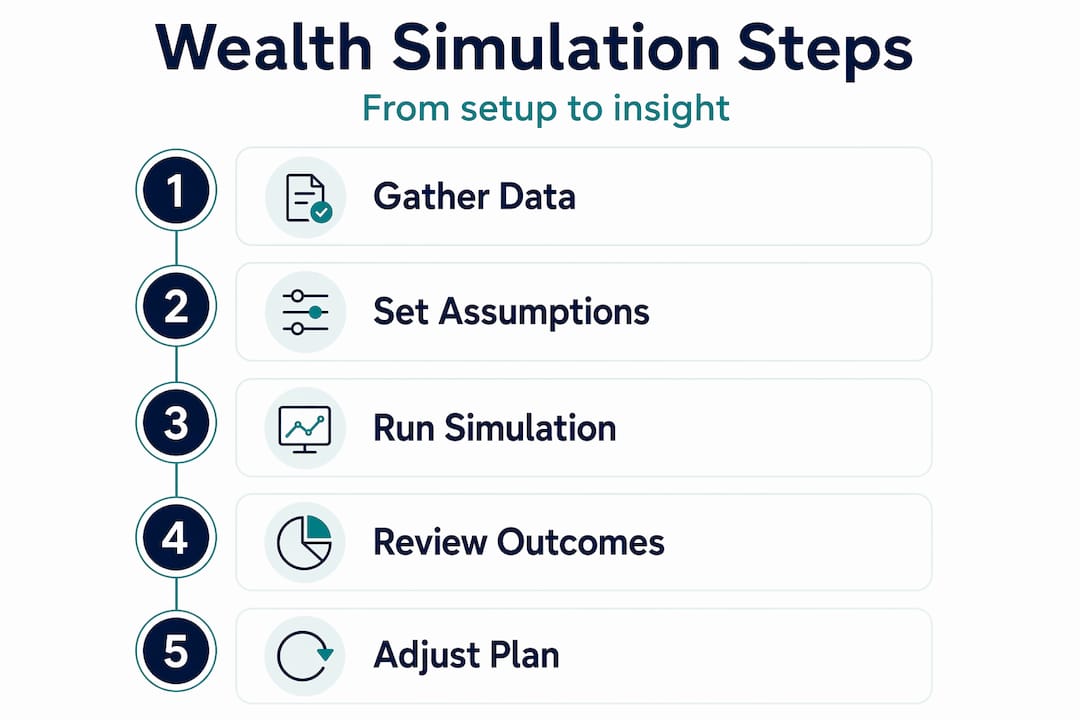
- How to simulate wealth scenarios step by step
- Limitations and pitfalls to avoid
- My take on why simulation is still underused
- See your financial future with Alphaiq
- FAQ
Key takeaways
| Point | Details |
|---|---|
| Simulation beats averages | Wealth simulation models thousands of scenarios, revealing risks that average-return calculations completely miss. |
| Success rate is your benchmark | A simulation success rate of 90% or above signals a robust retirement plan worth building on. |
| Sequence risk is the hidden threat | Poor market returns early in retirement can derail a plan even when long-term averages look fine. |
| Tools are increasingly accessible | Australian investors can now access tax-aware simulation platforms without paying for ongoing financial advice. |
| Assumptions drive accuracy | The quality of your inputs, including realistic returns, inflation, and expenses, determines how useful your results are. |
What is wealth simulation and how does it work?
The wealth simulation definition, at its core, is straightforward. It is the process of using computational modelling to project the future value of your financial assets across a wide range of possible market conditions, rather than assuming one fixed outcome. Instead of asking "what happens if my portfolio returns 7% every year?", a wealth simulation asks "across thousands of possible futures, how often does my plan survive?"
The primary technique behind most wealth management simulations is called Monte Carlo simulation. Think of it this way: imagine rolling a pair of dice 10,000 times and recording every outcome. You are not predicting any single roll. You are mapping the full range of probable results. Monte Carlo simulations test thousands of random market return scenarios to calculate the probability that your portfolio survives your retirement.
The outputs from a well-constructed simulation are far richer than a single projected balance. They typically include:
- Success probability: the percentage of scenarios where your money lasts the full retirement period
- Median outcome: the middle result across all simulated futures
- Worst-case scenario: the bottom percentile outcomes, which reveal real downside exposure
- Best-case scenario: the upper percentile, useful for legacy and estate planning context
To run a simulation, you need to supply realistic inputs. These include your current asset values, expected contributions, anticipated expenses in retirement, assumed inflation rate, and your investment mix. The simulation then layers in historical return data and probability distributions to generate its range of outcomes.
Pro Tip: When you first run a simulation, do not chase the best-case scenario. Focus on the worst-case and median results. Those two numbers tell you far more about the real shape of your financial future.
Why wealth simulation matters for your plan
The most compelling case for wealth simulation is not technical. It is practical. Traditional 7% average return assumptions are dangerous because they mask a critical variable: the sequence in which returns arrive.

Imagine two retirees with identical average returns over 20 years. One experiences strong gains early and a market crash late. The other experiences the crash first. The first retiree is fine. The second may run out of money a decade before they expected to. Simulations expose this sequence risk in a way that simple average-return maths never can.
Beyond sequence risk, wealth simulation delivers several concrete benefits for financial planning:
- Stress-testing against volatility: you can see how your plan performs through scenarios equivalent to the 2008 financial crisis or a prolonged low-growth period, not just in calm markets
- Closing the perception gap: 64% of millionaires do not consider themselves wealthy, often because inflation and lifestyle costs erode purchasing power in ways that are not obvious without objective modelling
- Goal-specific projections: simulations can model your actual lifestyle costs, legacy intentions, and healthcare spending rather than applying generic benchmarks
- Strategy comparison: you can test whether a higher withdrawal rate, a different asset allocation, or a transition to part-time income changes your success probability in measurable ways
A wealth simulation does not predict the future. It maps the probability of your plan surviving a wide range of futures, which is a far more honest and useful thing to know.
Personalised simulations consider individual pension entitlements, legacy goals, and spending flexibility, and dynamic strategies built from simulation insights improve success rates by 5 to 10% over fixed withdrawal rules.
Simulation methods and tools for Australian investors
Understanding wealth simulation tools means knowing which methods are available and what each one does well.
| Method | How it works | Best suited for |
|---|---|---|
| Monte Carlo simulation | Runs thousands of randomised return sequences based on historical data | Retirement income planning, withdrawal rate testing |
| Historical sequence simulation | Uses actual historical return periods to test portfolio survival | Evaluating real-world crash scenarios |
| Fat-Tail (Student's t-distribution) | Models extreme market events more conservatively than normal distributions | Long-term plans requiring greater downside protection |
| Scenario builder | Manually tests specific future conditions (e.g., property sale, inheritance) | Estate planning, tax optimisation, major life events |
Most accessible simulation tools rely on Monte Carlo methodology. For Australian investors, the most relevant applications include superannuation projections, property scenario modelling, debt recycling analysis, and capital gains planning. You can explore retirement projection tools that integrate these methods specifically for the Australian super environment.
Advanced simulation modes using Fat-Tail distributions better capture market crash risk than standard normal distribution models, providing more conservative buffers for long-term security. If your tool only offers a single distribution model, treat its results with some caution.
Scenario builders deserve particular mention for higher-net-worth planning. Advanced planning engines can model complex estate strategies, helping to preserve wealth across generations with precision that manual calculations cannot match.
Pro Tip: Always check which distribution model your simulation tool uses. A tool that assumes normally distributed returns will underestimate the probability of extreme market events. Look for tools that offer Fat-Tail or Student's t-distribution options for more realistic long-term projections.
How to simulate wealth scenarios step by step
Learning how to simulate wealth scenarios effectively comes down to following a disciplined process. The quality of your results depends entirely on the accuracy of your inputs and the rigour of your interpretation.
-
Gather your complete financial picture. List all assets including superannuation, investment accounts, property equity, and cash. Record your current liabilities, annual expenses, and expected income sources in retirement such as the Age Pension, rental income, or part-time work. For ideas on diverse retirement income sources, consider mapping each income stream separately.
-
Set realistic assumptions. Avoid optimistic defaults. For Australian investors, a blended real return assumption of 4 to 5% after inflation is generally more defensible than the often-cited 7% nominal figure. Set your inflation assumption at 2.5 to 3% and choose an expense figure that reflects your actual projected lifestyle, not a generic rule of thumb.
-
Run multiple scenario tests. Do not rely on a single simulation. Test at least three withdrawal rate scenarios: your planned rate, a rate 10% higher, and a rate 10% lower. Then test different asset allocations to see how shifting between growth and defensive assets changes your outcomes.
-
Interpret your success probability carefully. A success rate of 90% or higher indicates a robust retirement plan. Success rates between 75 and 89% are considered acceptable but may warrant adjustments during volatile markets. Anything below 50% signals that your current plan carries high risk and requires meaningful change.
-
Identify the specific failure scenarios. Do not just note your overall success rate. Dig into which scenarios cause failure. Is it an early market crash? Is it longevity? Is it unexpectedly high healthcare costs? This is where simulation transitions from interesting to genuinely useful.
-
Adjust your plan and rerun. Shift one variable at a time. Reduce your annual withdrawal by $5,000 and note the change in success probability. Delay retirement by two years and observe the impact. Each adjustment teaches you something specific about the levers you actually control. For a structured approach to planning retirement income, this iterative process is the core of good practice.
Limitations and pitfalls to avoid
Wealth simulation is a powerful tool. It is not a perfect one. Understanding its limits prevents you from placing more confidence in a model than it deserves.
- Assumptions constrain accuracy. If your inputs are unrealistic, your outputs will be misleading. Using an inflated expected return or an underestimated expense figure will produce an artificially high success rate that does not reflect your real situation.
- No model captures everything. Simulations do not account for sudden job loss, serious illness, divorce, or caring responsibilities. These events can fundamentally alter your financial position in ways no model anticipates.
- Sequence risk nuances vary by tool. Some simpler tools treat each year's return as independent. In reality, market returns exhibit some correlation across periods. More sophisticated tools handle this better, which is why tool selection matters.
- Single model outputs mislead. Running one simulation and treating the result as definitive is a mistake. Run multiple simulations with varied assumptions and treat the range of outcomes as your true picture, not any single number.
Pro Tip: Use simulation results as a compass, not a map. They tell you which direction to head and which risks deserve your attention. A qualified financial adviser can then help you translate those insights into specific actions suited to your circumstances.
My take on why simulation is still underused
In my experience observing how Australians approach financial planning, the gap between what people think they know about their retirement readiness and what a simulation actually reveals is consistently striking. Most people have a number in their head: "I'll need $1.5 million and I'll be fine." That number almost always comes from a rough average-return calculation, not a stress-tested probability model.
What I've seen is that the moment someone runs their first proper simulation, the conversation shifts entirely. They stop asking "will I have enough?" and start asking "under what conditions might I not have enough, and what can I do about it now?" That is a far more productive question. It is also a calmer one, because the simulation gives you a concrete basis for confidence rather than a vague hope.
I've also noticed that the behavioural benefit of simulation is consistently underestimated. Knowing your plan has a 92% success rate across thousands of market scenarios changes how you respond to a sharp market correction. You have a reference point. You are less likely to make a panic-driven decision that undermines a plan that was, statistically speaking, working.
The tools available to everyday Australian investors have improved dramatically. Platforms now offer tax-aware modelling that accounts for superannuation rules, franking credits, and capital gains obligations in ways that were previously only accessible through expensive ongoing advice relationships. The opportunity to take control of your own financial modelling, backed by serious analytical capability, has never been more accessible. The main barrier now is awareness, not cost.
— Jonathan
See your financial future with Alphaiq
If this article has clarified what wealth simulation is and how it could sharpen your own financial planning, Alphaiq gives you the tools to put those concepts to work directly.

Alphaiq is an Australian wealth intelligence platform built for self-directed investors who want to model their financial position across superannuation, property, investments, and retirement without paying for ongoing advice. The platform combines tax-aware financial modelling with scenario simulation, so you can run your own projections accounting for capital gains, franking credits, debt recycling, and super projections in one place. You can start with the AlphaIQ super calculator to project your retirement balance, or explore the debt recycling calculator to see how restructuring your debt could accelerate your wealth position. If you are ready to model your full financial picture, the AlphaIQ platform brings all of it together.
FAQ
What is wealth simulation in simple terms?
Wealth simulation is the process of modelling your financial assets across thousands of possible market scenarios to estimate the probability that your plan achieves your goals. Rather than assuming a single average return, it maps a full range of outcomes.
How does Monte Carlo simulation work for retirement planning?
Monte Carlo simulation runs thousands of randomised return sequences based on historical data to calculate the probability that your portfolio survives your retirement. Results include a success rate, median outcome, and worst-case projections.
What success rate should I aim for in a wealth simulation?
A success rate of 90% or above indicates a robust retirement plan. Rates between 75 and 89% are acceptable but may need adjustment during volatile markets, while anything below 50% signals the plan requires significant changes.
Can wealth simulation account for Australian-specific factors like super?
Yes. Platforms built for the Australian market, such as Alphaiq, incorporate superannuation rules, preservation age, contribution caps, franking credits, and capital gains tax into their modelling, making projections far more accurate for Australian investors.
What are the main limitations of wealth simulation?
Simulations depend on the quality of your inputs and cannot predict life events such as illness, job loss, or divorce. They also vary in how well they model sequence risk and extreme market events, so choosing a tool with advanced distribution modelling is worth the effort.