
TL;DR:
- A transition to retirement (TTR) pension allows Australians aged 60 and over to draw income while still working, offering a flexible pathway to reduce work hours gradually. It is an account-based pension that converts to full retirement phase at age 65, with tax advantages on pension payments but ongoing earnings taxed at 15% during the TTR phase. Proper planning around withdrawal limits, tax implications, and lifestyle adjustments is crucial for maximizing its benefits and aligning it with individual goals.
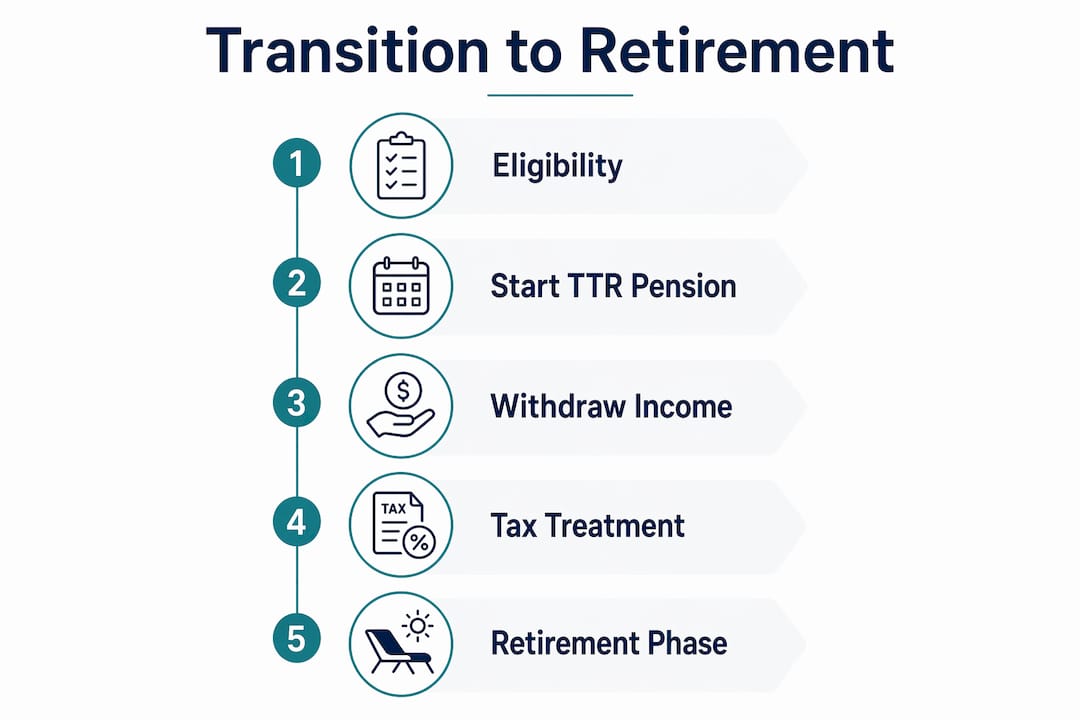
A transition to retirement (TTR) pension is defined as an account-based superannuation income stream that allows Australians aged 60 and over to draw regular income from their super while continuing to work. Administered under rules set by the Australian Taxation Office (ATO) and offered through funds like AustralianSuper, a TTR pension gives you a structured way to reduce your working hours without waiting until you fully retire. The strategy suits people who want to supplement their salary with super income, manage their tax position, or simply ease into a slower pace of work before stopping altogether. Understanding how the retirement transition process works, including its rules, tax treatment, and lifestyle implications, puts you in a far stronger position to act at the right time.

What is a TTR pension and who qualifies?
A TTR pension is an account-based pension that begins at preservation age, which is currently 60 for most Australians. You do not need to retire fully or meet any other condition of release. You simply need to have reached preservation age and be a member of a complying superannuation fund.
The key eligibility and operating rules are:
- Preservation age: You must be at least 60 years old to start a TTR pension under current rules.
- Still working: You can be employed full-time, part-time, or casually. There is no minimum or maximum hours requirement.
- No lump sum withdrawals: A TTR pension pays regular income only. You cannot take a one-off lump sum from the pension account while in the TTR phase.
- Withdrawal limits: You must withdraw between 4% and 10% of your account balance each financial year, calculated on the balance as at 1 July. For example, a $500,000 TTR balance means your annual pension income must fall between $20,000 and $50,000.
- Automatic conversion: Your TTR pension converts to a retirement phase pension at age 65, or earlier if you meet a full condition of release such as retiring permanently.
Once your pension moves into the retirement phase, the 10% withdrawal cap disappears and your fund earnings become tax-free. That conversion is a significant financial milestone worth planning for well in advance.
Pro Tip: If you start your TTR pension part-way through a financial year, the minimum withdrawal is calculated on a pro-rata basis for that first year. The maximum 10% cap, however, applies in full regardless of when you commence. Time your start date carefully to avoid drawing more than you need.
How is a TTR pension taxed?
Tax treatment is one of the most misunderstood aspects of the retirement transition process, and getting it wrong can cost you real money. There are two separate layers of tax to understand: tax on earnings inside the fund, and tax on the pension payments you receive.
| Tax layer | TTR phase | Retirement phase (post-65 or full retirement) |
|---|---|---|
| Earnings inside the fund | Taxed at 15% | Tax-free |
| Pension payments (age 60+) | Tax-free from a taxed fund | Tax-free from a taxed fund |
| Lump sum withdrawals | Not permitted | Permitted, conditions apply |
The 15% tax on fund earnings during the TTR phase is the key distinction that changed in 2017. Before that year, TTR fund earnings were also tax-free, making the strategy a straightforward tax arbitrage. Today, the earnings tax reduces but does not eliminate the strategy's value.
Pension payments you receive after age 60 from a taxed super fund remain completely tax-free. This means the income you draw from your TTR pension does not appear on your tax return and does not affect your Medicare levy calculation. For someone on a marginal tax rate of 34.5% or higher, replacing part of their salary with TTR pension income produces a genuine tax saving.
The financial advantage of TTR depends heavily on the interplay between your pension withdrawals and the 15% earnings tax inside the fund. This is why asset allocation within the TTR account matters. Holding growth assets that generate capital gains inside a TTR fund carries a higher tax cost than holding them in a retirement phase account. Reviewing your investment mix at the point of starting a TTR pension is a practical step most people overlook.
Pro Tip: Pairing a TTR pension with a salary sacrifice arrangement can amplify the tax benefit. You draw tax-free pension income to replace take-home pay, then redirect pre-tax salary into super at the 15% contributions tax rate. Use Alphaiq's salary sacrifice calculator to model whether this combination works for your income level.
What lifestyle and financial planning goes into transitioning to retirement?
The financial mechanics of a TTR pension are only part of the picture. Retirement transition involves emotional and identity shifts that are just as significant as the numbers, and planning for both gives you a much smoother experience.
Reducing your working hours is the most common reason people start a TTR pension. Moving from five days to three, or stepping back from a senior role to a less demanding one, changes your income, your routine, and your sense of purpose. AARP research recommends deliberately detaching from your work identity and building new structures around time, relationships, and activities before you stop work entirely. This is not soft advice. People who plan their post-work purpose report higher satisfaction and lower financial anxiety during the transition.
On the financial side, the first months after reducing work hours carry specific risks:
- Cashflow adjustment: Your regular income drops. Map your monthly expenses before you reduce hours so you know exactly how much TTR pension income you need to draw.
- Avoiding large financial decisions: Advisers recommend a 'cooling off' period in the first 100 days of any major life transition. Avoid selling property, making large investments, or restructuring debt until your new cashflow pattern is clear.
- Debt management: If you carry a mortgage or other debt, using TTR income to accelerate repayments before full retirement reduces your fixed costs and improves long-term income sustainability.
- Savings top-up: Some people use TTR pension income to maintain their lifestyle while directing more of their salary into super via salary sacrifice, building a larger balance for full retirement.
Planning your retirement income strategy before you reduce hours, rather than after, gives you the clearest picture of what is achievable and what trade-offs you are making.
What are the advantages and limitations of a TTR strategy?
A TTR pension is a useful tool, but TTR advantages are conditional and best suited to people working past 60 with specific financial circumstances. Treating it as a universal tax solution leads to poor outcomes.
The main advantages are:
- Supplemented income with reduced hours. You can cut your working week and replace lost salary with tax-free pension income, maintaining your lifestyle without drawing down savings.
- Tax optimisation potential. For people on higher marginal tax rates, replacing taxable salary with tax-free pension income reduces the overall tax paid on your income.
- Super balance growth via salary sacrifice. Redirecting pre-tax salary into super while drawing TTR income can grow your retirement balance faster than simply working and saving.
- Gradual lifestyle adjustment. Easing into retirement over two or three years is less disruptive than stopping work abruptly, both financially and psychologically.
The key limitations are:
- Capped withdrawals. The 10% annual cap means you cannot draw large amounts from your TTR account. A $300,000 balance limits you to a maximum of $30,000 per year.
- Earnings still taxed at 15%. The 2017 rule change removed the tax-free earnings benefit, reducing the strategy's attractiveness for people who are not also salary sacrificing.
- Complexity. Scenario planning across tax, cashflow, and withdrawal sequencing is necessary to confirm whether a TTR pension actually improves your position. The numbers do not always favour starting one.
- SMSF compliance requirements. For self-managed super fund members, starting a TTR pension involves trustee processes including fund valuation at market value and specific documentation, adding administrative responsibility.
The most common pitfall is confusing the tax treatments and assuming the strategy is always beneficial. Run the numbers for your specific balance, income, and working arrangement before committing.
Key takeaways
A TTR pension delivers real financial and lifestyle benefits for Australians aged 60 and over, but only when the withdrawal amounts, tax position, and lifestyle goals are planned together rather than treated as separate decisions.
| Point | Details |
|---|---|
| Eligibility starts at 60 | You must have reached preservation age and be a member of a complying super fund. |
| Withdrawals are capped at 4–10% | Annual pension income must fall within this range, calculated on your 1 July balance. |
| Earnings taxed at 15% in TTR phase | Pension payments to you are tax-free after 60, but fund earnings are not. |
| Lifestyle planning matters as much as finances | Reducing work hours triggers identity and cashflow changes that need deliberate preparation. |
| TTR converts at 65 | At age 65, the pension moves to retirement phase with tax-free earnings and no withdrawal cap. |
Why I think most people start a TTR pension too late
People approaching 60 often treat the transition to retirement as something to organise in the final few months before they reduce hours. In my experience, that timing creates unnecessary pressure and leaves money on the table.
The salary sacrifice and TTR combination works best when you have two or three years to run it. Starting at 62 or 63, rather than 59, gives you time to build your super balance through concessional contributions while drawing tax-free income to cover reduced salary. The compounding effect of those extra contributions, even over two years, is meaningful at balances above $400,000.
The other thing I see consistently is people underestimating the lifestyle adjustment. The financial plan is usually solid. The identity shift is not planned at all. Someone who has worked full-time for 35 years and drops to three days a week often finds the first six months disorienting, regardless of how well the cashflow works. Planning what you are moving towards, not just what you are moving away from, changes the experience entirely.
The TTR strategy is also not for everyone. If your super balance is below $200,000, the withdrawal amounts are modest and the 15% earnings tax may outweigh the benefit of tax-free pension income. The strategy rewards people with larger balances, higher marginal tax rates, and a genuine plan to reduce hours rather than stop work immediately.
Start modelling your position at 57 or 58. That gives you time to adjust your salary sacrifice rate, review your investment mix inside super, and make the lifestyle decisions from a position of clarity rather than urgency.
— Jonathan
Model your TTR strategy with Alphaiq

Alphaiq's wealth intelligence platform is built for Australians aged 35 to 65 who want to model their financial position with real numbers rather than rough estimates. The superannuation calculator lets you project your super balance under different TTR withdrawal scenarios, salary sacrifice rates, and retirement ages, so you can see exactly how each decision affects your long-term income. You can also model the tax impact of combining a TTR pension with salary sacrifice, compare outcomes across different start dates, and stress-test your cashflow against reduced working hours. Explore the full Alphaiq platform to take control of your retirement transition planning with confidence.
FAQ
What is the preservation age for a TTR pension in Australia?
The preservation age for starting a TTR pension is currently 60 for most Australians. You must have reached this age and be a member of a complying superannuation fund to commence a TTR income stream.
Can I take a lump sum from my TTR pension?
No. A TTR pension only allows regular income payments within the 4% to 10% annual withdrawal range. Lump sum withdrawals are not permitted until you meet a full condition of release, such as retiring permanently or reaching age 65.
Are TTR pension payments taxable income?
Pension payments from a TTR account are tax-free for Australians aged 60 and over who are members of a taxed super fund. However, earnings inside the TTR fund are still taxed at 15% until the pension converts to retirement phase.
When does a TTR pension convert to a retirement phase pension?
A TTR pension automatically converts to a retirement phase pension at age 65. It can also convert earlier if you permanently retire or meet another full condition of release. Once converted, fund earnings become tax-free and the 10% withdrawal cap no longer applies.
Is a TTR strategy worth it for everyone?
A TTR pension is most beneficial for Australians working past 60 with super balances above $200,000, higher marginal tax rates, and a plan to reduce rather than stop work. For people with smaller balances or those planning to retire immediately, the 15% earnings tax inside the TTR phase may reduce the strategy's net benefit.