
TL;DR:
- Investment simulations use virtual funds to mimic market conditions and help investors practice strategies without risking real money. They include stock trading and long-term Monte Carlo models that improve emotional resilience and decision-making skills, but are limited by data delays and lack of real consequences. Most investors should view simulations as tools for ongoing testing and self-awareness rather than guarantees of future success.
Investment simulations are digital tools that replicate real financial market conditions using virtual money, letting you practise trading and test portfolio strategies without risking actual capital. Known in the industry as paper trading or virtual trading, these tools give both aspiring and experienced investors a risk-free environment to build skills and refine their approach. Platforms like the Investopedia Simulator, TradingSim, and Monte Carlo simulation engines each serve different investing goals. Whether you are learning the basics of share trading or stress-testing a retirement drawdown strategy, understanding what investment simulations are is the first step to using them well.
What are investment simulations and how do they work?
Investment simulations, also called paper trading or virtual trading, let you buy and sell assets using simulated money without touching real capital. Most platforms provide free access but require account registration. The mechanics mirror live markets closely enough to build genuine skill.

The core engine behind most stock simulators uses delayed market data. Most free paper trading platforms carry a 15–20 minute data delay, which means prices you see are not the prices a live trader acts on. This gap matters. Ignoring it creates unrealistic expectations about how quickly you can enter or exit a position at a target price.
Two distinct simulation types serve different investor needs:
- Real-time trading simulators replicate daily share market activity. You place orders, track positions, and manage a virtual portfolio using current or near-current price data. Tools like the Investopedia Simulator and TradingSim fall into this category.
- Monte Carlo portfolio simulators take a longer view. These engines run thousands of randomised scenarios over periods of 1 to 50 years, modelling the probability that your portfolio survives a given withdrawal rate or reaches a target balance. A 90% or higher success rate across those scenarios signals a sound retirement plan.
- Specialised simulators cover derivatives, options, forex, and futures. These tools replicate the mechanics of complex instruments before you commit real money to them.
Pro Tip: When you first use a stock simulator, set your virtual capital to match what you would realistically invest in real life. Practising with $1,000,000 in virtual funds when your actual budget is $20,000 builds habits that do not transfer to live trading.
What are the main benefits of investment simulations?
Simulations deliver benefits that go well beyond basic practice. The most significant is psychological. Simulations remove fear of failure, letting you experience the emotional highs and lows of market volatility without the financial consequences. That emotional preparation carries real value when you eventually commit actual capital.
The practical benefits build on that foundation:
- Learn market mechanics safely. You can practise placing market orders, limit orders, and stop-losses without any cost. Understanding how order types work is foundational knowledge that most investors skip when they jump straight into live trading.
- Test and refine strategies. Paper trading enables performance tracking across hundreds of simulated sessions. You can identify which strategies hold up across different market conditions and which ones fail under pressure.
- Understand your own decision-making patterns. Reviewing your simulated trade history reveals whether you cut winners too early, hold losers too long, or overtrade during volatile periods. These patterns are far cheaper to identify in a simulator than in a live account.
- Build confidence before scaling up. Confidence grounded in tracked results is different from confidence based on gut feeling. Simulations give you a record to point to.
- Ongoing experimentation for experienced investors. Seasoned investors use simulators as sandboxes to test new asset classes or complex strategies before live implementation. The tool is not just for beginners.
"Simulations do not just teach you how markets work. They teach you how you work inside markets. That self-knowledge is what separates disciplined investors from reactive ones."
How do different investment simulation tools compare?
The right simulation tool depends on what you are trying to achieve. A day trader testing a short-term momentum strategy needs a different tool than a 55-year-old Australian modelling their superannuation drawdown over 30 years.
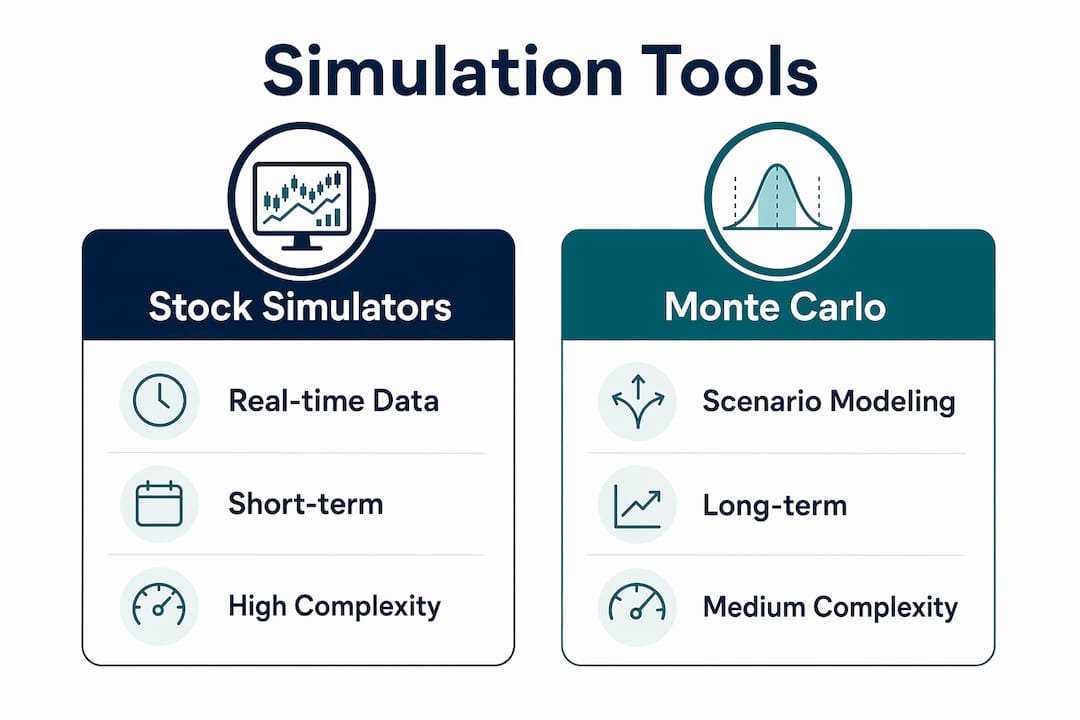
Asset allocation explains over 90% of the variance in returns of diversified portfolios. Individual stock picking accounts for less than 10%. That single fact should shape which type of simulator you prioritise. If you are building long-term wealth, a Monte Carlo portfolio simulator will teach you more than a stock-picking game.
| Tool type | Best for | Data type | Complexity |
|---|---|---|---|
| Stock market simulator (e.g. Investopedia Simulator) | Learning share trading, testing short-term strategies | 15–20 min delayed live data | Low to medium |
| Monte Carlo portfolio simulator (e.g. Fire Planner) | Retirement planning, long-term asset allocation | Historical and randomised scenarios | Medium to high |
| Options and derivatives simulator | Practising complex instruments before live use | Varies by platform | High |
| Replay-based simulator (e.g. TradingSim) | Backtesting strategies on historical price data | Historical replay | Medium |
Stock simulators replicate real exchange environments, covering stocks, bonds, options, futures, and foreign currency within a risk-free digital space. That breadth means you can use a single platform to build familiarity across multiple asset classes before you diversify your live portfolio.
Pro Tip: If your primary goal is retirement planning, prioritise a Monte Carlo simulator over a stock trading simulator. The probabilistic output, showing your chance of not running out of money, is far more useful for long-term planning than a simulated profit and loss statement.
What are the common pitfalls of investment simulations?
Simulations are powerful, but they carry specific limitations that can mislead you if you are not aware of them. The most common is the simulator trap. The 15–20 minute data delay on most free platforms means your simulated fills do not reflect real execution conditions. In a fast-moving market, that gap can represent a significant price difference.
Other pitfalls to watch for:
- Emotional disconnect. Simulated losses feel nothing like real losses. The discipline you build in a simulator may not fully transfer to live trading, where the stakes are real and the emotions are amplified.
- Overconfidence from simulated profits. Strong performance in a simulator does not guarantee live success. Execution costs, slippage, and the psychological weight of real money all affect outcomes.
- Overreliance on historical data. Simulators test strategy robustness against historical and randomised market conditions, but they cannot predict future events like a global pandemic or a sudden interest rate shock.
- Ignoring sequence-of-returns risk. For retirement planning, the order in which returns occur matters as much as the average return. A Monte Carlo simulator that does not stress test early negative returns in retirement can give you a false sense of security.
- Treating simulation results as guarantees. A 90% Monte Carlo success rate means a 10% chance of running out of money. That residual risk deserves attention, not dismissal.
The fix for most of these pitfalls is the same: treat simulation results as one input among several, not as a final answer.
How can you use investment simulations in your financial decision-making?
Integrating simulations into your investing process requires a structured approach. Ad hoc experimentation produces limited insight. A deliberate process produces results you can act on.
- Define a clear hypothesis before you simulate. Decide what you are testing. "I want to see if a 60/40 portfolio survives a 30-year retirement at a 4% withdrawal rate" is a testable hypothesis. "I want to try some trades" is not.
- Use Monte Carlo engines for asset allocation decisions. Because asset allocation drives over 90% of portfolio variance, running scenarios across different allocation mixes gives you far more useful data than testing individual stock picks. Tools that model the Sharpe ratio across allocations help you find the best risk-adjusted return for your situation. You can go deeper on this with Alphaiq's guide to modelling investment returns.
- Stress test sequence-of-returns risk. If you are within 10 years of retirement, run scenarios where your portfolio drops 30% in the first two years of drawdown. Monte Carlo outputs focus on probability of ruin over decades, not average returns. That framing is more honest about retirement risk.
- Track your simulated decisions in a log. Record why you made each decision, not just what the outcome was. Reviewing that log after 30 or 60 sessions reveals your decision-making patterns clearly.
- Test new asset classes before adding them to your live portfolio. Adding property investment trusts, international equities, or infrastructure assets to your live portfolio without prior experience carries unnecessary risk. A simulator lets you understand how these assets behave in your portfolio before you commit.
- Connect simulation outputs to your broader financial plan. A simulation result only has value if it informs a real decision. Use your findings to refine your asset allocation strategy and adjust your live portfolio with confidence.
Key takeaways
Investment simulations are most valuable when used with a clear purpose, an awareness of their limitations, and a commitment to applying what you learn to real decisions.
| Point | Details |
|---|---|
| Definition and purpose | Investment simulations use virtual money to replicate market conditions for practice and strategy testing without financial risk. |
| Two main types | Stock trading simulators suit short-term practice; Monte Carlo engines suit long-term retirement and portfolio planning. |
| Biggest benefit | Simulations build emotional preparedness and reveal personal decision-making patterns before real capital is at stake. |
| Key limitation | Data delays of 15–20 minutes and the absence of real financial consequences mean simulator results do not fully replicate live trading. |
| Best practice | Define a clear hypothesis, track your decisions, and use simulation outputs as one input into your broader financial plan. |
Why I think most investors underuse simulations
Most investors treat simulations as a beginner's tool and move on once they feel confident enough to trade with real money. That is a missed opportunity. The investors I have seen get the most from simulations are the ones who return to them repeatedly, not to practise basics, but to stress test specific decisions before making them live.
The clearest example is sequence-of-returns risk. Many Australians approaching retirement have a general sense that a market downturn early in retirement is bad. Running a Monte Carlo simulation that shows your portfolio depleting by age 75 under a specific scenario makes that risk concrete and personal. It changes the conversation from abstract concern to a specific problem with specific solutions, like adjusting your withdrawal rate or holding a larger cash buffer.
Simulations also helped me think more clearly during volatile markets. When share prices dropped sharply in early 2020, investors who had already modelled a 30% drawdown scenario in a simulator were better prepared emotionally. They had already seen the numbers and worked through the implications. That preparation did not eliminate anxiety, but it reduced the impulse to sell at the worst possible time.
The one caution I would offer is this: do not let simulation confidence become a substitute for real-world judgement. A simulator cannot model your personal tax position, your superannuation balance, or the specific timing of your retirement. Use it to sharpen your thinking, then apply that thinking to your actual situation with the full picture in front of you.
— Jonathan
How Alphaiq helps Australian investors model their financial future
Alphaiq is built for Australian investors who want to move beyond generic simulation tools and model their actual financial position, including superannuation, property, investments, and retirement income, all in one place.
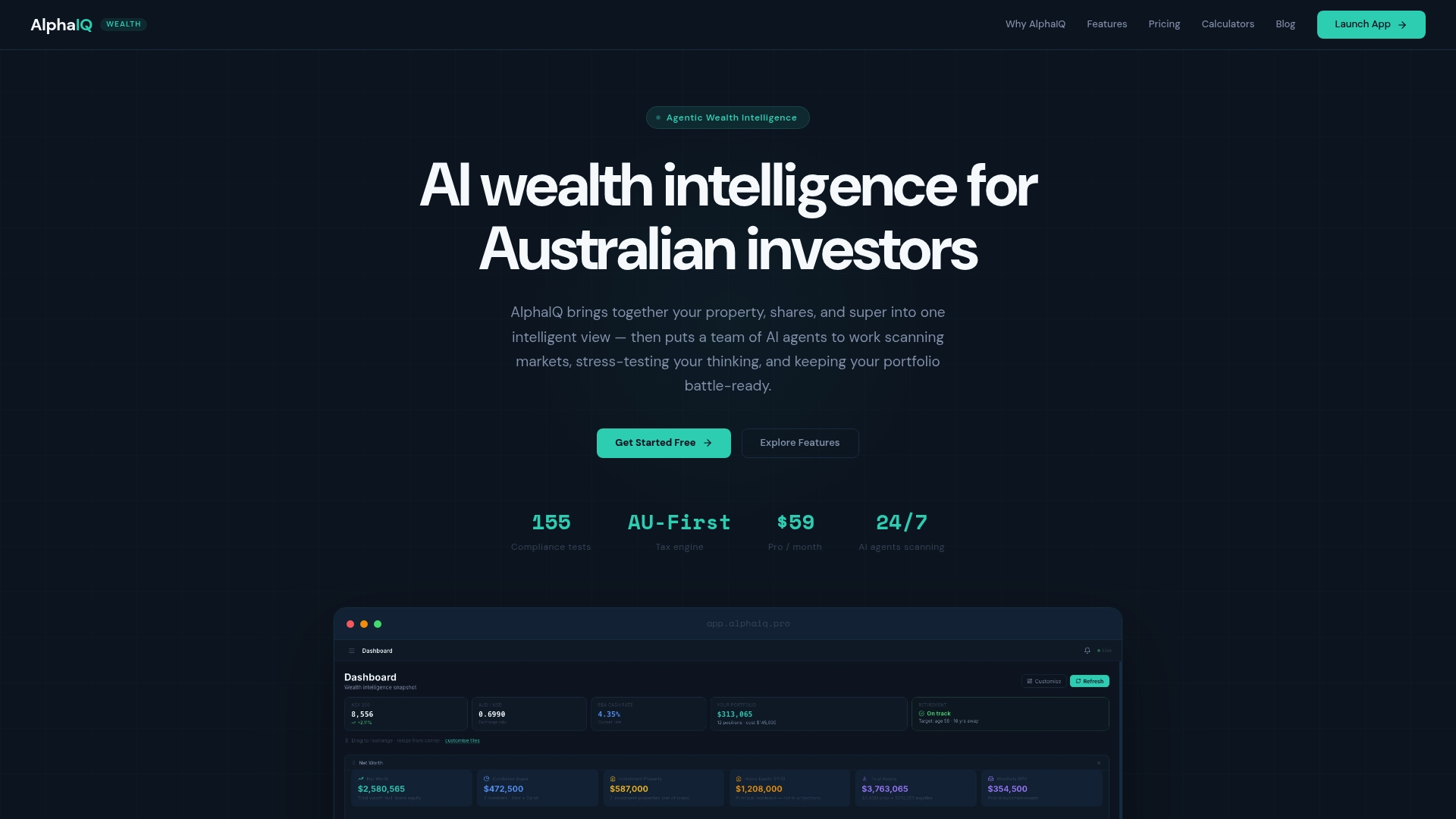
The platform combines tax-aware financial modelling with scenario simulation, giving you clarity on capital gains, franking credits, debt recycling, and super projections. The Alphaiq Super Calculator applies retirement projection techniques to your specific superannuation balance and contribution history, showing you the probability of reaching your retirement income target. For investors who want to put the insights from this article into practice with real numbers, the Alphaiq wealth intelligence platform is the logical next step.
FAQ
What are investment simulations in simple terms?
Investment simulations are digital tools that let you trade shares, bonds, and other assets using virtual money. They replicate real market conditions so you can practise and test strategies without risking actual capital.
How do investment simulations differ from real trading?
The main differences are the absence of real financial consequences and the use of delayed market data. Most free simulators carry a 15–20 minute data delay, which means execution conditions do not fully match a live trading environment.
What is a Monte Carlo simulation in investing?
A Monte Carlo simulation runs thousands of randomised future scenarios to show the probability that your portfolio reaches a target or survives a given withdrawal rate. A 90% or higher success rate across scenarios is generally considered a sound result for retirement planning.
Are investment simulations useful for experienced investors?
Yes. Experienced investors use simulators to test new asset classes and complex strategies before committing real capital. They are a permanent tool for risk management, not just a beginner's training ground.
What is the biggest limitation of investment simulations?
The biggest limitation is the emotional gap between simulated and real trading. Simulated losses carry no financial consequence, so the discipline you build may not fully transfer when real money is at stake. Awareness of this gap is the first step to using simulations effectively.