
TL;DR:
- Investment return modeling uses statistical methods, like Monte Carlo simulations, to estimate portfolio outcomes over time. Proper inputs and consistent assumptions are essential for accurately evaluating retirement success probabilities and managing sequence-of-returns risk. Regularly updating models and acting on the results help optimize portfolios and improve financial resilience.
Investment return modelling is the process of using statistical and computational methods to estimate the range of possible outcomes for your portfolio over time. The industry standard approach is Monte Carlo simulation, which runs thousands of random return paths to produce probabilities rather than single-point guesses. For Australian investors aged 35–65, understanding how to model investment returns is the difference between a retirement plan built on hope and one built on evidence. This guide covers the essential inputs, the Monte Carlo framework, common pitfalls, and how to turn model outputs into better financial decisions.
What are the essential inputs for modelling investment returns?

Every return model is only as reliable as the assumptions you feed into it. Before you run a single simulation, you need five core inputs: expected return, volatility (standard deviation), a correlation matrix across asset classes, your investment time horizon, and your initial portfolio value.
Expected return is not a guess. Institutions like Vanguard and State Street publish capital market assumptions expressed as return distributions for broad asset classes over 10- and 30-year horizons. These are updated regularly as market conditions shift. State Street builds its forecasts by layering inflation, real earnings growth, and credit spread analysis across equities, bonds, and REITs. That layered approach gives you a far more grounded starting point than simply extrapolating past returns.
The distinction between nominal and real return assumptions matters enormously. Nominal returns include inflation; real returns strip it out. If your model uses nominal return inputs, your withdrawal amounts must also be expressed in nominal terms. Mixing the two is one of the most common and consequential errors in return modelling, and it leads directly to incorrect probability estimates.
Here is a checklist of the inputs you need before modelling:
- Expected return per asset class: sourced from published capital market assumptions, not historical averages alone
- Volatility (standard deviation): annualised, matched to the same time horizon as your return forecast
- Correlation matrix: how each asset class moves relative to others, especially during market stress
- Time horizon: the number of years until and through retirement, not just to retirement
- Initial portfolio value and contribution or withdrawal schedule: including the timing convention (start or end of period), which materially affects sequence-of-returns outcomes
- Inflation assumption: used to convert nominal spending targets into real withdrawal amounts
Pro Tip: Always document whether your inputs are nominal or real before you start. A single note at the top of your spreadsheet or model file prevents the most expensive planning mistake you can make.
How does monte carlo simulation model investment returns?
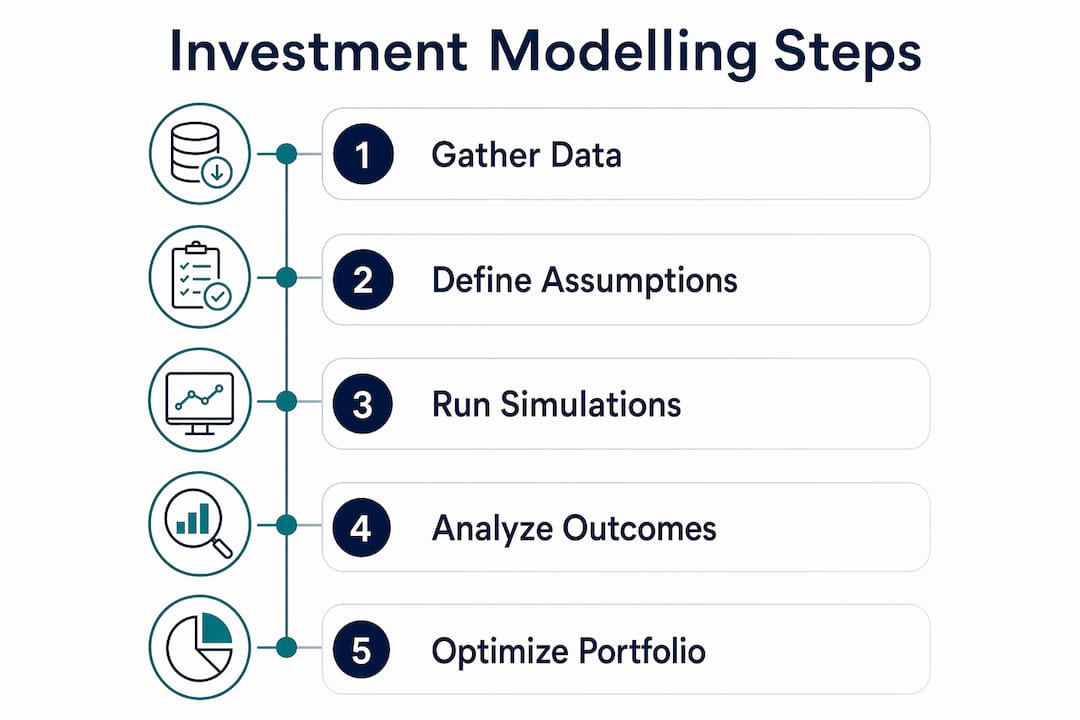
Monte Carlo simulation is the preferred method for investment return forecasting because it replaces a single projected line with a full distribution of outcomes. A standard implementation uses 10,000 simulation paths to capture median terminal wealth and failure probabilities. That scale matters: with fewer paths, tail risks are underrepresented and your probability estimates become unreliable.
Here is how to run a Monte Carlo simulation step by step:
- Define your return distribution. Specify expected return and volatility for each asset class. Decide whether you will use a normal distribution or a fat-tailed distribution. Fat-tailed or bootstrapped distributions better capture extreme losses, which is critical when estimating retirement ruin probability.
- Build your correlation matrix. Estimate how asset classes move together. Apply shrinkage techniques or a factor model to reduce estimation error. Then stress-test for crisis scenarios where correlations rise toward 1, because diversification benefits shrink sharply during market downturns.
- Generate random return paths. For each of your 10,000 simulations, draw a sequence of annual returns consistent with your inputs. Each path represents one possible version of your financial future.
- Apply your withdrawal or contribution rule. Deduct annual spending (or add contributions) from the portfolio at each time step. Use a consistent timing convention throughout.
- Record the outcome for each path. Note whether the portfolio survived to the end of the horizon and what the terminal balance was.
- Aggregate results across all paths. Report median terminal wealth, the 10th and 90th percentile outcomes, and the probability of portfolio ruin.
The output table below illustrates what a typical simulation summary looks like for a $500,000 portfolio over 25 years with a 4% annual withdrawal rate:
| Metric | Result |
|---|---|
| Median terminal balance | $820,000 |
| 10th percentile balance | $95,000 |
| 90th percentile balance | $1,740,000 |
| Probability of ruin | 14% |
| Probability of success | 86% |
These numbers are illustrative. Your actual results depend entirely on your inputs.
Pro Tip: Never report a single "expected" outcome from a Monte Carlo model. Always show at least the median, the 10th percentile, and the probability of ruin. A plan that looks fine at the median can still fail one time in seven.
What pitfalls and sequence-of-returns risks should you avoid?
Sequence-of-returns risk is the single greatest threat to a retirement portfolio that is in drawdown. The order in which returns arrive determines whether your capital lasts, often more than the average return itself. Research comparing reversed return sequences found ending balances ranging from $318,000 to $1.96 million and failure rates swinging from 46% to 0% across otherwise identical scenarios. That is a sixfold difference in outcome driven purely by the timing of good and bad years.
The most common modelling errors that distort your results include:
- Mixing nominal and real assumptions. If your return inputs are nominal, your spending withdrawals must be nominal too. Inconsistent treatment of these values produces incorrect probability estimates and can make a fragile plan look sound.
- Using a single expected return. A point estimate ignores the full distribution of outcomes. Treat return forecasts as distributions, not fixed lines.
- Ignoring correlation changes during crises. Asset classes that appear uncorrelated in normal markets often move together during downturns. A model that does not account for this overstates the benefit of diversification at exactly the moment you need it most.
- Neglecting withdrawal timing conventions. Whether withdrawals occur at the start or end of each period changes the effective sequence of returns and shifts failure probabilities in ways that are not trivial.
Sequence-of-returns risk dominates retirement plan success. The order and timing of returns can determine whether capital lasts, more than average returns alone.
Stress testing is the practical antidote to these risks. Run your model with a crisis scenario where correlations spike and returns drop sharply in the first three to five years of retirement. If your plan still shows an acceptable probability of success under that scenario, you have a genuinely resilient strategy. If it does not, you know where to focus your adjustments before they become urgent. For a deeper look at managing this risk, the guide on sequence-of-returns and retirement covers the practical implications in detail.
How can you use modelling results to optimise your portfolio?
Model outputs are only useful if you act on them. The probability of success figure is your primary planning lever. A result above 90% suggests your current strategy is sound. A result below 80% is a signal to adjust your asset allocation, reduce your withdrawal rate, or extend your working years.
Here is how to translate simulation outputs into portfolio decisions:
- Adjust asset allocation based on tail risk. If your 10th percentile outcome is uncomfortably low, shift toward assets with lower volatility or higher income yield. The goal is not to maximise the median but to raise the floor.
- Set a withdrawal rate informed by failure probability. A 4% withdrawal rate is a common starting point, but your actual sustainable rate depends on your specific asset mix, time horizon, and return assumptions. Run the model with your actual numbers, not a rule of thumb.
- Update your capital market assumptions annually. Return forecasts from institutions like Vanguard and State Street change as bond yields and inflation expectations shift. A model built on 2022 assumptions may significantly overstate or understate expected returns in 2026. Staying current on capital market forecasts keeps your plan grounded in current conditions.
- Incorporate tax-aware strategies. For Australian investors, franking credits, debt recycling, and superannuation contribution strategies all affect after-tax returns. A model that ignores tax can overstate the income your portfolio actually delivers.
- Review the plan at major life events. A job change, inheritance, property purchase, or shift in health status all change your inputs. Re-run the model whenever your circumstances change materially.
Pro Tip: Work backwards from your desired retirement income, not forwards from your current savings. Set your spending target first, then use the model to find the asset allocation and savings rate that achieves it with an acceptable probability of success.
Understanding why forecasting investment returns matters as a discipline is a useful complement to running the simulations themselves.
Key takeaways
Effective investment return modelling requires consistent inputs, a probabilistic framework, and the discipline to act on what the outputs reveal.
| Point | Details |
|---|---|
| Use probabilistic methods | Monte Carlo simulation with 10,000 paths produces reliable median and tail-risk estimates. |
| Align nominal and real assumptions | Mixing nominal returns with real withdrawals produces incorrect probability estimates. |
| Account for sequence-of-returns risk | Return order can cause a sixfold difference in ending balance across otherwise identical portfolios. |
| Stress-test correlation assumptions | Crisis scenarios where correlations rise protect against overstating diversification benefits. |
| Act on the outputs | Adjust asset allocation, withdrawal rates, and tax strategy based on failure probabilities, not median outcomes alone. |
Why i think most investors are modelling returns the wrong way
After years of working with financial models and watching how investors actually use them, the pattern I see most often is this: people build a model, get a number they like, and stop there. They treat the median outcome as a plan. They do not look at the 10th percentile. They do not stress-test the correlation assumptions. They certainly do not revisit the model when interest rates move by 200 basis points.
The uncomfortable truth is that a Monte Carlo simulation is not a prediction. It is a structured way of understanding uncertainty. The value is not in the median result. The value is in knowing how bad things could get and whether your plan survives that scenario. A plan with an 85% success rate sounds reassuring until you realise that means roughly one in six versions of your future ends in portfolio ruin.
The other mistake I see constantly is treating capital market assumptions as permanent. Vanguard and State Street publish updated forecasts for a reason. The expected return on Australian equities in 2026 is not the same as it was in 2020. If you built your model three years ago and never updated the inputs, you are not modelling your future. You are modelling a past that no longer exists.
My honest recommendation is to treat return modelling as a habit, not a one-off exercise. Run the model, record the assumptions, and revisit it at least once a year. The investors who do this consistently are the ones who make adjustments early, when they still have options.
— Jonathan
See your retirement numbers with Alphaiq
Alphaiq brings Monte Carlo modelling and tax-aware scenario analysis together in one place, built specifically for Australian self-directed investors. If you want to move from spreadsheet guesswork to a clear picture of your retirement position, the tools are ready.

The Alphaiq Super Calculator uses Monte Carlo methods to project your superannuation balance and estimate portfolio sustainability across thousands of scenarios, giving you success rates and median outcomes tailored to your actual inputs. Pair it with the Debt Recycling Calculator to model how converting non-deductible debt into investment debt could improve your after-tax returns and accelerate your wealth position. Both tools are free to use and require no ongoing financial advice fees.
FAQ
What is monte carlo simulation in investment modelling?
Monte Carlo simulation generates thousands of random return paths using your expected return, volatility, and correlation inputs to produce a distribution of portfolio outcomes. Standard implementations use 10,000 paths to estimate median terminal wealth and the probability of portfolio ruin.
What is sequence-of-returns risk?
Sequence-of-returns risk is the danger that poor returns early in retirement, when withdrawals begin, permanently reduce your capital base. Research shows identical average returns can produce ending balances ranging from $318,000 to $1.96 million depending solely on the order returns arrive.
Should i use nominal or real return assumptions?
Use one consistently throughout your entire model. If your return inputs are nominal, your withdrawal amounts must also be nominal. Mixing the two produces incorrect probability estimates and is one of the most common planning errors in return modelling.
How often should i update my return model?
Update your model at least once a year or whenever your circumstances change materially. Capital market assumptions from institutions like Vanguard and State Street are revised regularly, and a model built on outdated inputs will produce unreliable projections.
What probability of success should i aim for in retirement modelling?
A probability of success above 90% is generally considered sound for a retirement plan. Results below 80% signal a need to adjust your asset allocation, reduce your withdrawal rate, or reconsider your retirement timeline.