
TL;DR:
- Superannuation management involves actively monitoring and adjusting your retirement funds to meet savings goals and comply with regulations. Regular reviews, contribution planning within the 2026/27 caps, and age-specific investment strategies are essential to close the retirement savings gap.
Superannuation management is the process of proactively monitoring and adjusting your retirement funds to align with your savings goals and regulatory requirements. Most Australians rely on employer contributions alone, yet the average balance for ages 60–64 sits at around $263,400. The ASFA comfortable retirement target is $540,000 for singles and $720,000 for couples. That gap is significant, and closing it requires more than passive participation. This guide covers the key steps: assessing your current position, understanding the 2026/27 contribution caps, selecting the right investment strategy, and reviewing your plan regularly.
How to assess your current superannuation position
Your starting point is knowing exactly what you have. Many Australians hold multiple super accounts from different jobs, each charging its own fees and insurance premiums. That duplication quietly erodes your balance over time.
Check your balance and locate lost super
- Log in to myGov and link your Australian Taxation Office (ATO) account.
- View all super accounts registered under your Tax File Number (TFN).
- Check for any lost or unclaimed super the ATO may be holding on your behalf.
- Download recent fund statements to review fees, insurance costs, and investment returns.
- Compare your current balance against ASFA benchmarks for your age group.
Locating lost super takes less than ten minutes through myGov. Many people are surprised to find accounts they forgot about from casual or part-time work years earlier.
Should you consolidate your super accounts?

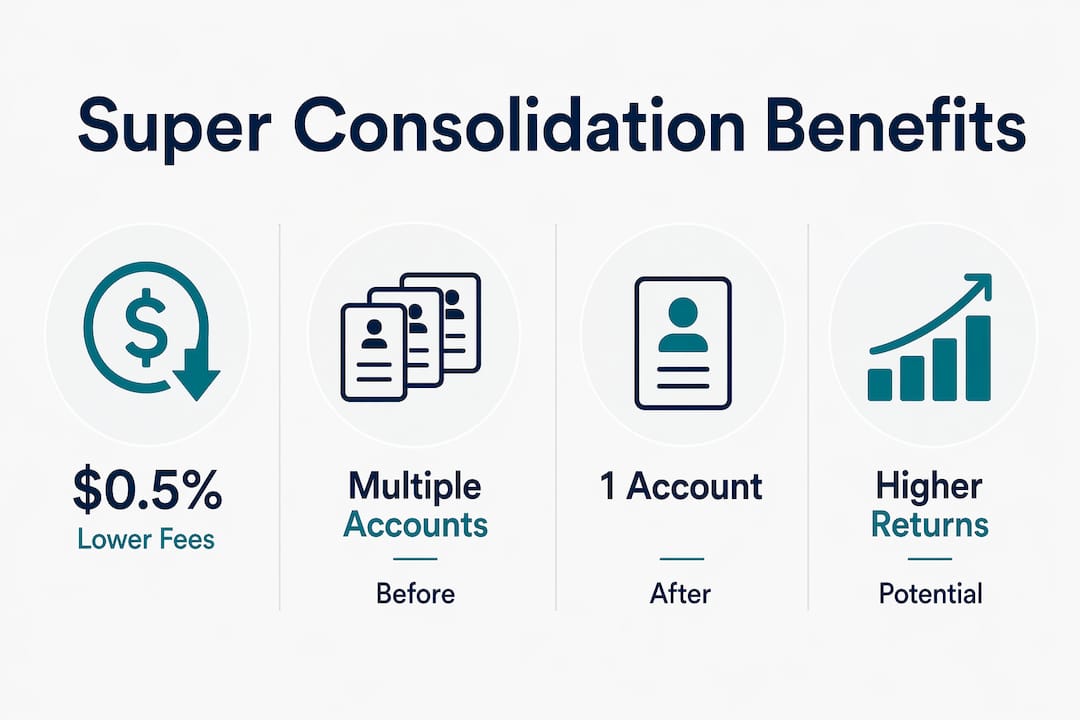
Consolidating multiple accounts into one fund can reduce annual fees from the 1–2% range down to around 0.5%. That difference compounds significantly over a decade or more. Before you consolidate, check two things: whether your existing fund provides insurance cover you would lose by closing the account, and whether any exit fees apply. Consolidation can affect insurance coverage, so review your policy documents carefully before proceeding.
Pro Tip: Call your current fund directly and ask what insurance cover is attached to your account before initiating a rollover. This one step prevents a common and costly mistake.
What are the 2026/27 superannuation contribution caps?
The contribution caps updated from 1 july 2026 are the most important numbers in your superannuation contribution strategy guide. Getting these wrong results in excess contributions tax, which can be painful and avoidable.
Contribution caps at a glance
| Contribution type | 2026/27 cap | Key rule |
|---|---|---|
| Concessional (pre-tax) | $32,500 | Includes employer SG contributions |
| Non-concessional (after-tax) | $130,000 | Subject to total super balance limits |
| Bring-forward (3 years) | $390,000 | Eligibility based on 30 june balance |
| Carry-forward (unused concessional) | Up to 5 years | Requires balance under $500,000 |
From 1 july 2026, the concessional cap rises to $32,500 and the non-concessional cap to $130,000. The bring-forward rule allows eligible individuals to contribute up to $390,000 in non-concessional contributions across three years. That is a powerful catch-up tool for anyone in their 50s who has the capacity to inject a lump sum.
Key points on concessional contributions
- Your employer's Super Guarantee (SG) contributions count toward your $32,500 concessional cap. This leaves less room for salary sacrifice than many people expect.
- Concessional contributions are taxed at 15% inside super, compared to marginal rates that can reach 47%. The tax saving is the primary reason to prioritise voluntary contributions.
- Unused concessional caps can be carried forward for up to five years if your total super balance was under $500,000 at the prior 30 june. This rule rewards those who had career breaks or lower-income years.
- Bring-forward eligibility depends on your total super balance as at 30 june of the year before you contribute. Missing this date check is a common reason people either miss the opportunity or trigger a penalty.
Pro Tip: If you have two or more jobs, ask each employer for a contribution statement at the end of each financial year. Exceeding the concessional cap across multiple employers is more common than people realise.
Pairing your contribution planning with retirement tax strategies can further reduce your overall tax burden, particularly in the years approaching preservation age.
How should you invest your super at different ages?
Your super investment strategy is not a one-time decision. It should shift by decade as your retirement timeline shortens and your priorities change. Getting this right has a larger impact on your final balance than most people appreciate.
The three broad investment categories in most Australian super funds are growth, balanced, and conservative. Growth options hold a higher proportion of shares and property. Conservative options hold more cash and fixed interest. Balanced sits in between. The right mix depends on how many years you have before you need to draw down.
Decade-by-decade investment approach
- In your 40s: Prioritise growth-oriented options. You have 20 or more years before retirement, which gives compounding time to recover from market downturns. Staying too conservative at this stage is one of the most costly mistakes you can make.
- In your 50s: Begin refining your risk exposure. You may shift a portion of your balance toward balanced options while accelerating contributions to close any gap. This is also the decade to model your projected retirement income against ASFA targets.
- In your 60s: Focus on income sustainability. Transition-to-retirement (TTR) strategies and pension phase options become relevant. The goal shifts from accumulation to making sure your money lasts.
Reviewing fund performance data annually matters here. A fund with strong long-term returns and low fees consistently outperforms one with average returns and high fees, even if the headline investment option looks similar. For a detailed breakdown of available options, the superannuation investment options guide covers each category in depth.
Treating retirement as a phased transition across decades rather than a single event produces better outcomes. It aligns your contributions, investment mix, and drawdown planning into a coherent sequence rather than a last-minute scramble.
How do you monitor and review your superannuation plan?
Active management means reviewing your super at least once a year. A single annual check covers your balance, fees, contributions received, investment performance, and beneficiary nominations. Skipping this review for several years is how people arrive at 60 with a balance well below what they need.
Four steps to an effective annual super review
- Check contributions received. Confirm your employer has paid the correct SG amount. Unpaid super is more common than most employees realise, and the ATO provides a tool to report non-payment.
- Review fees and investment returns. Compare your fund's net return (after fees) against its stated benchmark. If it has underperformed for three or more consecutive years, consider switching options or funds.
- Update beneficiary nominations. Binding death benefit nominations expire every three years in most funds. An outdated nomination can direct your super to the wrong person.
- Confirm your TFN is registered. Without a TFN on file, your fund withholds tax at the highest marginal rate on contributions. This is easy to fix and easy to overlook.
The ASIC Moneysmart Retirement Planner models the effect of Age Pension entitlements, investment returns, fees, and career changes on your projected retirement income. It is free and takes about 15 minutes to run a personalised scenario. Alphaiq's Super Calculator provides a similar function with additional scenario modelling for Australian investors who want to test contribution changes and investment assumptions side by side.
"Superannuation should be actively managed and reviewed regularly rather than treated as 'set and forget.' Regular reviews are the single most effective habit for closing the retirement savings gap." — Financial planning advisors
Pro Tip: Set a calendar reminder for the first week of july each year. That timing captures the new financial year's contribution caps, any legislative changes, and your updated super balance in one sitting.
Aligning your super review with your broader financial plan, including debt levels, cash flow, and estate planning, gives you a complete picture. For a broader view of how to plan retirement income across all assets, not just super, the five-step framework is worth working through alongside your annual review. You can also find practical guidance on securing your financial future that covers budgeting, investment property, and insurance alongside super.
Key takeaways
Active superannuation management, combining regular reviews, contribution planning within the 2026/27 caps, and age-appropriate investment choices, is the most reliable way to close the gap between average balances and ASFA retirement targets.
| Point | Details |
|---|---|
| Know your gap | The average balance at age 60–64 is $263,400 against a comfortable retirement target of up to $720,000. |
| Consolidate with care | Merging multiple accounts can cut fees from 1–2% to around 0.5%, but check insurance cover first. |
| Use the 2026/27 caps | Concessional cap is $32,500; non-concessional is $130,000; bring-forward allows up to $390,000 over three years. |
| Shift strategy by decade | Growth in your 40s, risk refinement in your 50s, income sustainability in your 60s. |
| Review annually | Check contributions, fees, beneficiaries, and TFN registration every year without exception. |
What I've learned from watching Australians manage their super
The most common mistake I see is not a bad investment choice or a missed contribution. It is inertia. People set up their super when they start a job, choose the default fund option, and then do not look at it again for years. By the time they check, the gap between their balance and what they actually need has grown into something that feels impossible to close.
The second mistake is misunderstanding the concessional cap. Many people assume they have $32,500 of room for salary sacrifice. They do not account for the fact that their employer's SG contributions already consume a large portion of that cap. A 45-year-old earning $120,000 with an employer contributing 11.5% SG has already used roughly $13,800 of their cap before they make a single voluntary contribution.
The 2026/27 legislative changes, particularly the carry-forward rule and the updated bring-forward thresholds, create real opportunities for people who have had career breaks or lower-earning years. But you have to know the rules to use them. Most people do not find out about carry-forward until they speak to an adviser or do their own research.
My honest view is that super management does not require a financial adviser for every decision. What it requires is a clear picture of your numbers, an understanding of the rules, and a habit of reviewing both once a year. The tools exist to do this yourself. The question is whether you use them.
— Jonathan
Alphaiq's super calculator: model your retirement with real numbers
Knowing the rules is one thing. Seeing how they apply to your specific balance, income, and timeline is another.

Alphaiq's Super Calculator lets you model your projected retirement balance under different contribution scenarios, investment return assumptions, and fee structures. You can test what happens if you increase salary sacrifice by $500 a month, switch to a lower-fee fund, or use the bring-forward rule in your late 50s. The calculator measures your projected outcome against ASFA comfortable retirement targets, so you can see exactly where you stand and what changes will move the needle. There is no product to sell and no advice fee. Just clear projections based on your numbers. If you want to know how much super you need to retire at 60, that is a good place to start alongside the calculator.
FAQ
What is superannuation management?
Superannuation management is the active process of monitoring, reviewing, and adjusting your super contributions, investment options, and fund structure to meet your retirement savings goals.
How much super should I have at age 60?
The ASFA comfortable retirement standard targets $540,000 for singles and $720,000 for couples. The average Australian balance at age 60–64 is around $263,400, which highlights the importance of active management.
What is the concessional contribution cap for 2026/27?
The concessional cap is $32,500 from 1 july 2026. This includes employer Super Guarantee contributions, so your room for additional salary sacrifice depends on how much your employer already contributes.
Can I carry forward unused super contributions?
Yes. Unused concessional caps can be carried forward for up to five years if your total super balance was under $500,000 at the prior 30 june. This is a useful catch-up tool for those who had lower-income or career-break years.
How often should I review my superannuation?
Review your super at least once a year. Check your balance, fees, investment performance, beneficiary nominations, and TFN registration. The start of the financial year in july is a practical time to do this.