
TL;DR:
- Building a property portfolio involves clear goals, sound financing, and strategic property selection. Diversify across geography, property types, and asset classes to reduce risk and enhance stability. Systematic management and incremental growth prevent costly mistakes and support long-term success.
A property portfolio is a collection of investment properties held by one owner to generate rental income and long-term capital growth. Building one successfully requires a clear process, not just capital. This step by step property portfolio guide covers every stage Australian investors aged 30–50 need to know: setting goals, securing finance, selecting properties, managing assets, and diversifying for the long term. ASIC and MoneySmart both flag that pending tax and policy changes in 2026, including shifts to negative gearing and capital gains tax, make financial modelling more critical than ever.
What does a step by step property portfolio guide actually cover?
A property portfolio guide covers six core stages: goal setting, financial assessment, financing, property selection, management, and diversification. Skipping any stage creates gaps that compound over time. The most common mistake Australian investors make is buying a second property before they have a clear system for managing the first.
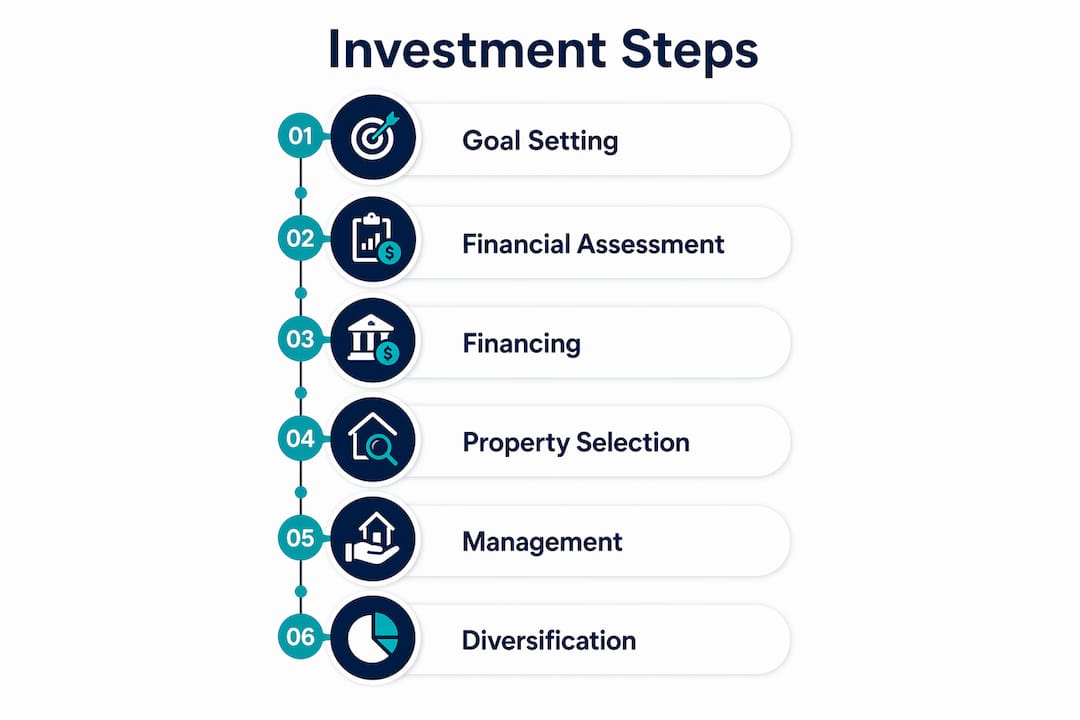
Property investment in Australia is not a passive activity. Each property you add increases your tax exposure, borrowing complexity, and management load. A structured approach keeps each stage manageable and reduces the risk of costly errors. The property investment types available to Australian investors range from residential houses to commercial units, each with different yield profiles and risk characteristics.
How do you set investment goals and assess your finances?
Success starts with goals and risk tolerance, not property selection. A mismatched portfolio creates instability because your asset mix does not align with your investment horizon or income needs. Before you look at a single listing, answer three questions: What annual income do I want this portfolio to generate? When do I need it? How much capital loss can I absorb in a downturn?

Once your goals are clear, assess your financial position honestly. Your borrowing capacity depends on your income, existing debts, and savings rate. Investors earning $75,000–$150,000 can typically save for an initial entry within 6–12 months with disciplined savings. That timeline assumes you are targeting a house hack entry rather than a traditional buy-to-let.
Two entry strategies suit most beginners:
- House hacking: You live in one part of the property and rent out the rest. This reduces your living costs while building equity.
- Traditional buy-to-let: You purchase a standalone investment property and rent it entirely. This requires more upfront capital but keeps your personal residence separate.
Each strategy suits a different financial position and lifestyle. House hacking suits investors who want to enter the market faster with less capital. Buy-to-let suits those with stronger savings who want a clean separation between home and investment.
Pro Tip: Write your investment goals in a single sentence before you speak to a mortgage broker. "I want three properties generating $40,000 in annual net rent within ten years" is a goal. "I want to invest in property" is not.
How do you finance your first and subsequent properties?
Financing is where most portfolios stall. House hacking requires as little as 3.5% down, while traditional buy-to-let investments typically require 20–25% of the purchase price. That gap is significant. A $600,000 property requires $21,000 under a house hack structure versus $120,000–$150,000 for a standard investment loan.
Beyond the deposit, your total cost of ownership includes:
- Mortgage repayments on principal and interest or interest-only terms
- Property management fees, typically 7–10% of gross rent
- Maintenance and repairs, which average 1–2% of property value annually
- Insurance, including landlord and building cover
- Vacancy periods, which reduce effective annual income
- Land tax and council rates, which vary by state
Many investors underestimate ongoing costs and find their cash flow is negative within the first year. Budget for all of these before you commit to a purchase price.
The financing challenge grows at scale. At the fourth mortgaged property, lenders apply stricter scrutiny and require detailed portfolio-level documentation. Preparing a Debt Service Coverage Ratio (DSCR) calculation and understanding cross-collateralisation before you reach that threshold saves significant time and stress. DSCR measures whether your rental income covers your debt repayments. A ratio above 1.25 is generally considered acceptable by most lenders.
Pro Tip: Organise your financial documents into a single folder before approaching any lender: two years of tax returns, rental statements for existing properties, a current balance sheet, and a cash flow summary. Lenders at the portfolio stage want to see the full picture, not just your salary.
How do you select the right properties for your portfolio?
Property selection is where financial modelling separates good investors from reactive ones. Location drives both rental demand and capital growth. The strongest locations share three characteristics: low vacancy rates, proximity to employment centres or universities, and infrastructure investment planned or underway.
Rental yield is the primary metric for income-focused investors. Net rental yields above 6% are considered strong, and yields above 7% indicate a high-performance asset. Yields below 4% suggest you are relying heavily on capital growth, which is harder to predict and slower to realise.
| Yield range | Classification | Investor implication |
|---|---|---|
| Below 4% | Low yield | Capital growth dependent; negative cash flow likely |
| 4%–5.9% | Moderate yield | Balanced; may require top-up from income |
| 6%–6.9% | Strong yield | Positive or near-neutral cash flow |
| 7% and above | High performance | Strong cash flow; lower capital growth typical |
Use financial modelling to stress-test each property before purchase. Model three scenarios: base case (current rent, current rates), downside (10% rent reduction, rate rise of 1%), and upside (rent growth of 5%, capital gain of 3% per year). If the downside scenario breaks your cash flow, the property carries too much risk for your position. Tools that let you model property investment scenarios before committing capital are worth using at every stage.
Also factor in the 2026 regulatory environment. ASIC and MoneySmart both note that legislative changes to negative gearing and capital gains tax are under active review. Properties that rely on negative gearing to remain viable carry policy risk that a positively geared property does not.
How do you manage and scale a property portfolio?
Scaling a property portfolio depends on systems, not just capital. Beyond 3–5 properties, manual management becomes unworkable. Standardised processes for rent collection, maintenance requests, and tenant screening are what allow you to grow without burning out.
The core systems every portfolio needs are:
- Automated rent collection via direct debit or property management software
- A vetted contractor network covering plumbing, electrical, and general repairs
- A tenant screening checklist that includes rental history, employment verification, and reference checks
- A maintenance log for each property tracking costs and repair history
- A monthly cash flow report comparing actual income and expenses against budget
The BRRRR method (Buy, Rehab, Rent, Refinance, Repeat) is a popular scaling strategy. It allows you to recycle capital by refinancing after renovation. The risk is in the rehab phase. Renovation costs overrun by 15–20% on average, so a contingency budget is not optional. Budget the contingency before you start, not after the first surprise bill arrives.
Pro Tip: Build your contractor and property management team before you need them. Trying to find a reliable tradesperson during a vacancy or emergency repair costs you time and money. Vet three contractors per trade category and keep their details in a single reference document.
What are the best diversification strategies for a property portfolio?
Diversification reduces risk only when the assets you hold do not move together. Real estate reacts differently to market changes than stocks and bonds, which makes it a genuine diversifier when combined with other asset classes. Holding five residential properties in the same suburb is not diversification. It is concentration with extra steps.
Effective portfolio diversification for property investors works across three dimensions:
| Dimension | Low diversification | High diversification |
|---|---|---|
| Geography | All properties in one suburb | Properties across multiple cities or states |
| Property type | All residential houses | Mix of residential, commercial, or regional |
| Asset class | Property only | Property plus equities, bonds, or super |
Rebalancing matters as much as initial allocation. Review your portfolio allocation annually. If one property now represents more than 40% of your total net worth, that concentration creates risk. Selling, refinancing, or redirecting new capital into other asset classes restores balance. Aligning your asset mix with your investment horizon is the single most effective way to reduce long-term portfolio volatility.
For Australian investors, superannuation is a natural complement to a property portfolio. Super grows in a tax-advantaged environment and provides income in retirement that property alone may not cover reliably. A retirement-focused investment strategy that combines property with super projections gives you a clearer picture of your total retirement income.
Key takeaways
Building a property portfolio requires a structured process: clear goals, sound financing, disciplined property selection, operational systems, and genuine diversification across geography, property type, and asset class.
| Point | Details |
|---|---|
| Set goals before buying | Define your income target and timeline before approaching any lender or agent. |
| Match entry strategy to capital | House hacking suits lower deposits; traditional buy-to-let requires 20–25% down. |
| Model yields before committing | Net yields above 6% are strong; below 4% means relying on capital growth alone. |
| Build systems early | Automate rent collection and vet contractors before you exceed three properties. |
| Diversify across dimensions | Spread across geography, property type, and asset class to reduce concentration risk. |
What I have learned building property portfolios over time
The investors I have seen succeed are rarely the ones who moved fastest. They are the ones who treated each acquisition as a business decision rather than an emotional one. The discipline to pass on a property that does not meet your yield or location criteria is harder than it sounds when you have been searching for six months.
The operational reality of managing multiple properties surprises most people. After the third property, the administrative load becomes a part-time job if you have not built systems. I have watched investors with strong portfolios on paper struggle because they had no processes, no contractor relationships, and no monthly reporting. The portfolio looked good in a spreadsheet and felt chaotic in practice.
My strongest advice is to scale incrementally. One property, then two, then three. Each step teaches you something the previous one did not. Rapid expansion before you understand your own management capacity is one of the most common property investor mistakes I see. Build a professional network early: a good accountant, a mortgage broker who specialises in portfolio lending, and a property manager you trust. Those relationships are worth more than any single property decision.
— Jonathan
Alphaiq: financial modelling built for Australian property investors
Alphaiq is an Australian wealth intelligence platform designed for self-directed investors who want real numbers behind their decisions.

The platform models your property portfolio alongside superannuation, capital gains, debt recycling, and retirement income in one place. You can run scenario simulations to test how a new acquisition affects your tax position, cash flow, and retirement projections before you commit. For investors navigating the 2026 regulatory environment, that kind of tax-aware modelling replaces guesswork with clarity. Explore Alphaiq's wealth intelligence platform to see how your portfolio positions you for retirement, or use the super projection calculator to model how property and super work together.
FAQ
What is a property portfolio?
A property portfolio is a collection of investment properties owned by one individual or entity to generate rental income and capital growth over time.
How much deposit do I need to start a property portfolio?
House hacking requires as little as 3.5% down, while traditional buy-to-let investment properties typically require a 20–25% deposit.
What rental yield should I target?
Net yields above 6% are considered strong, and yields above 7% indicate a high-performance asset. Yields below 4% mean your returns depend primarily on capital growth.
When does financing become harder as a portfolio grows?
At the fourth mortgaged property, lenders apply stricter scrutiny and require portfolio-level financial documentation including DSCR calculations.
How do I diversify a property portfolio effectively?
Diversify across geography, property type, and asset class. Holding multiple properties in the same suburb is concentration, not diversification. Combining property with superannuation and equities reduces overall portfolio volatility.