
Portfolio scenario modelling simulates several plausible futures for a portfolio so you can quantify the probability of meeting objectives and set pre-agreed responses. It combines quantitative techniques like Monte Carlo simulation with narrative scenario planning to stress-test outcomes against your investment policy statement (IPS). The payoff is concrete: instead of a single forecast, you get a probability distribution, a ranked set of risks, and rules for what to do when things go wrong.
TL;DR:
- Scenario modeling is most valuable when portfolios have long-term horizons, assets' correlations are unstable, and outcomes depend on macroeconomic shifts.
- Using multiple methods, such as regime-specific Monte Carlo simulations combined with stress tests, provides a more accurate picture of potential risks and regimes.
- Evaluation should focus on probability of meeting targets, tail risks like VaR and CVaR, and outcome percentiles, with attention to non-normal return distributions.
- Applying scenario insights involves adjusting allocations, increasing liquidity, and setting automated trigger thresholds instead of reacting emotionally during market stress.
- Proper modelling requires credible data sources, disciplined assumption setting, version control, and regular backtesting to avoid overconfidence and overfitting.
Table of Contents
- What is portfolio scenario modelling and when should you use it?
- A practical 5-step scenario modelling framework you can apply
- Monte Carlo, stress tests, and regime models: which method fits?
- How do you interpret scenario modelling results correctly?
- Turning scenario outputs into portfolio decisions
- What tools and data do you need to model scenarios properly?
- How Alphaiq operationalises scenario modelling for investors
- Practitioner perspective: where scenario models go wrong
- Model your own numbers with Alphaiq
- Sources
- FAQ
What is portfolio scenario modelling and when should you use it?
Forecasting gives you one number. Scenario modelling gives you a range of plausible outcomes and the conditions that produce each one. That distinction matters more than it sounds. A single-point forecast tells you "the portfolio should return 7% a year." Scenario modelling tells you what happens to that portfolio if inflation stays elevated for three years, if credit spreads blow out, or if equity markets deliver a lost decade. It's a different question, and a more useful one for anyone managing real money against real goals.
Scenario planning as a discipline originated in corporate strategy, where it's used to pressure-test decisions against multiple futures rather than one assumed trajectory. Applied to portfolios, the same logic works for strategic asset allocation, retirement income planning, project portfolio prioritisation, and enterprise risk assessment.
It earns its place particularly when:
- The investment horizon is long enough that macro regimes will almost certainly shift at least once
- Outcomes are non-linear (a drawdown near retirement matters far more than one a decade earlier)
- You're managing against a specific target (a retirement income figure, a funding ratio) rather than a vague "beat the market" mandate
- Correlations between assets have shown signs of instability in past stress periods
If none of those apply, a simpler forecast might suffice. For most investors with meaningful capital and a defined goal, they usually do apply.
A practical 5-step scenario modelling framework you can apply
Scenario modelling works best as a repeatable process, not a one-off spreadsheet exercise. A standard scenario planning framework for portfolios follows five steps, and skipping any one of them tends to produce models that look sophisticated but answer the wrong question.
- Define objectives and constraints. Start with your investment policy statement. Your IPS should specify return targets, risk tolerance, liquidity needs, and time horizon, and these should drive every scenario you build. CFA Institute guidance treats the IPS as the anchor for portfolio construction, and scenario modelling is no exception.
- Identify critical uncertainties. List the two or three variables that would most change your outcome if they moved. This is usually inflation, growth, interest rates, or a specific concentration risk in your holdings.
- Develop distinct, plausible scenarios. Build narratives around those variables, then translate each narrative into a parameter set (expected ranges of returns, volatilities, and correlations) that a model can use.
- Quantify the financial impact. Run simulations or stress tests against each scenario to see how your portfolio actually responds in dollar terms and probability terms.
- Plan responses and set early-warning indicators. Decide in advance what you'll do if a scenario starts to unfold, and pick measurable signals that tell you it's happening.
Pro Tip: Write your step 5 responses down before you need them. Deciding to reduce equity exposure calmly in January is a completely different exercise from deciding it while markets are falling in real time.
This process also works for project portfolios and capital allocation decisions outside pure investment contexts, since the six-step version used in corporate risk management follows nearly identical logic.
Monte Carlo, stress tests, and regime models: which method fits?
Three quantitative approaches dominate portfolio scenario modelling, and each answers a slightly different question.
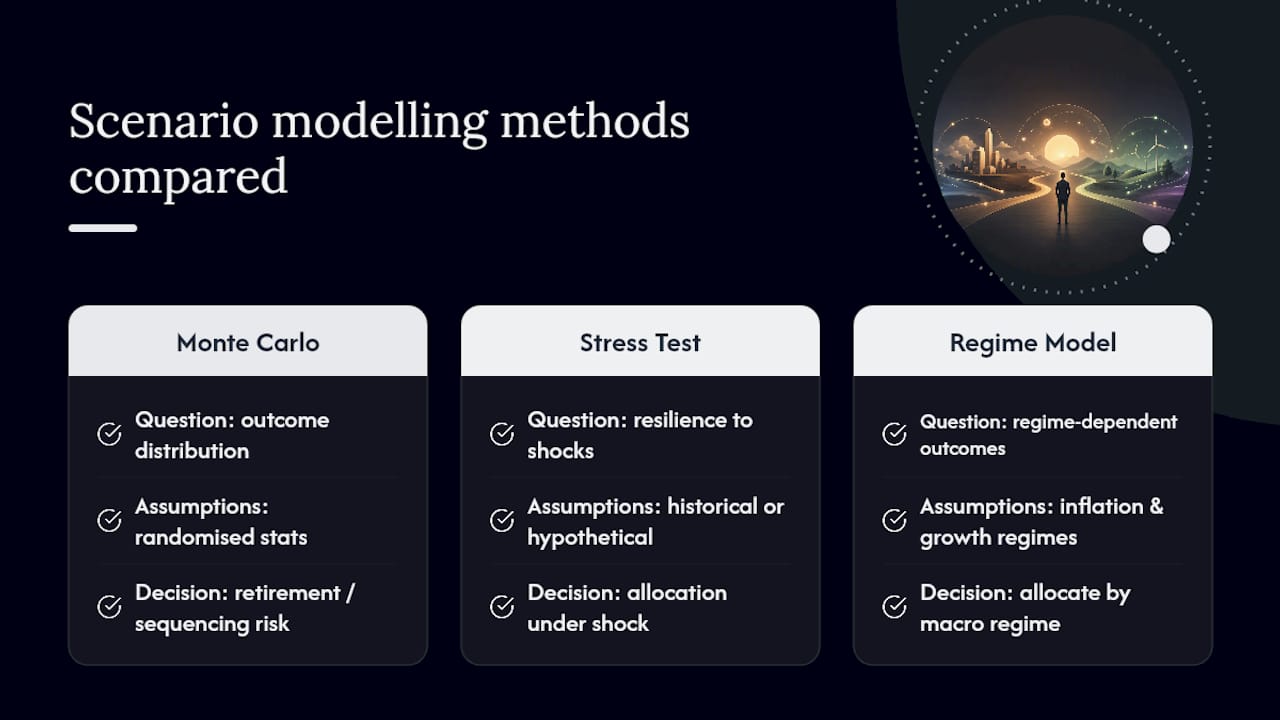
Monte Carlo simulation runs thousands of randomised return paths based on assumed statistical properties, then reports the distribution of outcomes. Rather than one projected balance at retirement, you get a 10th percentile, a median, and a 90th percentile, along with a probability of meeting your target. It's the workhorse for retirement and long-horizon planning because it captures sequencing risk that a straight-line average return completely hides.
Stress testing takes a different angle: rather than randomising, it applies a specific shock. This can mean replaying an actual historical period (the 2008 credit crisis, the 2022 bond sell-off) or constructing a hypothetical one (a simultaneous equity and property downturn). Historical replays are grounded but backward-looking; constructed shocks let you test scenarios that haven't happened yet but plausibly could.
Regime-specific modelling addresses a problem both other methods can miss on their own: asset returns and correlations behave differently depending on the macro environment. Research on regime-specific portfolio modelling shows that pre-defining regimes around inflation and growth conditions changes outcome distributions enough to alter allocation conclusions entirely, compared to a single blended model.
The strongest practitioner approach doesn't pick one method. Advanced modelling combines regime pathway definitions with Monte Carlo simulation, feeding each regime's parameters into a separate simulation run rather than relying on one stationary covariance matrix for all conditions.
Institutional practice increasingly leans this way too. Market-driven scenario construction encourages portfolio managers to think through several macro outcomes simultaneously rather than extrapolating from historical data alone.
How do you interpret scenario modelling results correctly?
Running the model is the easy part. Reading the output without fooling yourself is where most of the value, and most of the risk, actually lives.
The metrics that matter most:
- Probability of meeting target — the share of simulated paths that hit your goal, sometimes framed around a Portfolio Performance Index concept that tracks how quickly failure probability decays as conditions worsen
- Value at Risk (VaR) — the loss you might expect not to exceed at a given confidence level over a set period
- Conditional Value at Risk (CVaR) — the average loss in the worst-case tail beyond VaR, which matters more than VaR itself for genuinely dangerous scenarios
- Percentile bands (10th/50th/90th) — a spread that shows the range of plausible outcomes rather than a false single number
The biggest pitfall is treating these outputs as more precise than they are. Equity returns are demonstrably non-normal, with fatter tails and more extreme events than a standard bell curve predicts. Models built on mean-variance assumptions alone tend to understate genuine tail risk, which is exactly why percentile-based and PPI-style metrics have gained ground over pure mean-variance outputs. Correlations between assets are similarly unstable, often tightening precisely when diversification matters most, during a broad market sell-off.
Run sensitivity analysis on your key assumptions, use several distinct scenarios rather than one "base case," and treat any single point estimate with appropriate scepticism. Understanding how portfolio risk is actually measured helps make sense of why standard deviation alone rarely tells the full story.
Turning scenario outputs into portfolio decisions
A scenario model that never changes a decision was a wasted exercise. The outputs should feed directly into three areas.
- Allocation tilts. If a stagflation scenario shows an unacceptable risk of shortfall, that's a signal to reduce duration risk or add inflation-linked exposure before the regime arrives, not after.
- Liquidity and hedging. Scenarios that reveal a forced-selling risk during a downturn point to holding a larger cash buffer or short-term liquid instrument, an area where comparing money market account features is worth doing before you need the cash.
- Trigger thresholds. Define numeric early-warning indicators tied to each scenario, such as certain credit spread levels or inflation indicators, so a response is automatic rather than debated in the moment.
For a retiree drawing down capital, this might mean pre-agreeing to cut discretionary drawdown by a set percentage if the portfolio falls below a defined funding ratio. For a project portfolio, it might mean capping exposure to a single sector once a concentration threshold is breached. The mechanism is the same in every context: turn a scenario finding into a rule, written down before pressure forces a rushed call.
What tools and data do you need to model scenarios properly?
Scenario modelling spans a range of tooling, from simple to institutional-grade, and the right choice depends on complexity and stakes rather than budget alone.
- Spreadsheet and code-based toolkits suit straightforward Monte Carlo runs and single-scenario stress tests, and remain the entry point for most individual investors and smaller advisory practices.
- Dedicated scenario platforms handle regime-switching models, larger simulation ensembles, and multi-asset correlation structures that spreadsheets struggle to manage cleanly.
- Macro and regime data providers supply the historical regime classifications and forward-looking scenario paths that feed the parameter sets in step three of the framework.
- Climate and ESG datasets are increasingly relevant for long-horizon portfolios, particularly where transition risk or physical climate risk could reshape sector returns over decades.
Whichever tools you use, the essential inputs stay consistent: historical and forward asset return assumptions, regime transition data, macro paths for growth and inflation, credit spread behaviour, and, where relevant, climate transition pathways. Governance matters as much as the model itself. Version control, a documented link back to the IPS, and a clear audit trail for how each scenario was built all separate a credible model from a black box nobody trusts. Modelling investment returns properly starts with getting these input choices right before any simulation runs.
How Alphaiq operationalises scenario modelling for investors
Alphaiq applies this framework directly to personal wealth. The platform maps your objectives, superannuation position, property holdings, and investment portfolio into a tax-aware model, then runs scenario simulations across:
- Retirement income projections under different market and inflation paths
- Capital gains and debt recycling outcomes across shifting rate environments
- Superannuation contribution and drawdown strategies tested against multiple regimes
- Franking credit impacts under varying portfolio compositions
The framework applies the five-step logic to a household's financial data rather than an institutional book, offering modelling without building spreadsheets from scratch.
Practitioner perspective: where scenario models go wrong
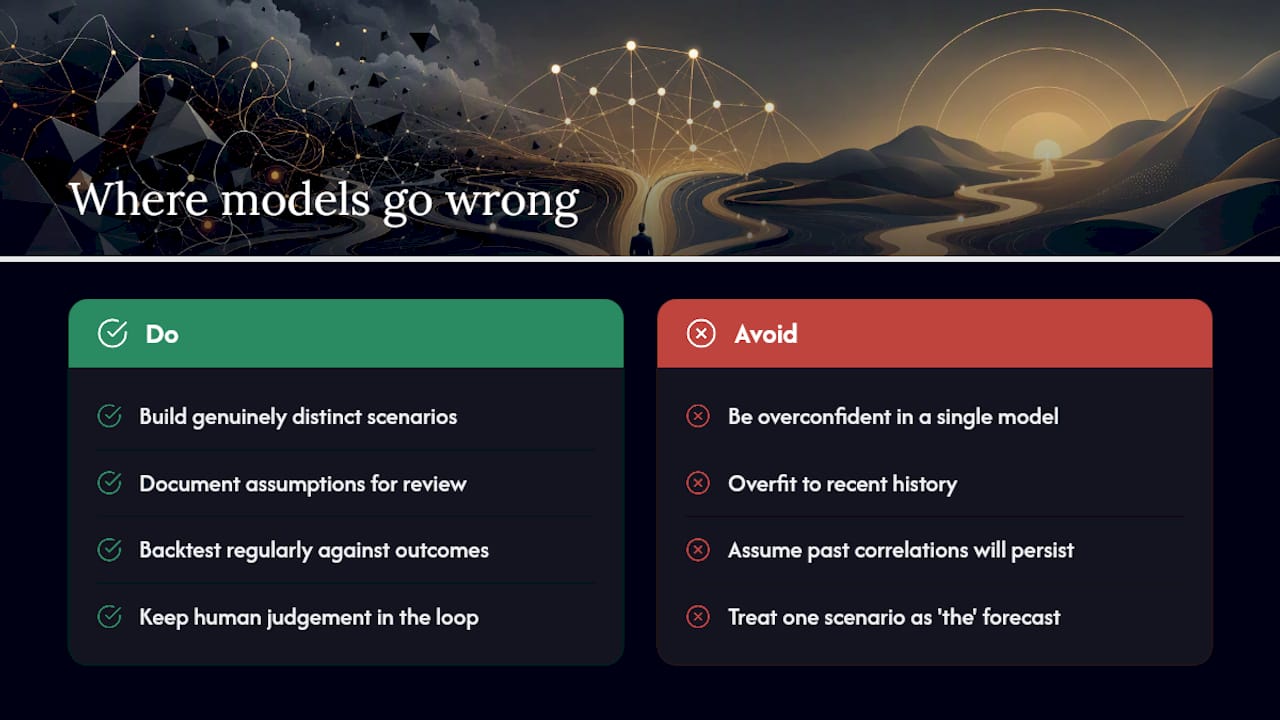
The most common failure isn't a bad model. It's overconfidence in a good one. Overfitting to recent history, assuming correlations that held in 2019 will hold again, and treating one scenario as "the" forecast all quietly undermine otherwise sound work. Nassim Taleb's long-standing critique of fixed-parameter risk models applies squarely here: volatility and correlation are unstable, and a model that assumes otherwise offers false comfort rather than real insight.
The fix isn't a better algorithm. It's discipline: build genuinely distinct scenarios, document your assumptions so they can be challenged later, and backtest regularly against what actually happened. Judgement doesn't disappear just because the model is running.
— Jonathan
Model your own numbers with Alphaiq
Reading about scenario modelling is useful. Seeing your own retirement, super, and property numbers run through it is what actually changes a decision. This platform is designed for self-directed investors who want regime-aware, tax-aware modelling applied to their household finances, without paying for ongoing financial advice just to see the numbers.

Such platforms pull super, investment, and property positions into one model and simulate how different market and policy scenarios affect retirement income, capital gains position, and drawdown strategy. Where a generic Monte Carlo spreadsheet stops at "here's a probability," this approach connects that probability back to factors like franking credits, debt recycling opportunities, and super contribution caps relevant to the user's situation. If you want a concrete starting point, run your numbers through the Super Calculator to see how your current retirement trajectory holds up under a few plausible future scenarios.
Sources
- Scenario planning resources — Lumivero
- Basics of portfolio planning and construction — CFA Institute (2026)
- Regime-based portfolio optimisation — ESM publication
This article is general information, not a substitute for advice from a qualified financial advisor. Consult a qualified financial professional about your own circumstances before acting on anything here.
FAQ
What is portfolio modelling?
Portfolio modelling is the practice of simulating how a portfolio's value and risk change under different assumptions, using tools like Monte Carlo simulation, stress tests, or regime-based analysis, rather than relying on a single forecast.
What are the 5 steps of the scenario planning process?
The standard process is defining objectives and constraints, identifying critical uncertainties, developing distinct plausible scenarios, quantifying financial impact through simulation or stress testing, and planning pre-agreed responses with early-warning indicators.
What are the criticisms of modern portfolio theory?
Critics point out that returns are often non-normal with fatter tails than models assume, correlations between assets can become unstable exactly when diversification matters most, and fixed-parameter models can create false confidence rather than genuine risk control.
What is the 60/20/20 rule for portfolios?
There's no single, widely agreed fixed allocation split in portfolio construction; allocation varies by investor goals, risk tolerance, and time horizon, and should be set through an investment policy statement rather than a fixed formula.
Can scenario modelling replace financial advice?
Scenario modelling gives you probability-based clarity on outcomes, but it doesn't replace personalised advice for complex situations. Platforms like Alphaiq are built to give self-directed investors that clarity without the ongoing cost of traditional advice.