
An investment is a single asset you own — a share in BHP, a managed fund unit, or an investment property. Portfolio management is the ongoing process of assembling, monitoring, and adjusting a collection of those assets so they work together toward a specific financial goal. The practical difference matters: buying an ASX share is a security-level decision; deciding how much of your wealth sits in shares versus bonds versus property is a portfolio-level decision. Regulatory bodies including the ATO, ASIC, and ASX each govern different parts of that process, from tax treatment to market conduct to listed securities.
Three things you can do today to sharpen your position:
- Clarify your goal. Write down a single sentence: what you want your portfolio to produce, by when, and at what level of risk you can tolerate.
- Check your current allocation. List every asset you hold — including superannuation — and calculate what percentage sits in each asset class.
- Set one rebalance rule. Decide now that you will rebalance whenever any asset class drifts more than 5–10% from its target, or at least once per year.
Key takeaways
Disciplined portfolio management — combining a clear asset allocation, low-cost instruments, regular rebalancing, and annual tax review — is the most reliable path to long-term wealth growth for Australian self-directed investors.
| Point | Details |
|---|---|
| Asset allocation drives returns | The split between growth and defensive assets explains most of your long-term return variation. |
| Include super in every review | Your superannuation balance is part of your portfolio; ignoring it distorts your true allocation and tax position. |
| Fees and tax compound against you | A 1% annual fee difference and poor CGT timing can cost more than most investors realise over 20 years. |
| Rebalance with a rule, not a feeling | Set a calendar or threshold trigger in advance; rebalance using new contributions first to avoid unnecessary CGT events. |
| Alphaiq models your after-tax position | Alphaiq's scenario simulation shows the real impact of CGT timing, franking credits, and super contributions on your specific numbers. |
Table of Contents
- What does portfolio management actually involve?
- How does investment management differ from portfolio management?
- What are the core principles that drive long-term portfolio outcomes?
- What does the portfolio lifecycle look like in practice?
- How do you build and manage a portfolio step by step?
- What tax and cost factors matter most for Australian investors?
- How do you monitor performance and when should you rebalance?
- What mistakes do investors make most often, and how do you avoid them?
- Which tools and professionals can help you manage your portfolio?
- How does tax-aware modelling improve your portfolio decisions?
- Why disciplined portfolio management matters more than most Australians realise
- Alphaiq puts these principles into practice for self-directed Australians
- Sources
What does portfolio management actually involve?
Portfolio management is the ongoing process of setting an asset allocation, diversifying across securities, rebalancing when allocations drift, and monitoring results against long-term objectives. It is not a one-off purchase decision. It is a continuous cycle with four broad phases: planning, construction, implementation, and ongoing monitoring and adjustment.
Common investor objectives that portfolio management serves include:
- Growth — building wealth over a long time horizon through capital appreciation
- Income — generating regular cash flow from dividends, distributions, or interest
- Capital preservation — protecting the nominal or real value of existing wealth
- Tax efficiency — structuring holdings to minimise tax drag (especially relevant in Australia given franking credits and the CGT discount)
- Liquidity — keeping enough accessible assets to meet near-term spending needs
Time horizon shapes everything. A 35-year-old accumulating wealth for retirement has a fundamentally different risk capacity than a 62-year-old drawing down a super balance. Aligning your portfolio to your actual time horizon — not a generic template — is what separates a managed portfolio from a random collection of assets.
Who does what in portfolio management
| Role | Typical responsibilities | Who holds accountability |
|---|---|---|
| Individual investor | Sets goals, approves strategy, contributes capital | You |
| Investment platform | Executes trades, holds assets, provides reporting | Platform provider (AFSL holder) |
| Financial adviser | Recommends strategy, models scenarios, reviews annually | Licensed adviser (AFSL) |
| Portfolio manager | Selects securities, manages allocation within mandate | Fund manager or DMA provider |
Understanding which role you are filling — and which you are delegating — is the first step toward building a portfolio that actually reflects your intentions.
How does investment management differ from portfolio management?
Investment management focuses on security-level choices — which specific share, bond, or fund to buy or sell — while portfolio management focuses on risk and return across the whole collection of investments. Both matter, but they operate at different levels of abstraction.
A concrete example makes this clearer. Suppose you decide to buy shares in a specific ASX-listed company after researching its earnings and dividend yield. That is investment management: you are making a judgement about one security. That is portfolio management when you are making a structural decision about allocation and risk.
The distinction becomes especially important in three situations. First, tax planning: the timing of a sale (investment management) can trigger a CGT event, but whether that sale fits your overall tax position for the year is a portfolio-level question. Second, adviser selection: a stockbroker helps with security selection; a financial planner or wealth platform helps with portfolio construction and strategy. Third, performance reporting: measuring whether a single stock beat its benchmark is investment management; measuring whether your total portfolio is on track to meet your retirement goal is portfolio management.
What are the core principles that drive long-term portfolio outcomes?
Strategic asset allocation — the deliberate split between growth assets (shares, property) and defensive assets (bonds, cash) — is the single most important driver of long-term portfolio returns. Security selection and market timing matter far less than most investors assume.
The core principles that underpin sound portfolio management:
- Asset allocation: Decide your target split between growth and defensive assets based on your goal, time horizon, and risk tolerance. This decision explains the majority of return variation over time.
- Diversification: Spread exposure across asset classes, geographies, sectors, and securities. Concentration in a single stock or sector amplifies both upside and downside.
- Risk tolerance: Match your allocation to what you can genuinely sustain through a market downturn without selling at the wrong time. A portfolio you abandon in a correction is worse than a conservative one you hold through it.
- Rebalancing: Periodically restore your target allocation when markets cause drift. This enforces a buy-low, sell-high discipline without requiring market timing.
- Cost control: Fees compound just as returns do. A 1% annual fee difference, sustained over 20 years, can meaningfully reduce your ending balance.
- Tax awareness: In Australia, the structure of your holdings — inside or outside super, the timing of sales, the use of franking credits — changes your after-tax outcome materially.
Passive vs active: a practical view for Australian self-directed investors
A passive approach — holding low-cost index ETFs tracking the ASX 200, global equities, or bond indices — delivers market returns minus a small fee. Most active fund managers fail to consistently outperform their benchmark after fees over long periods, which makes passive the rational default for most self-directed investors.
Active management may be justified in specific situations: small-cap or emerging-market segments where markets are less efficient, or where a tax-managed separately managed account (SMA) can harvest losses or time franking credits in ways a passive ETF cannot.
Pro Tip: If you are a self-directed Australian investor with a straightforward goal and a long time horizon, a core portfolio of two or three broad index ETFs (Australian equities, global equities, bonds) will outperform most actively managed alternatives after fees. Reserve active strategies for the satellite portion of your portfolio, not the core.
What does the portfolio lifecycle look like in practice?
A well-managed portfolio moves through six repeating phases. The cycle does not end; it loops back to planning whenever your circumstances or goals change.
Planning
Define your goal in concrete terms: target amount, target date, income required, and the maximum loss you could absorb in a bad year without changing your plan. This phase produces a written investment policy statement (IPS) — even a one-page document — that anchors every later decision.
Construction
Translate your goal and risk tolerance into a target asset allocation. Choose the asset classes (Australian equities, international equities, fixed income, property, cash) and decide the target weight for each. At this stage you also select the instruments — ETFs, managed funds, direct shares, term deposits — that will fill each allocation bucket.
Implementation
Open accounts, fund them, and place the initial trades. For most Australians, this also means deciding how your superannuation balance fits into the total picture. Your super is part of your portfolio; ignoring it creates a distorted view of your actual allocation.
Monitoring
Track performance against your benchmark and your goal on a regular schedule. Monthly is appropriate for a quick check of total value and any significant market moves. Quarterly is the right cadence for a more thorough review of allocation drift, income received, and fees paid.
Rebalancing
Use new contributions to top up underweight positions before selling overweight ones, since selling triggers CGT events. Maintaining allocation discipline through rebalancing adds measurable value versus attempting to time the market.
Annual review
Once a year, revisit the plan itself. Has your goal changed? Has your time horizon shortened? Have tax rules shifted? The annual review is also the moment to check whether your total fee load — platform fees, fund management fees, adviser fees — remains justified by the value delivered.
What to track at each phase
| Phase | Key metrics to watch |
|---|---|
| Monitoring (monthly) | Total portfolio value, major allocation drift |
| Monitoring (quarterly) | Asset class weights, income received, fees paid, tax events |
| Annual review | Total return vs benchmark, goal progress, fee total, tax position |
How do you build and manage a portfolio step by step?
Follow a clear sequence and you will avoid the most common structural mistakes. The checklist below works for most Australian self-directed investors starting from scratch or reorganising an existing portfolio.
- Define your goal. Write one sentence: what you want the portfolio to produce, by when, and what annual income or lump sum you need.
- Map your total financial position. Include superannuation, investment property equity, direct shares, managed funds, and cash. Your super balance is part of your portfolio even if it sits in a separate account.
- Decide your asset mix. Use your time horizon and risk tolerance as the primary inputs. A growth allocation with a large proportion of growth assets suits a long horizon; a balanced allocation suits a medium horizon; a conservative allocation suits a short horizon or low risk tolerance.
- Select low-cost instruments. For most self-directed investors, broad index ETFs on the ASX — covering Australian equities, global equities, and bonds — provide diversification at low cost. Managed funds, term deposits, and direct shares can complement the core.
- Implement the portfolio. Open a brokerage account or investment platform, fund it, and place trades to reach your target allocation.
- Set up automated contributions. Regular contributions — even modest ones — smooth out market timing risk through dollar-cost averaging and keep the portfolio growing without requiring active decisions.
- Schedule rebalances. Commit to reviewing allocation quarterly and rebalancing annually, or whenever drift exceeds your tolerance band.
Sample allocation templates
Conservative (suited to investors within 5 years of needing the funds, or low risk tolerance)
Balanced (suited to investors with a 7–15 year horizon and moderate risk tolerance)
Growth (suited to investors with a 15+ year horizon and higher risk tolerance)
The 40-40-20 rule
It provides broad diversification while maintaining meaningful exposure to ASX-listed companies and their franking credits. Like all rules of thumb, it is a starting point, not a prescription — your actual allocation should reflect your specific goal and circumstances.
How regular investing can build toward $1,000,000
Assume a starting balance of zero, regular monthly contributions, an average annual return as expected, and an investment horizon of a couple of decades. Under these assumptions, the portfolio would grow substantially over that period. Lower returns would reduce the final amount accordingly. These figures are illustrative only; actual returns vary with market conditions, tax treatment, fees, and the specific assets held. The point is that time and consistent contributions do most of the work.
Pro Tip: Use new contributions to rebalance before selling existing holdings. Directing fresh capital into underweight asset classes restores your target allocation without triggering a CGT event.
What tax and cost factors matter most for Australian investors?
Tax and fees are the two variables most within your control, and both materially change your net return. Understanding them is not optional for a self-directed Australian investor.
Franking credits
If you receive a fully franked dividend, you receive a tax offset equal to the tax already paid by the company. For investors in lower tax brackets, this can result in a tax refund. The ATO's guidance on franking credits is the authoritative source for current rules.
Capital gains tax (CGT) discount
This makes the timing of asset sales a genuine portfolio management decision, not just a trading one. Selling before the 12-month mark doubles your effective CGT rate on the gain.
Superannuation interactions
Super is the most tax-effective structure available to most Australians for long-term wealth accumulation. Holding growth assets inside super — particularly for investors in higher marginal tax brackets — can produce meaningfully better after-tax outcomes than holding the same assets outside super. The Commonwealth Investment Framework illustrates how governance and return thresholds apply even at the institutional level, reinforcing why structure matters for any investor.
Platform and adviser fees
Fees compound against you the same way returns compound for you. Before selecting a platform or adviser, ask for a total cost of ownership figure — not just the headline management fee.
Directional fee comparison
The performance gap needs to be substantial and consistent for active management to justify its cost.
For official guidance on tax treatment of investments, use the ATO's investment income section, ASIC's MoneySmart for general investor education, and the ASX for listed product information.
How do you monitor performance and when should you rebalance?
Monitor your portfolio's returns, allocation drift, fees, tax events, and income needs on a regular schedule. Checking too frequently leads to reactive decisions; checking too rarely allows drift to compound into structural risk.
Core metrics to track
- Total return: Capital growth plus income (dividends, distributions, interest), expressed as a percentage of your starting value. Compare this to a relevant benchmark (e.g., the ASX 200 Total Return Index for Australian equities).
- Volatility: The degree to which your portfolio's value fluctuates. Higher volatility is acceptable if your time horizon is long; it becomes a problem if it causes you to sell at the wrong time.
- Maximum drawdown: The largest peak-to-trough decline in a given period. Knowing your historical drawdown helps you calibrate whether your allocation matches your actual risk tolerance.
- Tracking error: How far your portfolio's returns deviate from your benchmark. A large tracking error in a passive portfolio suggests something is wrong with implementation.
- Expense ratio: The total annual cost of all funds and platform fees as a percentage of your portfolio value.
- Tax drag: The reduction in after-tax return caused by realised gains, income tax, and missed franking credit offsets.
Rebalancing rules
| Rule type | Description | When to apply |
|---|---|---|
| Calendar rebalance | Restore target allocation once per year | Low-maintenance, suits most investors |
| Threshold rebalance | Rebalance when any asset class drifts significantly from target | More precise, reduces drift risk |
| Contribution rebalance | Direct new money to underweight asset classes | Avoids CGT events from selling |
| Hybrid | Annual review plus threshold trigger | Best practice for most self-directed investors |
Managed portfolio platforms can automate rebalancing, improving efficiency and allowing tax-aware trading — for example, avoiding the sale of assets held for less than 12 months to preserve the CGT discount.
Pro Tip: Keep a simple spreadsheet or use a dedicated portfolio tracker to log every trade, dividend received, and fee paid. This record is essential at tax time and makes annual reviews far faster. A platform with integrated tax reporting removes most of this manual work.
What mistakes do investors make most often, and how do you avoid them?
The most common mistake is starting without a written plan and then making allocation decisions reactively, which typically results in poor diversification and high costs. Understanding investment risk before you commit capital is the most reliable way to avoid the errors below.
- Chasing past returns. Last year's top-performing fund or sector rarely repeats. Buying after a strong run means buying at elevated prices. Countermeasure: set your allocation based on your goal, not recent performance tables.
- Over-concentration. Holding too much in a single stock, sector, or asset class amplifies losses when that position falls. Australian investors often have excessive home-country bias and property concentration. Countermeasure: review portfolio concentration risk regularly and set a maximum weight for any single position.
- Ignoring fees and tax. A portfolio that looks good on gross returns may underperform after fees and tax. Countermeasure: calculate your total cost of ownership annually and model after-tax returns, not just pre-tax ones.
- Failing to rebalance. A portfolio left unattended can drift toward asset classes that have performed best, increasing risk without deliberate decision. Set reminders and rebalancing rules to maintain target allocation.
- Emotional trading. Selling during a market downturn locks in losses and removes you from the recovery. Buying aggressively at market peaks amplifies risk. Countermeasure: write your investment policy statement before a downturn, not during one. Commit to your rebalance rule in advance.
- Ignoring superannuation. Treating super as separate from your investment portfolio produces a distorted picture of your actual allocation and tax position. Countermeasure: include your super balance in every portfolio review.
Which tools and professionals can help you manage your portfolio?
The right combination of tools and advice depends on your portfolio's complexity, your tax situation, and how much time you want to spend managing it. Options range from a DIY spreadsheet to a full wealth platform with tax-aware modelling and licensed financial advice.
Types of tools and services
Investment platforms (such as those offering ASX brokerage and ETF access) let you buy and hold securities directly. They vary in cost, reporting quality, and tax features. Look for AFSL-licensed providers with transparent fee schedules.
Managed funds and ETFs give you instant diversification within a single purchase. ETFs listed on the ASX are generally lower cost than unlisted managed funds and offer intraday liquidity. For most self-directed investors, a core of broad index ETFs is the most cost-effective starting point.
Portfolio trackers aggregate your holdings across multiple accounts and show your total allocation, performance, and income. Some integrate with tax reporting tools.
Tax-aware modelling platforms such as Alphaiq go further: they model your after-tax position across investments, super, property, and retirement income, and let you run scenarios (what if I sell this property? what if I increase super contributions?) before making a decision. This is especially useful for Australians navigating franking credits, CGT timing, and super drawdown sequencing.
Licensed financial advisers provide personalised advice under an Australian Financial Services Licence (AFSL). They are best suited to complex situations: large portfolios, business sale proceeds, estate planning, or SMSF establishment. Managed portfolios and platform automation can improve efficiency and allow advisers to deliver scalable, customised outcomes while enabling tax and trading efficiencies.
Questions to ask before engaging a platform or adviser
- What is your total annual cost, including platform fees, fund management fees, and advice fees?
- Are you licensed under an AFSL, and is your advice independent or aligned with a product provider?
- How do you handle CGT timing, franking credits, and super interactions in your recommendations?
- What reporting do you provide, and how does it integrate with my tax return?
- How often will you review my portfolio, and what triggers an out-of-cycle review?
For investment strategy examples specific to the Australian context, including how policy and market conditions shape practical choices, the Alphaiq blog covers the major approaches in detail.
How does tax-aware modelling improve your portfolio decisions?
Modelling turns assumptions into comparable scenarios, so you can choose between options based on projected after-tax outcomes rather than gut feel. This is where the difference between a good and a great portfolio decision is often made.
Investor A holds all assets outside super in a high marginal tax bracket, receives unfranked dividends, and sells assets before the 12-month CGT discount threshold. Investor B holds growth assets inside super in accumulation phase, receives fully franked dividends, and times sales to qualify for the CGT discount. Over a decade, the after-tax outcomes for these two investors can diverge substantially, not because of different investment choices, but because of different structural and timing decisions.
A tax-aware model makes these trade-offs visible before you act. The features that materially affect decisions include:
- CGT timing: Modelling the difference between selling before and after the 12-month threshold on a specific position
- Franking credit treatment: Calculating the effective yield of a fully franked dividend at your marginal tax rate versus inside super
- Super projections: Modelling the impact of additional concessional contributions on your retirement balance and tax position
- Withdrawal sequencing: Determining the most tax-efficient order to draw down assets in retirement (super pension, non-super assets, property)
Equity investments require specific monitoring and reporting arrangements to be classified and valued correctly — a principle that applies equally to individual investors managing their own portfolios. Knowing the fair value and expected return of each position is the foundation of any credible model.
Equity investments carry higher volatility and require active governance — a point that holds whether you are a government entity or an individual investor. Modelling helps you quantify that volatility and decide whether the expected return justifies the risk in your specific tax and structural context.
For a practical walkthrough of how to build return assumptions and run scenarios, the guide to modelling investment returns on the Alphaiq blog covers the methodology in detail.
Any model is only as good as its inputs. Results depend on the assumptions you enter — return rates, inflation, contribution amounts, tax rates — and should be treated as directional projections, not guarantees. Use modelling to compare options and stress-test assumptions, not to predict a specific outcome.
Why disciplined portfolio management matters more than most Australians realise
The Australian investment context is genuinely different from most other markets. Superannuation creates a tax-advantaged accumulation vehicle that most Australians underuse as a portfolio management tool. Franking credits make Australian equities more valuable to domestic investors than their gross yield suggests. And the concentration of household wealth in residential property means many Australians are already heavily exposed to a single illiquid asset class before they buy their first share.
Disciplined portfolio management — a written plan, a target allocation, regular rebalancing, and annual tax review — addresses all three of these structural realities. It forces you to see your super as part of your portfolio, to value franking credits correctly, and to recognise that your home is already a large position in your overall wealth picture.
The investors I see make the best long-term decisions are not the ones who pick the best stocks. They are the ones who set a clear allocation, keep costs low, rebalance without emotion, and review their tax position every year. The mechanics are not complicated. The discipline is.
If you have not reviewed your total portfolio — including super — in the last 12 months, that is the most useful thing you can do this week.
Alphaiq puts these principles into practice for self-directed Australians
Knowing the principles is one thing. Seeing how they apply to your specific numbers — your super balance, your property equity, your marginal tax rate, your target retirement income — is where most self-directed investors get stuck.
Alphaiq is a personal wealth intelligence platform built specifically for Australians who want to model and optimise their financial position without paying for ongoing financial advice. The platform brings together your investments, superannuation, property, and retirement income in one place, and runs tax-aware scenarios so you can see the after-tax impact of decisions before you make them.
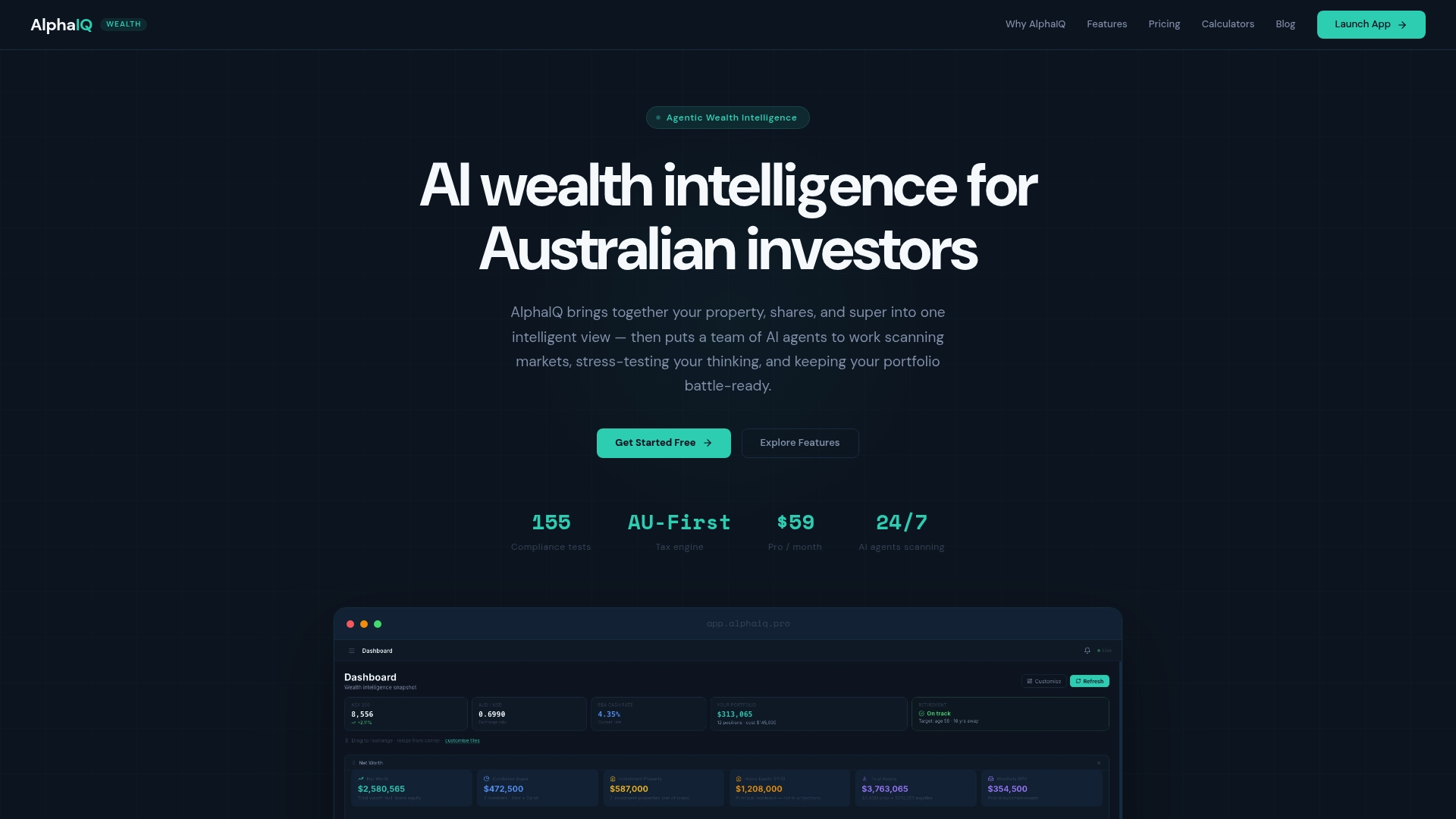
Key capabilities relevant to the steps in this guide:
- Tax-aware financial modelling across CGT timing, franking credits, and super contributions
- Scenario simulation — compare two strategies side by side with real numbers
- Consolidated portfolio view including super and property
- Retirement income projections showing how long your assets last under different drawdown assumptions
Start with Alphaiq's superannuation calculator to model your projected super balance at retirement and see how changes to contributions or investment mix affect your outcome.
Disclosure: this article is published by Alphaiq. The platform is not a licensed financial adviser; modelling outputs are projections based on user inputs and should not be treated as personal financial advice.
Sources
The sources below are the ones professionals use for official rules, regulatory guidance, and deeper reading on Australian investments and portfolio management.
- Commonwealth Investment Framework
- Portfolio management: What it is and how to do it - Vanguard
- Portfolio Management: Definition, Types, and Strategies
This article is general information, not a substitute for advice from a qualified financial advisor. Consult a qualified financial professional about your own circumstances before acting on anything here.