
TL;DR:
- Estate planning involves arranging your assets, authority, and healthcare decisions to ensure your wishes are upheld during your lifetime and after death.
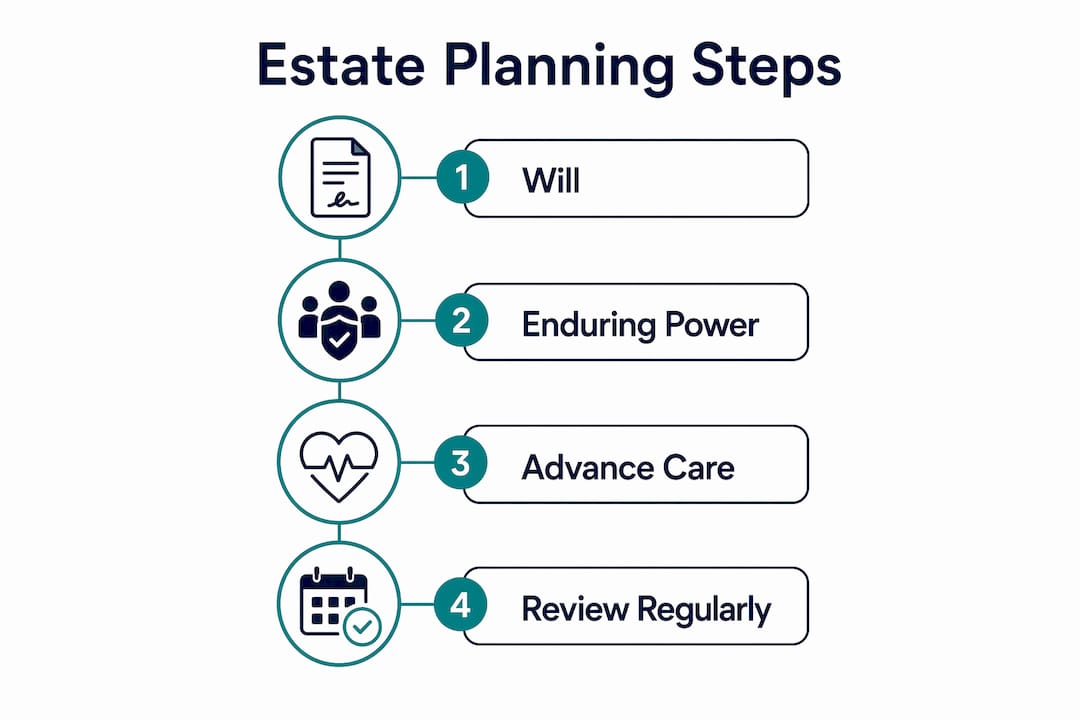
- Every Australian adult needs three core legal documents: a Will, an Enduring Power of Attorney, and an Enduring Guardianship or Advance Care Directive.
Estate planning is defined as the process of arranging your assets, legal authority, and care decisions so your wishes are legally recognised during your lifetime and after your death. A comprehensive Australian estate plan requires three core legal documents: a valid Will, an Enduring Power of Attorney, and an Enduring Guardianship or Advance Care Directive. These are not optional extras for the wealthy or elderly. They are the foundation every Australian adult needs to protect their family, their property, and their financial future. Getting the estate planning basics right now prevents costly legal disputes and family stress later.
What are the essential documents in a basic estate plan?
A legally valid Will is the starting point of any estate plan. Under Australian law, a Will must be in writing, signed by you, and witnessed by at least two adults who are not beneficiaries. That witnessing requirement is strict. Failing to meet it makes the document invalid, regardless of how clearly your wishes are expressed.
An Enduring Power of Attorney (EPA) gives a trusted person legal authority to manage your financial and legal affairs if you lose capacity. This is different from a general power of attorney, which ceases to operate when capacity is lost. The EPA continues precisely when you need it most. Choosing the right person for this role is one of the most consequential decisions in your estate plan.
An Enduring Guardianship or Advance Care Directive covers your health and lifestyle decisions. It appoints someone to make medical choices on your behalf if you cannot. Without this document, those decisions fall to medical professionals or a tribunal, not your family.
Pro Tip: Choose your attorney and guardian separately if possible. The skills required for financial management differ from those needed for medical decision-making. Legal experts urge careful, informed selection because the duties involved carry significant responsibility and trust.
| Document | Purpose | Key legal requirement |
|---|---|---|
| Will | Distributes assets after death | Written, signed, witnessed by two non-beneficiary adults |
| Enduring Power of Attorney | Manages financial and legal affairs during incapacity | Must be witnessed and registered for property dealings |
| Enduring Guardianship / Advance Care Directive | Covers health and lifestyle decisions during incapacity | Appointed person must be willing and capable |
These three documents work together. A Will without an EPA leaves a gap during your lifetime. An EPA without an Advance Care Directive leaves medical decisions unresolved. All three are required for a complete plan.
How does estate planning handle superannuation and property?
Superannuation is one of the most misunderstood assets in Australian estate planning. Super assets are held in trust by your fund, so they do not automatically form part of your estate. Your Will has no authority over them. Without a valid binding death benefit nomination, the super fund trustee decides who receives your balance. That decision may not reflect your wishes.

A binding death benefit nomination directs your super fund to pay your death benefit to specific dependants or your estate. It overrides the trustee's discretion entirely. Binding nominations are often overlooked but are critically important, particularly for blended families where competing claims are common. Check whether your nomination is lapsing or non-lapsing, as lapsing nominations expire every three years.
Property requires a different consideration. Your EPA must be registered with your state's land registry before your attorney can act on your behalf in real estate transactions. In NSW, registration with Land Registry Services is a mandatory step that many people miss. Without it, your attorney cannot sell, transfer, or mortgage your property, even in an emergency.
| Asset type | Covered by Will? | Additional step required |
|---|---|---|
| Bank accounts (sole name) | Yes | Executor applies for probate |
| Superannuation | No | Binding death benefit nomination |
| Investment property | Yes | EPA registered with land registry |
| Joint tenancy property | No | Passes by survivorship to co-owner |
| Shares (sole name) | Yes | Executor applies for transmission |
Testamentary trusts are another tool worth understanding. These trusts are created within your Will and take effect after your death. They allow you to control the timing and conditions of inheritance, which is particularly useful for vulnerable beneficiaries or for tax planning purposes. They must be included in your Will to have legal effect.
What are common estate planning mistakes to avoid?
Most estate planning failures come down to a small number of recurring errors. Recognising them early saves your family significant time, money, and distress.
- No Will at all. Dying without a Will means intestacy laws determine who receives your assets. The outcome often differs substantially from what you would have chosen.
- Invalid witnessing. Incorrect or incomplete witnessing of Wills and powers of attorney is a leading cause of invalid documents. DIY kits frequently fail this test because signatories do not understand the state-specific requirements.
- Assuming super follows your Will. Without a binding death benefit nomination, your superannuation does not follow your Will. This is the single most common and costly misconception in Australian estate planning.
- Choosing the wrong attorney or guardian. Selecting someone based on family obligation rather than genuine capability creates problems. Your attorney needs to be financially responsible, available, and free from conflicts of interest.
- Using DIY kits without professional review. DIY Will kits carry real risks if not reviewed by a solicitor. Documents that appear complete may fail in court due to technical defects.
- Waiting until capacity is at risk. An EPA and Advance Care Directive can only be created while you have full legal capacity. Waiting too long removes the option entirely.
- Never reviewing your documents. A Will written before a second marriage, a property purchase, or the birth of a grandchild may no longer reflect your intentions.
Pro Tip: Review your estate plan immediately after any major life event: marriage, divorce, the birth of a child or grandchild, a significant asset purchase, or a change in your health. Regular updates aligned to life changes protect against disputes and unintended distributions under intestacy laws.
How do you create an estate plan and when should you review it?
Creating your estate plan is a structured process. Working through it step by step makes it manageable and ensures nothing is overlooked.
-
Take stock of your assets. List everything you own: property, bank accounts, superannuation, shares, vehicles, and personal valuables. Note which assets are in your sole name, which are jointly held, and which sit outside your estate (like super).
-
Identify your beneficiaries. Decide who you want to receive your assets and in what proportions. Consider contingency beneficiaries in case a primary beneficiary predeceases you.
-
Choose your executor. Your executor administers your estate after your death. Legal experts recommend appointing an independent executor with relevant experience where appropriate, given the practical and emotional demands of the role.
-
Appoint your attorney and guardian. Select separate people for financial and medical roles if their skills differ. Confirm they are willing to act before naming them.
-
Engage a solicitor or the Public Trustee. Professional legal advice is not optional for a reliable estate plan. A solicitor reviews your documents for legal compliance and ensures they reflect your actual wishes. The Public Trustee in your state offers accessible services for straightforward estates.
-
Lodge your binding death benefit nomination. Contact your super fund directly. Complete the nomination form and confirm whether it lapses or is non-lapsing.
-
Register your EPA with the land registry. If you own property, register your EPA with your state's land registry. This step is frequently missed and creates serious problems later.
-
Store documents securely and tell the right people. Your executor and attorney need to know where your documents are kept. A Will that cannot be found is effectively no Will at all.
-
Review every 3–5 years. Australian guidance recommends reviewing your estate plan every 3–5 years or immediately after a major life change. Laws change, assets change, and family circumstances change.
Communicating your wishes with your family is as important as the documents themselves. Conversations about your intentions reduce the likelihood of disputes and give your loved ones clarity when they need it most. Understanding the role of estate planning in protecting your legacy helps frame these conversations constructively.
Key takeaways
A complete Australian estate plan requires a valid Will, an Enduring Power of Attorney, and an Advance Care Directive, plus a binding death benefit nomination for superannuation.
| Point | Details |
|---|---|
| Three core documents | Every adult needs a Will, an EPA, and an Advance Care Directive to cover assets, finances, and health decisions. |
| Super sits outside your Will | Lodge a binding death benefit nomination with your fund to control how your superannuation is distributed. |
| Register your EPA for property | Without land registry registration, your attorney cannot act on real estate transactions on your behalf. |
| Review every 3–5 years | Update your plan after marriage, divorce, a new child, a major asset change, or any shift in your health. |
| Professional advice is non-negotiable | DIY documents frequently fail due to technical defects. A solicitor or Public Trustee review protects your family. |
Why estate planning is not just paperwork
Estate planning is not a task for later. That is the most persistent and damaging misconception I encounter among Australians in their 40s and 50s. People assume it is something you do when you are old, unwell, or wealthy. None of those conditions apply. Estate planning is relevant to every adult who owns anything, earns anything, or cares about anyone.
What I find genuinely underappreciated is the capacity issue. An Enduring Power of Attorney and an Advance Care Directive can only be created while you have full legal capacity. If you wait until a health crisis forces the issue, the option may no longer exist. Your family then faces a tribunal process to obtain authority, which is slow, expensive, and stressful at the worst possible time.
The other thing I would push back on is the idea that estate planning is a proactive tool, not just a document preparation task. When you sit down and work through who gets what, who makes decisions, and under what conditions, you are doing something genuinely useful for the people you care about. You are removing ambiguity from a moment that will already be difficult.
Get the documents done. Review them regularly. Tell your family where they are. That is the whole job.
— Jonathan
How Alphaiq supports your financial planning
Estate planning and retirement planning are two sides of the same coin. Knowing what your superannuation balance will look like at retirement directly informs how you structure your estate.

Alphaiq is an Australian wealth intelligence platform built for self-directed investors aged 35–65. It models your financial position across superannuation, property, investments, and retirement income in one place. The Alphaiq super calculator projects your retirement balance under different contribution and drawdown scenarios, giving you the numbers you need to make informed decisions about your estate. For a complete picture of your financial position, the Alphaiq platform combines tax-aware modelling with scenario simulation, without the cost of ongoing financial advice.
FAQ
What is estate planning in Australia?
Estate planning is the process of arranging your assets, legal authority, and care decisions through key legal documents so your wishes are upheld during your lifetime and after your death. A complete plan includes a Will, an Enduring Power of Attorney, and an Advance Care Directive.
Does my Will cover my superannuation?
No. Superannuation is held in a separate trust and does not automatically form part of your estate. You must lodge a binding death benefit nomination directly with your super fund to control how those assets are distributed.
How often should I update my estate plan?
Australian guidance recommends reviewing your estate plan every 3–5 years or immediately after a major life event such as marriage, divorce, the birth of a child, or a significant change in your assets or health.
Can I use a DIY Will kit?
DIY Will kits carry real legal risks if not reviewed by a solicitor. Documents that appear complete can fail in court due to incorrect witnessing or state-specific technical defects, causing costly delays for your family.
When is the right time to start estate planning?
The right time is now, regardless of your age or wealth. An Enduring Power of Attorney and Advance Care Directive can only be created while you have full legal capacity, so waiting until a health event forces the issue may remove the option entirely.