
TL;DR:
- Investment modelling converts uncertain financial inputs into scenario-based projections to support retirement decisions. It produces a range of plausible outcomes, helping investors test strategies and manage risks effectively. Regular updates and stress-testing ensure models accurately reflect changing circumstances and market variability.
Investment modelling is defined as a structured numerical method that converts uncertain financial inputs into scenario-based projections, giving investors a clear basis for decisions. For anyone approaching retirement, this matters enormously. Research shows 48% of Australians aged 50–66 worry about running out of money, yet only 18% have a clear plan. That gap is exactly where investment modelling delivers its greatest value. Understanding why use investment modelling means understanding how to move from financial anxiety to grounded, evidence-based confidence.
Why use investment modelling: the core case
Investment modelling is not about predicting the future with certainty. Financial models convert historical and forecast data into structured formats that estimate the impact of future decisions, supporting valuations and planning. The critical word is estimate. A model gives you a range of plausible outcomes, not a single guaranteed number.

This distinction matters most for investors near retirement. Your decisions at this stage, such as when to draw down super, how much to withdraw each year, and whether to hold growth assets, carry consequences that compound over decades. A model lets you test those decisions before you commit to them.
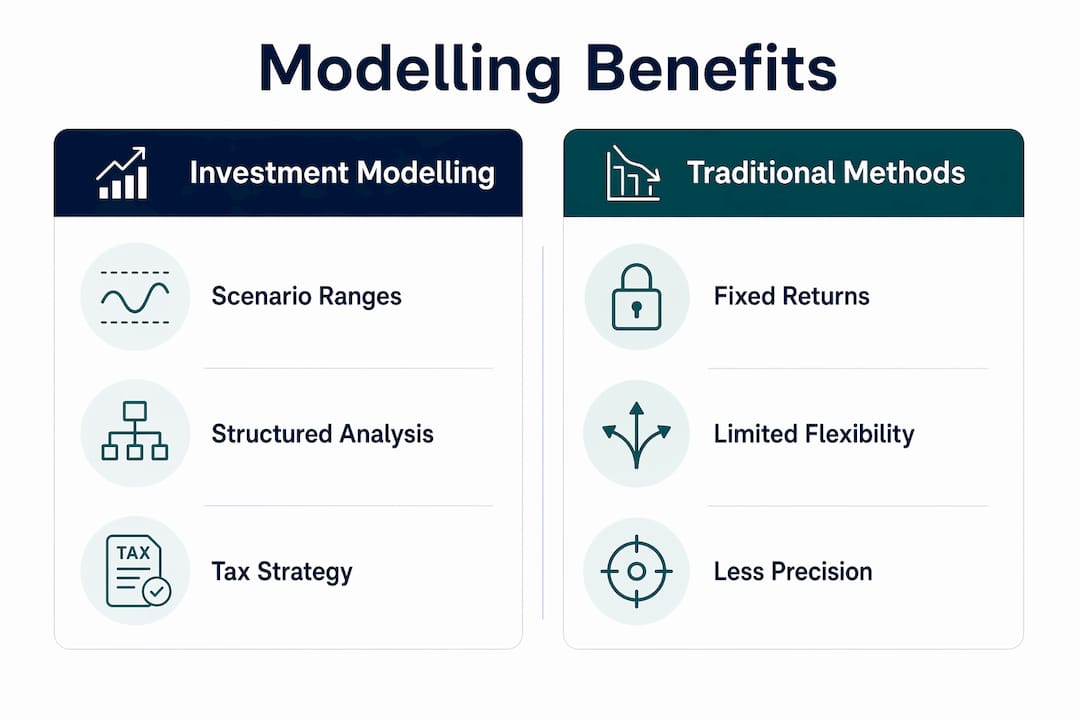
The role of financial modelling is to replace guesswork with structured analysis. You input your assumptions, run the numbers across multiple scenarios, and see which choices hold up under pressure. That process alone changes how you think about risk.
How does investment modelling work?
Most investment models start with a spreadsheet that pulls together historical performance data, forward-looking assumptions, and personal financial inputs. The model then projects outcomes across time, typically showing balances, income, and tax positions year by year.
Two techniques sit at the heart of good modelling practice:
- Scenario analysis tests plausible alternative futures. You might model a base case (average returns, moderate inflation), an optimistic case (strong markets, low fees), and a pessimistic case (poor returns, high inflation, early health costs). Each scenario produces a different outcome range.
- Sensitivity analysis identifies which single inputs drive results most. Sensitivity tables in discounted cash flow models test key drivers like discount rate or withdrawal rate, showing how much your outcome changes when one variable shifts. This tells you where to focus your attention.
- Discounted cash flow (DCF) modelling estimates the present value of future income streams, useful for valuing investment properties or business interests alongside super.
- Retirement income projection models map your super balance, pension entitlements, and non-super assets forward to show whether your money lasts as long as you do.
The output of a well-built model is never a single number. It is a range of defensible results tied to clearly stated assumptions.
Pro Tip: Always document your assumptions before you run a model. If you cannot explain why you chose a particular return rate or inflation figure, the output is not reliable.
Why is investment modelling valuable for retirement planning?
Retirement planning involves more uncertain variables than almost any other financial decision. Returns fluctuate. Inflation erodes purchasing power. Fees compound silently. Withdrawal timing affects both tax and longevity outcomes. The ASIC Moneysmart Retirement Planner lets you adjust these assumptions and see projected super balances and income under different inputs, reflecting real-life variability rather than a fixed formula.
The specific benefits of investment modelling for retirement planning include:
- Longevity risk management. Modelling shows whether your assets last to age 90 or 95 under different drawdown rates, giving you a concrete view of how long your money holds up.
- Downside resilience testing. The most valuable output for near-retirees is often a range showing what happens in poor market conditions, not just average ones. Knowing your floor is as important as knowing your ceiling.
- Withdrawal timing decisions. Modelling shows the difference in total wealth between retiring at 60 versus 65, or between drawing from super first versus non-super assets first.
- Fee impact quantification. A 0.5% difference in annual fees looks small but compounds significantly over a 25-year retirement. A model makes that visible.
- Inflation sensitivity. Modelling at 2.5% versus 4% inflation shows how quickly your real purchasing power erodes under different economic conditions.
Small changes in key inputs produce materially different retirement outcomes. Retirement calculators that assume fixed returns and inflation understate real-world variability. Stress-testing your assumptions is not optional for serious retirement planning.
Pro Tip: Run your retirement model at a return rate 1.5% below your base case. If the outcome is still acceptable, your plan has genuine resilience.
What role does modelling play in retirement tax and withdrawal strategy?
Tax timing is one of the most underestimated levers in retirement wealth. The sequence in which you draw from different accounts, and when you realise gains, directly affects how much of your wealth you keep.
Division 296 modelling quantifies how withdrawal timing and vehicle choice affect total wealth by modelling super and non-super combinations with tax and cost inputs. For investors with super balances above $3 million, this analysis is no longer optional. It is the difference between an efficient retirement structure and an unnecessarily expensive one.
Key areas where modelling supports tax and withdrawal decisions:
- Realised versus unrealised gains. Accurate timing of gains recognition in super and non-super accounts influences whether a withdrawal strategy increases total wealth over time. Selling assets in the wrong account at the wrong time creates avoidable tax.
- Super versus non-super drawdown sequencing. Modelling compares the after-tax outcome of drawing from super first, non-super first, or a blended approach across different time horizons.
- Pension phase transitions. Moving from accumulation to pension phase within super has tax implications that modelling can quantify before you make the switch.
The table below illustrates how withdrawal sequencing affects a hypothetical investor's projected wealth at age 85, holding all other variables constant.
| Withdrawal strategy | Projected wealth at 85 | Key tax consideration |
|---|---|---|
| Super first, then non-super | Moderate | Lower early tax, higher later CGT |
| Non-super first, then super | Higher in many cases | Preserves tax-free super growth longer |
| Blended annual draw | Varies by tax bracket | Smooths taxable income across years |
| Lump sum non-super early | Lower in most cases | Triggers large CGT event upfront |
Sophisticated retirement modelling treats the model as an optimisation engine, searching across multiple withdrawal pathways to find the strategy that maximises total wealth. That is a fundamentally different use of modelling than simply projecting a balance forward.
Common misconceptions about investment modelling
The most damaging misconception is that a model produces a precise answer. Financial models are decision tools, not precise forecasts. Their value lies in specifying assumptions clearly and exploring multiple scenarios, not in generating a single number to act on.
Three other misconceptions regularly cause problems for individual investors:
- "My calculator already does this." Basic retirement calculators apply fixed return and inflation rates across every year. Real markets do not work that way. A model that varies returns year by year produces fundamentally different and more realistic results.
- "The model is only useful once." A model built on last year's assumptions and last year's balance is already outdated. Modelling is a dynamic process for understanding risk, not a one-time exercise.
- "More complexity means more accuracy." A model with 40 variables and uncertain inputs is not more reliable than a simpler model with well-researched assumptions. Precision in inputs matters more than complexity in structure.
A model that shows you three plausible futures is more useful than a calculator that shows you one optimistic one. The goal is better decisions, not better-looking numbers.
Practitioners warn against "assumption stability", the trap of applying the same return and inflation rate every year. Advanced modelling applies variation across years and stress-tests cashflows to avoid false precision. If your model has never produced a bad outcome under any scenario, your assumptions are probably too optimistic.
How can you practically use investment modelling tools?
Getting started with investment modelling does not require a financial degree. The key is using the right tools, inputting realistic assumptions, and updating your model as your circumstances change.
- Start with the ASIC Moneysmart Retirement Planner. This free tool lets you input your super balance, age, salary, and expected retirement age, then projects income under different assumptions. It is a solid foundation for modelling investment returns before moving to more detailed analysis.
- Input personalised, realistic assumptions. Use your actual super balance, your real fee rate, and a conservative return estimate. Avoid using the default assumptions without checking whether they reflect your situation.
- Run at least three scenarios. Model a base case, a pessimistic case, and an optimistic case. The gap between your pessimistic and optimistic outcomes tells you how much uncertainty you are actually carrying.
- Stress-test your withdrawal rate. If you plan to draw $60,000 per year, model what happens if you need $75,000 due to health costs or inflation. Knowing your buffer gives you confidence.
- Update your model annually. Markets shift, legislation changes, and your personal circumstances evolve. A model built three years ago on different super rules and different balances is not a reliable guide today.
- Combine modelling with professional advice. Modelling integrates with broader financial advice to improve retirement decisions. A model clarifies the questions; an adviser helps you act on the answers.
Pro Tip: Use the financial scenario planning process to structure your scenarios before you open any calculator. Knowing what you want to test makes the modelling faster and more useful.
Key takeaways
Investment modelling is the most reliable method available to investors and near-retirees for converting uncertain financial variables into defensible, scenario-based decisions.
| Point | Details |
|---|---|
| Models produce ranges, not predictions | Use scenario and sensitivity analysis to understand the spread of plausible outcomes. |
| Retirement planning needs stress-testing | Run pessimistic scenarios to confirm your plan holds up under poor market conditions. |
| Tax and withdrawal sequencing matters | Division 296 modelling and drawdown sequencing can materially increase total retirement wealth. |
| Assumption stability is a trap | Apply variable returns and inflation paths rather than fixed annual rates for realistic results. |
| Modelling is an ongoing process | Update your model annually as balances, legislation, and personal circumstances change. |
Investment modelling changed how I think about retirement uncertainty
I have worked through enough retirement projections to know that the single most common mistake is treating a model's output as a destination rather than a map. Investors come in with a number in their head, run a calculator, and feel reassured when the number appears. That reassurance is often false.
The models that actually help people are the ones that make them uncomfortable first. When you run a pessimistic scenario and see your money running out at 82, that is not a failure of the model. That is the model doing its job. It is showing you a risk you need to address now, not at 81.
What I find most underused is the tax and withdrawal sequencing analysis. Most investors focus entirely on the accumulation side, building the balance, and give almost no thought to the decumulation structure. The order in which you draw from super versus non-super assets, and when you realise gains, can shift total retirement wealth by a meaningful amount. That is not theoretical. It shows up clearly in the numbers when you model it properly.
My honest view is that modelling should start earlier than most people think. Waiting until you are 18 months from retirement to run your first serious projection means you have almost no time to adjust. The investors who use modelling iteratively, revisiting their assumptions every year from their mid-50s onward, arrive at retirement with far greater clarity and far fewer surprises.
— Jonathan
Alphaiq: model your retirement with real Australian numbers
Alphaiq is built specifically for Australian investors who want to model their financial position without paying for ongoing advice.

The platform combines tax-aware financial modelling with scenario simulation across super, investments, property, and retirement income. You can use the Alphaiq Super Calculator to project your super balance and retirement income under different contribution rates, return assumptions, and drawdown strategies. For investors who want to go further, the Alphaiq wealth platform supports Division 296 analysis, capital gains timing, franking credits, and debt recycling, all in one place. If you are serious about making informed retirement decisions backed by real numbers, this is where to start.
FAQ
What is investment modelling?
Investment modelling is a structured numerical method that converts financial assumptions into projected outcomes across multiple scenarios. It helps investors test decisions before committing to them, rather than relying on a single estimate.
Why is scenario analysis important in retirement planning?
Scenario analysis tests multiple plausible futures, including poor market conditions, so you can see whether your retirement income holds up beyond the average case. Downside resilience is often the most important output for near-retirees.
How does Division 296 modelling affect retirement strategy?
Division 296 modelling compares super and non-super withdrawal strategies with tax and cost inputs to identify the approach that maximises total wealth. It is particularly relevant for investors with super balances above $3 million.
What is the difference between a retirement calculator and a financial model?
A basic retirement calculator applies fixed return and inflation rates each year. A financial model varies those inputs, runs multiple scenarios, and applies sensitivity analysis to show a realistic range of outcomes rather than a single projection.
How often should I update my investment model?
Update your model at least once a year, and also after any significant change in legislation, market conditions, or personal circumstances such as a change in employment, inheritance, or health costs.