
TL;DR:
- Reviewing capital structure helps investors optimize their mix of debt and equity to lower costs and manage risks. Regular assessments are necessary due to interest rate changes, tax reforms, and business growth that can shift optimal leverage. Starting reviews early in the year improves borrowing conditions and supports strategic, tax-efficient decisions.
Reviewing capital structure is the process of analysing a company's mix of debt and equity to ensure it supports financial performance, manages risk, and aligns with strategic goals. For investors and finance professionals, this assessment sits at the heart of sound decision-making. The importance of capital structure cannot be overstated: get the balance wrong and you pay too much for capital, carry unnecessary risk, or miss tax advantages that compound over time. With significant tax reforms reshaping the investment environment in 2026, the case for regular capital structure assessment has never been stronger.
Why review capital structure: the financial performance link
Capital structure directly determines your weighted average cost of capital, known as WACC. WACC is the blended rate a business pays across all its funding sources, both debt and equity. A lower WACC means more projects clear the investment hurdle rate, which lifts enterprise value. A higher WACC does the opposite.

The relationship between debt and equity is not simply about cost. Debt carries a tax shield because interest payments are deductible, which reduces the effective cost of borrowing. That advantage must be weighed against the financial risk that comes with fixed obligations. When earnings fall, debt repayments do not.
Trade-off and pecking order theories both confirm that optimal leverage is not a fixed number. It shifts as a firm grows, acquires assets, or changes its revenue profile. A capital structure that suited a business five years ago may now be suboptimal, costing more than necessary or leaving tax advantages on the table.
Key effects of capital structure composition on financial performance include:
- Cost of capital: A higher debt ratio typically lowers WACC up to a point, after which financial distress risk pushes the cost back up.
- Earnings per share: Debt amplifies returns in good years and losses in bad ones, a direct consequence of financial leverage.
- Credit rating and borrowing capacity: Lenders assess debt-to-equity ratios and interest coverage when setting terms. A deteriorating ratio limits future financing options.
- Tax efficiency: Corporate tax rates of 25–30% compare favourably with a personal top marginal rate of 47%, creating a structural incentive to hold income-producing assets inside a company.
Understanding these dynamics is the starting point for any meaningful capital structure assessment.
What factors necessitate regular capital structure assessment?
Capital structure is not a set-and-forget decision. Several forces push it out of alignment, and recognising them early gives you time to respond.
-
Interest rate movements. Rising rates increase the cost of variable debt and reduce the attractiveness of leveraged positions. When the Reserve Bank of Australia adjusts the cash rate, the impact flows directly into debt serviceability calculations.
-
Tax law changes. The 2026–27 Federal Budget introduced a reduction in the capital gains tax discount and a 30% minimum tax on real gains. These changes alter the after-tax return on many investment structures, making a review of your capital mix urgent.
-
Regulatory shifts in capital markets. The Australian bank hybrid market is phasing out by 2032, with the $40 billion hybrid market giving way to a $120 billion subordinated debt market under APRA's framework. Investors holding hybrids in their capital stack need to reassess fixed-income allocations now.
-
Business growth and asset base changes. A company that has doubled its asset base through property acquisition carries different risk than it did at a smaller scale. Optimal leverage changes with firm size, so the capital structure must be reassessed as the business evolves.
-
End of financial year (EOFY). EOFY is the natural annual checkpoint to consolidate holdings, reassess diversification, and confirm that capital is deployed in the best-performing assets. Many investors use this period for administrative tasks only, missing the more valuable strategic review.
Pro Tip: Start your capital structure review in april or may, not june. Lender responsiveness declines significantly as 30 June approaches, and beginning early gives you time for competitive bidding and better financing terms.
How to analyse capital structure data effectively
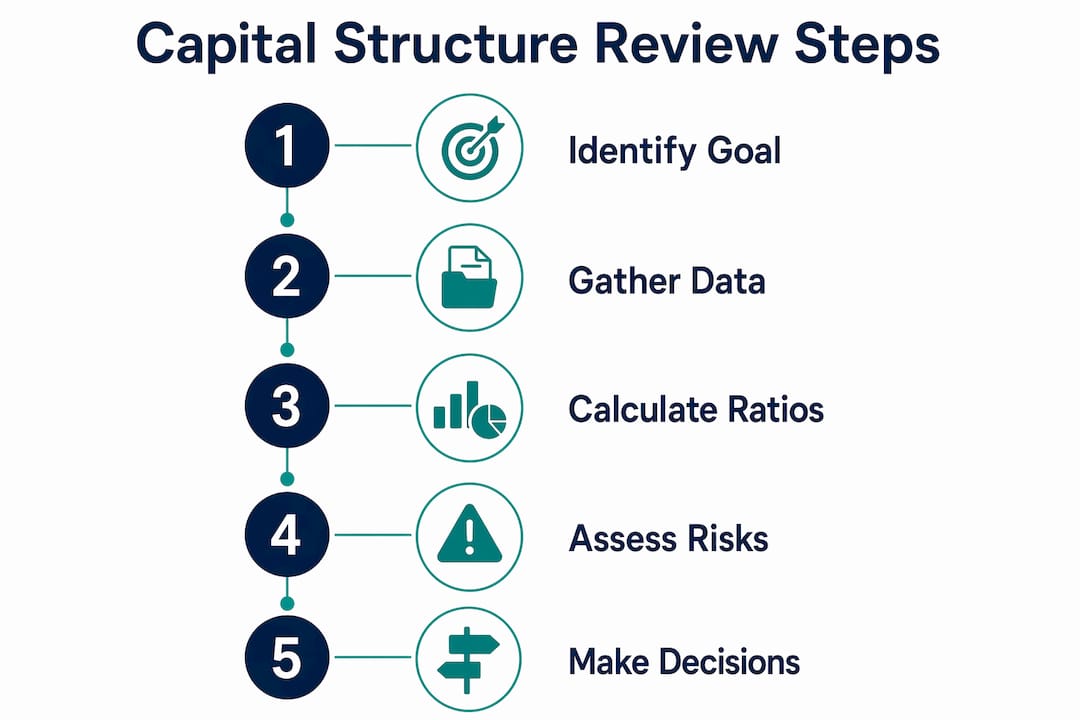
Effective capital structure analysis relies on a small set of financial ratios, interpreted in context. The numbers alone tell you little. Their meaning comes from comparing them against industry benchmarks, your own history, and your strategic objectives.
Key ratios to assess
Debt-to-equity ratio (D/E): This ratio shows how much debt funds the business relative to equity. A D/E ratio above the industry average signals higher financial risk. A ratio well below the average may indicate underutilised debt capacity and a higher-than-necessary WACC.
Interest coverage ratio: Calculated as earnings before interest and tax (EBIT) divided by interest expense. A ratio below 2.0 raises serious concerns about debt serviceability. A ratio above 5.0 suggests room to take on additional debt if the strategy warrants it.
Debt-to-assets ratio: This measures what proportion of total assets is financed by debt. It is particularly relevant for property investors assessing loan-to-value exposure across a portfolio.
Interpreting the capital stack
The order in which capital is drawn down matters as much as the mix itself. In development financing, drawdown sequencing errors cause multi-week delays and increase senior facility costs. The standard sequence runs senior debt first, then mezzanine, then sponsor equity. Deviating from this order disrupts lender expectations and can trigger covenant breaches.
Tax implications sit inside every capital structure decision. Intercompany loans within corporate groups avoid Division 7A deemed dividend treatment, allowing capital to remain in lower-tax environments without triggering personal tax consequences. This is a material advantage for business owners who hold investment assets alongside operating companies.
| Metric | What it measures | Red flag threshold |
|---|---|---|
| Debt-to-equity ratio | Financial leverage | Above industry average by 30%+ |
| Interest coverage ratio | Debt serviceability | Below 2.0 |
| Debt-to-assets ratio | Asset financing mix | Above 70% for most sectors |
| WACC | Blended cost of capital | Rising year-on-year without growth offset |
For a practical framework on asset allocation and capital mix, the step-by-step approach to structuring positions across asset classes applies directly to capital structure decisions.
What are the benefits of reviewing capital structure for investors?
Regular capital structure review delivers concrete advantages that go well beyond tidying up a balance sheet. The benefits of reviewing capital structure fall into four clear categories.
- Lower cost of capital. Identifying and correcting an imbalanced debt-to-equity ratio reduces WACC. A one percentage point reduction in WACC on a $5 million portfolio has a material impact on net returns over a decade.
- Better negotiating position with lenders. Reviewing your structure before you need new finance, rather than during a crisis, gives you time to approach multiple lenders. Starting early in the EOFY period improves lender engagement and negotiation capacity.
- Reduced concentration risk. A capital structure review often reveals that too much exposure sits in one asset class or funding source. Addressing this through structural adjustments reduces the impact of any single adverse event. You can read more about managing portfolio concentration risk and when a single position becomes dangerous.
- Tax efficiency gains. Business owners paying the top personal marginal rate of 47% can retain 17–22 cents more of every dollar by holding assets inside a company structure taxed at 25–30%. This advantage compounds significantly over time.
- Regulatory alignment. With CGT discount reductions and trust taxation changes taking effect from the 2026–27 budget, structures that were tax-efficient last year may now be suboptimal. A review identifies where adjustments are needed before the tax year closes.
Pro Tip: Many investors focus on EOFY admin and miss the strategic question entirely. Ask yourself: is each dollar of capital currently deployed in the best available position given today's conditions? If you cannot answer that with confidence, a capital allocation review is overdue.
Key takeaways
Reviewing capital structure is a continuous discipline, not an annual checkbox, and the investors who do it well consistently outperform those who treat it as an afterthought.
| Point | Details |
|---|---|
| WACC drives value | Reducing your blended cost of capital directly increases enterprise and portfolio value. |
| Tax structure matters | Holding assets in a company at 25–30% tax versus 47% personal rate retains significantly more capital for reinvestment. |
| Timing is critical | Starting capital reviews in april or may, not june, secures better lender terms and more negotiating room. |
| Regulatory changes demand action | The 2026–27 Federal Budget's CGT and trust reforms require immediate reassessment of existing investment structures. |
| Sequencing errors are costly | Drawing down capital in the wrong order in development finance causes delays and increases facility costs. |
The part most investors get wrong about capital structure
Capital structure review is one of those disciplines where the theory is well understood and the practice is consistently poor. I have seen investors who can articulate WACC, trade-off theory, and pecking order theory with precision, then leave their own capital structure untouched for three or four years because "nothing major has changed."
The problem is that capital structure does not need a dramatic event to drift out of alignment. Interest rates move. Tax laws shift. Asset values change. A structure that was genuinely optimal in 2022 may now carry 10–15 basis points of unnecessary cost, simply because no one ran the numbers again.
The other mistake I see regularly is treating EOFY as a compliance exercise rather than a strategic one. Many investors misuse EOFY by focusing on administrative tasks rather than asking whether capital is deployed in the best-performing assets. That question, asked honestly, is the entire point of the review.
Sequencing matters more than most people realise. In development finance, drawing mezzanine before senior debt is not just inefficient. It can breach covenants and stall a project entirely. The same logic applies to personal investment structures: the order in which you establish entities, draw income, and deploy capital has tax and legal consequences that compound over time.
My honest view is that capital structure review should happen at least twice a year, with a deeper assessment whenever a material event occurs: a rate change, a budget announcement, a significant asset acquisition, or a change in personal income. The optimal capital structure is not fixed. It is a moving target, and the investors who treat it that way build wealth more efficiently than those who do not.
— Jonathan
How Alphaiq supports your capital structure decisions
Alphaiq gives self-directed Australian investors the modelling tools to assess their financial position across investments, superannuation, property, and retirement in one place.

When you are reviewing your capital mix, the numbers need to be current and connected. Alphaiq's tax-aware financial modelling lets you run scenario simulations across different debt-to-equity configurations, super contribution strategies, and property structures. You can see how a shift in your capital allocation affects retirement income projections before you commit to a change. Use the Alphaiq super calculator to model how your current capital structure aligns with your retirement goals, and identify where adjustments could improve your long-term position.
FAQ
What is capital structure and why does it matter?
Capital structure is the mix of debt and equity a company or investor uses to fund assets. It matters because the balance directly affects the cost of capital, financial risk, and after-tax returns.
How often should you review your capital structure?
A capital structure assessment should occur at least twice a year, with additional reviews triggered by interest rate changes, tax law updates, or significant asset acquisitions.
What ratios are most useful in a capital structure assessment?
The debt-to-equity ratio, interest coverage ratio, and debt-to-assets ratio are the three most practical metrics. Each reveals a different dimension of leverage and financial risk.
How do tax reforms affect capital structure decisions?
The 2026–27 Federal Budget reduced the CGT discount and introduced a 30% minimum tax on real gains, which alters the after-tax return on many structures and may require investors to restructure holdings.
Why does EOFY matter for capital structure review?
EOFY is the natural annual checkpoint for reassessing capital allocation and financing terms. Starting the review in april or may, rather than june, gives investors more time to negotiate with lenders and act on findings before the financial year closes.