
TL;DR:
- Capital growth is essential for building wealth that outpaces inflation and secures retirement income.
- Investing in quality growth assets, maintaining disciplined market behavior, and leveraging tax-efficient strategies maximize long-term wealth.
Capital growth is defined as the increase in an asset's value over time, and it is the primary mechanism through which Australian investors build wealth that outpaces inflation and funds a secure retirement. Without it, your portfolio loses real purchasing power every year. A static investment of $10,000 today will buy significantly less in 20 years if it simply sits still. The role of capital appreciation extends beyond personal portfolios too. It underpins economic development, business expansion, and the long-term financial security of millions of Australians navigating the years between 35 and 65.
How does capital growth drive wealth and economic expansion?
Capital growth powers both individual wealth and broader economic development. When you invest in growth assets such as Australian shares, property, or managed funds, you are participating in a system where capital formation creates productive capacity, which in turn generates returns. The Investment Company Institute reports that money market funds hold $7.7 trillion globally, with bond funds attracting $1.4 trillion in inflows over five years. This scale of capital deployment illustrates how investment markets channel savings into economic activity that generates the returns investors depend on.
Capital markets are not abstract financial machinery. They are the mechanism through which your savings become productive assets, and productive assets become retirement income.
At the macroeconomic level, growth is increasingly driven by capital deepening rather than employment expansion. Research from Fair Observer shows that revenue growth is decoupling from payroll increases, with capital's share of income rising while labour's share declines. This structural shift means wealth is concentrating among asset owners rather than wage earners. For investors aged 35 to 65, this is not an abstract economic observation. It is a direct argument for owning growth assets rather than relying solely on employment income to build wealth.
The inflation dimension makes this even more pressing. BlackRock's analysis shows that £10,000 invested in 2006 needed to grow to over £21,270 by 2026 just to maintain its purchasing power. Apply that logic to Australian dollars and the message is clear: capital that does not grow is capital that shrinks in real terms. This is the foundational case for prioritising capital appreciation in any long-term wealth plan.

Does all capital growth actually create value?
Not all growth is equal, and understanding this distinction separates disciplined investors from those who overpay for the promise of future gains. The critical test, articulated by valuation expert Aswath Damodaran, is whether return on capital exceeds the cost of capital. When it does, growth adds value. When it does not, growth actually destroys it.
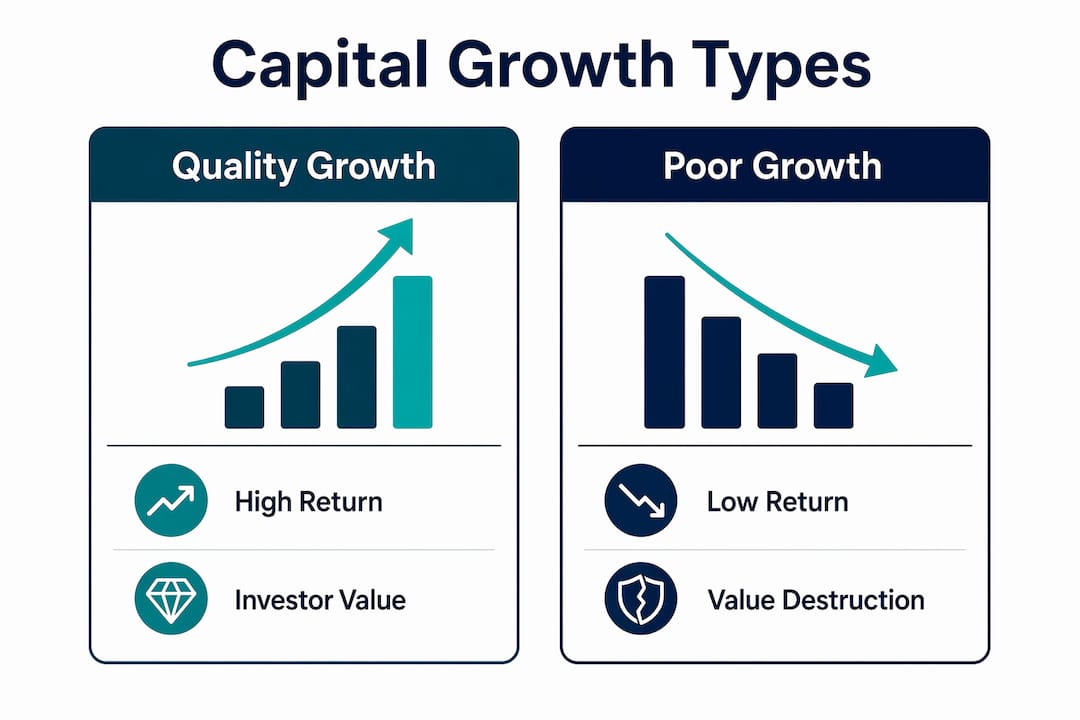
Consider two companies, both growing revenue at 15% per year. Company A funds that growth by reinvesting capital at a 20% return while its cost of capital is 10%. Company B achieves the same revenue growth but earns only 8% on reinvested capital against the same 10% cost. Company A creates genuine wealth for shareholders. Company B is burning through capital to generate the appearance of growth. Paying a premium for Company B's shares is a wealth-destroying decision, regardless of how compelling the growth story sounds.
| Growth type | Return on capital vs cost of capital | Investor outcome |
|---|---|---|
| Quality growth | Return exceeds cost (e.g. 18% vs 10%) | Value creation and wealth accumulation |
| Neutral growth | Return equals cost (e.g. 10% vs 10%) | No net value added |
| Value-destroying growth | Return below cost (e.g. 7% vs 10%) | Capital erosion despite revenue growth |
For Australian investors evaluating shares or managed funds, this framework applies directly. Look for businesses and fund managers with a track record of generating returns above their cost of capital through sustainable reinvestment, not just top-line expansion.
Pro Tip: When assessing a growth investment, ask what the business earns on each dollar it reinvests. A company that earns 15 cents on every reinvested dollar is worth far more than one that earns 6 cents, even if both are growing at the same headline rate.
Capital growth vs income vs preservation: which should you prioritise?
The answer depends on your age, risk tolerance, and retirement timeline. These three objectives sit on a spectrum, and most investors need elements of all three at different stages of their financial lives.
-
Capital growth targets asset appreciation over time. It suits investors with a longer time horizon who can tolerate short-term volatility in exchange for higher long-term returns. Australian shares and property are the classic growth vehicles.
-
Income generation focuses on regular cash flow through dividends, interest, or rental income. Australian investors benefit particularly from franking credits on share dividends, which can significantly boost after-tax income. This approach suits investors approaching or in retirement who need reliable withdrawals.
-
Capital preservation prioritises protecting the nominal value of your portfolio. Cash, term deposits, and short-duration bonds fall into this category. The trade-off is that preservation strategies often fail to keep pace with inflation, meaning real purchasing power still erodes over time.
The most effective approach for investors in their 40s and 50s is not to choose one strategy exclusively but to combine them deliberately. BlackRock's high-conviction portfolio research shows that balancing asset appreciation with dividend income provides both inflation protection and the cash flow stability that retirees need. A portfolio that grows in value while also generating income gives you two levers to manage in retirement: you can draw on income without selling assets during market downturns.
As you move through your 50s and into your 60s, a gradual shift from pure growth toward a blend of growth and income makes practical sense. You are not abandoning capital appreciation. You are adding a cash flow layer that reduces your dependence on selling assets at potentially unfavourable times. Understanding how growth assets power retirement is the starting point for getting this balance right.
What capital growth strategies work best for Australian investors in 2026?
Practical capital growth strategies for Australian investors rest on four pillars: behavioural discipline, diversified asset allocation, tax-aware planning, and the right tools to model your outcomes.
-
Behavioural consistency over market timing. Gala Capital's research confirms that superior investment results come from maintaining exposure through market cycles rather than reacting to short-term volatility. Investors who stayed invested through the 2020 COVID sell-off and the 2022 rate-rise correction captured the subsequent recoveries. Those who moved to cash locked in losses and missed the rebound.
-
Diversified growth asset allocation. A well-constructed growth portfolio spreads exposure across Australian equities, international shares, listed property, and infrastructure. Each asset class responds differently to economic conditions, which smooths the overall return profile without sacrificing long-term growth. A practical asset allocation guide can help you build this structure systematically.
-
Tax-aware compounding. The structure of your investments matters as much as the investments themselves. Holding growth assets inside superannuation attracts a maximum 15% tax on earnings during accumulation, compared with your marginal rate outside super. Tax-aware investing strategies such as debt recycling, franking credit optimisation, and timing capital gains realisations can meaningfully improve your after-tax compounding rate. As Creative Capital Wealth Management notes, integrating tax, risk, liquidity, and legacy goals is what separates structured wealth building from ad hoc product selection.
-
Modelling your outcomes with real numbers. Knowing that capital growth matters is one thing. Knowing how much growth you need, at what rate, and across which assets to reach your retirement target is another. This is where scenario modelling tools become genuinely useful rather than merely interesting.
Pro Tip: Avoid chasing last year's top-performing asset class. Sector rotation is real, but retail investors who chase performance typically buy near the peak and sell near the trough. Set your allocation based on your goals and time horizon, then rebalance annually rather than reactively.
Key takeaways
Capital growth is the single most important driver of long-term wealth accumulation for Australian investors, and its effectiveness depends on quality, tax structure, and behavioural discipline rather than simply choosing growth assets.
| Point | Details |
|---|---|
| Inflation erodes static capital | Capital that does not grow loses real purchasing power every year, making growth a necessity rather than an option. |
| Quality growth creates value | Growth only adds wealth when return on capital exceeds the cost of capital; revenue growth alone is not sufficient. |
| Blend growth with income | Combining capital appreciation with dividend income provides inflation protection and cash flow stability in retirement. |
| Tax structure amplifies compounding | Holding growth assets in superannuation and applying tax-aware strategies materially improves long-term outcomes. |
| Behaviour drives results | Staying invested through market cycles, not market timing, is what sustains compounding over decades. |
Capital growth in 2026: what I've learned from watching investors get this wrong
After years of observing how Australian investors approach wealth building, the pattern that stands out most is not a lack of knowledge about capital growth. It is a gap between knowing and doing. Most investors understand that shares and property grow over time. Far fewer maintain the conviction to hold through a 20% drawdown without second-guessing their entire strategy.
The inflation environment of the past few years has sharpened this challenge. When cash rates rose sharply in 2022 and 2023, many investors shifted toward term deposits and high-interest savings accounts, reasoning that 5% with no risk was better than volatile equities. That logic is understandable. But it ignores the compounding cost of sitting out a recovery, and it treats inflation as a solved problem when it remains a structural risk for anyone with a 20-year retirement horizon.
What I find most underappreciated is the quality dimension of growth. Investors spend enormous energy debating asset allocation percentages while paying little attention to whether the growth they are buying is actually value-accretive. A diversified portfolio of businesses earning strong returns on reinvested capital will outperform a broader index of mediocre growers over a full cycle, even if the short-term volatility looks similar.
The other shift worth noting is structural. As capital deepening accelerates through automation and technology, the gap between asset owners and wage earners will likely widen further. For investors in the 35 to 65 age bracket, this is an argument for increasing your exposure to growth assets now, while your time horizon is still long enough to absorb volatility and benefit from compounding.
The investors I see building real wealth are not the ones with the most sophisticated strategies. They are the ones who set a clear goal, build a tax-aware structure around it, and hold their nerve when markets test them.
— Jonathan
How Alphaiq helps you plan for capital growth
Knowing the importance of capital growth is the first step. Modelling exactly how much growth you need, across which assets, and within what tax structure is where most self-directed investors get stuck.

Alphaiq is built for Australian investors who want those answers without paying for ongoing financial advice. The platform models your superannuation, investments, and property in one place, running scenario simulations that show you the real impact of different growth rates, contribution strategies, and tax structures on your retirement outcome. The AlphaIQ superannuation calculator lets you project your super balance under different growth assumptions, so you can see clearly whether your current trajectory reaches your target. Start with the free tools at Alphaiq and get the clarity your retirement plan deserves.
FAQ
What is the role of capital growth in retirement planning?
Capital growth increases the real value of your portfolio over time, which is what funds a retirement that lasts 20 to 30 years. Without sufficient growth, inflation erodes your purchasing power and you risk outliving your savings.
How does capital growth differ from investment income?
Capital growth is the increase in an asset's value, while investment income is the cash generated by that asset through dividends, interest, or rent. Most effective retirement portfolios combine both to provide growth and regular cash flow.
What factors affect capital growth most significantly?
The primary factors are the quality of the underlying asset (return on capital relative to cost of capital), the holding period, tax structure, and investor behaviour during market volatility. Staying invested through downturns is one of the most consistent predictors of long-term growth outcomes.
Is capital growth or income more important for investors in their 50s?
Both matter, but the balance shifts with age. Investors in their early 50s typically benefit from maintaining a growth-oriented allocation, then gradually introducing more income-generating assets as they approach their preservation age and retirement drawdown phase.
How can Australian investors maximise capital growth within superannuation?
Holding growth assets inside super takes advantage of the 15% concessional tax rate on earnings during accumulation, which significantly improves after-tax compounding compared with holding the same assets outside super. Combining this with salary sacrifice contributions and franking credit offsets amplifies the effect further.