
TL;DR:
- Growth investing involves purchasing shares in companies expected to surpass market revenue and earnings growth, aiming for capital appreciation. It relies on assessing fundamentals like revenue, earnings, market size, and the Rule of 40, while managing risks such as valuation and market fluctuations. A disciplined approach, including diversification and clear investment theses, enhances success in building a growth-focused portfolio.
Growth investing is the strategy of buying shares in companies expected to grow their revenues and earnings substantially faster than the market average, with the goal of maximising capital gains rather than earning income from dividends. Pioneered by Thomas Rowe Price Jr. in the 1950s, this approach targets businesses with strong future potential, often accepting higher valuation multiples today on the basis that anticipated growth will justify the premium. For Australian investors aged 30 to 55 building long-term wealth, understanding what growth investing involves, how it compares to other strategies, and how to manage its risks is the foundation of a sound growth portfolio.
What is growth investing and how does it work?
Growth investing targets companies expected to grow faster than their peers or the broader market, with the primary focus on capital appreciation rather than dividends. The logic is straightforward: you buy a stake in a business today at a price that reflects its future potential, then benefit as that potential is realised over time. Companies in sectors like technology, healthcare, and clean energy frequently attract growth investors because their markets are expanding and their earnings trajectories are steep.

What separates growth investing from simply buying popular stocks is the discipline behind stock selection. Investors assess business fundamentals tied to future growth potential, including revenue growth rates, profit margins, the quality of leadership, and the capacity for innovation. A company like Nvidia or Afterpay at earlier stages of their growth cycles would have met these criteria, offering investors exposure to markets that were still in their early phases of expansion.
Growth companies typically reinvest profits back into the business rather than distributing them as dividends. This reinvestment funds research and development, market expansion, and talent acquisition, all of which compound the growth trajectory over time. For investors focused on long-term capital appreciation, this trade-off between current income and future value is the central bargain of the strategy.
Key metrics growth investors use to evaluate stocks
Identifying genuine growth companies requires more than reading headlines. Growth investors rely on a combination of quantitative metrics and qualitative judgement to separate durable growth from short-lived momentum.
The most widely used indicators include:
- Revenue growth rate: Consistent year-on-year revenue growth above 20% signals a company is capturing market share at pace.
- Earnings per share (EPS) growth: Rising EPS over multiple periods confirms that revenue gains are translating into real profitability.
- Total addressable market (TAM): A large expanding market gives a company significant runway. A business with a small fraction of a $200 billion market has far more growth potential than one already dominant in a $5 billion market.
- Net revenue retention (NRR): NRR above 120% means existing customers are spending more each year, reducing dependence on costly new customer acquisition. Companies like Snowflake and CrowdStrike have demonstrated this metric at exceptional levels.
- Price-to-earnings (P/E) ratio: Growth stocks trade at higher P/E ratios than the market average, reflecting investor confidence in future expansion rather than current earnings.
One particularly useful framework is the Rule of 40. The Rule of 40 balances a company's revenue growth rate and profit margin, with a combined score above 40 considered healthy. A company growing revenue at 60% with a negative 15% margin scores 45 and passes the test. A company growing at 20% with a 25% margin also scores 45. This metric is especially relevant for software and technology businesses where high growth often precedes profitability.
Pro Tip: Do not rely on any single metric in isolation. Growth investing uses both subjective and objective analysis, combining financial data with judgement about competitive position, management quality, and market timing. The best growth investors treat metrics as a starting point, not a final answer.
| Metric | What it tells you |
|---|---|
| Revenue growth rate | Whether the business is expanding its top line at pace |
| Net revenue retention | Whether existing customers are deepening their spend |
| Rule of 40 score | Whether growth and profitability are in balance |
| Total addressable market | How much room remains for the business to grow |
| P/E ratio | What premium the market is pricing in for future growth |
Growth vs value investing: what is the real difference?
Growth and value investing represent two distinct philosophies, though they are not mutually exclusive. Understanding the contrast helps you decide where your own strategy sits.
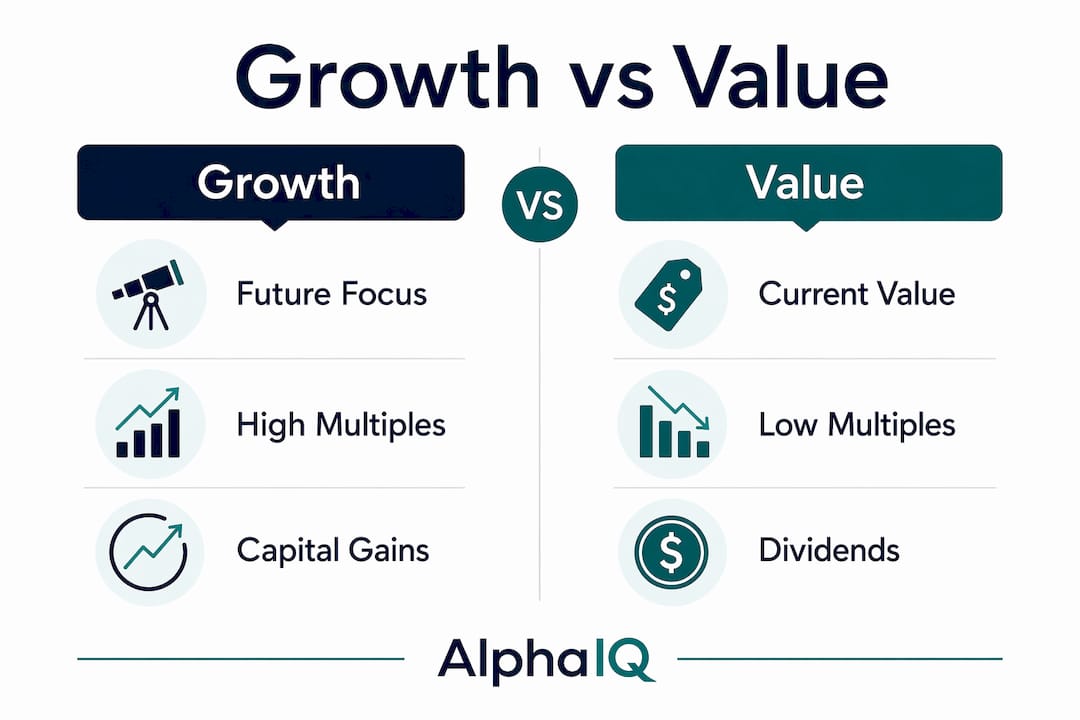
Value investing, associated with Benjamin Graham and Warren Buffett, focuses on buying stocks trading below their intrinsic worth. The investor seeks a margin of safety by purchasing undervalued assets and waiting for the market to recognise their true price. Growth investing, by contrast, emphasises momentum and future potential over discounted prices. You are paying a premium today for what you believe a company will become.
| Factor | Growth investing | Value investing |
|---|---|---|
| Primary focus | Future earnings potential | Current undervaluation |
| Typical P/E ratio | High (often 30x or above) | Low (often below market average) |
| Dividend income | Rare; profits reinvested | More common |
| Volatility | Higher | Generally lower |
| Time horizon | Long-term | Medium to long-term |
| Risk profile | Higher | Moderate |
The practical differences show up most clearly during market cycles. Growth stocks tend to outperform in bull markets when investor confidence is high and capital flows toward future potential. Value stocks often hold up better during downturns because their lower valuations provide a natural floor. Neither approach dominates across all conditions, which is why many experienced investors adopt a blended approach.
Many investors use hybrid strategies like GARP (Growth at a Reasonable Price), which combines growth investing's focus on earnings momentum with value investing's discipline around not overpaying. GARP investors look for companies growing earnings at above-average rates but trading at valuations that are not stretched relative to that growth. This approach suits investors who want growth exposure without the extreme volatility that can accompany the highest-multiple stocks.
What are the risks of growth investing?
Growth investing carries a higher risk profile than income or value strategies, and understanding those risks is what separates disciplined investors from those who get caught out. Returns depend on execution and on meeting elevated market expectations. When a growth company misses its targets, even slightly, the share price reaction can be severe because the premium valuation leaves no room for disappointment.
The most common risks include:
- Valuation risk: Paying too high a multiple for growth that does not materialise leaves you holding an expensive stock with no earnings support.
- Execution risk: A company's ability to sustain rapid growth depends on management quality, competitive dynamics, and market conditions, all of which can shift.
- Concentration risk: Portfolios heavily weighted toward a few high-growth names amplify losses when those names correct. Understanding portfolio concentration risk is particularly relevant for growth investors who favour conviction positions.
- Interest rate sensitivity: Growth stocks are valued on future cash flows, which are discounted more heavily when interest rates rise. The 2022 rate cycle illustrated this sharply, with many high-growth technology stocks falling 50% to 80% from their peaks.
- Market disruption: A company's growth thesis can be invalidated by a competitor, a regulatory change, or a technological shift that the original analysis did not anticipate.
Monitoring profitability trends is a key risk control discipline. If a company's revenue growth or margins begin to deteriorate below the benchmarks that justified your original investment, that is a signal to reassess the thesis rather than hold on out of hope.
Pro Tip: Diversified growth funds or ETFs offer a practical way to reduce company-specific risk without abandoning the growth strategy. For Australian investors, ASX-listed ETFs focused on global technology or innovation themes provide broad growth exposure without the concentration risk of owning individual stocks.
How to start building a growth investing portfolio
Building a growth portfolio is a structured process, not a single decision. These steps give you a practical framework to get started.
-
Assess your risk tolerance and time horizon. Growth investing suits investors with higher risk tolerance and longer time horizons. If you are more than ten years from retirement, you have the runway to absorb volatility and benefit from compounding. If you are within five years of drawing down your portfolio, a heavy growth allocation may not be appropriate.
-
Decide between individual stocks and diversified funds. Selecting individual growth stocks requires significant research and ongoing monitoring. ASX-listed ETFs tracking global growth indices, such as those covering the Nasdaq-100 or global technology sectors, give you diversified growth exposure with lower stock-specific risk. For most investors starting out, funds are the more practical entry point.
-
Set position sizing rules. No single growth stock should represent more than 5% to 10% of your total portfolio. This rule limits the damage if one holding corrects sharply while still allowing meaningful upside if it performs well.
-
Monitor key metrics regularly. Review revenue growth, earnings trends, and the Rule of 40 score for each holding at least quarterly. If a company's fundamentals deteriorate, act on the data rather than waiting for a recovery that may not come.
-
Rebalance as your portfolio grows. Growth stocks that perform well can quickly become oversized positions. Rebalancing your portfolio periodically locks in gains and keeps your risk exposure aligned with your original plan.
-
Integrate growth investing with your broader wealth plan. For Australian investors, this means considering how growth assets interact with your superannuation, any property holdings, and your target retirement income. Growth assets inside super benefit from concessional tax rates, making super an efficient vehicle for long-term growth investing.
Key takeaways
Growth investing delivers the strongest results when investors combine rigorous metric analysis with patience, diversification, and a clear understanding of the risks involved.
| Point | Details |
|---|---|
| Core definition | Growth investing targets capital appreciation by buying companies with above-average earnings and revenue growth potential. |
| Key metrics | Revenue growth, NRR above 120%, Rule of 40, TAM, and P/E ratios are the primary evaluation tools. |
| Growth vs value | Growth stocks carry higher valuations and volatility; GARP blends both approaches for balanced exposure. |
| Primary risks | Valuation risk, execution risk, and interest rate sensitivity are the three most significant threats to growth portfolios. |
| Getting started | Begin with diversified growth ETFs, set position limits, monitor fundamentals quarterly, and integrate with your super strategy. |
Growth investing in practice: what I have actually observed
The most common mistake I see Australian investors make with growth investing is confusing a good company with a good investment. A business can have exceptional products, strong revenue growth, and a compelling story, and still be a poor investment if you pay too much for it. Valuation discipline is not the opposite of growth investing. It is the part most people skip.
The second pattern worth calling out is the tendency to abandon a growth strategy during a correction. When high-growth stocks fell sharply in 2022, many retail investors sold at the bottom and locked in permanent losses on businesses that subsequently recovered. Growth investing requires you to hold through periods of significant paper loss, which is psychologically difficult unless you have done the work to understand why you own each position in the first place.
What actually works, in my observation, is a written investment thesis for each holding. Before you buy, document the specific metrics that justify the valuation and the conditions under which you would sell. This removes emotion from the decision and gives you a framework to reassess objectively when conditions change. Exploring growth assets and retirement wealth in the context of your full financial picture is where this discipline pays off most clearly.
Growth investing is worth it for investors who are genuinely prepared to do the work and hold through volatility. For those who want growth exposure without the research burden, a diversified ETF approach delivers most of the upside with far less complexity.
— Jonathan
See your growth investing potential with Alphaiq
Understanding growth investing is the first step. Knowing how it fits into your total wealth picture, including your superannuation, property, and retirement income, is where the real planning begins.

Alphaiq is built for self-directed Australian investors who want to model their financial position with real numbers rather than rough estimates. The Alphaiq Super Calculator lets you project your superannuation balance under different growth scenarios, so you can see exactly how a shift in your investment strategy affects your retirement outcome. Whether you are weighing a higher growth allocation inside super or planning your drawdown strategy, Alphaiq gives you the clarity to make confident decisions without the cost of ongoing financial advice.
FAQ
What is growth investing in simple terms?
Growth investing means buying shares in companies expected to grow their revenues and earnings faster than the market average, with the goal of increasing the value of your investment over time rather than earning regular dividend income.
What are the main advantages of growth investing?
The primary advantage is the potential for significant capital appreciation over a long time horizon. Growth companies that successfully execute their strategies can deliver returns that substantially exceed those of the broader market.
How does growth investing differ from value investing?
Growth investing focuses on future earnings potential and accepts high valuation multiples, while value investing seeks stocks trading below their intrinsic worth. Growth strategies carry higher volatility; value strategies typically offer more downside protection.
Is growth investing suitable for beginners?
Growth investing through diversified ETFs is accessible for beginners, but selecting individual growth stocks requires substantial research and risk tolerance. Starting with a broad growth-focused fund reduces complexity while still providing meaningful exposure to the strategy.
How do I know if a stock is a good growth investment?
Evaluate revenue growth rates, net revenue retention, the Rule of 40 score, and the size of the total addressable market. A company scoring above 40 on the Rule of 40 with NRR above 120% and a large, underpenetrated market is a strong candidate for further analysis.