
TL;DR:
- Balancing investment and debt involves comparing after-tax debt costs with expected investment returns to determine the best use of funds. Building financial foundations such as an emergency buffer and maximizing super contributions should precede any investment or debt repayment strategy. Choosing between avalanche or snowball debt repayment methods depends on individual preferences, risk tolerance, and psychological factors.
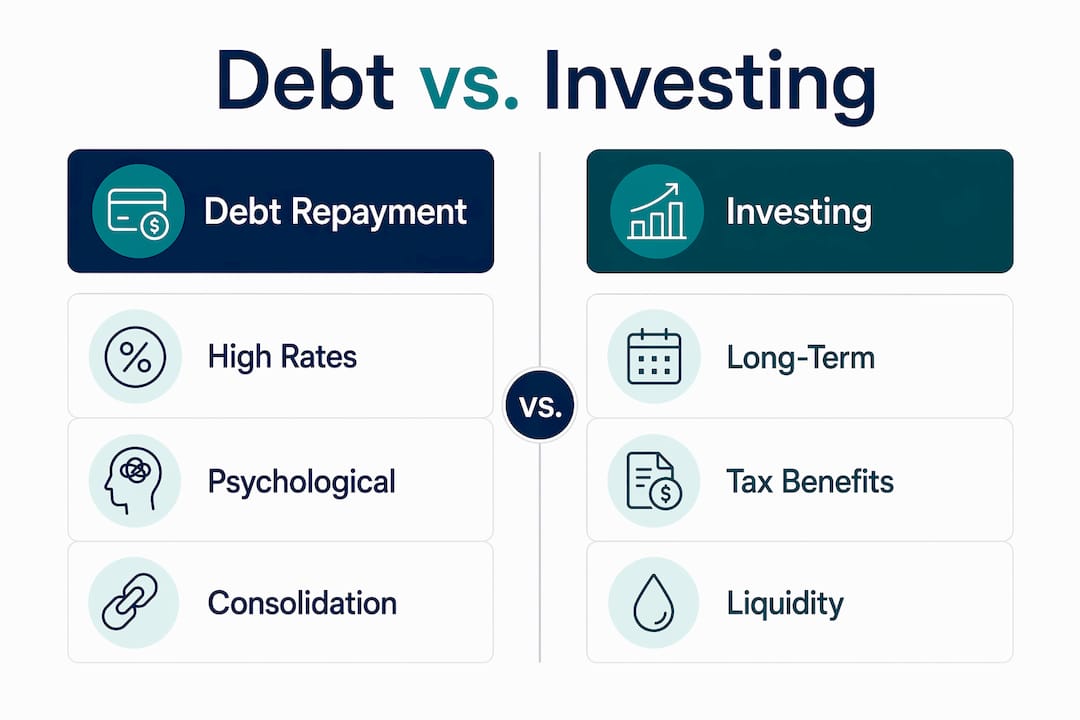
Balancing investment and debt is defined as the strategic process of comparing your debt's interest rate against your expected after-tax investment return to decide where each spare dollar works hardest. Knowing how to balance investment and debt is the core skill separating Australians who build wealth steadily from those who spin their wheels. The decision is not binary. You do not have to choose between paying off your mortgage and growing your super. You compare rates, secure your foundations, and then deploy capital where the maths favours you. This guide gives you a clear framework to do exactly that.
How do interest rates determine your balance strategy?
The interest rate on your debt is the single most important number in this decision. Think of debt as a negative asset with a guaranteed negative return equal to its interest rate. Paying off a debt charging 20% per annum is mathematically identical to earning a guaranteed 20% return on an investment. No diversified share portfolio reliably beats that.

The 2026 guidance from financial planners follows a clear three-tier model when managing investments and liabilities:
| Debt Interest Rate | Recommended Action | Examples |
|---|---|---|
| Above 8% | Aggressively pay off first | Credit cards (15–29% APR), personal loans |
| 5%–8% | Personalised approach | Car loans, some personal loans |
| Below 5% | Invest while paying minimums | Mortgages, low-interest student debt |
Credit cards often carry 15–29% APR. At those rates, no reliable investment consistently delivers a better guaranteed return, so aggressive payoff is the correct call. Mortgages sitting below 5% are a different story. The long-run average return from a diversified Australian share portfolio has historically exceeded that threshold, making investing the stronger move while you service the loan normally.
The 5%–8% grey zone is where personal factors matter most. Tax deductibility of interest, your risk tolerance, and your psychological relationship with debt all influence the right answer. An investment property loan, for example, may have deductible interest that effectively lowers its real cost below 5%, shifting the maths toward investing. You need to run the numbers on your specific situation, not apply a blanket rule.
Pro Tip: Use an after-tax interest rate when comparing debt costs to investment returns. A 7% mortgage with deductible interest may cost you closer to 4.9% in real terms, depending on your marginal tax rate.
What foundations must you build before investing while in debt?
Before you allocate a single extra dollar to either debt repayment or investments, two prerequisites must be in place. Skipping these steps creates fragility. One unexpected car repair or medical bill can force you back into high-interest debt, undoing months of progress.
Follow this sequence:
-
Build a $1,000 cash buffer. A small initial reserve prevents you from reaching for a credit card when a minor emergency hits. This is your first line of defence, not your full emergency fund.
-
Capture your full employer superannuation or retirement match. Your employer's super contributions represent a guaranteed 50–100% return on that dollar. No debt payoff strategy beats that. Contribute enough to receive the full match before directing extra funds anywhere else.
-
Pay all minimum debt repayments on time. Missing minimum payments triggers penalty rates and damages your credit file. Minimum payments are non-negotiable regardless of your broader strategy.
-
Build a full emergency fund of 3–6 months of essential expenses. A 3–6 month buffer covering rent, food, utilities, and transport gives you the stability to invest or pay down debt without fear. Without it, you are one setback away from derailing your plan.
-
Then apply your strategy. Only after steps 1–4 are secured should you direct surplus cash toward accelerated debt repayment or additional investing.
This sequence applies whether you earn $80,000 or $250,000 per year. The financial planning checklist for 2026 consistently places these foundations ahead of any investment or debt payoff optimisation. Getting the order right matters more than getting the strategy perfect.
Pro Tip: Automate your super contributions and your emergency fund transfers on payday. Automation removes the temptation to redirect those funds and builds the habit without requiring willpower.
Which debt repayment strategies best complement investment plans?
Once your foundations are secure, you need a structured method for tackling debt. Two approaches dominate personal finance: the avalanche and the snowball. Each suits a different type of person.
Avalanche vs. snowball: a direct comparison
| Method | How It Works | Best For | Mathematical Outcome |
|---|---|---|---|
| Debt Avalanche | Pay highest interest rate debt first | Disciplined, numbers-focused people | Minimises total interest paid |
| Debt Snowball | Pay smallest balance first | People who need motivation wins | Faster early payoffs, more total interest |
The debt avalanche method is mathematically optimal. You direct every extra dollar to the highest-rate debt while paying minimums on everything else. Once that debt is cleared, you roll its full payment into the next highest-rate debt. The compounding effect accelerates payoff speed significantly over time.
The debt snowball method sacrifices some mathematical efficiency for psychological momentum. Clearing a small debt quickly delivers a genuine sense of progress. Research shows that early wins improve long-term adherence to a repayment plan. If you have struggled to stick with a debt strategy in the past, the snowball may serve you better in practice, even if it costs slightly more in interest.
Beyond these two methods, Debt Management Plans (DMPs) offer a third path for those carrying multiple high-interest debts. A DMP is a credit counselling agreement, not a loan. It reduces interest rates from 20% or more down to 6–9%, consolidating payments into one monthly amount distributed to creditors. Payoff timelines typically run 3–5 years. DMPs work best when you have multiple unsecured debts and need structural help rather than just a repayment method.
Debt consolidation and balance transfer credit cards serve a similar simplification role. They combine multiple debts into one lower-rate obligation, reducing the cognitive load of managing several repayments and cutting total interest costs. The risk is extending your repayment timeline if you are not disciplined about the new arrangement.
How can you customise your debt and investment balance?
No single formula fits every Australian aged 30–55. Your tax position, risk tolerance, and emotional relationship with debt all shape the right approach for you. The goal is a strategy you will actually follow, not the theoretically perfect one you abandon after three months.
Consider these factors when building your personal plan:
-
Tax deductibility of interest. Interest on investment property loans and margin loans for shares is generally tax-deductible in Australia. This reduces the effective cost of that debt, often shifting it below the threshold where investing becomes the better use of surplus cash. Always calculate the after-tax cost before deciding.
-
Liability-Driven Investing (LDI). LDI is a strategy originally used by pension funds that matches asset durations with liabilities to neutralise interest rate risk. For a self-directed investor, this means aligning the maturity of your fixed-income investments with the timeline of your debts. If your mortgage has 10 years remaining, holding bonds or term deposits with similar durations reduces your exposure to interest rate swings. The asset-liability matching approach is underused by retail investors but genuinely reduces portfolio risk.
-
The "do both" approach. A blended strategy of investing small recurring amounts while making minimum debt payments and directing additional funds to priority debt provides steady progress on both fronts. This suits people who cannot tolerate the idea of making zero investment progress while paying down debt. Even $200 per month into a diversified index fund builds compounding returns over a decade.
-
Psychological comfort. Stress from debt can justify prioritising payoff even when the maths slightly favours investing. A decision you can sleep with is worth more than an optimal decision you second-guess constantly. Factor your mental state into the equation as a legitimate variable.
Pro Tip: If you hold an investment property loan, speak with your accountant about debt recycling. This strategy converts non-deductible debt into deductible debt over time, improving your after-tax position without increasing your total borrowing.
True financial stability requires managing liquidity alongside net worth. A high net worth on paper means little if you cannot cover next month's expenses without selling assets at a loss. Keep liquidity as a standing item on your personal balance sheet review.
Key takeaways
Balancing investment and debt effectively requires comparing after-tax debt costs against expected investment returns, securing foundations first, and choosing a repayment method that matches both your maths and your psychology.
| Point | Details |
|---|---|
| Use interest rate thresholds | Pay off debts above 8% aggressively; invest when debt costs fall below 5%. |
| Secure foundations first | Build a $1,000 buffer, capture your full super match, and hold 3–6 months of expenses in reserve. |
| Choose your repayment method | Avalanche saves the most interest; snowball builds momentum for those who need early wins. |
| Factor in tax and LDI | Deductible interest lowers effective debt cost; matching asset and liability durations reduces rate risk. |
| Consider the "do both" approach | Investing small amounts while repaying debt builds compounding returns and reduces the all-or-nothing pressure. |
The part most people get wrong about debt and investing
I have spoken with a lot of Australians in their 40s who carry a mortgage, some credit card debt, and a super balance they have not looked at in years. The most common mistake is not the debt itself. It is treating the decision as permanent.
People pick a strategy, whether that is paying off the mortgage aggressively or maxing out their super contributions, and then they stop reassessing. Interest rates change. Tax laws change. Your income changes. The right balance in 2022 is not automatically the right balance in 2026.
The second thing I see consistently is people underestimating liquidity risk. They focus entirely on net worth, which looks great on paper, and then a redundancy or a health issue hits and they have no accessible cash. Selling shares or drawing on super early to cover living costs is expensive and often irreversible in terms of lost compounding. Managing liquidity alongside net worth is not optional. It is the part of the balance sheet most advisers underweight.
The third observation is more personal. The psychological burden of debt is real and it deserves a seat at the table. I have seen people make mathematically suboptimal choices, like paying off a 4.5% mortgage faster than necessary, and come out ahead because the mental clarity freed them to take career risks and earn more. The numbers matter. So does your state of mind. Build a strategy that accounts for both, and revisit it every 12 months.
— Jonathan
Model your strategy with Alphaiq
Knowing the framework is one thing. Seeing how it plays out with your actual numbers is another entirely.

Alphaiq is built for Australians who want to model exactly this kind of decision. The Alphaiq platform lets you simulate different debt repayment and investment scenarios side by side, factoring in your tax position, super balance, and property holdings. You can run a debt recycling scenario, project your superannuation outcomes with the super calculator, and stress-test your plan against rate changes, all without paying for ongoing financial advice. If you are ready to move from general principles to your specific numbers, Alphaiq gives you the tools to do it with confidence.
FAQ
What interest rate makes debt repayment better than investing?
Debts above 8% interest should be paid off aggressively before investing, as no reliable investment consistently beats that guaranteed return. Below 5%, investing while making minimum repayments is generally the stronger financial move.
Should i invest while paying off my mortgage?
Yes, in most cases. A standard Australian mortgage sitting below 5–6% interest means the long-run return from a diversified share portfolio or super contributions is likely to exceed the cost of the debt. Capturing your full employer super match is always the first priority.
What is the debt avalanche method?
The avalanche method directs extra repayments to the highest-interest debt first while paying minimums on all others. It is mathematically optimal and minimises the total interest you pay over the life of your debts.
How much emergency savings do i need before investing?
A 3–6 month reserve covering essential living expenses is the standard recommendation. Start with a $1,000 cash buffer as a first step to avoid falling back into high-interest debt during minor emergencies.
What is liability-driven investing and does it apply to me?
Liability-Driven Investing (LDI) matches asset durations with liabilities to reduce interest rate risk. For a self-directed Australian investor, this means aligning fixed-income investments with the remaining term of your debts, a practical way to reduce portfolio volatility as you approach retirement.