
TL;DR:
- Financial independence occurs when investment income fully covers all living expenses, making work optional. Achieving it requires saving 50-70% of income and calculating a specific target using the Rule of 25.
Financial independence is defined as the state where your income-generating assets cover all living expenses without relying on active employment. This is a measurable financial condition, not a feeling. It differs from financial freedom, which is a subjective state of confidence and low financial stress. Understanding this distinction matters because financial independence gives you a concrete number to target, while financial freedom describes how you feel about money. For Australians aged 25–45, knowing the difference is the first step toward building a plan that actually works.
What is financial independence and how is it defined?
Financial independence is achieved when your investment returns and passive income replace your salary entirely. At that point, work becomes optional. You choose whether to keep working, change careers, or stop altogether. The key word is optional. That shift in control is what separates financial independence from simply having savings.

Financial freedom, by contrast, is about mindset. You can feel financially free on a modest income if you have low expenses and no debt. Financial independence is mathematical. It requires your assets to generate enough income to fund your lifestyle indefinitely. Both are worth pursuing, but they require different strategies.
The Rule of 25 and the 4% withdrawal rate are the two standard frameworks used to calculate your FI number. These give you a concrete target to work toward, which is far more useful than vague goals like "saving more."
How is financial independence calculated?
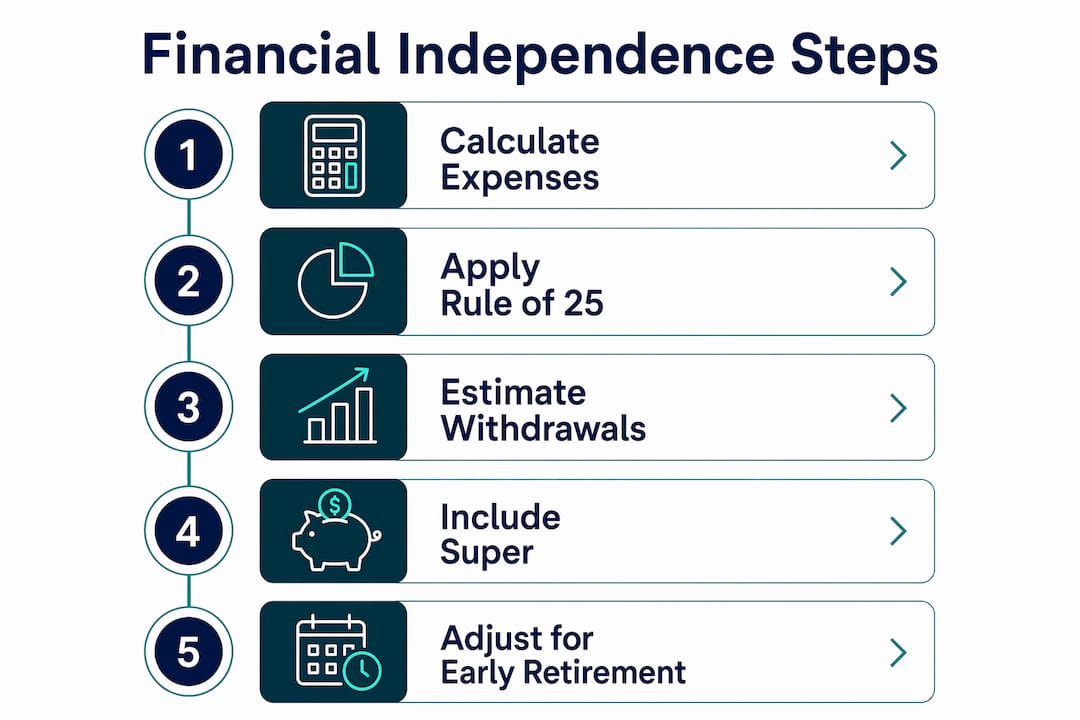
The Rule of 25 states that your FI target equals your annual expenses multiplied by 25. If you spend $60,000 per year, your target nest egg is $1,500,000. This formula is based on the 4% safe withdrawal rate, which assumes you can withdraw 4% of your portfolio annually without depleting it over a 30-year period.
The 4% rule works well for a standard retirement starting around age 65. For Australians planning to retire earlier, the 30-year horizon may not be long enough. A 40-year-old who retires at 45 needs their money to last 40 or more years. That may require a more conservative withdrawal rate of 3% to 3.5%, which pushes the FI target higher.
| Annual expenses | Rule of 25 target | 4% withdrawal | 3% withdrawal target |
|---|---|---|---|
| $40,000 | $1,000,000 | $40,000/yr | $1,333,333 |
| $60,000 | $1,500,000 | $60,000/yr | $2,000,000 |
| $80,000 | $2,000,000 | $80,000/yr | $2,666,667 |
| $100,000 | $2,500,000 | $100,000/yr | $3,333,333 |
Australian investors also need to factor in superannuation. Super is preserved until you reach your preservation age, which is currently 60 for most Australians. If you plan to retire at 45, you need a separate pool of assets to fund the gap years before you can access super. This is called a bridge strategy, and it is one of the most overlooked parts of early retirement planning in Australia.
Pro Tip: Calculate two FI numbers: one for your total portfolio and one for the pre-super bridge period. This prevents the common mistake of counting super assets you cannot yet access.
What practical steps can you take to achieve financial independence?
Reaching financial independence requires a higher savings rate than most Australians currently maintain. The average savings rate sits around 4.9%, but early FI typically requires saving 50–70% of take-home pay. That gap is significant. Closing it requires both increasing income and deliberately controlling expenses.
-
Calculate your FI number first. Use the Rule of 25 as your starting point. Visit your FI number for Australia to refine the calculation for your specific situation, including tax and super.
-
Automate your savings. Paying yourself first by automating transfers to investments immediately after each pay removes the temptation to spend. Automation is more reliable than willpower alone.
-
Control lifestyle creep. Every pay rise is an opportunity to increase your savings rate, not your spending. Frugality means prioritising financial goals over transient consumption, not living without comfort.
-
Invest in diversified assets. For most Australians, low-cost index funds through a platform like a brokerage account, combined with maximising super contributions, form the core of an FI portfolio. Property can also play a role, particularly for those who understand the tax implications.
-
Eliminate high-interest debt first. Carrying debt at 20% interest while earning 8% on investments is a guaranteed loss. Pay off credit cards and personal loans before directing surplus income to investments.
-
Build an emergency fund. Without 3–6 months of living expenses in cash, a market downturn or job loss can force you to sell investments at the worst time. An emergency fund protects your long-term plan from short-term shocks.
Pro Tip: Track your savings rate monthly, not just your account balance. A rising savings rate is the most reliable leading indicator that you are on track for FI.
What is the FIRE movement and how does it relate to financial independence?
FIRE stands for Financial Independence, Retire Early. It applies the same mathematical principles as standard FI but with an aggressive timeline, often targeting retirement in your 30s or 40s rather than your 60s. The movement has grown significantly because it reframes retirement not as an age but as a financial condition.
FIRE variants accommodate different lifestyles and risk tolerances. Understanding which version fits your values prevents burnout and keeps your plan sustainable.
- Lean FIRE targets a minimal lifestyle with a small nest egg, typically under $1,000,000. It requires very low annual spending and leaves little margin for unexpected costs.
- Fat FIRE targets a comfortable or affluent lifestyle, requiring a larger portfolio, often $2,500,000 or more. It suits higher earners who do not want to sacrifice lifestyle in retirement.
- Barista FIRE involves reaching partial financial independence and supplementing investment income with part-time or casual work. This reduces the required nest egg and maintains social connection.
- Coast FIRE means you have invested enough that compound growth alone will reach your FI number by traditional retirement age, without any further contributions. You still work, but only to cover current expenses.
FIRE is not about avoiding work entirely. Financial independence offers work optionality, meaning you choose work that is fulfilling rather than work that pays the bills. Many people who reach FIRE continue working in some capacity, just on their own terms.
Early retirement also requires explicit bridge planning to fund living expenses during the gap before penalty-free access to tax-advantaged accounts. In Australia, this means building a taxable investment portfolio large enough to cover expenses from retirement age until preservation age.
How do you measure progress toward financial independence?
Tracking progress keeps motivation high and reveals when your plan needs adjusting. The most useful metrics are your net worth relative to your FI target and your savings rate.
- Net worth as a percentage of FI target. If your FI number is $1,500,000 and your net worth is $300,000, you are at 20% of your goal. Watching this percentage grow is more motivating than watching a dollar figure.
- Savings rate. A savings rate of 50% or more puts you on an accelerated path. Calculate it monthly and treat it as your primary performance indicator.
- Passive income coverage. Track how much of your annual expenses your passive income streams cover. When this reaches 100%, you have reached FI.
- Super projections. Use a superannuation calculator to model your super balance at preservation age. This tells you whether your super will cover post-60 expenses, which reduces the burden on your taxable portfolio.
- Budget reviews. Revisit your annual expense estimate every 12 months. Life changes, and so does your spending. An accurate expense figure keeps your FI target current.
Tax optimisation also accelerates progress. Salary sacrificing into super reduces taxable income and grows your retirement balance at a concessional tax rate of 15%. Debt recycling converts non-deductible home loan debt into deductible investment debt, improving your after-tax return. Both strategies require careful modelling to confirm they suit your situation.
Key takeaways
Financial independence is a measurable financial condition where investment income covers all living expenses, making work entirely optional.
| Point | Details |
|---|---|
| Definition of FI | Assets generate enough income to cover living expenses without active employment. |
| FI target formula | Multiply annual expenses by 25 to calculate your minimum nest egg using the Rule of 25. |
| Savings rate matters | Reaching FI early requires saving 50–70% of take-home pay, far above the average rate. |
| Australian super gap | Plan a bridge strategy to fund expenses between early retirement and your preservation age. |
| Track the right metrics | Monitor savings rate and net worth as a percentage of FI target, not just account balances. |
The part most people get wrong about financial independence
People treat financial independence as a finish line. They assume that once they hit their FI number, everything becomes easy. In my experience, the harder work is the decade before you get there.
The most common mistake I see is underestimating annual expenses. People calculate their FI number based on current spending, then forget to account for health costs, home maintenance, travel, or the fact that their lifestyle tends to expand once they stop working. A 10% buffer on your expense estimate is not conservative. It is realistic.
The second mistake is neglecting the emergency fund. Investors who skip this step end up selling shares during downturns to cover unexpected costs. That locks in losses and sets back the timeline by years. Three to six months of expenses in cash is not dead money. It is insurance for your entire investment strategy.
What I find genuinely encouraging is that the path to FI does not require deprivation. It requires clarity. When you know your number, your savings rate, and your timeline, every financial decision becomes easier. You stop spending on things that do not matter and start directing money toward the assets that will eventually replace your income. That shift in thinking is more powerful than any formula.
The wealth-building process is not complicated. It is just uncomfortable at first, because it requires saying no to things you could technically afford. That discomfort fades quickly once you see your FI percentage climbing.
— Jonathan
Alphaiq: model your path to financial independence
Knowing your FI number is one thing. Modelling how to get there, accounting for tax, super, property, and investment returns, is where most Australians get stuck.

Alphaiq is built for exactly this. The platform combines tax-aware financial modelling with scenario simulation, so you can see how changes to your savings rate, super contributions, or investment mix affect your FI timeline. The Alphaiq Super Calculator projects your superannuation balance at preservation age, helping you plan the bridge between early retirement and when your super becomes accessible. For self-directed investors who want real numbers without the cost of ongoing advice, Alphaiq gives you the clarity to make confident decisions.
FAQ
What does financial independence mean?
Financial independence means your investment income covers all living expenses without needing to work. It is a measurable financial condition, not a feeling.
What is the Rule of 25 for financial independence?
The Rule of 25 calculates your FI target by multiplying your annual expenses by 25. It is based on the 4% safe withdrawal rate over a 30-year retirement horizon.
How much do I need to save to become financially independent?
Reaching FI early typically requires saving 50–70% of take-home pay. The exact amount depends on your annual expenses and target retirement age.
What is the difference between financial independence and financial freedom?
Financial independence is a mathematical condition where assets cover expenses. Financial freedom is a subjective mindset of confidence and low financial stress. You can have one without the other.
How does superannuation affect financial independence in Australia?
Super is preserved until your preservation age, currently 60 for most Australians. Early retirees need a separate taxable portfolio to fund living expenses until super becomes accessible, known as a bridge strategy.