
TL;DR:
- Building wealth requires managing debt, saving consistently, and investing over time without relying on financial windfalls. Starting with an emergency fund and paying off high-interest debt before investing are essential steps for long-term security. Automating savings and focusing on low-cost index funds enable steady wealth growth and protect against common behavioral mistakes.
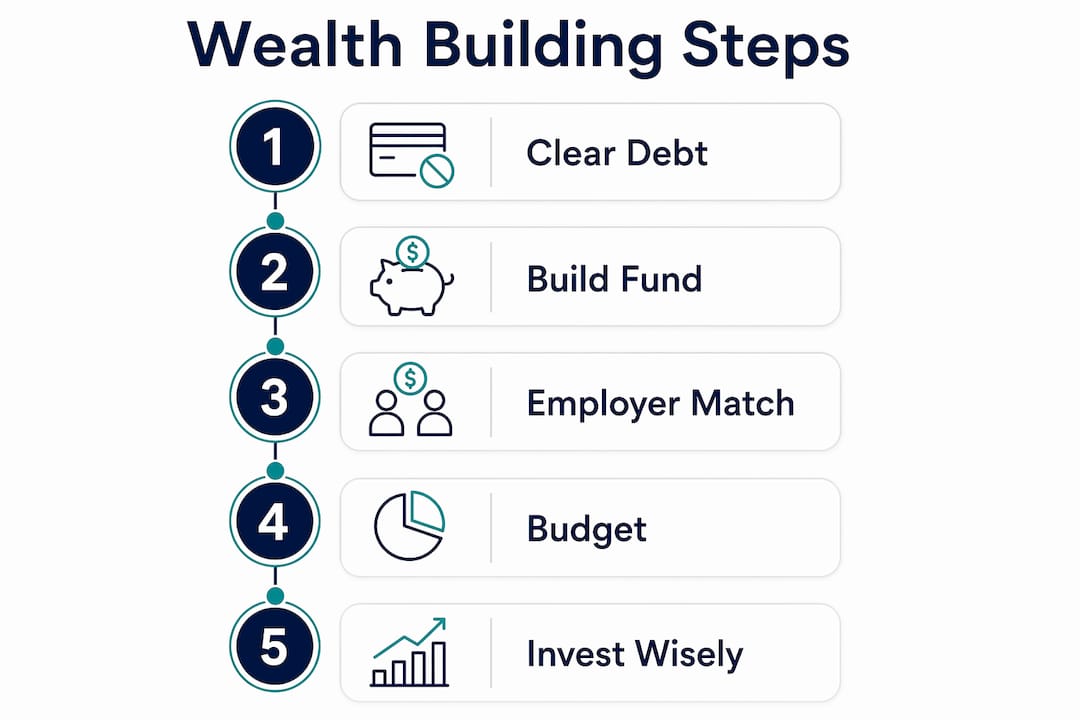
Building wealth step by step is a systematic process that combines debt management, disciplined saving, consistent investing, and income growth to achieve lasting financial security. The approach is not about windfalls or timing markets. It is about repeatable behaviour applied over years. A starter emergency fund of $1,000 or one month of essential expenses is the first concrete milestone. From there, the path follows a clear sequence: clear high-interest debt, build reserves, invest consistently, and grow income. Australians aged 25–50 have the single most powerful asset on their side: time.
What initial financial steps must be taken before investing?
Beginners often focus prematurely on investment returns, but the first years should focus exclusively on cash flow control and debt elimination. This is not cautious advice. It is mathematics.

Clear high-interest debt first
High-interest debt above 7–8% APR destroys wealth faster than most investments build it. Credit cards in Australia commonly charge 20–30% APR. Paying off a 24% APR credit card delivers a guaranteed return that beats average stock market gains of 7–10% per year. No investment strategy competes with that certainty.
Two repayment methods work well in practice:
- Avalanche method: Pay minimums on all debts, then direct every extra dollar to the highest-interest debt first. This minimises total interest paid.
- Snowball method: Pay off the smallest balance first regardless of interest rate. This builds psychological momentum through quick wins.
Both methods work. The avalanche saves more money. The snowball keeps more people on track. Choose the one you will actually stick to.
| Debt type | Typical APR | Priority |
|---|---|---|
| Credit cards | 20–30% | Immediate |
| Personal loans | 10–20% | High |
| Car loans | 6–12% | Medium |
| Home mortgage | 5–7% | Low (after above) |
| HECS/HELP debt | CPI-indexed | Lowest |
Build your emergency fund in stages
A starter emergency fund of $1,000 covers minor setbacks without derailing your debt repayment. Once high-interest debt is cleared, build a full fund covering 3–6 months of living expenses. This transition typically takes 4–7 years for most people working through debt and savings simultaneously. The fund is not an investment. It is insurance against needing to borrow again.
Capture your employer super match immediately
Employer superannuation matching represents an immediate guaranteed return of 50–100% on your contribution. No other financial action delivers that return. If your employer offers any form of additional super matching above the Superannuation Guarantee, contribute enough to capture the full match before directing extra cash anywhere else.
Pro Tip: Set up a separate high-interest savings account labelled "Emergency Fund" and automate a fixed transfer to it on payday. Treating it like a non-negotiable bill removes the decision entirely.
How do you budget effectively to build wealth consistently?
Budgeting is the mechanism that converts income into wealth. Without it, lifestyle spending absorbs every pay rise and the wealth-building formula stalls. The formula is straightforward: Wealth = (Income minus Expenses) × Investment Returns × Time. You control the first two variables directly.
The 50/30/20 rule in an Australian context
The 50/30/20 budgeting rule allocates 50% of after-tax income to essentials (rent, groceries, utilities), 30% to discretionary spending, and 20% or more to savings, debt repayment, and investment. For Australians in high-cost cities like Sydney or Melbourne, the 50% essentials allocation may need to stretch to 55–60%, which means trimming discretionary spending rather than cutting savings.
| Budgeting approach | Best for | Main advantage | Main limitation |
|---|---|---|---|
| 50/30/20 rule | Most earners | Simple, flexible | May not suit high-cost cities |
| Zero-based budget | Detail-oriented planners | Full control of every dollar | Time-intensive to maintain |
| Pay yourself first | Inconsistent savers | Savings happen automatically | Requires discipline on remainder |
| Envelope method | Cash spenders | Prevents overspending by category | Less practical for digital payments |
Automate to remove willpower from the equation
Automating savings and investments removes reliance on motivation and keeps you consistent through busy or stressful periods. Set up automatic transfers to your savings account and super or investment account on the same day your salary arrives. You spend what remains, not what you intended to save.
Practical habits that support consistent budgeting:
- Review your bank statements weekly for the first three months to identify spending patterns.
- Use a budgeting app or spreadsheet to track actual versus planned spending each fortnight.
- Separate accounts for bills, daily spending, and savings to create natural friction against overspending.
Pro Tip: Treat your savings transfer like a direct debit you cannot cancel. Schedule it for the morning of payday so the money moves before you have a chance to spend it.
What are the most effective investment strategies for gradual wealth growth?
Once your emergency fund is in place and high-interest debt is cleared, consistent investing becomes the primary wealth-building lever. The wealth-building formula confirms that time and saving rate matter more than chasing higher returns.
Start with low-cost, diversified index funds
Diversified, low-cost index funds are the foundation of a beginner investment plan. They provide broad market exposure, require no stock-picking skill, and carry lower fees than actively managed funds. For Australians, this includes ASX-listed exchange-traded funds (ETFs) tracking the S&P/ASX 200 or global indices, as well as low-cost super funds with diversified investment options.
Beginner investment principles to follow:
- Invest regularly, not reactively. Set a fixed monthly amount and invest it regardless of market conditions.
- Reinvest dividends. Compound growth accelerates significantly when dividends are reinvested rather than withdrawn.
- Keep fees low. Management expense ratios above 0.5% per year erode returns meaningfully over decades.
- Do not try to time the market. Consistent contributions over time outperform attempts to buy at the bottom.
- Use tax-advantaged structures. Superannuation contributions are taxed at 15% rather than your marginal rate, making super one of the most tax-efficient investment vehicles available to Australians.
Common pitfalls to avoid early on
New investors frequently make the same mistakes. Chasing high-return trends, such as speculative shares or cryptocurrency, before building a stable base amplifies risk at exactly the wrong time. Skipping super contributions to invest outside super ignores the tax advantage. Withdrawing investments during market downturns locks in losses that time would otherwise recover.
Simple automated investing in low-cost, diversified funds immediately after debt clearance is the single biggest practical differentiator between investors who build wealth and those who do not.
How does increasing income and protecting wealth accelerate financial goals?
Controlling expenses creates the foundation. Growing income accelerates the timeline. Both levers work together, but income growth has no ceiling.
Methods for growing your income
- Skills development: Completing a professional certification or upskilling in a high-demand area directly increases earning capacity.
- Salary negotiation: Australians leave significant money on the table by not negotiating at annual reviews. Prepare with market salary data from sources like SEEK or LinkedIn Salary Insights before any review conversation.
- Side income: Freelancing, consulting, or monetising a skill outside your primary role adds a second income stream without requiring a career change.
Avoiding lifestyle inflation
Lifestyle inflation is the tendency to spend all of a pay rise rather than saving or investing it. Committing 50–70% of any income increase directly to savings or investments before adjusting your lifestyle prevents this. The remaining 30–50% still improves your quality of life, making the habit sustainable.
Wealth protection matters as much as wealth creation. Income protection insurance, adequate home and contents cover, and appropriate life insurance safeguard the assets you are building. A single uninsured event can erase years of progress.
Pro Tip: Every time you receive a pay rise, immediately increase your automated savings transfer by at least half the after-tax increase. You will not miss money you never had in your spending account.
What common mistakes derail wealth building and how do you avoid them?
Most wealth-building failures are behavioural, not mathematical. The plan is rarely the problem. Consistency is.
- Skipping the emergency fund. Without a cash buffer, any unexpected expense forces you to borrow, restarting the debt cycle.
- Investing before clearing high-interest debt. Earning 8% in the market while paying 22% on a credit card is a guaranteed net loss.
- Waiting for the perfect plan. A working financial plan implemented today beats a perfect plan that never starts. Imperfect action compounds. Inaction does not.
- Ignoring super. Superannuation is the most tax-effective wealth vehicle most Australians have. Neglecting voluntary contributions in your 30s and 40s costs significantly more in retirement.
- Reacting to market volatility. Selling during downturns converts paper losses into real ones. Time in the market consistently outperforms attempts to time it.
"The best financial plan is the one you actually follow. Simple, automated, and reviewed quarterly beats complex and abandoned."
Review your financial plan every quarter. Check that your savings rate still reflects your income, that your investments are rebalanced to your target allocation, and that your insurance cover remains adequate. Adjust as your circumstances change, but do not overhaul the plan every time markets move.
Key takeaways
Building wealth step by step requires clearing high-interest debt first, automating savings, investing consistently in low-cost diversified funds, and directing income growth into savings before lifestyle spending absorbs it.
| Point | Details |
|---|---|
| Clear high-interest debt first | Paying off 20–30% APR debt delivers a guaranteed return no investment can match. |
| Build your emergency fund in stages | Start with $1,000, then grow to 3–6 months of expenses before investing heavily. |
| Automate savings and investments | Automation removes willpower from the equation and keeps contributions consistent. |
| Capture your employer super match | Employer super matching is an immediate guaranteed return and should never be left unclaimed. |
| Commit raises to savings first | Allocating 50–70% of income increases to savings prevents lifestyle inflation from eroding gains. |
Why systems matter more than motivation
I have spent years looking at how Australians actually build wealth, not how they plan to. The pattern is consistent. The people who succeed are rarely the ones with the most sophisticated investment strategies. They are the ones who set up simple systems and leave them alone.
The mathematics of wealth building is not complicated. The behaviour is. Automation is the single most underrated tool in personal finance. When your savings transfer happens automatically on payday, you remove the daily decision that most people eventually lose. You do not need discipline if the system does not require it.
Starting small matters far more than starting perfectly. An investor who puts $200 a month into a diversified ETF from age 28 will, in most market scenarios, outperform someone who waits until 35 to invest $500 a month. Time is the variable you cannot buy back.
My honest observation is that most people delay because they are waiting to feel ready. That feeling rarely arrives. The practical steps to financial freedom are not a secret. The gap is almost always between knowing and doing. Build the system. Start today with whatever amount you can. Adjust as you go.
— Jonathan
Alphaiq: model your wealth with real numbers
Knowing the steps is one thing. Seeing exactly how they apply to your super balance, property equity, and investment portfolio is another.

Alphaiq is an Australian wealth intelligence platform built for self-directed investors who want clarity without the cost of ongoing financial advice. You can model scenarios across superannuation, investments, and property, run projections on debt recycling and franking credits, and see how today's decisions affect your retirement income. Use the Alphaiq superannuation calculator to project your super balance under different contribution strategies, or explore the full Alphaiq platform to model your complete financial position in one place.
FAQ
What is the first step in building wealth?
The first step is establishing a starter emergency fund of $1,000 or one month of essential expenses, then eliminating high-interest debt above 7–8% APR before focusing on investing.
How much should I save each month to build wealth?
The 50/30/20 rule recommends directing at least 20% of after-tax income to savings, debt repayment, and investment. Increasing this percentage as income grows accelerates the timeline significantly.
Should I invest while paying off debt?
Clear high-interest debt first. The guaranteed return from eliminating 20–30% APR debt exceeds average investment returns. The exception is capturing any employer super match, which delivers an immediate guaranteed return.
How does superannuation fit into a wealth-building plan?
Superannuation is one of the most tax-effective investment structures available to Australians, with contributions taxed at 15% rather than your marginal rate. Voluntary contributions in your 30s and 40s compound significantly by retirement.
How do I avoid lifestyle inflation when my income grows?
Commit 50–70% of any after-tax income increase to savings or investments immediately by increasing your automated transfer. Spending only the remaining portion keeps your lifestyle improving without eroding your wealth-building rate.