
TL;DR:
- Insurance forms the core of a resilient retirement strategy by addressing health, care, and estate risks beyond superannuation.
- Strategically using products like annuities, life, long-term care, and health insurance ensures income stability, asset protection, and legacy planning.
Insurance is the financial safety net that protects your retirement from income gaps, rising health costs, and estate planning risks that superannuation alone cannot cover. For Australians aged 50 to 65, understanding the role of insurance in retirement is not optional. It is a core part of any credible retirement strategy. The right mix of life insurance, health cover, annuities, and long-term care protection determines whether your savings last and whether your family is protected. Getting this mix right requires planning well before you stop working, because your options narrow significantly once you do.
What types of insurance are essential for retirement?

Retirement risk management, the recognised discipline for protecting income and assets in later life, relies on several distinct insurance products. Each one addresses a different threat to your financial security.
Life insurance provides a tax-free death benefit to your beneficiaries and, in the case of whole life policies, builds cash value over time. Whole life insurance allows you to borrow against that cash value to fund retirement expenses, making it a dual-purpose tool. Term life insurance is cheaper and focuses purely on the death benefit, with no savings component.
Annuities convert a lump sum into a guaranteed income stream for life or a fixed period. They are the most direct tool for managing sequence-of-returns risk, which is the danger that poor investment returns early in retirement permanently deplete your savings. The Janus Henderson 2025 Investor Survey found that 54% of retirees reported greater financial stability after incorporating annuities, and that retirees typically preserve around 80% of pre-retirement savings over 20 years when using structured income products. That figure reflects how much a guaranteed income floor changes spending behaviour and portfolio longevity.
Long-term care (LTC) insurance covers custodial care costs such as nursing home fees and in-home assistance. These costs are not covered by Medicare or the Australian public health system beyond limited periods. LTC insurance is the most commonly overlooked product in retirement planning, and also the most expensive to obtain later in life.
Health insurance bridges the gap between leaving employer-sponsored cover and reaching Medicare eligibility at 65. For Australians retiring at 60 or earlier, private health insurance is not a luxury. It is a necessity.
| Insurance type | Primary purpose | Key retirement benefit |
|---|---|---|
| Life insurance (whole) | Death benefit + cash value | Tax-free liquidity and supplemental income |
| Life insurance (term) | Death benefit only | Lower cost protection for dependants |
| Annuity | Guaranteed income stream | Manages sequence-of-returns risk |
| Long-term care insurance | Custodial care costs | Protects savings from nursing home fees |
| Health insurance | Medical expense coverage | Bridges gap before Medicare at 65 |
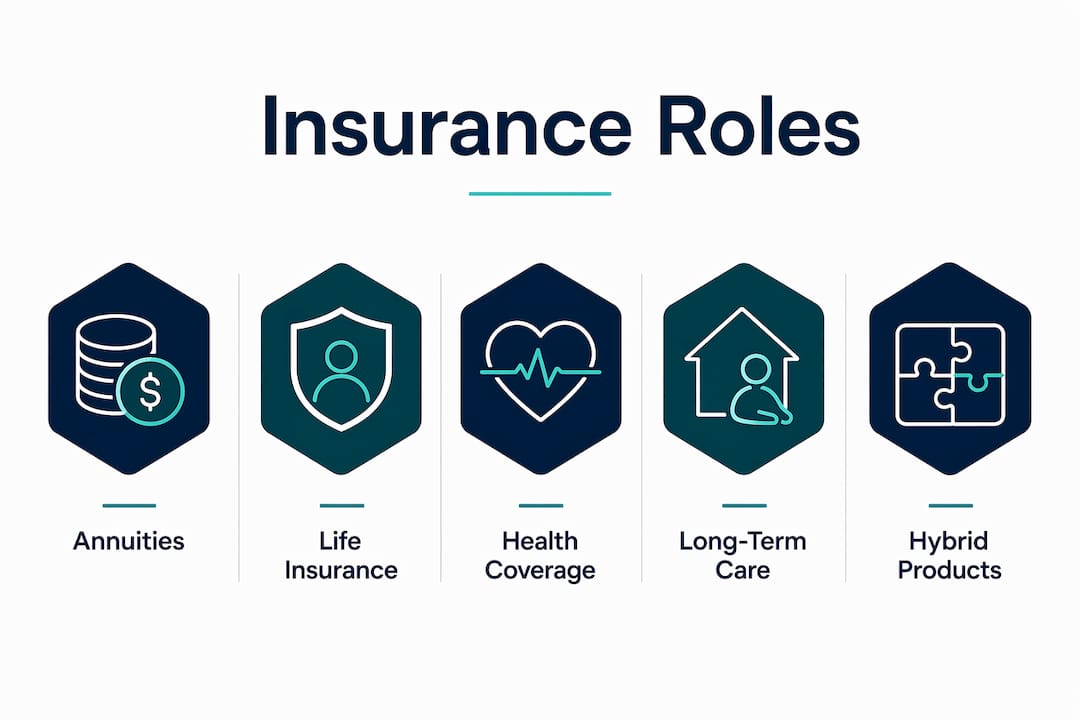
Pro Tip: Do not treat these products as alternatives. Annuities and life insurance complement each other in retirement planning, addressing income, legacy, and risk mitigation simultaneously. The strongest plans use all four product types in proportion to your circumstances.
How does insurance bridge income and expense gaps in retirement?
The financial shocks that derail retirement are rarely the ones retirees plan for. Market downturns, unexpected health events, and the compounding cost of long-term care are the three most common causes of retirement savings failure. Insurance addresses each one directly.
Sequence-of-returns risk is the most misunderstood threat in retirement planning. If your portfolio drops 25% in the first three years of retirement and you are drawing down income at the same time, you may never recover, even if markets rebound strongly afterwards. An annuity solves this by creating an income floor that does not depend on market performance. You can plan retirement income around a guaranteed base, then treat your investment portfolio as a growth layer rather than a survival mechanism.
Health and long-term care costs represent the largest unplanned expense category for retirees. A 65-year-old couple in Australia can expect to face substantial after-tax health expenses across retirement, with nursing home care in comparable markets averaging over $127,000 per year. Medicare covers skilled nursing care for up to 100 days only, with significant co-payments after day 20, and excludes custodial care entirely. That gap falls directly on your savings unless you have LTC insurance in place.
Life insurance plays a different but equally important role. The death benefit provides tax-free liquidity to your estate, allowing beneficiaries to receive funds without triggering capital gains events or waiting for asset sales. For retirees with property-heavy portfolios, this is particularly valuable. The cash value component of a whole life policy also acts as a reserve you can draw on for unexpected costs without selling investments at a loss.
A layered approach to retirement risk management works best. Think of it as three tiers: annuities covering your income floor, health and LTC insurance covering unpredictable medical costs, and life insurance covering estate and legacy goals. Your superannuation and investment portfolio then operate above this base, focused on growth and discretionary spending rather than survival.
What coverage gaps should Australian retirees watch for?
The most costly assumption in retirement planning is that government health coverage will be sufficient. Assuming Medicare covers long-term care is a common and expensive misconception. It does not, and the financial consequences of discovering this after the fact are severe.
Australian retirees face several specific coverage gaps that require deliberate planning:
-
Custodial care costs. Nursing home and in-home care fees are not covered by Medicare beyond short-term skilled nursing. Families either pay out of pocket or deplete assets to qualify for government assistance. LTC insurance, purchased before health underwriting becomes restrictive, is the most cost-effective solution.
-
The pre-Medicare gap. Australians who retire between 50 and 64 need private health insurance to cover the years before Medicare eligibility. Early retirees aged 50 to 64 often rely on continuation of employer-sponsored cover or marketplace plans with income-based subsidies. In Australia, private health insurance with hospital cover is the direct equivalent, and premiums are significantly lower when you maintain continuous cover rather than re-entering the market after a gap.
-
Underwriting restrictions. Insurance underwriting becomes more restrictive as you age. Health assessments for LTC coverage are particularly stringent, and many applicants in their late 60s are declined or face exclusions for pre-existing conditions. Securing cover in your 50s, when you are still in good health, preserves your options and controls your premiums.
-
Superannuation insurance implications. Many Australians hold life insurance and total and permanent disability (TPD) cover inside their super fund. This cover often cancels automatically if your account becomes inactive or your balance falls below a threshold. Review your super fund's insurance terms before you stop working.
-
Employer-sponsored cover ending. Some employer life insurance programmes allow continuation into retirement, but coverage levels typically reduce with age and premiums are deducted from your retirement income. Do not assume this cover is adequate or permanent.
Pro Tip: Review your super fund's insurance cover at least 12 months before your planned retirement date. Cancellation of TPD or life cover inside super can happen without notice if your contributions stop, leaving you uninsured at the worst possible time.
How to integrate insurance into your retirement income strategy
Integrating insurance into your retirement plan is not a one-time decision. It is an ongoing process of matching your coverage to your changing risk profile, income needs, and estate goals.
The starting point is your income floor. Work backwards from your essential monthly expenses and identify how much of that amount is covered by guaranteed sources: the Age Pension, superannuation pension payments, and any annuity income. The gap between your guaranteed income and your essential spending is your primary insurance target. An annuity sized to close that gap removes the need to draw down investments during market downturns, which is the single most effective way to extend portfolio longevity.
- Annuities as income anchors. Allocate a portion of your superannuation lump sum to a lifetime annuity at retirement. This creates a predictable income base that does not fluctuate with markets. Combine this with your super pension drawdown for discretionary spending.
- Whole life cash value as a reserve. If you hold a whole life policy, the accumulated cash value can be accessed via policy loans for large, unexpected expenses without triggering a taxable event or forcing asset sales.
- Hybrid insurance products. Hybrid products combining LTC with annuities or life insurance reduce the "use it or lose it" problem of standalone LTC policies. If you never need long-term care, the benefit transfers to your estate or income stream instead.
- Balancing premiums with spending goals. Insurance premiums are a real cost that reduces your available retirement income. Model the trade-off explicitly: paying $5,000 per year in LTC premiums may protect $200,000 in savings from a single nursing home admission.
- Reviewing employer cover. Check whether your employer-sponsored life insurance can continue after retirement and at what cost. In many cases, converting to an individual policy before leaving employment is more cost-effective than re-applying later.
| Strategy | Risk addressed | Practical outcome |
|---|---|---|
| Lifetime annuity | Sequence-of-returns risk | Guaranteed income regardless of market conditions |
| LTC insurance | Custodial care costs | Protects super and savings from nursing home fees |
| Whole life cash value | Unexpected expenses | Accessible reserve without selling investments |
| Hybrid LTC/annuity | Longevity and care risk | Flexible benefit with no "use it or lose it" penalty |
| Private health cover | Pre-Medicare gap | Continuous cover from retirement to age 65 |
Working with a licensed financial adviser to model these combinations against your specific superannuation balance, property holdings, and income needs gives you a clear picture of where your gaps are. Alphaiq's retirement modelling tools let you run these scenarios yourself before committing to any product.
Key takeaways
Insurance is the structural layer that prevents superannuation and investment savings from being eroded by health costs, market timing, and estate planning gaps in retirement.
| Point | Details |
|---|---|
| Build an income floor first | Use annuities to cover essential expenses before relying on investment drawdowns. |
| Plan LTC cover early | Secure long-term care insurance in your 50s before underwriting restrictions apply. |
| Close the pre-Medicare gap | Private health insurance is non-negotiable for Australians retiring before age 65. |
| Use hybrid products strategically | Combined LTC and annuity products eliminate the "use it or lose it" drawback of standalone policies. |
| Review super insurance before retiring | Employer and super fund cover often lapses when contributions stop. Check 12 months out. |
Why I think most Australians underestimate insurance in retirement
After years of working through retirement planning scenarios, the pattern I see most often is this: people spend enormous energy optimising their superannuation contributions and investment allocations, then treat insurance as an afterthought. It is not an afterthought. It is the foundation that determines whether everything else holds up under pressure.
The uncomfortable truth is that retirement security depends not just on investments but on managing health, longevity, and property risks simultaneously. A well-constructed super portfolio can be undone by a single nursing home admission or a market downturn in the first three years of retirement. Insurance is what prevents those events from becoming permanent setbacks.
What I find particularly underappreciated is the timing constraint. The window for securing affordable long-term care insurance closes faster than most people realise. By the time you are 65 and facing a health assessment, your options may already be limited. The Australians who handle this best are the ones who treat insurance decisions with the same urgency as their super contributions, starting in their early 50s and reviewing annually.
My recommendation is straightforward. Map your guaranteed income sources, identify the gap, and build your insurance layer to close it before you retire. Then review it every two years as your health, family situation, and financial position change. The diverse income streams that make retirement resilient are not just investment-based. Insurance is one of them.
— Jonathan
Model your retirement insurance scenarios with Alphaiq
Understanding the role of insurance in retirement is one thing. Seeing exactly how different insurance choices affect your retirement income, super balance, and estate outcomes is another.

Alphaiq is built for Australians who want to run those numbers themselves. The platform's superannuation calculator lets you project your retirement balance under different drawdown rates, income floors, and expense scenarios, including the cost of private health insurance and long-term care. You can model the impact of adding an annuity, compare premium costs against savings protection, and stress-test your plan against market downturns. Visit Alphaiq to start building a retirement plan that accounts for every layer of risk, not just your investment returns.
FAQ
What is the role of insurance in retirement?
Insurance in retirement manages risks that superannuation and investments cannot fully absorb, including health costs, long-term care expenses, income gaps from market downturns, and estate planning needs. It functions as a financial safety net that protects your savings from being depleted by unpredictable events.
Does Medicare cover long-term care costs in retirement?
Medicare covers skilled nursing care for up to 100 days only, with co-payments applying after day 20, and excludes custodial care entirely. Families without long-term care insurance face significant out-of-pocket costs or must deplete assets to qualify for government assistance.
When should I take out long-term care insurance?
Securing long-term care insurance in your early to mid-50s is strongly recommended, because health underwriting becomes more restrictive with age and many applicants in their late 60s face exclusions or outright declines. Earlier cover also means lower premiums locked in while you are in good health.
What is a hybrid insurance product and why does it matter?
A hybrid insurance product combines long-term care benefits with a life insurance policy or annuity, eliminating the "use it or lose it" problem of standalone LTC cover. If you never need care, the benefit transfers to your estate or income stream, making hybrid product designs more flexible and cost-effective for many retirees.
How do annuities help manage retirement income risk?
Annuities convert a lump sum into a guaranteed income stream, creating an income floor that does not depend on market performance. The Janus Henderson 2025 Investor Survey found that 54% of retirees reported greater stability after incorporating annuities, directly addressing sequence-of-returns risk in the critical early years of retirement.