
TL;DR:
- Alternative assets diversify portfolios by offering low correlation to stocks and bonds, providing inflation protection and growth opportunities. Most private-wealth portfolios allocate 10% to 25% to these assets, emphasizing manager selection, liquidity planning, and diligent due diligence. They serve mainly as risk mitigation tools with potential for higher long-term returns compared to traditional portfolios.
Alternative assets are defined as investments outside traditional stocks, bonds, and cash, and their role in modern portfolios is to provide diversification, inflation protection, and access to return drivers unavailable in public markets. Private equity, private credit, hedge funds, and real assets such as infrastructure, farmland, and commercial real estate all fall under this category. The adoption of alternatives grew by over 98% between 2024 and 2025, signalling a structural shift in how sophisticated investors construct portfolios. For Australian investors aged 35 to 65, understanding this shift is no longer optional. It is the foundation of a genuinely resilient financial strategy.
What are the main types of alternative assets?
Alternative assets span a broad range of structures, each with distinct risk, return, and liquidity characteristics. Understanding the differences between them is the starting point for any allocation decision.

Private equity involves investing directly in companies not listed on public exchanges, either through buyout funds, venture capital, or growth equity. Returns are typically generated over a 5 to 10 year horizon, and capital is illiquid for most of that period.
Private credit covers loans and debt instruments issued outside the banking system. It includes direct lending, mezzanine finance, and distressed debt. Investors receive regular income, often at floating rates, which provides a natural buffer against rising interest rates.
Hedge funds use a wide range of strategies including long/short equity, global macro, and arbitrage. They aim to generate returns regardless of market direction, though outcomes vary significantly by manager and strategy.
Real assets include commercial real estate, infrastructure, timberland, and farmland. These assets generate income and tend to appreciate with inflation. Real assets like farmland and timberland show virtually zero correlation with US large-cap equities, making them among the most effective diversifiers available.
| Asset type | Liquidity | Return driver | Inflation hedge | Typical horizon |
|---|---|---|---|---|
| Private equity | Low | Capital appreciation | Moderate | 5 to 10 years |
| Private credit | Low to medium | Income (floating rate) | Strong | 3 to 7 years |
| Hedge funds | Medium | Strategy-dependent | Variable | 1 to 3 years |
| Real assets | Low | Income and appreciation | Strong | 7 to 15 years |
| Infrastructure | Low | Regulated income | Strong | 10 to 20 years |
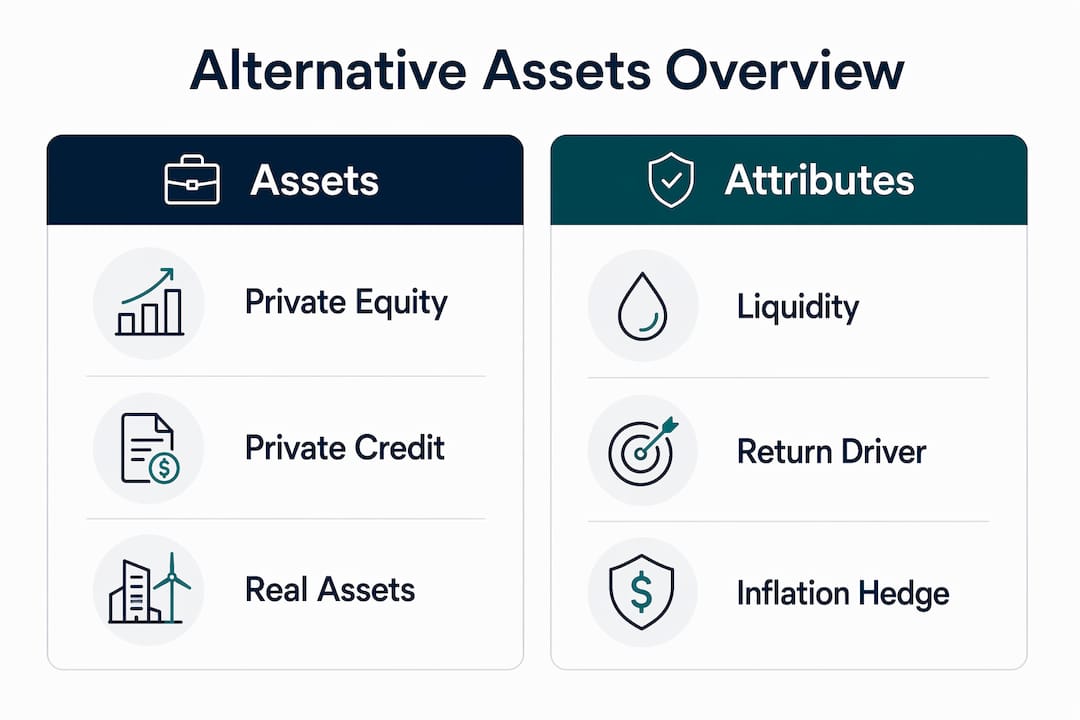
The table above illustrates why no single alternative asset type serves every purpose. A well-constructed allocation typically combines several of these categories to balance income, growth, and risk reduction.
How do alternative assets perform compared to traditional portfolios?
Performance data from the past five years makes a compelling case for non-traditional investments. Hedge funds returned approximately 9.4% since 2020, compared to 6.6% for a standard 60/40 public portfolio over the same period. That 2.8 percentage point gap compounds meaningfully over a 20 to 30 year investment horizon.
The performance advantage is not uniform, however. Manager selection is the single most important variable in alternatives. Top-quartile versus bottom-quartile private equity funds show performance spreads of approximately 12.9 percentage points. That spread is far wider than anything seen in public equity markets, where index funds have largely commoditised returns. Choosing the wrong manager in alternatives does not just underperform. It can destroy capital.
| Metric | Alternatives | Traditional 60/40 |
|---|---|---|
| Hedge fund return (2020–2025) | 9.4% | 6.6% |
| Private equity top/bottom spread | ~12.9 percentage points | Narrow |
| Recommended portfolio allocation | 10% to 25% | 75% to 90% |
| Correlation to equities (real assets) | Near zero | High |
Liquidity risk is the other side of the performance equation. Private market investments require capital to be locked up, sometimes for a decade. Capital calls, where the fund draws down committed capital over time, can be unpredictable. Investors who do not plan for these obligations can find themselves forced to sell other assets at inopportune times.
Pro Tip: Before committing to any private market fund, map out your expected capital call schedule against your known liquidity needs over the next five years. A mismatch here is one of the most common and avoidable mistakes in alternatives investing.
What are the benefits and risks of diversifying with alternative assets?
The importance of alternative investments lies primarily in what they do to overall portfolio risk. Alternatives reduce portfolio risk by moving independently of stocks and bonds, which means they absorb less of the shock when public markets fall sharply. During the 2022 equity and bond drawdown, many real asset and private credit allocations held their value while listed portfolios fell 15% to 20%.
Key benefits of including alternative assets:
- Diversification: Low or zero correlation to public equities reduces overall portfolio volatility without necessarily sacrificing returns.
- Inflation protection: Real assets, infrastructure, and private credit with floating rates all tend to preserve purchasing power during inflationary periods.
- Return enhancement: Access to private market premiums, illiquidity premiums, and complexity premiums that are simply not available in listed markets.
- Income generation: Private credit and infrastructure assets provide regular cash distributions, which is particularly relevant for investors approaching or in retirement.
Key risks to manage carefully:
- Illiquidity: Capital is locked up for years. You cannot sell a private equity position the way you can sell shares in BHP.
- Valuation complexity: Private assets are not marked to market daily. This can mask true volatility and make performance comparisons difficult.
- Manager risk: Given the wide performance dispersion, selecting the wrong manager is a genuine and significant risk.
- Fee structures: Management fees of 1.5% to 2% plus performance fees of 20% are common. These fees compound and reduce net returns substantially over time.
- Governance requirements: Alternatives require strong governance and due diligence because they are less regulated than public assets, placing a higher burden on the investor.
Pro Tip: When reviewing an alternative investment, ask for the audited track record of the specific strategy you are being offered, not the firm's overall performance. Managers often highlight their best-performing funds while newer or different strategies carry very different risk profiles.
How should you allocate alternative assets in your portfolio?
Sophisticated private-wealth portfolios allocate between 10% and 25% of total capital to alternative investments. That range reflects a balance between capturing diversification and return benefits while preserving enough liquidity to meet ongoing financial needs. For Australian investors, the right number within that range depends on several personal factors.
Here is a practical framework for thinking through your allocation:
-
Assess your liquidity needs. Calculate how much capital you need accessible within the next three years for living expenses, property plans, or other commitments. This amount should not be allocated to illiquid alternatives.
-
Define your investment horizon. Investors with 15 or more years before retirement can tolerate longer lock-up periods and access the highest-returning private equity and infrastructure strategies. Those within five years of drawing down capital should focus on shorter-duration alternatives such as private credit.
-
Identify your return objective. If your goal is capital growth, private equity and venture capital are the primary tools. If your goal is income, private credit and infrastructure are more appropriate. If your goal is risk reduction, real assets and hedge funds with low equity correlation serve that purpose best.
-
Start with a modest allocation. A 10% allocation to alternatives is a sensible starting point for most investors new to the asset class. This provides meaningful diversification without overcommitting to illiquid positions before you understand how they behave in your portfolio.
-
Review and rebalance annually. As private market positions mature and distribute capital, your actual allocation will drift. Regular review keeps your alternatives exposure within your intended range.
For practical guidance on building a diversified Australian portfolio that incorporates these principles, the process of mapping your current asset mix is the logical first step.
What practical steps help you access alternative investments?
Accessing alternative investments has become more straightforward over the past decade, though it still requires more effort than buying an ETF. The main access routes available to Australian investors are as follows:
- Wholesale investor platforms such as those offered by institutional managers provide access to private equity, private credit, and infrastructure funds. These typically require a minimum investment of $50,000 to $500,000 and are restricted to wholesale or sophisticated investors under Australian law.
- Listed investment companies and trusts that invest in private markets offer a liquid entry point to alternatives. The trade-off is that the listed vehicle introduces its own price volatility, which can undermine the diversification benefit.
- Liquid alternatives are managed funds that use hedge fund strategies but offer daily or weekly liquidity. They sacrifice some return potential for accessibility and are a reasonable starting point for investors new to the category.
- Secondary market purchases allow you to buy existing private market positions from other investors, often at a discount to net asset value. Secondary market activity has matured significantly, providing a genuine liquidity solution for those who need to exit before a fund's natural end date.
Due diligence is non-negotiable. Review the manager's audited performance history, fee structure, investment mandate, and key person risk. Understand how the fund handles capital calls and distributions. For investors building a broader investment strategy that incorporates alternatives alongside superannuation and property, modelling the combined impact on your overall financial position is where the real clarity comes from.
Pro Tip: Ask any alternative fund manager for their loss ratio and their worst-performing vintage year, not just their headline IRR. How a manager performs in a downturn tells you far more than their peak returns.
Key takeaways
The role of alternative assets is to reduce portfolio risk, improve long-term returns, and provide access to inflation-resistant income streams that traditional stocks and bonds cannot replicate.
| Point | Details |
|---|---|
| Define your allocation range | Most private-wealth portfolios hold 10% to 25% in alternatives, depending on liquidity needs and time horizon. |
| Manager selection is decisive | Performance spreads of 12.9 percentage points between top and bottom quartile managers make fund selection the most important decision. |
| Real assets hedge inflation | Farmland, timberland, and infrastructure show near-zero correlation to equities and preserve purchasing power over time. |
| Plan for illiquidity | Capital calls are unpredictable. Map your liquidity needs before committing to any private market fund. |
| Governance matters | Alternatives are less regulated than public assets and require rigorous due diligence and ongoing monitoring. |
Why I think most investors underestimate what alternatives actually do
After spending years watching investors approach alternatives, the most common mistake is treating them as a return-enhancement tool rather than a risk-management tool. People hear that hedge funds returned 9.4% since 2020 and they want in. What they miss is that the more important number is the correlation figure. A real asset with a near-zero correlation to equities does something a high-returning stock cannot: it stays standing when everything else falls.
The second thing I have observed is that Australian investors often delay alternatives exposure until they have accumulated a very large portfolio, assuming it is only relevant at the institutional level. That thinking is changing, and rightly so. Liquid alternatives and secondary market access have lowered the entry point considerably.
The governance requirement is real, though. Investing in alternatives requires a shift toward delegated management and rigorous due diligence. If you are not prepared to do that work, or to pay someone who will, the risks outweigh the benefits. The investors who do it well treat alternatives as a deliberate, researched allocation. The ones who struggle treat it as a product they were sold.
My practical advice for any Australian investor considering this space: start with private credit or a listed infrastructure fund. Both offer meaningful diversification, reasonable liquidity, and a lower complexity burden than private equity. Build your understanding before you commit to a 10-year lock-up.
— Jonathan
Model your full financial position with Alphaiq
Understanding the role non-traditional investments play in your portfolio is one thing. Seeing exactly how a 15% alternatives allocation affects your projected retirement income, capital gains position, and superannuation balance is another level of clarity entirely.

Alphaiq is built for self-directed Australian investors who want to model these decisions with real numbers rather than rough estimates. The Alphaiq platform combines tax-aware financial modelling with scenario simulation, so you can test how adding private credit or infrastructure to your portfolio changes your retirement outcome before you commit a dollar. You can also use the superannuation calculator to project how your super balance interacts with your broader investment mix over time.
FAQ
What is the role of alternative assets in a portfolio?
Alternative assets reduce overall portfolio risk by providing exposure to return drivers with low correlation to stocks and bonds. They also offer inflation protection and access to illiquidity and complexity premiums unavailable in public markets.
How much should I allocate to alternative investments?
Sophisticated private-wealth portfolios typically allocate between 10% and 25% of total capital to alternatives. The right amount depends on your liquidity needs, investment horizon, and risk tolerance.
How do alternative assets perform compared to a 60/40 portfolio?
Hedge funds returned approximately 9.4% since 2020, compared to 6.6% for a standard 60/40 portfolio over the same period. However, performance varies significantly by manager and strategy, making fund selection critical.
What are the main risks of investing in alternative assets?
The primary risks are illiquidity, valuation complexity, manager risk, high fees, and the governance burden that comes from investing in less-regulated structures. Capital calls in private market funds can also create unexpected liquidity demands.
Can Australian retail investors access alternative assets?
Most private market alternatives are restricted to wholesale or sophisticated investors under Australian law. However, listed investment companies, liquid alternative funds, and secondary market platforms provide accessible entry points for a broader range of investors.