
Sequence of returns risk is the danger that poor investment returns arriving early in retirement, combined with regular withdrawals, permanently shrink your nest egg even if your average return over time looks perfectly fine, as explained in Sequence of Returns Risk: What Stock Investors Must Know. Early losses force you to sell more units at depressed prices, which shrinks the base left to compound when markets recover. The first five years after you stop working carry the most weight, according to explanatory material from Challenger, because that's when a falling balance and ongoing withdrawals do the most lasting damage. Longer retirements, tracked in SSA cohort tables, only widen the exposure window. Tools like Alphaiq's scenario modelling let you stress test this before it happens to you, rather than after.
- The risk: bad returns early, not late, do the real damage to a retirement pot.
- The mechanism: withdrawals during a downturn lock in losses by selling assets low.
- The window: years one to five of retirement matter more than any other stretch.
Key Takeaways
Reducing sequence of returns risk means sizing a cash buffer, setting flexible withdrawal guardrails, and stress testing your plan against unlucky early sequences rather than average ones.
| Point | Details |
|---|---|
| Order beats average | The same average return can produce very different balances depending on when losses hit. |
| Watch years one to five | Early losses combined with withdrawals do the most lasting damage to a retirement pot. |
| Build a cash buffer | Hold one to three years of essential spending outside growth assets. |
| Blend strategies | Combine guardrails, diversification, and partial annuitisation rather than relying on one alone. |
| Test before you commit | Alphaiq's Super Calculator models buffer size, withdrawal rules, and annuity timing against your own numbers. |
Where to read more
- SSA retirement and longevity statistics
- FINRA investor education
- MIT Sloan on mitigating sequencing risk
- SIPC investor protection information
These sources are worth bookmarking for verification and further reading as you build out your own plan.
Table of Contents
- What is sequence of returns risk and how does it work?
- Two examples that show why the first five years matter most
- Practical ways to reduce sequence of returns risk
- Building your sequence risk plan step by step
- Why scenario modelling makes buffer decisions clearer
- What retirees consistently get wrong about this risk
- Sources
What is sequence of returns risk and how does it work?
Two retirees can earn the exact same average annual return over 25 years and end up with wildly different balances, purely because of the order those returns arrived in. During accumulation, order doesn't matter much. You're adding money, not withdrawing it, so a bad year early on barely dents your final result. In retirement, it's the opposite. Withdrawals turn a market downturn into a permanent loss, because you're pulling dollars out of a shrinking pool rather than letting it recover.
Here's a simplified illustration of how reversing a return sequence changes the outcome, assuming a retiree withdraws a fixed dollar amount each year:
- Sequence A: returns of 8%, 5%, and negative 15% in years one to three, in that order, while withdrawals continue throughout.
- Sequence B: the exact same three returns, reversed, so the negative 15% year hits last instead of first.
- Result: Sequence A leaves the retiree with a meaningfully smaller balance than Sequence B, despite both sequences averaging the same return.
That gap exists because the negative year in Sequence A forces withdrawals from a smaller, more damaged balance, and there are fewer years left afterward for recovery to compound.
The number that matters: analysis from MIT Sloan's Action Learning work shows that structured buffer and withdrawal policies materially cut the odds of an unlucky sequence derailing a plan, precisely because they reduce forced selling during the years right after retirement begins.
Two examples that show why the first five years matter most
Picture two retirees, both starting with the same balance and the same long-term average return, both withdrawing the same percentage each year.
- Retiree A hits a sharp market fall in year two, right after retiring, and keeps withdrawing through it.
- Retiree B experiences the identical fall, but it lands in year eighteen instead.
Retiree A ends up considerably worse off, because the early loss combined with ongoing withdrawals leaves a smaller base for every subsequent year of growth. Retiree B's portfolio has had over a decade to grow before the same shock arrives, so the withdrawals taken in the meantime came from a much larger pool.
This isn't theoretical. Retirees who stopped working just before the early-2000s downturn or the 2008 global financial crisis lived through exactly this pattern, according to planning research summarised by Morningstar, which found that unlucky timing cut balances far more severely than the market's long-run average return would suggest.
Why does the five-year window carry so much weight?
- Your balance is at its largest, so percentage losses translate into the biggest dollar losses of your retirement.
- You haven't yet had years of growth to offset a downturn.
- Withdrawal rates set early tend to anchor your spending for years afterward, making early cuts painful to walk back.
Higher withdrawal rates and longer retirement horizons both amplify this effect, which is one reason SSA longevity data matters when you're stress testing a plan, not just guessing at "average" life expectancy.
Practical ways to reduce sequence of returns risk
None of these strategies eliminate sequencing risk. They trade it off against other risks, mainly the risk of running out of growth assets over a long retirement. Understanding that trade-off is the whole game.
- Bucket strategy. Hold one to three years of essential spending in cash or short-term fixed interest, so you're never forced to sell shares or property during a downturn just to pay the bills. The trade-off is that cash earns less over time, which is a drag if markets stay strong.
- Flexible withdrawals and guardrails. Instead of a fixed dollar or fixed percentage every year, set rules that cut spending in a down year and allow more in a strong one. This reduces the damage from forced sales at low prices, though it means your income varies year to year.
- Asset allocation and diversification. A more conservative mix smooths the ride, but research from the Actuaries Institute shows that sequencing exposure varies by asset class and that reducing volatility too aggressively increases the risk of outliving your money. FINRA's investor education material makes the same point: diversification limits risk, it doesn't remove it.
- Guaranteed income (annuities). Putting part of your balance into an annuity locks in income that doesn't depend on market timing at all. Partial annuitisation can lift the overall success rate of a plan, according to Morningstar's retirement research, but it comes with fees, reduced liquidity, and less left over for your estate. Alphaiq's breakdown of annuities in retirement planning walks through when the trade-off tends to make sense.
Pro Tip: Don't pick one strategy in isolation. Most durable retirement plans blend a cash buffer for the first few years, flexible guardrails for the middle stretch, and a small slice of guaranteed income to cover essential expenses no matter what markets do.
Building your sequence risk plan step by step
Turning these strategies into an actual plan means working through a short, ordered checklist rather than picking one idea and hoping it holds.
- Size your cash buffer by calculating essential annual spending, then holding one to three years of it in cash. Lean toward three years if you have a lower risk tolerance, no other income sources, or a spouse who's also fully retired.
- Run stress scenarios against your actual balance and spending, not a generic rule of thumb. A modelling guide like Alphaiq's shows how to test different buffer sizes and withdrawal rules against historically bad sequences.
- Document your withdrawal rule with explicit guardrails: what you'll cut, by how much, and in what market conditions.
- Set rebalancing rules for when and how you top the cash bucket back up after a strong year, so the buffer doesn't quietly drain away.
- Decide on guaranteed income timing, weighing fees, your health, and how much you want left for beneficiaries against the certainty an annuity buys you.
Your retirement risk profile should shape every one of these five decisions, since a conservative profile and an aggressive one will land on very different buffer sizes and guardrail settings.
| Point | Details |
|---|---|
| Biggest risk window | Years one to five of retirement carry the most sequencing exposure. |
| Buffer sizing | Hold one to three years of essential spending in cash or short-term fixed interest. |
Why scenario modelling makes buffer decisions clearer
Sequence of returns risk is hard to feel until it's happening to you, which is exactly why stress testing before retirement matters more than reading about it after the fact. Tax-aware, cashflow-aware modelling lets you see what an unlucky sequence would actually do to your specific balance, your specific withdrawal rate, and your specific tax position, rather than relying on generic averages.
- It shows how different buffer sizes hold up against historically bad sequences, not just typical ones.
- It reveals how withdrawal guardrails change your outcome in a downturn versus a fixed dollar approach.
- It accounts for the tax treatment of drawdowns from different account types, which a simple calculator usually ignores.
Alphaiq's scenario simulation tools model these trade-offs directly against your own numbers, and its guide to modelling investment returns covers the mechanics in more depth.
Retirees who stress test their withdrawal plan against an unlucky sequence, rather than an average one, tend to make more confident decisions about buffer size and guardrails, because they've already seen the worst case play out on paper.
What retirees consistently get wrong about this risk
Most retirement advice treats the safe withdrawal rate as a fixed number you set once and forget. That's the part I think is genuinely misleading. The rate matters far less than the sequence.
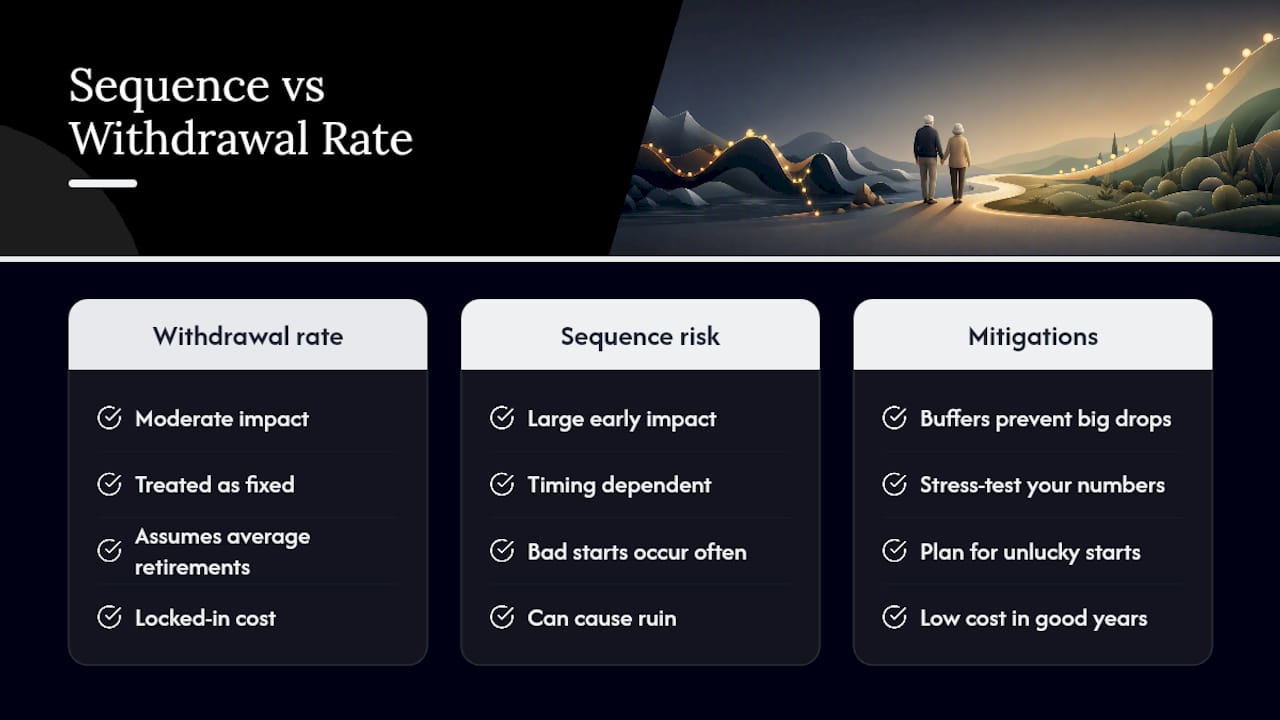
The bigger gap I see is that people plan for the "expected" retirement rather than the unlucky one. Nobody budgets for a 2008-style start to retirement, yet historical data shows it happens often enough to matter. Diversification helps, but the Actuaries Institute's own analysis confirms it doesn't erase the problem, especially across asset classes with correlated downturns.
If you take one thing from this, prioritise stress testing your specific numbers against a bad early sequence before you lock in a withdrawal rate. A cash buffer and a flexible rule cost you very little in good years and save you enormously in bad ones. That asymmetry is the whole argument for building a plan around the worst plausible start, not the average one.
— Jonathan
AlphaIQ Super Calculator: model buffers, withdrawals and annuity timing
Reading about sequencing risk is one thing. Seeing what it does to your own numbers is another. Alphaiq's Super Calculator lets you model your own retirement balance against different cash buffer sizes, withdrawal guardrails, and partial annuity timing, all with the tax treatment built in rather than bolted on afterward.

You can test what a bad early sequence would do to a three-year buffer versus a one-year buffer, or compare a fixed withdrawal against a guardrail rule, using your actual balance and spending rather than a generic example. If you're within a few years of retiring, or already drawing down, run a scenario now and see where your plan holds and where it doesn't.
Sources
- Mitigating sequence of returns risk (SORR) | Action Learning
- SSA actuarial publications and retirement statistics
- FINRA investor education
- SIPC investor protection information