
TL;DR:
- Index funds track market indexes to offer low-cost, broad exposure and market-matching returns. They benefit Australian investors with diversification, low fees, tax advantages, and simplicity, but market and concentration risks remain. A core-satellite approach with three funds effectively builds a diversified long-term portfolio, reducing unnecessary overlap and complexity.
Index funds are investment vehicles designed to track a market index, giving you broad market exposure at low cost without active stock picking. The role of index funds in a well-built portfolio is to deliver consistent, market-matching returns while keeping fees and complexity low. Australian investors have embraced this approach at scale: ETFs in Australia now hold $350 billion under management, with 72 new listings and a 26% rise in trading activity in the last financial year alone. That growth reflects a genuine shift in how Australians build wealth, and understanding the mechanics behind it puts you in a stronger position to benefit.
How do index funds work to deliver market returns?
An index fund mirrors the composition of a benchmark index, such as the S&P/ASX 200 or the S&P 500, by holding the same securities in the same proportions. When the index rises, the fund rises with it. When the index falls, so does the fund. There is no fund manager making active calls on which stocks to buy or sell.
This passive management approach produces two structural advantages:
- Low portfolio turnover. Because the fund only trades when the index itself changes, transaction costs stay minimal and capital gains tax events are rare.
- Low fees. Passive ETF management expense ratios in Australia typically range from 0.03% to 0.20% per year, compared to 0.5% to 1.5% for actively managed funds. That fee gap compounds significantly over a 20-year horizon.
- Transparency. You always know what you own because the index's holdings are publicly listed.
- Broad exposure. A single ASX 200 index fund gives you a slice of 200 Australian companies across financials, materials, healthcare, and more.
Index funds use different weighting methods. Market capitalisation weighting, the most common approach, allocates more of the fund to larger companies. Equal weighting spreads the allocation evenly across all holdings. Each method produces a different risk and return profile, which matters when you are building a portfolio rather than just buying a single fund.
Pro Tip: Check the weighting methodology of any index fund before you buy. A market cap weighted fund tracking the ASX 200 will have a very different concentration profile than an equal-weighted alternative.

What are the key benefits of index funds for Australian investors?
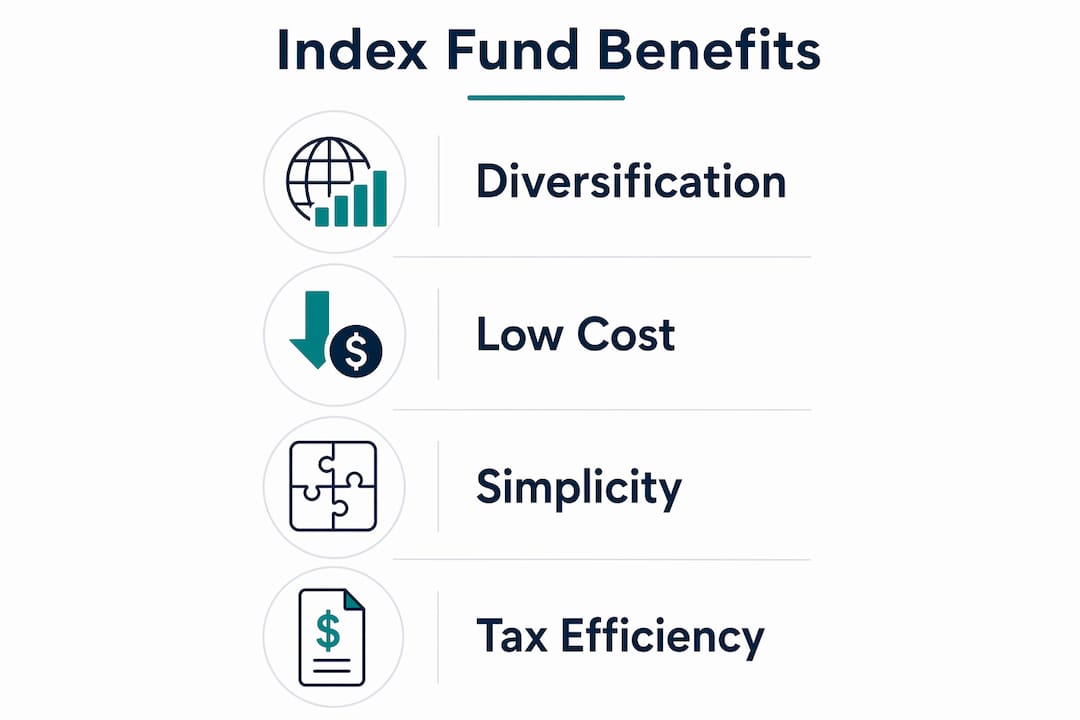
The importance of index funds comes down to four practical advantages that compound over time.
Diversification without complexity. A single broad-market index fund spreads your money across dozens or hundreds of companies. Diversification reduces single-company risk, meaning one bad earnings result or corporate scandal does not derail your portfolio. You still carry market risk, but you eliminate the risk of any one company collapsing your returns.
Cost efficiency that compounds. The fee difference between passive and active funds sounds small in percentage terms. Over 20 years, paying 1.2% annually instead of 0.10% on a $200,000 portfolio costs tens of thousands of dollars in foregone returns. Managing investment fees is one of the highest-impact decisions you can make as a self-directed investor.
Tax advantages specific to Australia. Index funds carry two meaningful tax benefits for Australian investors:
- Low turnover means fewer capital gains tax events each year, so you defer tax rather than triggering it repeatedly.
- Many Australian index funds distribute franking credits on dividends, which reduce your overall tax liability. A fully franked dividend from a domestic index fund carries a 30% company tax credit you can apply against your personal tax bill.
Simplicity that reduces behavioural risk. Active investing requires constant research, decision-making, and emotional discipline. Index funds remove most of those decisions. You set your allocation, contribute regularly, and let the market do the work. That simplicity is not a weakness. It is a feature that protects you from the most common investor mistake: trading on emotion.
Pro Tip: If you hold Australian index funds inside superannuation, the tax benefits multiply. Franking credits are fully refundable in the accumulation phase and even more valuable in pension phase.
What are the common risks and limitations of index funds?
Index funds reduce certain risks but do not eliminate them. Understanding the specific risks helps you build a portfolio that accounts for them.
Market risk remains
Index funds do not eliminate market risk. When the broader market falls, your fund falls with it. The 2008 global financial crisis and the 2020 COVID crash both hit index fund holders hard. The difference is that index fund investors who stayed the course recovered fully as markets rebounded. Panic-selling during downturns is the primary way index fund investors destroy their own returns.
Concentration risk in cap-weighted indexes
- Top-heavy exposure. In a market cap weighted index, the top 10 holdings can account for around 50% of the index's total value. For the ASX 200, that means heavy exposure to a handful of banks and mining companies.
- Sector concentration. Australian domestic indexes are structurally overweight in financials and materials. If those sectors underperform, your "diversified" fund underperforms with them.
- Overlap in international funds. Multiple international ETFs often hold the same large US technology stocks. Buying two global index funds does not double your diversification. It often just doubles your exposure to the same companies.
The rise of speculative ETFs
The growth of thematic ETFs focused on sectors like artificial intelligence, cybersecurity, or clean energy introduces a different risk profile entirely. These products carry the ETF label but behave more like concentrated sector bets. They suit a different investor with a different risk tolerance and time horizon. Treating them as equivalent to a broad-market index fund is a category error that can cost you significantly.
| Risk type | What it means | How to manage it |
|---|---|---|
| Market risk | Whole market falls, fund falls with it | Long time horizon, regular contributions |
| Concentration risk | Top holdings dominate the index | Add equal-weighted or international funds |
| Overlap risk | Multiple funds hold the same stocks | Choose one primary global fund |
| Speculative ETF risk | Thematic funds behave like sector bets | Separate these from your core index allocation |
Pro Tip: Before adding a new ETF to your portfolio, check its top 10 holdings against what you already own. Overlap is far more common than most investors realise.
How can you use index funds to build a strong portfolio?
The most practical framework for Australian investors is the core-satellite approach. This allocates 70–80% of your portfolio to broad-market index funds as the core, with 20–30% in targeted positions as satellites. You can achieve genuine diversification with as few as three funds.
A practical three-fund structure
- Australian shares index fund. Tracks the ASX 200 or a similar domestic benchmark. Provides exposure to Australian equities and access to franking credits.
- International shares index fund. Tracks a global benchmark such as the MSCI World Index. Reduces your reliance on the Australian economy and the financial and materials sectors.
- Bond index fund. Tracks a fixed income benchmark. Reduces overall portfolio volatility and provides income during equity downturns.
This structure covers the major asset classes without redundancy. Adding more funds beyond this core typically adds complexity without meaningfully improving diversification.
Allocation by risk profile
Your split between growth assets (shares) and defensive assets (bonds) depends on your time horizon and risk tolerance. A 45-year-old with 20 years to retirement can carry more growth exposure than a 58-year-old planning to draw down in seven years. Rebalancing once or twice a year keeps your allocation aligned with your target without requiring constant attention.
The long-term discipline required for index fund investing is straightforward in principle but genuinely difficult in practice. Regular contributions, regardless of market conditions, and a commitment to your target allocation are the two habits that separate successful index fund investors from those who underperform.
Pro Tip: Set up automatic contributions to your index funds on a monthly schedule. Automating removes the temptation to time the market and builds the habit of consistent investing.
Key takeaways
Index funds deliver market returns at low cost, and their role in an Australian portfolio is most powerful when combined with tax awareness, fee discipline, and a long time horizon.
| Point | Details |
|---|---|
| Low fees compound significantly | Passive ETF fees of 0.03%–0.20% outperform active fund fees of 0.5%–1.5% over decades. |
| Diversification has limits | Market cap weighted indexes concentrate around 50% in the top 10 holdings, creating sector risk. |
| Tax efficiency is a real advantage | Low turnover and franking credits reduce your tax bill in ways active funds rarely match. |
| Three funds are enough | Australian shares, international shares, and bonds cover the major asset classes without overlap. |
| Discipline beats timing | Regular contributions and staying invested through downturns drive long-term index fund returns. |
Why I think most investors overcomplicate this
The most common mistake I see Australian investors make with index funds is adding too many of them. They start with a sensible ASX 200 fund, then add a global fund, then a technology ETF, then a healthcare ETF, then an ESG version of something they already own. By the time they are done, they have eight funds, significant overlap, and no clearer picture of what they actually own.
The appeal of thematic ETFs is real. When artificial intelligence dominates the financial news, buying an AI-focused ETF feels like participating in something meaningful. What it actually does is concentrate your risk in a narrow sector at exactly the moment that sector is most expensive and most hyped. Broad-market index funds already give you exposure to the companies driving those themes, at a fraction of the concentration risk.
The other thing I have noticed is that investors underestimate the tax angle. Franking credits from Australian index funds are genuinely valuable, particularly for investors in the 30–45% marginal tax bracket. Pairing that with the low turnover of a passive fund means you are keeping more of your return every single year. That is not a minor detail. It is a structural advantage that active funds rarely replicate.
My honest view is that the ASX dividend investing angle is underappreciated. Australian investors have access to one of the most franking-credit-rich markets in the world. A domestic index fund captures that systematically, without requiring you to pick individual dividend stocks.
The discipline required is simple but not easy. You will watch your portfolio fall in a downturn and feel the urge to act. The investors who resist that urge and keep contributing are the ones who benefit most from the compounding that index funds are designed to deliver.
— Jonathan
How Alphaiq helps you put index funds to work
Knowing the theory behind index funds is one thing. Seeing how they fit into your specific financial position, across super, property, and taxable investments, is another.
Alphaiq is an Australian wealth intelligence platform built for self-directed investors who want real numbers, not generic advice. You can model how different index fund allocations affect your capital gains position, project retirement income from your super balance, and run scenarios on franking credit benefits, all in one place. If you are ready to see how passive investing fits your full financial picture, the Alphaiq platform gives you the tools to do it with confidence.
FAQ
What is the role of index funds in a portfolio?
Index funds provide broad market exposure at low cost, reducing single-company risk while delivering returns that reflect overall market performance. They work best as the core of a diversified portfolio.
How do index funds differ from actively managed funds?
Index funds track a benchmark passively, with fees typically between 0.03% and 0.20%, while active funds charge 0.5% to 1.5% and rely on a manager's stock-picking decisions to beat the market.
Are index funds tax-efficient for Australian investors?
Yes. Low portfolio turnover means fewer capital gains tax events, and many Australian index funds distribute franking credits on dividends, which directly reduce your personal tax liability.
What is concentration risk in index funds?
Concentration risk occurs when the top holdings dominate the index. In market cap weighted Australian indexes, the top 10 companies can represent around 50% of the fund's value, creating heavy exposure to financials and materials.
How many index funds do I need for a diversified portfolio?
Three funds covering Australian shares, international shares, and bonds provide genuine diversification for most investors. Adding more funds typically creates overlap rather than additional diversification.