
Yes, your SMSF can hold property — but the rules are specific, the costs are real, and a 2026 legislative change has closed one of the most common entry points. Before you proceed, here is what matters most.
The verdict: SMSFs can acquire residential and commercial property, but every purchase must satisfy the sole purpose test — the fund exists to provide retirement benefits, not present-day personal use. Breach that test and your fund loses its tax concessions.
Top constraints to confirm before you act:
- The sole purpose test applies to every investment decision, without exception
- Residential property cannot be acquired from or leased to a related party (a member, their relatives, or associated entities)
- If borrowing, the asset must be held in a bare trust under a limited recourse borrowing arrangement (LRBA)
- From 10 August 2026, new LRBAs to acquire residential property are prohibited; existing arrangements are grandfathered and business real property remains borrowable
- Lenders apply higher serviceability buffers and interest rates than standard investment loans
Immediate next steps before exchanging contracts:
- Confirm your trust deed and investment strategy explicitly permit property investment
- Run a viability model covering deposit, acquisition costs, and a multi-month cash buffer
- Obtain SMSF loan pre-approval if borrowing (and confirm the lender is a specialist SMSF lender)
- Seek independent legal and tax advice before signing anything
This property and super integration guide walks through every layer: the legal rules, ownership structures, borrowing mechanics, tax treatment, costs, and the step-by-step purchase process.
Table of Contents
- What SMSF property rules do trustees need to follow?
- How should you structure SMSF property ownership?
- How do limited recourse borrowing arrangements actually work?
- What are the tax consequences of holding property in an SMSF?
- What does it cost to hold property in an SMSF?
- Step-by-step: how do you buy property inside an SMSF?
- Is a property strategy right for your SMSF?
- What mistakes and red flags should trustees watch for?
- Key takeaways
- When does property in super actually make sense?
- How Alphaiq helps you model your SMSF property decision
- Useful sources and further reading
What SMSF property rules do trustees need to follow?
The ATO's investment requirements set a clear framework. Understanding where the lines are drawn is the difference between a compliant investment and a fund-threatening breach.

The sole purpose test
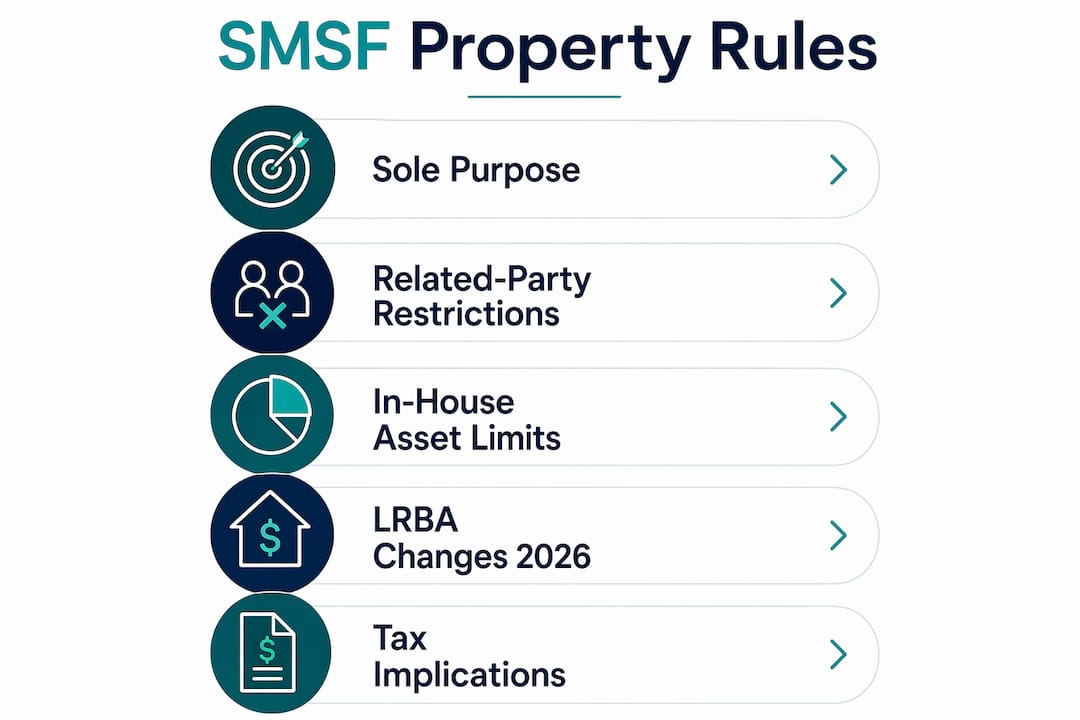
Every SMSF investment must be made and maintained for the sole purpose of providing retirement benefits to members, or death benefits if a member dies before retirement. The ATO is explicit: if you or a related party obtains more than an incidental personal financial benefit from an investment, you are likely in breach. Classic examples include a member holidaying in the fund's investment property, or a trustee's business storing equipment in a fund-owned warehouse at below-market rent.
A breach does not just attract a fine. It can strip the fund of its concessional tax treatment entirely, and trustees face a range of compliance actions including civil penalties.

Related-party rules for residential property
Residential property held by an SMSF cannot be:
- Acquired from a related party (a member, their relatives, or entities they control)
- Leased to a related party under any circumstances
- Used by a member or their family, even temporarily
These restrictions are absolute for residential property. There is no arm's length exception that overrides them.
Business real property: the key exception
Business real property (BRP) is land and buildings used wholly and exclusively in a business. BRP is treated concessionally under the Superannuation Industry (Supervision) Act 1993 (SISA): an SMSF can acquire BRP from a related party at market value, and BRP leased to a related party is not counted as an in-house asset. A small business owner leasing their commercial premises from their own SMSF at a genuine market rent is the textbook application of this rule.
In-house asset limits
Your SMSF cannot hold in-house assets exceeding 5% of the fund's total market value. An in-house asset includes any loan to a related party, investment in a related party, or asset leased to a related party. BRP leased to a related party is explicitly excluded from this calculation, which is why it is such a useful structure for business owners. If your fund's in-house assets breach the 5% cap at year end, you must prepare a written reduction plan before the end of the following financial year.
The 2026 LRBA change: what it means for new purchases
From 10 August 2026, SMSFs cannot enter a new LRBA to acquire residential property. Existing residential LRBAs entered before that date are grandfathered, provided the terms are not materially changed (refinancing or significant variation can trigger a new arrangement, which would then be prohibited). New LRBAs to acquire commercial property and BRP remain permitted. If you were planning to borrow inside super to buy a residential investment property, that path is now closed for new arrangements.
How should you structure SMSF property ownership?
Three structures cover most SMSF property scenarios. Each has different compliance requirements, lending implications, and costs.
Direct ownership
The SMSF trustee holds the property outright, with no borrowing. Title is registered in the name of the trustee(s) in their capacity as trustee of the fund. This is the simplest structure: no bare trust, no lender, no LRBA paperwork. It suits funds with sufficient cash to purchase without leverage, and it avoids the additional compliance layer that comes with borrowing.
The trade-off is that direct ownership requires the full purchase price plus costs to be available in the fund at settlement. For most residential properties in Australian capital cities, that means a substantial fund balance before the purchase is viable.
Bare trust (single acquirable asset) under an LRBA
When an SMSF borrows to acquire property, the asset must be held in a separate bare trust during the loan period. The bare trustee holds legal title; the SMSF holds the beneficial interest. The borrowed money must be used to acquire a single acquirable asset (or a collection of identical assets with the same market value). You cannot bundle multiple properties under one LRBA.
Once the loan is fully repaid, the SMSF trustee acquires legal ownership from the bare trustee without triggering a new acquisition under superannuation law. Until that point, the bare trust structure is mandatory.
Pros: Access to leverage; fund does not need the full purchase price upfront. Cons: Higher setup costs (bare trust deed, specialist legal advice), ongoing lender compliance, higher interest rates, and from 10 August 2026, this structure is unavailable for new residential purchases.
Business real property
BRP can be held directly or via an LRBA. The critical requirement is that the land is used wholly and exclusively in a business. A related party can lease BRP from the SMSF at a genuine commercial rent, and that rent flows into the fund as taxable income at the concessional SMSF rate. This structure is particularly effective for small business owners who want their super fund to own the premises their business operates from.
Pro Tip: Before exchanging contracts on any SMSF property purchase, verify three documents: (1) the trust deed explicitly permits property investment; (2) the investment strategy reflects the intended purchase and addresses concentration and liquidity risk; and (3) for an LRBA, the bare trust deed is prepared by a specialist SMSF solicitor before the contract is signed. Getting the contract in the wrong name is one of the most common and costly errors trustees make.
For trustees building a multi-asset portfolio, the step-by-step property portfolio guide covers how to sequence acquisitions across structures.
How do limited recourse borrowing arrangements actually work?
An LRBA allows an SMSF to borrow money to acquire an asset, with the lender's recourse limited to that single asset. If the fund defaults, the lender can only claim against the property in the bare trust — not the rest of the fund's assets. That protection for members is the defining feature of the structure, and it is also why lenders charge a premium.
Step-by-step LRBA process
- Confirm eligibility: Check the trust deed permits borrowing, and confirm the intended property is an asset the SMSF is permitted to acquire (noting the 2026 residential prohibition for new arrangements).
- Obtain pre-approval: Apply to a specialist SMSF lender with trustee minutes, the investment strategy, SMSF bank statements, projected fund cashflows, rental evidence, and member contribution history.
- Establish the bare trust: A specialist SMSF solicitor prepares the bare trust deed before contracts are signed. The bare trustee (often a corporate trustee) will hold legal title during the loan period.
- Sign the contract: The contract of sale must be in the bare trustee's name, not the SMSF trustee's name. The deposit must come from the SMSF bank account.
- Settlement: The lender funds the balance; title is registered to the bare trustee. Settlement periods for SMSF purchases commonly run 60–90 days to allow time for bare trust and lender documentation.
- Ongoing management: Rent flows to the SMSF bank account; loan repayments are made from the SMSF account; all expenses are paid from SMSF funds.
- Loan repayment: Once the loan is fully repaid, legal title transfers from the bare trustee to the SMSF trustee. This transfer does not constitute a new acquisition under superannuation law.
What lenders look for
SMSF lenders assess serviceability on projected ongoing cashflows, not just the current fund balance. Steady employer contributions and reliable rental income both improve your position. Lenders typically require:
- Trustee minutes authorising the borrowing
- A current investment strategy that reflects the proposed purchase
- At least two years of SMSF financial statements and tax returns
- Evidence of rental income (or comparable market rent for the property)
- Projected fund cashflows showing the fund can service the loan after settlement
Specialist SMSF lenders often cap loan-to-value ratios around 70% for residential property, and SMSF property loans are priced above standard investment loans, with larger cash buffers required. The limited recourse feature is the reason: the lender's security is the single asset only, so they price that risk into the rate and the serviceability buffer.
Many trustees pass a lender's serviceability test but hold no genuine cash buffer after settlement. That is a different problem. Passing the test means the lender is satisfied; it does not mean the fund can absorb a vacancy, a rate rise, or a major repair without stress.
What are the tax consequences of holding property in an SMSF?
The tax treatment inside an SMSF is one of its genuine advantages over personal ownership, but the rules are specific and the timing of key decisions matters.
Accumulation phase
Rental income is taxed at 15% inside the fund. Capital gains on assets held for more than 12 months attract a one-third discount, reducing the effective CGT rate to 10%. Depreciation and capital works deductions can be claimed against rental income, reducing the taxable amount further.
Pension phase
Once a member commences an account-based pension and the fund moves assets to support that pension, income and capital gains attributable to those assets become tax-free. Timing the sale of a property relative to pension commencement can therefore have a material impact on the CGT outcome. A property sold after the fund has transitioned to pension phase may attract no CGT at all, depending on the proportion of the fund in pension mode. This is one of the most significant tax planning considerations in any SMSF property strategy.
Repairs versus capital improvements
The distinction matters for both tax and LRBA compliance:
- Repairs and maintenance (restoring something to its original condition) are deductible in the year incurred
- Capital improvements (adding something new or substantially improving the asset) must be capitalised and depreciated over time
- Under an LRBA, borrowed money cannot be used to improve an asset — only to acquire it or cover acquisition costs. Improvements must be funded from the SMSF's own cash
Misclassifying a capital improvement as a repair is a common audit trigger. Keep detailed records, including contractor invoices, photographs, and written descriptions of the work.
GST and commercial property
If your SMSF acquires commercial property, GST registration may be required if the fund makes taxable supplies above the registration threshold. Purchasing a commercial property as a going concern can allow the transaction to be treated as GST-free. Input tax credits may be available on acquisition costs. These rules are complex and the consequences of getting them wrong are significant — specialist tax advice is not optional for commercial property transactions.
What does it cost to hold property in an SMSF?
Trustees often underestimate the total cost of SMSF property ownership. The table below sets out typical cost ranges across the purchase lifecycle.
| Cost item | Typical range |
|---|---|
| Deposit (typically less than the full purchase price, depending on the loan-to-value ratio capped by lenders) | |
| Stamp duty | Varies by state and property value |
| Conveyancing and legal fees | $1,500–$3,500 |
| Bare trust deed preparation | typically involves legal fees that vary by provider |
| Loan establishment fees | can vary depending on lender and loan type |
| Lender's mortgage insurance (if applicable) | Varies |
| Annual SMSF administration and audit | commonly $4,000–$6,000+ for leveraged property funds due to complexity |
| Property management fees | generally a percentage of the annual rental income, varying by manager |
| Council rates and strata levies | Varies by property |
| Building and landlord insurance | costs vary depending on property type and coverage |
| Repairs and maintenance reserve | budget an appropriate amount annually based on property age and type |
Annual administration and audit costs for SMSFs holding leveraged property commonly reach $4,000–$6,000+, reflecting the additional complexity of LRBA compliance, bare trust accounting, and lender reporting requirements.
Annual compliance checklist
- Lodge the SMSF annual return and pay the supervisory levy
- Complete the independent audit (required every year, regardless of fund activity)
- Update the investment strategy to reflect current holdings, concentration risk, and liquidity position
- Prepare and retain trustee minutes for all investment decisions
- Maintain rent and expenditure records for the auditor
- For BRP leases: confirm the lease is current, at market rent, and the related party is meeting payment obligations
- Review insurance coverage annually
Pro Tip: Keep a minimum cash buffer of at least three to six months of loan repayments and holding costs in the SMSF bank account at all times. Lenders assess serviceability before settlement; the buffer protects you after it. A vacancy or unexpected repair should not force you to sell the property or make an emergency contribution.
Step-by-step: how do you buy property inside an SMSF?
The purchase process for an SMSF property is more involved than a personal purchase. Each step has compliance implications.
Pre-purchase
- Confirm the trust deed permits property investment and borrowing (if applicable)
- Update the investment strategy to reflect the intended purchase, addressing concentration risk and liquidity
- Obtain SMSF loan pre-approval from a specialist lender (if borrowing)
- Engage an SMSF solicitor to prepare the bare trust deed before any contract is signed
- Conduct standard property due diligence: title search, building and pest inspection, zoning checks
- Confirm the property is an asset the SMSF is permitted to acquire (check related-party rules and the 2026 LRBA prohibition for residential)
At exchange and settlement
- The contract of sale must be in the bare trustee's name (not the SMSF trustee's name) if borrowing
- The deposit must be paid from the SMSF bank account
- Allow 60–90 days for settlement to accommodate bare trust and lender documentation
- Coordinate with the lender on funding confirmation and title registration
- Record trustee minutes authorising the purchase and documenting the investment rationale
Post-settlement
- Instruct the property manager to direct all rent to the SMSF bank account
- Set up direct debits for council rates, insurance, and strata levies from the SMSF account
- Retain all settlement documents, bare trust deed, and trustee minutes for the auditor
- Update the investment strategy to reflect the fund's actual concentration and liquidity position
- For BRP: execute a formal lease agreement at market rent and retain a copy for audit purposes
The smart property investment workflow published by Alphaiq covers the evaluation steps trustees should complete before committing to any property purchase inside super.
Is a property strategy right for your SMSF?
The honest answer depends on numbers, not enthusiasm. A realistic viability model treats the required fund size as an output of the deposit, stacked acquisition costs, and a multi-month liquidity buffer — not a fixed threshold you either clear or don't.
Inputs to model before deciding
- Deposit: typically 30% or more of the purchase price if a lender caps LVR at 70%
- Acquisition costs: stamp duty (varies by state), conveyancing ($1,500–$3,500), bare trust setup ($1,000–$2,500), loan establishment fees
- Ongoing admin and audit: budget $4,000–$6,000+ per year for a leveraged property fund
- Holding costs: rates, insurance, property management, repairs reserve
- Rental yield and vacancy risk: model a realistic yield for the property type and location, and stress-test with 3–6 months of vacancy
Fund size guidance
There is no legislated minimum balance to run an SMSF, but industry consensus places a practical floor at $250,000–$400,000, driven by the cost structure rather than any legal threshold. Below that range, annual compliance costs consume a disproportionate share of returns. For a leveraged property purchase, the relevant question is whether the fund can cover the deposit, acquisition costs, and a genuine cash buffer after settlement — and still service the loan if contributions slow or a vacancy occurs.
Lenders assess serviceability on projected ongoing cashflows, not just the current balance. Predictable employer contributions and evidence of rental income can materially improve your lending position even when the current balance is modest.
Stress-testing scenarios to run
- Interest rate rises of 1%–2% above the current rate
- Three to six months of vacancy with no rental income
- A major repair or capital expenditure event
- A member reducing or ceasing contributions (redundancy, career break, retirement)
Pro Tip: Use Alphaiq's superannuation calculator to model deposit and cost scenarios, project fund cashflows under different rental and rate assumptions, and compare the after-tax outcome of buying inside super versus personal ownership. The numbers often tell a different story to the headline yield.
For context on how RBA rate changes affect property serviceability, the Alphaiq analysis is worth reviewing before finalising your stress-test assumptions. And if you are weighing property against other superannuation investment options, the 2026 guide covers the full range of asset classes available inside super.
What mistakes and red flags should trustees watch for?
The most expensive SMSF property errors are usually avoidable. They tend to cluster around documentation failures, misunderstood rules, and high-pressure sales situations.
Common trustee mistakes
- Paying the deposit or purchase costs from a personal bank account rather than the SMSF account
- Signing the contract in the SMSF trustee's name rather than the bare trustee's name (for an LRBA purchase)
- Settling without a genuine cash buffer, leaving the fund unable to cover a vacancy or repair
- Assuming a related party can rent a residential property from the fund at any price
- Failing to update the investment strategy before or after the purchase
- Treating capital improvements as repairs in the fund's accounts
- Not retaining adequate documentation for the annual auditor
Red flags in advisers and lenders
- Pressure to exchange contracts before the bare trust deed is finalised
- Promises of guaranteed rental returns or capital growth
- Advice that does not address the sole purpose test or the 2026 LRBA prohibition
- Lenders or promoters who downplay ongoing administration costs
- Any arrangement where a related party benefits from the transaction beyond an arm's length commercial return
Questions to ask before proceeding
- Is this adviser licensed to provide SMSF-specific financial advice?
- Has the trust deed been reviewed by an SMSF specialist solicitor for this transaction?
- What is the fund's projected cash position six months after settlement, assuming one month of vacancy?
- How does this purchase affect the fund's in-house asset percentage?
- If the property is commercial, has GST treatment been confirmed by a tax adviser?
The ATO strongly encourages independent professional advice before entering any property arrangement inside super, particularly where related parties or LRBAs are involved.
Key takeaways
Integrating property into an SMSF requires the sole purpose test, correct ownership documentation, a genuine liquidity buffer, and specialist advice — every time, without exception.
| Point | Details |
|---|---|
| Sole purpose test is non-negotiable | Every SMSF property decision must be made solely to provide retirement benefits; personal use by any member or related party is a breach. |
| 2026 LRBA change closes residential borrowing | New LRBAs to acquire residential property are prohibited from 10 August 2026; existing arrangements and commercial BRP borrowing are unaffected. |
| Liquidity buffer protects the fund | Hold at least three to six months of loan repayments and holding costs in cash after settlement; passing serviceability is not the same as being financially safe. |
| Costs are higher than most trustees expect | Annual administration and audit for a leveraged property SMSF commonly reaches $4,000–$6,000+; model the full cost stack before committing. |
| Alphaiq models the full picture | Alphaiq's tax-aware platform lets you run deposit, cost, and cashflow scenarios to compare buying inside super versus personal ownership before you decide. |
When does property in super actually make sense?
Property inside an SMSF is genuinely powerful for the right trustee profile — and genuinely unsuitable for the wrong one. The distinction is worth being direct about.
The trustees who tend to get the most from an SMSF property strategy share a few characteristics: they have pooled balances large enough to absorb the full cost stack without leaving the fund cash-poor, they have predictable ongoing contributions (employer or personal), and they have a specific property in mind that serves a clear retirement purpose. Business owners who want their SMSF to own their commercial premises are the clearest example. The rent flows into super at a concessional tax rate, the business gets a stable tenancy, and the property can be sold or transferred at retirement in a tax-advantaged environment.
Where I see trustees get into trouble is when the decision is driven by property enthusiasm rather than retirement modelling. Buying a residential investment property inside super because "property always goes up" is not a retirement strategy. The compliance costs, the liquidity constraints, and the 2026 closure of new residential LRBAs all narrow the window considerably. For many trustees, holding a diversified mix of superannuation investment options inside an industry or retail fund will outperform a single leveraged residential property on a risk-adjusted, after-cost basis.
If you are genuinely considering property in super, the right sequence is: model it first, get specialist tax and legal advice second, and sign contracts third. Reversing that order is where the expensive mistakes happen. The SMSF vs industry super comparison is also worth reading before you commit to the SMSF path at all.
How Alphaiq helps you model your SMSF property decision
Running the numbers on an SMSF property strategy used to mean paying an adviser for a modelling session or building a spreadsheet from scratch. Alphaiq gives you a faster, more rigorous alternative.
The platform is built specifically for Australian self-directed investors who want to model their financial position across super, property, and retirement without the cost of ongoing advice. For SMSF trustees considering a property purchase, that means you can run deposit and cost scenarios, stress-test interest rate rises and vacancy periods, and compare the after-tax outcome of buying inside super versus personal ownership — all in one place.

Alphaiq's tax-aware modelling covers CGT implications, pension phase transitions, and super projections, so you can see how a property acquisition affects your retirement income across different scenarios. The superannuation calculator is a practical starting point for any trustee working through viability numbers.
This article is general information only and does not constitute financial, legal, or tax advice. Your circumstances will differ — confirm the current rules with the ATO or a qualified SMSF specialist before acting.
Start modelling your SMSF property strategy at alphaiq.pro.
Useful sources and further reading
Before acting on any SMSF property strategy, verify that the sources you rely on reflect current law — particularly given the 2026 LRBA changes. Check the publication date of any external guide.
- ATO — SMSF investment requirements: The primary source for the sole purpose test, arm's length requirements, and investment strategy obligations. Read this before any investment decision.
- ATO — SMSF investment restrictions and business real property: Covers related-party rules, in-house asset limits, and the BRP exception in detail. Authoritative and regularly updated.
- ATO — Limited recourse borrowing arrangements: The definitive guide to LRBA rules, including the single acquirable asset requirement, bare trust mechanics, and refinancing conditions.
- ATO — SMSF Regulator's Bulletin SMSFR 2020/1 (property development): Essential reading for any trustee considering property development inside super; covers in-house assets, LRBAs, non-arm's length income, and record-keeping.
- SuperGuide — SMSF borrowing rules: Practical explanation of the 2026 residential LRBA prohibition and what it means for trustees planning new purchases.
- Moneysmart — SMSFs and property: ASIC's consumer-facing overview of the risks and costs of SMSF property investment; useful for a plain-language summary of the key risks.
- Alphaiq — Superannuation calculator: Model deposit, cost, and cashflow scenarios for SMSF property purchases and compare outcomes across different investment strategies.
- Alphaiq — Optimise property investment for retirement: Practical guidance on aligning property investments with retirement goals, including sequencing and concentration risk.