
TL;DR:
- An SMSF is ideal for investors over AU$200,000 seeking direct asset control and willing to handle governance responsibilities. It offers benefits like direct property ownership, fee transparency, and tailored tax and estate planning. Cost-effectiveness and compliance demands increase with fund balance and complexity, requiring careful modeling and ongoing management.
An SMSF makes the most sense when you want direct control over specific investments, including direct property or business real property, and your combined fund balance is approaching AU$200,000 or above. The ATO's guidance is clear: the potential advantages are real, but so is the personal legal responsibility.
Three quick deciding factors:
- Balance: Industry guidance places the cost-effectiveness threshold at around AU$200,000, with clearer advantages above AU$500,000.
- Time and skills: You need the knowledge and ongoing commitment to manage compliance, record-keeping and investment decisions.
- Direct-asset need: If you want to hold direct property, business real property, or a bespoke mix of assets, a pooled fund simply cannot match an SMSF.
Pro Tip: Run your SMSF scenarios through Alphaiq before rolling over any funds. Seeing the projected tax, fee and pension-phase outcomes side-by-side with your current fund takes the guesswork out of the decision.
Table of Contents
- What an SMSF actually lets you do
- How SMSFs are taxed: accumulation vs pension phase
- What does it cost to run an SMSF?
- What are your legal duties as an SMSF trustee?
- Is an SMSF right for you? A practical checklist
- How long does SMSF setup actually take?
- When a pooled super fund is the better choice
- Key takeaways
- The governance reality most trustees underestimate
- Model your SMSF decision with Alphaiq
- Useful sources and further reading
What an SMSF actually lets you do
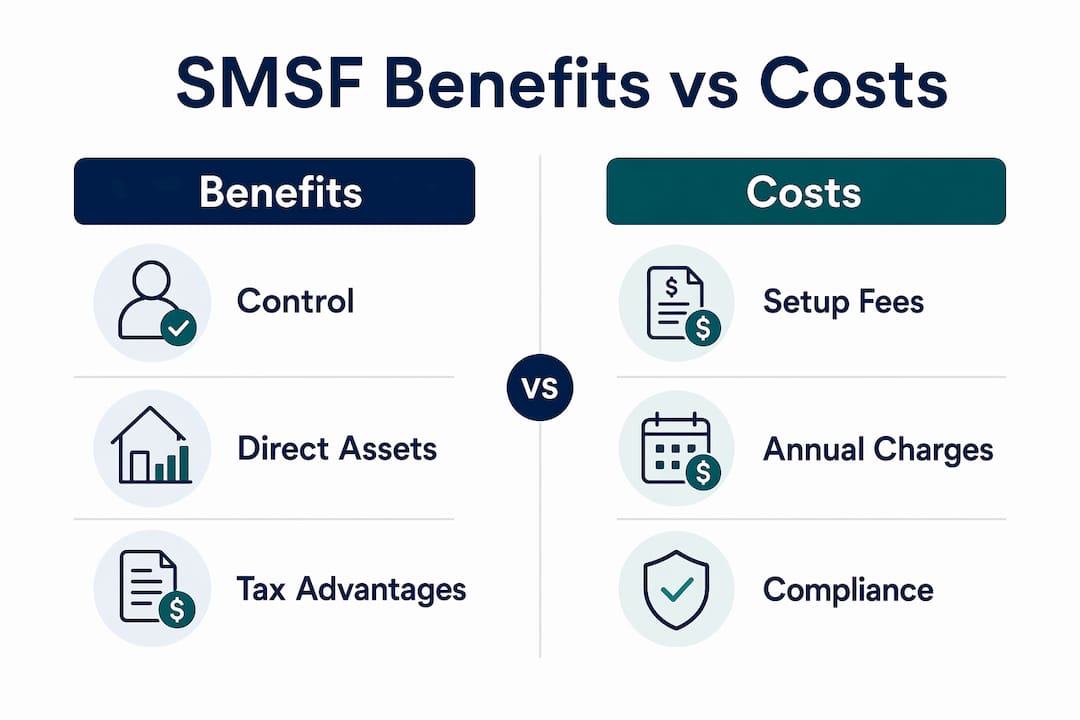
The practical advantages of self-managed super go well beyond a vague sense of "control." Industry advisers including Hudson Financial Partners and MDS Accounting consistently identify three primary motivators: granular investment control, fee transparency, and tailored tax and estate planning.
- Direct assets: An SMSF can hold direct shares, listed investment companies, ETFs, term deposits, bonds, and direct property. Critically, it can also hold business real property, allowing a business owner to purchase their own commercial premises inside the fund and pay rent back to themselves.
- Fee transparency: You see exactly what assets the fund holds, what they cost to run, and what returns they generate. There are no hidden layers.
- Tax and estate planning: Trustees can time capital gains realisations, manage the transition to pension phase, and structure binding death benefit nominations to direct assets to specific beneficiaries outside the standard superannuation payment hierarchy.
The SMSF sector's scale reflects genuine demand. The ATO publishes annual statistics on the sector's health and performance, and the number of Australians choosing this structure has grown steadily as investment options have broadened.
How SMSFs are taxed: accumulation vs pension phase
SMSF earnings in the accumulation phase are generally taxed at 15%; capital gains on assets held longer than 12 months attract an effective rate of 10%; and once the fund moves to retirement pension phase, earnings are typically tax-free. These rates apply subject to individual circumstances and current legislation.

| Income type | Accumulation phase | Pension phase |
|---|---|---|
| Investment earnings (dividends, rent) | 15% | — |
| Capital gains (assets held >12 months) | Effective 10% | — |
| Capital gains (assets held <12 months) | 15% | — |
| Franking credit refunds | Offset tax payable | Refundable |
For a trustee holding a direct investment property inside the fund, rental income taxed at 15% during accumulation compares favourably with personal marginal rates that can reach 47%. The gap widens further once the fund converts to pension phase. Timing that conversion well, and timing capital gains realisations around it, is where retirement tax strategies inside an SMSF can deliver meaningful outcomes.
What does it cost to run an SMSF?
Annual running costs typically range from AU$2,000 to AU$4,500 for a straightforward fund, with cost-effectiveness generally emerging around AU$200,000 in combined balances and becoming more compelling above AU$500,000. Below AU$200,000, fixed compliance costs consume too large a share of returns.
Typical ongoing costs include:
- Annual independent audit (legally required every year)
- ATO supervisory levy
- Accounting and tax agent fees for the annual return
- Administration fees (if using an SMSF administrator)
- Asset valuations (required for market-linked assets)
- Actuarial certificates (required when the fund is in pension phase)
| Cost item | Typical annual range |
|---|---|
| Total (simple fund) | AU$2,000–AU$4,500 |
Pro Tip: Adding direct property or a limited recourse borrowing arrangement (LRBA) raises costs noticeably. Legal fees for the LRBA structure alone can run to several thousand dollars at setup. Model the full cost stack, not just the base administration fee, before committing.
What are your legal duties as an SMSF trustee?
As a trustee, you are personally and legally responsible for every fund decision and compliance obligation under the Superannuation Industry (Supervision) Act 1993 (SISA). Outsourcing administration to an accountant or administrator does not transfer that liability to them.
Core trustee duties include:
- Meeting the sole purpose test: the fund must exist solely to provide retirement benefits.
- Developing, implementing and regularly reviewing a written investment strategy.
- Maintaining records including trustee meeting minutes, financial statements and trustee declarations for at least 10 years.
- Appointing an approved SMSF auditor each year, no later than 45 days before the annual return is due.
- Lodging the annual return on time and acting on the auditor's findings.
MoneySmart and the ATO both warn explicitly against schemes claiming to offer early access to superannuation. Early access is illegal except in narrow, legislated circumstances, and the penalties are severe.
Pro Tip: Treat your investment strategy as a living document, not a one-time form. The ATO's investment requirements expect it to guide each investment decision and be updated whenever circumstances change.
Is an SMSF right for you? A practical checklist
Use this checklist if you want direct investment control and are prepared to meet the governance, time and cost requirements.
- Is your combined super balance at or approaching AU$200,000?
- Do you need to hold assets unavailable in a pooled fund (direct property, business real property, specific shares)?
- Can you commit more than 8 hours a month to fund management on an ongoing basis?
- Do you have the financial literacy to understand investment risk, diversification and compliance obligations?
- Have you reviewed what group insurance cover you currently hold in your existing fund and confirmed you can replace it?
- Do you have estate planning goals (specific beneficiary nominations, succession planning) that a pooled fund cannot accommodate?
- Are you prepared to engage an accountant, auditor and possibly a licensed SMSF adviser each year?
Red flags to pause and reconsider:
- Balance well below AU$200,000 with no clear growth trajectory.
- Unwillingness to spend time on governance and record-keeping.
- Reliance on bundled life and total permanent disability insurance inside your current fund, with no plan to replace it.
- No specific investment need that a pooled fund cannot meet.
If most checklist items match your situation, the next step is to model the numbers with Alphaiq and then seek advice from a licensed SMSF adviser before initiating any rollover.
How long does SMSF setup actually take?
From decision to first investable balance, most straightforward SMSF setups take four to eight weeks. Complex structures involving property or an LRBA can extend that timeline considerably.
- Suitability check (week 1): Confirm balance, investment goals and governance appetite. Seek licensed SMSF advice if needed.
- Trustee structure decision (week 1–2): Choose individual trustees or a corporate trustee (a corporate trustee costs more upfront but offers greater flexibility and succession continuity).
- Trust deed and registration (week 2–3): Engage a specialist to draft the trust deed; apply for the fund's TFN and ABN through the ATO.
- Open a bank account (week 3): The fund needs its own bank account in the fund's name before any rollovers can occur.
- Rollover and transfer (week 3–6): Initiate rollovers from existing funds. Allow extra time if insurance checks or property settlements are involved.
- Finalise investment strategy (week 4–6): Document objectives, risk tolerance, liquidity needs and insurance considerations before making any investments.
- Appoint auditor and administrator (week 5–8): Engage an approved SMSF auditor and, if required, an administration platform.
- First-year compliance: Lodge the annual return, complete the audit, and review the ATO's starting an SMSF guide for ongoing obligations.
When a pooled super fund is the better choice
For many Australians, an industry fund, retail fund, or managed account platform is simpler and cheaper, particularly at lower balances. The comparison between SMSFs and other fund types comes down to a few clear factors.
- Industry funds: Low fees, strong long-term performance records, bundled insurance, and no trustee obligations. Well-suited to members below AU$200,000 or those who prefer a hands-off approach.
- Retail funds: Broader investment menus than industry funds, though typically at higher cost. APRA-regulated with access to AFCA for dispute resolution.
- Managed account platforms: Offer more investment transparency and direct-asset exposure than standard pooled funds, without the full compliance burden of an SMSF. A middle-ground option for investors who want more control but are not ready for trustee responsibilities.
Prefer a pooled fund when: your balance is below AU$200,000, you value bundled insurance and do not want to source cover separately, you want APRA regulation and AFCA dispute access, or you have no specific investment requirement that a standard fund cannot meet. SMSF trustees have no access to AFCA or government compensation for losses; disputes between members are resolved at the trustees' own expense.
Key takeaways
An SMSF is worth considering when your combined balance is at or above AU$200,000, you need direct-asset access, and you are prepared to meet the ongoing governance and compliance obligations personally.
| Point | Details |
|---|---|
| Balance threshold | Cost-effectiveness typically starts near AU$200,000; strategic advantages are clearest above AU$500,000. |
| Tax advantage | Accumulation earnings taxed at 15%; effective 10% CGT for assets held over 12 months; — in pension phase. |
| Annual running costs | Simple funds typically cost AU$2,000–AU$4,500 per year, including audit and ATO levy. |
| Governance commitment | Trustees are personally liable under SISA; most spend more than 8 hours a month managing their fund. |
| Alphaiq modelling | Model tax, CGT timing, fees and pension outcomes with Alphaiq before committing to setup. |
The governance reality most trustees underestimate
The decision to set up an SMSF is worth making carefully, and the single biggest mistake I see is treating governance as a one-time setup task rather than an ongoing discipline.
Most people who struggle with their SMSF do not fail on the investment side. They fail on the paperwork: an investment strategy that has not been updated in three years, trustee minutes that do not reflect actual decisions, or an audit that surfaces a compliance issue that could have been caught earlier. The ATO's enforcement posture has sharpened, and the penalties for non-compliance are not trivial.
The other underestimated risk is insurance. Rolling your entire balance into an SMSF without first confirming you can replace your group life and total permanent disability cover is a mistake that can be very costly to unwind, particularly if your health has changed since you first joined your existing fund.
My practical recommendation: before you sign anything, run the numbers through a modelling tool, get a written suitability assessment from a licensed SMSF adviser, and document your investment strategy in enough detail that it would survive an ATO audit on day one. An SMSF done well is genuinely powerful. Done carelessly, it creates problems that take years and real money to fix.
Model your SMSF decision with Alphaiq
Knowing the tax rates and cost benchmarks is useful. Seeing how they interact with your specific balance, asset mix and retirement timeline is what actually moves the decision forward.

Alphaiq's superannuation modelling tool lets you test SMSF scenarios across tax treatment, CGT timing, fee sensitivity and pension-phase outcomes before you commit to a single rollover. You can compare your projected position inside an SMSF against your current fund, adjust assumptions, and see where the numbers genuinely favour a change. There is no advice relationship required and no long-term commitment. Run the scenarios, review the outputs, and go into any conversation with a licensed SMSF adviser with your own numbers already in hand.
Useful sources and further reading
- ATO — About SMSFs: Start here for trustee obligations, compliance requirements and the ATO's own comparison of SMSFs with other fund types.
- ATO — Trustee obligations: Detailed breakdown of legal duties, penalties and the sole purpose test under SISA.
- ATO — Starting an SMSF (PDF guide): Step-by-step setup, running and winding-up guidance from the regulator.
- MoneySmart — SMSF: ASIC's plain-language overview of SMSF suitability, time commitment, insurance implications and red flags to avoid.
- Alphaiq — Superannuation calculator: Model SMSF tax, fee and pension-phase scenarios against your own numbers before committing to setup.
This article is general information only and does not constitute financial, legal or tax advice. Confirm current rules with the ATO or a licensed SMSF adviser before making decisions about your own superannuation.