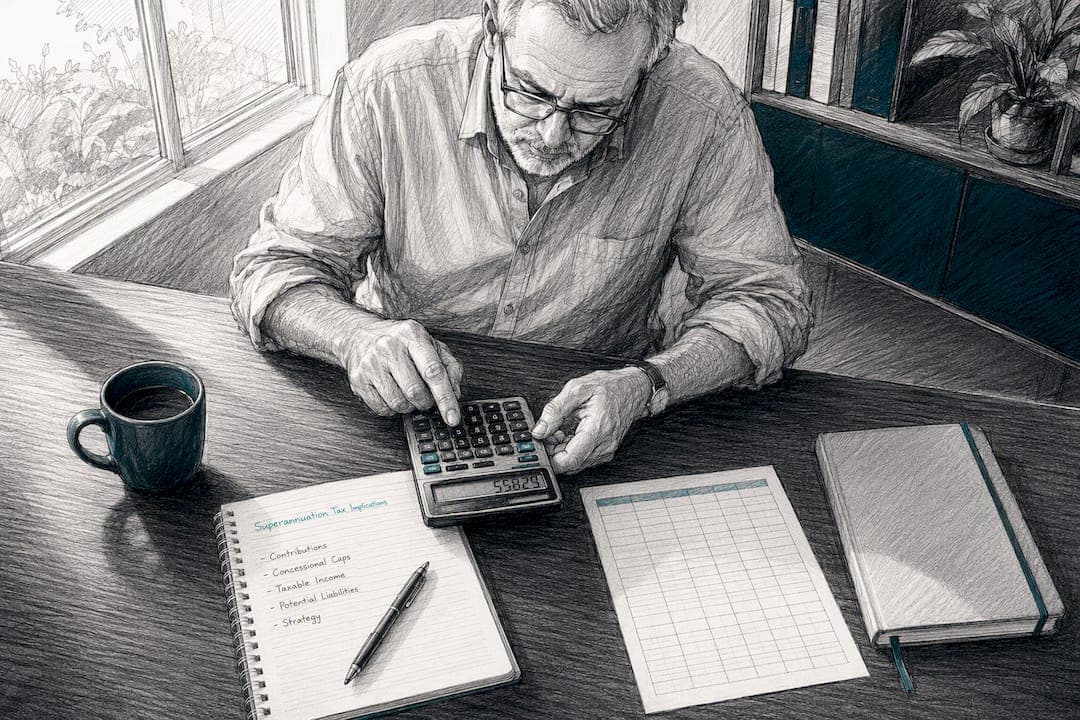
Whether you pay tax on a super withdrawal depends on three things: your age against your preservation age, whether the money is a tax‑free or taxable component, and whether you take a lump sum or an income stream. The Australian Taxation Office sets the rules, and caps like the low‑rate cap and untaxed plan cap decide how much concessional treatment you get.
- Age and preservation status — under preservation age, between preservation age and 60, or 60 and over all attract different tax outcomes.
- Component split — the tax‑free component is never taxed, while the taxable component might be.
- Withdrawal type — lump sums and income streams follow separate tax tables.
Key Takeaways
Tax on super withdrawals depends on age against preservation age, the tax‑free versus taxable split, and whether the payment is a lump sum or income stream.
| Point | Details |
|---|---|
| Age drives the outcome | Withdrawals after 60 from taxed elements are generally tax‑free; earlier withdrawals face marginal rates or capped concessions. |
| Components matter | Tax‑free and taxable portions are split pro rata; you can't choose to withdraw only the tax‑free part. |
| Caps limit concessions | The low‑rate cap and untaxed plan cap set the ceiling on how much taxable component avoids tax. |
| Lump sums vs income streams | Each follows separate ATO tax tables, so the same balance can be taxed differently depending on payment type. |
| Model before withdrawing | Check your age, component split, and current caps before locking in a withdrawal strategy. |
Where to check current rates and thresholds
- Tax on super benefits for the overarching ATO rules.
- Schedule 12 withholding tables for lump sum rates.
- Super income stream tax tables for pension taxation.
- Try the Alphaiq super calculator to model your own withdrawal scenario against current caps.
Table of Contents
- How is tax on super withdrawals actually worked out?
- How are super contributions taxed?
- How is investment growth taxed inside super?
- Do you pay tax on a super lump sum or pension?
- What's the difference between tax-free and taxable super?
- What caps and special rules affect super withdrawal tax?
- How can you reduce tax on your super withdrawals?
- How do you model your own withdrawal tax scenario?
- Frequently asked questions
- Sources
How is tax on super withdrawals actually worked out?
Super touches three separate tax layers before money ever reaches your bank account. Contributions are taxed going in, investment earnings are taxed while they sit in the fund, and withdrawals are taxed (or not) coming out. Each layer has its own rules, set through legislation and administered by the ATO, and what happens at one stage shapes what you owe at the next.
- Contributions tax — concessional contributions are taxed inside the fund, generally at 15%.
- Earnings tax — investment returns inside the fund face their own concessional rate.
- Withdrawal tax — governed by your age, component split and payment type, per ATO guidance.
How are super contributions taxed?
Concessional contributions, the ones made from pre‑tax income like salary sacrifice or employer super guarantee payments, are taxed inside the fund at up to 15%. Non‑concessional contributions come from money you've already paid income tax on, so they go in tax‑free and form part of your tax‑free component later.
Both contribution types are capped, and going over those caps can trigger extra tax. High‑income earners face an additional layer through Division 293, which adds tax on concessional contributions once income (including those contributions) crosses a set threshold.
- Concessional contributions: taxed at 15% inside the fund, subject to an annual cap.
- Non‑concessional contributions: no entry tax, subject to a separate annual cap.
- Division 293: extra tax for high‑income earners on concessional contributions.
Pro Tip: Caps and thresholds are adjusted periodically, so check current figures on the ATO site before making large contributions in any given financial year.
How is investment growth taxed inside super?
Earnings on your super investments are taxed inside the fund itself, typically at a concessional rate of up to 15%, well below most people's marginal tax rate outside super. That's one of the main reasons super remains a tax‑effective place to grow retirement savings over decades.
Most funds hold a taxed element, meaning tax has already been paid on contributions and earnings. Public sector and some defined benefit funds can carry an untaxed element instead, where tax hasn't yet been paid, which changes how that money is taxed on withdrawal.
- A member earning steady concessional returns inside a taxed fund builds a taxable component that has already had tax paid on it.
- An equivalent balance in an untaxed fund arrives at withdrawal with tax still owing, which is why untaxed elements often face higher withdrawal tax.
Do you pay tax on a super lump sum or pension?
Whether tax applies comes down to three checks: your age relative to preservation age, whether the amount is tax‑free or taxable component, and whether you're taking a lump sum or starting an income stream.
Lump sum withdrawals are taxed according to Schedule 12, which sets withholding rates by age and component. The tax‑free component is never withheld. The taxable component (taxed element) enjoys a low-rate cap, a lifetime limit up to which that component receives concessional tax treatment for people between preservation age and 60. Above the cap, it is taxed at a concessional rate including the Medicare levy. Untaxed elements face steeper withholding, and amounts above the untaxed plan cap can attract rates up to 47% where no tax file number has been supplied, per the 2024–25 Schedule 12 rates.
Income streams (account‑based pensions) are taxed differently. Once you turn 60, the taxed element of an income stream generally isn't assessable income at all, according to the super income stream tax tables. Before 60, the taxed element is taxed at marginal rates but usually attracts a 15% tax offset. Untaxed elements carry their own offsets, including a 10% offset available to some recipients aged 60 and over.
- Under preservation age: withdrawals are generally only available in limited circumstances (like severe financial hardship), and tax applies at higher rates.
- Preservation age to 60: the low‑rate cap applies to lump sums; income streams are taxed at marginal rates less a 15% offset.
- 60 and over: taxed lump sums and taxed income streams are generally tax‑free; untaxed elements may still attract tax with an offset applied.
| Age group | Lump sum (taxed element) | Income stream (taxed element) |
|---|---|---|
| Under preservation age | Taxed at marginal rates plus Medicare levy, subject to conditions | Rarely available |
| Preservation age to 60 | Tax‑free up to low‑rate cap, then 17% | Marginal rates less 15% offset |
| 60 and over | Generally tax‑free | Generally not assessable |
Worked example: Say you're 58 and withdraw a $200,000 lump sum, split $60,000 tax‑free and $140,000 taxable (taxed element). The $60,000 is untouched. If your low‑rate cap balance still has room for the full $140,000, none of it is taxed either, leaving your entire withdrawal tax‑free that year.
What's the difference between tax-free and taxable super?
Most super balances hold a mix of both components, and you generally can't cherry‑pick the tax‑free portion when you withdraw. Funds apply a pro rata rule: whatever proportion of tax‑free and taxable makes up your total balance applies equally to any lump sum you take out.
- The fund calculates the tax‑free percentage of your total balance.
- That same percentage is applied to the amount you're withdrawing.
- The remainder is taxable, split further into taxed or untaxed elements depending on the fund type.
Example: if your balance is 30% tax‑free and 70% taxable, a $100,000 withdrawal delivers $30,000 tax‑free and $70,000 taxable, taxed according to your age and the caps above.
| Component | Typical source |
|---|---|
| Tax‑free | Non‑concessional (after‑tax) contributions |
| Taxable (taxed element) | Concessional contributions and earnings, tax already paid |
| Taxable (untaxed element) | Contributions or earnings where tax hasn't yet been paid, common in public sector funds |
What caps and special rules affect super withdrawal tax?
A handful of named limits do most of the heavy lifting in determining your final tax bill.
- Low‑rate cap: a lifetime limit on how much taxable component (taxed element) can be withdrawn tax‑free between preservation age and 60.
- Untaxed plan cap: a per‑plan, annually indexed limit on concessional treatment of untaxed elements, detailed in ATO guidance on taxation of super benefits.
- Death benefits: tax depends on who receives the payment. Dependants (a spouse or minor child, generally) usually receive death benefits tax‑free, while non‑dependant adult children can face tax on the taxable component.
- Division 293: applies at the contributions stage for high earners, not at withdrawal, but it shapes how much taxable component accumulates over time.
- Reporting: funds must issue a PAYG payment summary for super lump sums, and the taxable component must be declared as assessable income on your tax return.
How can you reduce tax on your super withdrawals?
Most legitimate tax savings come down to timing and structure rather than any clever loophole.
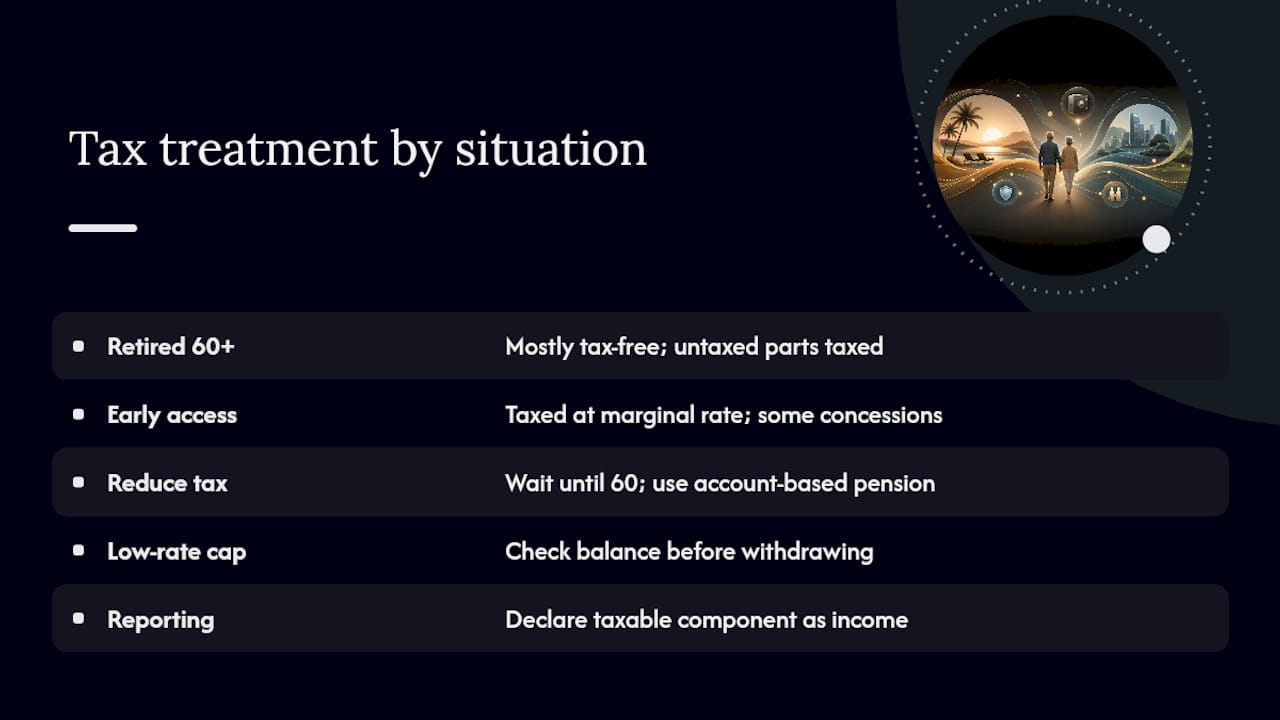
- Wait until 60 where possible, since taxed elements become largely tax‑free from that point.
- Use an account‑based pension instead of one large lump sum, spreading the tax impact over time.
- Check your low‑rate cap balance before withdrawing, so you don't waste concessional room unnecessarily.
- Coordinate withdrawal timing with other taxable income in the same financial year to avoid pushing yourself into a higher bracket.
- Confirm which tax offsets apply to your specific component mix before locking in a withdrawal strategy.
Pro Tip: Modelling several smaller withdrawals against your low‑rate cap, rather than one large payment, often preserves more of that cap for future years and can meaningfully change your total tax over retirement.
How do you model your own withdrawal tax scenario?
Before running any numbers, gather six inputs: your current age, your preservation age, your tax‑free versus taxable split, whether you're planning a lump sum or income stream, current caps and offsets, and any other taxable income you'll report that year.
If their low‑rate cap has room, the full $120,000 is tax‑free.
Scenario B: a 62 year old starts an account‑based pension entirely from taxed elements. Because they're over 60, the income stream isn't assessable income at all.
- Confirm your age and preservation age.
- Check your component split with your fund.
- Decide lump sum or income stream.
- Check current caps and applicable offsets.
- Factor in other taxable income for the year.
These figures are illustrative only. Check current caps before acting, and consider a tool like Alphaiq to run the calculation against your real balance.
Practical priorities for people planning withdrawals
Confirm your condition of release first, then check your component split, model the tax impact against other income for that year, and only then decide on timing. Small shifts in timing or structure often change the tax outcome more than people expect.

Frequently asked questions
Is superannuation tax-free once you retire? Not automatically. Superannuation becomes largely tax‑free on taxed elements once you're 60 and meet a condition of release, but untaxed elements and pre‑60 withdrawals can still attract tax.
What's the tax on early super access? Early access outside standard conditions of release, such as severe financial hardship or permanent incapacity, is generally taxed at your marginal rate, with some concessions depending on the reason for release.
How do I reduce tax on super withdrawals? Common approaches include waiting until 60, using an account‑based pension rather than one lump sum, and checking your low‑rate cap balance before withdrawing.
Do I need to report super withdrawals on my tax return? Yes, if there's a taxable component. Your fund provides a payment summary, and that taxable amount must be declared as assessable income.
What happens to super death benefits tax‑wise? Dependants generally receive death benefits tax‑free. Non‑dependant adult children can face tax on the taxable component, depending on whether it's a taxed or untaxed element.
This article is general information, not a substitute for advice from a qualified financial advisor. Consult a qualified financial professional about your own circumstances before acting on anything here.
Sources
- Tax on super benefits | Australian Taxation Office
- Schedule 12 – Tax table for superannuation lump sums | Australian Taxation Office
- Super income stream tax tables | Australian Taxation Office
- Taxation of super benefits | Australian Taxation Office
- Schedule 12 – Tax table for superannuation lump sums | Australian Taxation Office