
From 1 July 2026, the concessional contributions cap rises to $32,500, and the non-concessional cap climbs to $130,000. Those two numbers govern almost every decision you'll make about topping up super this financial year, and getting them mixed up is one of the most common (and costly) mistakes we see.
Before you start planning a catch-up contribution, three things matter most:
- Concessional cap: $32,500 (pre-tax contributions, including super guarantee and salary sacrifice)
- Non-concessional cap: $130,000 (after-tax contributions)
- Division 293 threshold: $250,000 in income, which adds an extra 15% tax to some concessional dollars
If your total super balance sat under $500,000 on 30 June last year, you may be able to carry forward unused concessional cap from previous years. If it's under the relevant transfer balance cap bands, bring-forward rules can let you contribute multiple years of non-concessional caps in one go. Either strategy can shift you into Division 293 territory faster than you'd expect, which is exactly why the mechanics below matter more than the headline figures alone.
Key Takeaways
Super contribution caps for 2026–27 sit at $32,500 concessional and $130,000 non-concessional, with Division 293's fixed $250,000 threshold quietly catching more contributors each year as those caps rise.
| Point | Details |
|---|---|
| Know your current caps | Concessional is $32,500 and non-concessional is $130,000 from 1 July 2026. |
| Check carry-forward eligibility | You need a total super balance under $500,000 on the prior 30 June to access unused concessional cap. |
| Confirm your TSB band before bring-forward | Bring-forward access ranges from $390,000 down to nil depending on your total super balance. |
| Watch Division 293 with catch-ups | The 15% extra tax applies to the lesser of your contributions or income over $250,000, a threshold that never moves. |
| Model before you contribute | Test any large catch-up contribution against your income before committing, since the tax outcome isn't always obvious. |
Where to verify the numbers and run your own scenarios
- The concessional contributions cap page confirms current caps and carry-forward rules directly from the ATO.
- The non-concessional contributions cap page sets out bring-forward bands and TSB thresholds.
- ProjectFi's Division 293 explainer walks through worked examples of the lesser-of calculation.
- For legislative context on broader super changes, The Recruitment Alternative's coverage offers an employer-side perspective worth reading alongside the ATO material.
Table of Contents
- Concessional contributions cap: what counts and how carry-forward works
- Non-concessional contributions cap and the bring-forward rule
- What is Division 293 tax and how does it interact with your caps?
- How to check your caps and what to do if you go over
- What changes are coming to super contribution caps?
- The gap between knowing the caps and using them well
- Sources
Concessional contributions cap: what counts and how carry-forward works
The concessional cap covers every pre-tax dollar going into your super: your employer's super guarantee payments, anything you salary sacrifice, and personal contributions you claim as a tax deduction. If you have more than one fund, the ATO adds contributions across all of them, so switching funds mid year doesn't reset anything.
The cap has moved in $2,500 steps as it tracks Average Weekly Ordinary Time Earnings (AWOTE), and it now sits at $32,500 from 1 July 2026, up from $30,000 the year before. Expect further increases in similar increments as wages rise, though nothing is guaranteed until the ATO confirms it each year.
Carry-forward is where things get genuinely useful for anyone who missed contributing in past years. You're eligible if your total super balance was under $500,000 on the prior 30 June, and you can access unused concessional cap from up to five previous financial years, starting from 2018–19. You don't need to apply for it. The ATO applies it automatically the moment your contributions exceed the standard annual cap.
Miss the cap entirely and the consequences are unforgiving but manageable. Excess concessional contributions (ECC) get added to your assessable income and taxed at your marginal rate, with a 15% tax offset to account for the tax already paid inside the fund.
Leave the excess sitting in your fund instead of releasing it, and it counts towards your non-concessional cap too, which can trigger a second breach if you're already close to that limit. That's the trap: one oversight can cascade into two separate cap problems in the same year.
Non-concessional contributions cap and the bring-forward rule
Non-concessional contributions are the after-tax dollars you put into super yourself, ones you haven't claimed a deduction for. The cap for 2026–27 is $130,000, four times the concessional limit, which is exactly why bring-forward strategies exist: this is the lever people use to make large, one-off contributions ahead of retirement or after selling an asset.
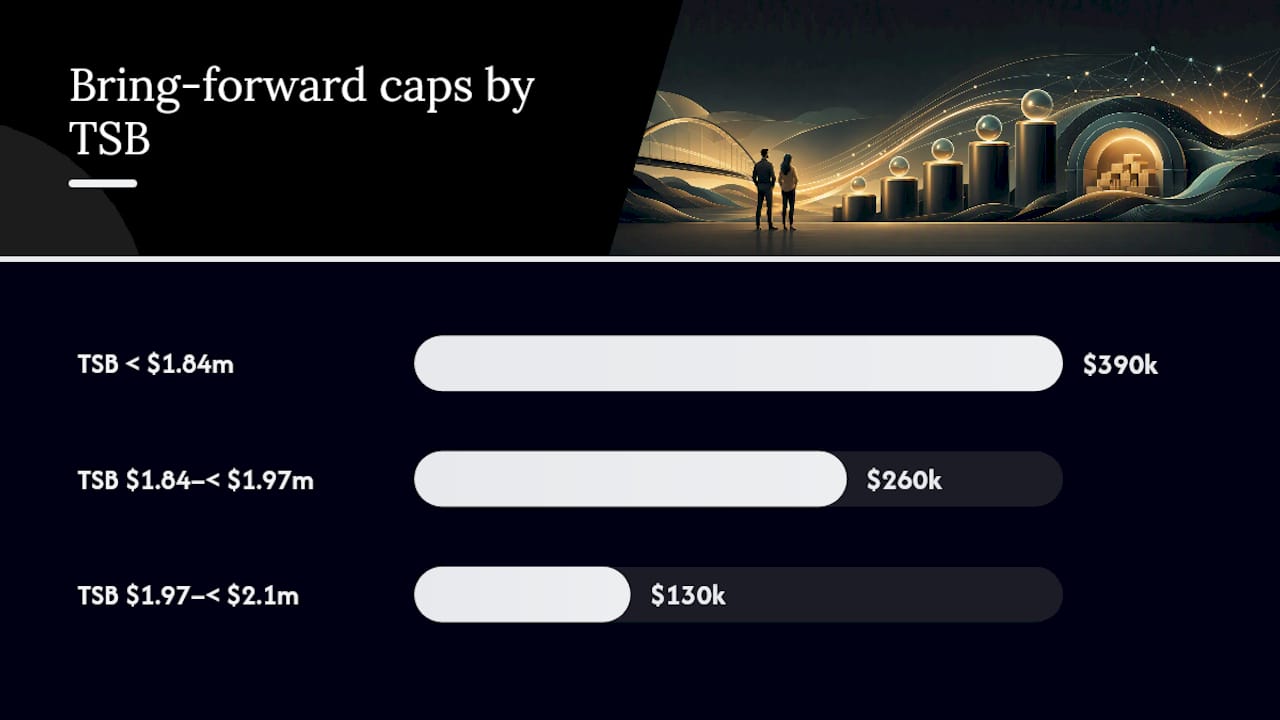
Bring-forward lets you access up to three years of non-concessional cap in a single financial year, but how much you get depends entirely on your total super balance (TSB) on the prior 30 June:
- TSB under $1.84 million: full three-year bring-forward, giving you $390,000 in the first year
- TSB between $1.84 million and under $1.97 million: two-year bring-forward, giving you $260,000
- TSB $1.97 million and above but under $2.1 million: one year only, capped at $130,000 (no bring-forward)
- TSB at or above $2.1 million: your non-concessional cap drops to nil
That last band catches people out. Once your balance reaches the general transfer balance cap, you simply can't make further non-concessional contributions at all, no matter how much cash you have sitting outside super waiting to go in.
Exceed your non-concessional cap and the fund treats the excess similarly to the concessional rules: you can release the excess amount plus an associated earnings component, and that release amount is added to your assessable income. It's not a fine so much as a correction, but it's paperwork you want to avoid by checking your TSB before you contribute, not after.
What is Division 293 tax and how does it interact with your caps?
Division 293 tax adds an extra 15% on top of the standard 15% contributions tax, applying once your income plus certain concessional contributions crosses $250,000. Unlike the contribution caps, this threshold is not indexed, so it stays fixed even as concessional caps rise with AWOTE.
Two quick examples show why this matters:
- Income side binds: you earn $400,000 and contribute $32,500. The excess over the threshold is $150,000, well above your contributions, so the bill is 15% of $32,500, around $4,875.
- Contributions side binds: you earn $260,000 and use carry-forward to contribute $80,000 in one year. The excess over the threshold is only $10,000, smaller than your contributions, so the bill is 15% of $10,000, just $1,500.
That second scenario is the trap worth remembering: catch-up contributions can push your total higher without necessarily blowing out your Division 293 bill, but only if your income itself stays close to the threshold. Salary sacrificing more won't help you dodge the income test either, because sacrificed amounts are added back into your Division 293 income calculation, not excluded from it.
How to check your caps and what to do if you go over
Before contributing a lump sum, confirm your numbers rather than estimating them.
- Check ATO online services (via myGov) for your total super balance, prior-year concessional contributions, and any carry-forward amounts already accrued.
- Cross-check your fund's annual statement, since timing differences between when a contribution is made and when it's reported can cause confusion near year-end.
- Stage large non-concessional contributions across financial years where possible, rather than assuming bring-forward eligibility without confirming your TSB band first.
- Delay discretionary salary sacrifice increases until you've confirmed how much concessional cap you have left for the year, particularly if you're using carry-forward.
- If you've already exceeded a cap, wait for the ATO's formal excess contributions determination before acting. Don't withdraw funds independently.
- Follow the release authority process the ATO issues, and consider whether splitting a release across multiple funds makes sense if you hold several accounts.
Keep a simple running log of contributions by financial year, separated into concessional and non-concessional, so you're never relying on memory when a decision needs to be made quickly.
Pro Tip: Run any planned catch-up contribution through a modelling tool before you commit. A $30,000 carry-forward contribution can look harmless in isolation but push your Division 293 bill up by hundreds of dollars once it's added to your actual income for the year.
How AlphaIQ modelling clarifies the carry-forward decision
Deciding whether to use carry-forward or bring-forward isn't just a cap question, it's a tax outcome question. Modelling your projected income alongside planned contributions shows whether the income side or the contributions side of the Division 293 lesser-of test will bind.
- AlphaIQ's super calculator projects how a catch-up contribution affects your balance and tax position together
- The salary sacrifice calculator helps time concessional payments against your remaining cap
- One recurring pattern: carry-forward dollars can lift your contributions base enough to flip which side of the lesser-of test applies, changing your bill without you realising it
What changes are coming to super contribution caps?
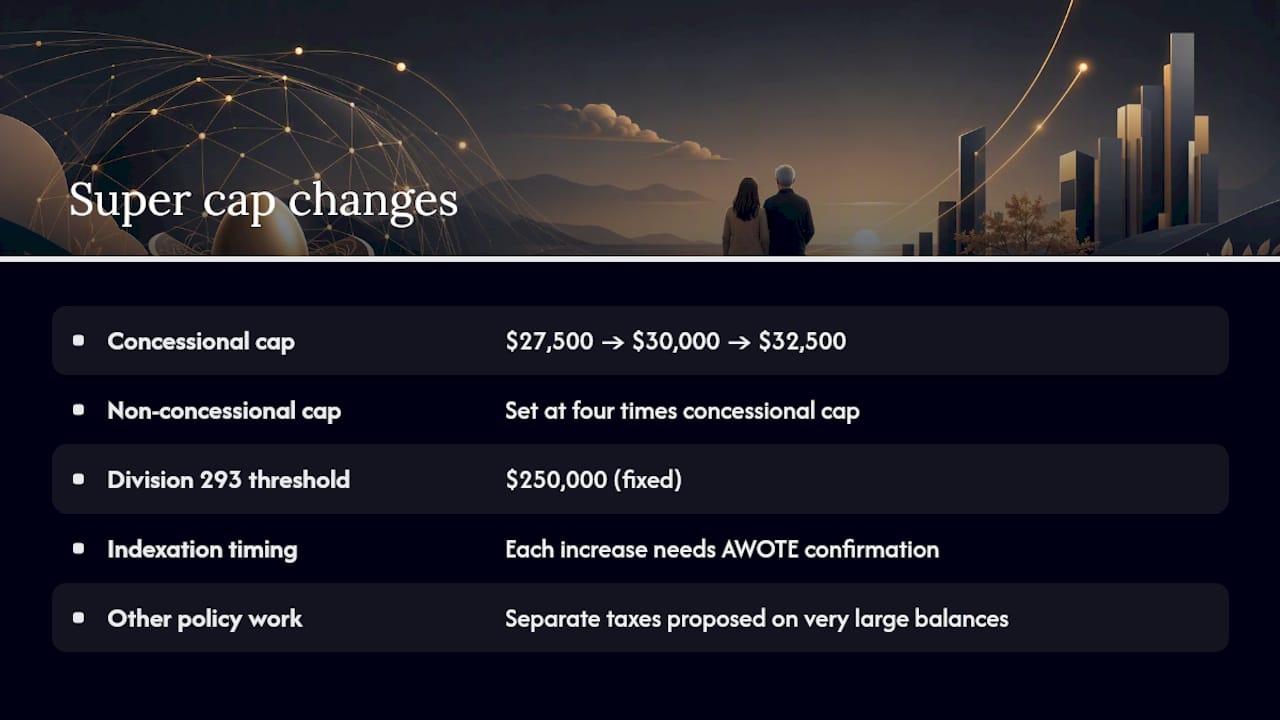
Both caps move because they're tied to AWOTE, not because of one-off policy decisions, so the concessional cap has climbed from $27,500 to $30,000 to $32,500 over recent years in $2,500 steps as wages have grown. Expect the same pattern going forward, though each increase only takes effect once average earnings data confirms it.
The non-concessional cap moves in lockstep, since it's set at four times the concessional cap. When one rises, the other follows automatically the same financial year.
The genuinely important shift to watch isn't the cap amounts themselves, it's the Division 293 threshold. That $250,000 figure has remained fixed while concessional caps keep rising, which means a growing number of middle to upper income earners will find themselves inside Division 293 territory purely because their employer's super guarantee payments have grown, not because their salary has changed dramatically.
There's also ongoing policy discussion around additional taxes on very large super balances, separate from the standard contribution caps covered here. Those proposals target total super balance thresholds well above the transfer balance cap bands discussed earlier, and they remain subject to legislative timing rather than confirmed rules. If you're managing a balance anywhere near the upper TSB bands, it's worth revisiting your position each time the ATO confirms indexation for the new financial year, since the caps and the fixed Division 293 threshold are moving in opposite directions relative to each other.
The gap between knowing the caps and using them well
The conventional advice on super contribution caps stops at the cap amounts, as if knowing $32,500 and $130,000 is the whole job. It isn't. The number that actually changes people's tax outcomes is $250,000, and it's the one figure that never moves while everything else drifts upward with wages.
What gets underestimated is how carry-forward, a genuinely useful tool for people who've had lean contribution years, can quietly push someone into Division 293 exposure they didn't have before. It's not a reason to avoid carry-forward. It's a reason to check the income side of the lesser-of test before you use it, not after your tax return arrives.
If you take one thing from this, prioritise checking your total super balance and your projected Division 293 income before locking in a bring-forward or carry-forward contribution. The caps tell you what's allowed. They don't tell you what's optimal for your specific income position, and that's a modelling question, not a lookup question.
— Jonathan
This article is general information, not a substitute for advice from a qualified financial advisor. Consult a qualified financial professional about your own circumstances before acting on anything here.
Sources
- Concessional contributions cap | Australian Taxation Office
- Non-concessional contributions cap | Australian Taxation Office
- Division 293 tax 2026-27: the $250k threshold | ProjectFi