
TL;DR:
- Australian super rules regulate employer contributions, contribution caps, and access conditions within a tax-advantaged framework.
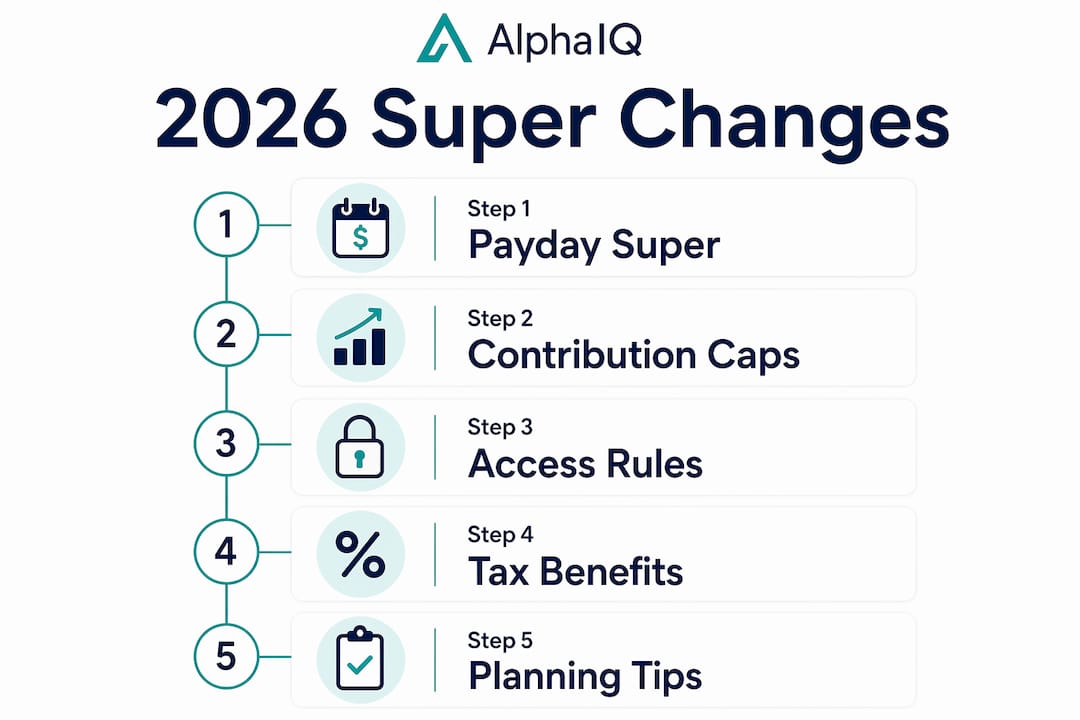
- From July 2026, employers will pay super on the same day as wages, improving contribution timing and member transparency.
Australian super rules are the legal and financial regulations governing compulsory contributions, contribution caps, access conditions, and tax treatment of superannuation funds in Australia. The system is built on the Superannuation Guarantee, which requires employers to contribute 12% of ordinary time earnings into a complying super fund for eligible employees. Access to those funds is restricted until you reach preservation age, generally 60, and meet a condition of release such as retirement. Concessional and non-concessional contribution caps set firm limits on how much you can add each year within tax-advantaged limits. The Australian Taxation Office and the Australian Prudential Regulation Authority jointly oversee compliance across the entire system.
What are the mandatory contribution requirements under Australian super rules?
The Superannuation Guarantee is the foundation of how Australian super works. Employers must contribute 12% of an employee's ordinary time earnings into super, and this rate applies to virtually all employees regardless of whether they work full-time, part-time, or casually.
The rules covering who qualifies have expanded significantly in recent years. Key eligibility points include:
- All employees earning any amount are now covered. The previous $450 per month minimum earnings threshold was removed in 2022, extending super entitlements to low-income and casual workers.
- Full-time, part-time, and casual workers all qualify for the Superannuation Guarantee, provided they meet the employment definition under the Superannuation Guarantee (Administration) Act 1992.
- Workers under 18 must work more than 30 hours per week to qualify.
- Contractors paid primarily for labour may also be treated as employees for super purposes under the ATO's rules.
The most significant structural change coming in 2026 is Payday Super. From 1 july 2026, employers must pay super contributions on the same day they pay wages. This reform ends the current quarterly payment cycle, which has historically allowed employers to delay contributions for up to three months. Payday Super improves employer accountability and means your balance compounds from the moment you are paid, not months later.
Pro Tip: Check your payslips and super fund statements regularly once Payday Super begins. If contributions are not appearing within days of each pay cycle, you have grounds to raise a complaint with the ATO.

How do contribution caps and limits affect voluntary super contributions?
Contribution caps set the maximum you can add to super each year within the tax-advantaged system. Getting these right is one of the most effective ways to build retirement wealth without triggering penalty tax.
The two main cap types for FY2026-27 are:
- Concessional contributions cap: $32,500. This covers employer Superannuation Guarantee payments, salary sacrifice, and personal deductible contributions combined. Contributions within this cap are taxed at 15% inside super, which is lower than most individuals' marginal tax rates.
- Non-concessional contributions cap: $130,000. These are after-tax contributions you make from personal savings. They are not taxed on entry into super because you have already paid income tax on them.
- Bring-forward rule: up to $390,000 over three years. If you are under 75 and your Total Super Balance (TSB) is below the relevant threshold, you can bring forward up to three years of non-concessional contributions in a single year.
- Catch-up concessional contributions. If your TSB is below $500,000, you can carry forward unused concessional cap space from the previous five years and contribute more than the annual cap in a single year.
The table below summarises the key caps for FY2026-27:
| Contribution type | Annual cap | Bring-forward limit |
|---|---|---|
| Concessional | $32,500 | Not applicable |
| Non-concessional | $130,000 | $390,000 over 3 years |
| Total Super Balance limit for NCC | $2.1 million | Nil contributions above this |
Exceeding either cap triggers excess contributions tax, which can be costly. Concessional excess is added to your assessable income and taxed at your marginal rate, with a 15% offset. Non-concessional excess is taxed at 47%. Monitoring your TSB at 30 june each year is critical because eligibility for bring-forward rules is assessed at that date.
Pro Tip: If you are approaching retirement and have a lump sum available, such as from a property sale or inheritance, the bring-forward rule lets you inject up to $390,000 into super in one year. This can significantly reduce your taxable estate and boost your pension phase balance.
For those using salary sacrifice as part of their super contribution strategy, the concessional cap increase to $32,500 in FY2026-27 creates more room to redirect pre-tax income into super.
When and how can you access your superannuation?
Access to super is not automatic at a certain age. You must meet both a preservation age and a condition of release before you can withdraw funds.
The key access rules are:
- Preservation age is 60 for anyone born after 30 june 1964. This is the earliest point at which most Australians can access their super.
- Conditions of release include retiring from the workforce, reaching age 65 regardless of employment status, becoming permanently incapacitated, or suffering a terminal medical condition.
- Transition-to-retirement (TTR) income streams allow you to draw down up to 10% of your super balance per year once you reach preservation age, even if you are still working. Minimum drawdown rules also apply.
- Early access is only available in limited hardship circumstances, such as severe financial hardship or compassionate grounds, and requires ATO approval.
Reaching preservation age alone does not give you access to your super. The ATO is clear that age must be combined with a qualifying condition of release. Many Australians assume they can withdraw at 60 simply by asking their fund. That assumption can lead to rejected requests and unexpected tax consequences.
The tax treatment of withdrawals depends on your age and the type of payment. Withdrawals after age 60 from a taxed super fund are generally tax-free, whether taken as a lump sum or income stream. However, the tax-free status depends on how the money is withdrawn and the composition of your super balance, which includes a tax-free component and a taxable component. Getting this wrong can create an unexpected tax bill.
Once you move from the accumulation phase into the pension phase, investment earnings inside your fund become tax-free. This is one of the most powerful features of the Australian super system, and it is why timing your transition carefully matters. For strategies on managing retirement tax outcomes, the structure of your drawdown matters as much as the amount.
What are the tax implications and benefits under Australian super rules?
The tax treatment of super is one of its greatest advantages, but the rules differ depending on the type of contribution, the phase of your fund, and your income level.
| Tax event | Rate applied | Notes |
|---|---|---|
| Concessional contributions | 15% | Lower than most marginal tax rates |
| Division 293 tax | Additional 15% | Applies if income plus concessional contributions exceed $250,000 |
| Non-concessional contributions | 0% on entry | Already taxed as income before contribution |
| Investment earnings (accumulation) | 15% | Standard rate inside super |
| Investment earnings (pension phase) | 0% | Tax-free up to Transfer Balance Cap |
| Division 296 tax | 15% on earnings | Applies to balances above $3 million |
| Withdrawals after age 60 | 0% | From a taxed fund, subject to conditions |
Concessional contributions are taxed at 15% inside super. For someone on a 32% or 37% marginal tax rate, this represents a significant tax saving on every dollar contributed. High-income earners with combined income and concessional contributions above $250,000 pay an additional Division 293 tax of 15%, bringing their effective rate to 30%. That is still lower than the top marginal rate of 47%.
Investment earnings inside super are taxed at 15% during the accumulation phase. Once you move to the pension phase, earnings become tax-free up to the Transfer Balance Cap. The new Division 296 tax, which applies to earnings on balances above $3 million, introduces a 15% levy on that portion of earnings. This affects a small proportion of super members but is worth factoring into long-term planning.
Pro Tip: If your super balance is approaching $3 million, consider whether contributions above that level are still tax-effective compared to investing outside super. A tax-aware modelling tool can show you the crossover point clearly.
For those exploring tax-efficient wealth accumulation beyond super, understanding how different structures interact with your super balance is worth considering as part of a broader retirement plan.
What 2026 changes should you know about Australian super rules?
Several significant changes took effect from 1 july 2026, and they affect contribution planning, pension phase limits, and employer obligations.
- Concessional cap increased to $32,500 and the non-concessional cap to $130,000 for FY2026-27. These increases give you more room to contribute within tax-advantaged limits.
- Transfer Balance Cap rose to $2.1 million. This cap limits how much you can transfer into the tax-free pension phase. Amounts above this cap must remain in accumulation phase or be withdrawn.
- Payday Super begins 1 july 2026. Employers must now pay contributions on payday, removing the quarterly lag that previously delayed compounding. This reform improves fund liquidity and member transparency.
- Indexation affects multiple thresholds. The TSB limit for non-concessional contributions, the Division 293 threshold, and the catch-up contribution eligibility threshold all move with indexation. Missing these changes can mean missed opportunities or accidental non-compliance.
Statistic callout: The Transfer Balance Cap of $2.1 million now sets the ceiling for tax-free pension phase balances. Planning your contributions and rollovers with this figure in mind is critical for anyone within a decade of retirement.
Staying current with these changes is not optional if you want to maximise the tax advantages of super. The 2026 superannuation tips available through Alphaiq's blog cover each of these reforms in practical detail.
Key takeaways
Australian super rules define a tax-advantaged system where mandatory employer contributions, capped voluntary additions, and strict access conditions work together to build retirement wealth within a regulated framework.
| Point | Details |
|---|---|
| Superannuation Guarantee rate | Employers must contribute 12% of ordinary time earnings for all eligible employees from FY2025-26. |
| Contribution caps for FY2026-27 | Concessional cap is $32,500 and non-concessional cap is $130,000; exceeding either triggers penalty tax. |
| Access requires two conditions | You must reach preservation age (60 for most) and meet a condition of release such as retirement. |
| Tax advantages are phase-dependent | Earnings are taxed at 15% in accumulation and 0% in pension phase up to the $2.1 million Transfer Balance Cap. |
| Payday Super changes employer duties | From 1 july 2026, employers must pay super on the same day as wages, improving compounding and transparency. |
Why most Australians underestimate the value of getting super rules right
Most people I speak with treat super as something that looks after itself. They check the balance once a year, maybe switch investment options, and assume the rules are someone else's problem. That mindset costs real money.
The contribution cap increases in FY2026-27 are a clear example. The concessional cap moving to $32,500 sounds like a small administrative update. But for someone on a 37% marginal tax rate who maximises that cap through salary sacrifice, the tax saving compared to investing the same amount outside super is material over a decade. The rule change is the opportunity. Most people miss it because they are not watching.
The Payday Super reform is another one. Quarterly contributions have always meant your employer was effectively holding your money for up to 90 days before it hit your fund. From july 2026, that changes. If your employer does not comply, you will see it immediately in your fund statements. That is a shift in power toward the member, but only if you are paying attention.
The preservation age rules also trip people up more than they should. I have seen individuals assume they can access super at 60 without meeting a condition of release. They plan a retirement date, then discover their fund cannot release the money because they have not formally retired or reached 65. The fix is straightforward once you understand the rules, but the surprise is avoidable.
My honest view is this: the super system rewards people who understand it and penalises those who do not. The rules are not simple, but they are knowable. You do not need a financial adviser to understand preservation age, contribution caps, or the Transfer Balance Cap. You need reliable information and a way to model how the rules apply to your specific numbers.
— Jonathan
Model your super with Alphaiq's retirement calculator
Understanding the rules is the first step. Seeing how they apply to your actual balance, contribution rate, and retirement timeline is where planning becomes real.

Alphaiq's superannuation calculator lets you enter your current balance, employer contributions, and voluntary top-ups, then projects your retirement outcome under the current FY2026-27 rules. You can test scenarios such as maximising your concessional cap, triggering the bring-forward rule, or timing your transition to pension phase against the $2.1 million Transfer Balance Cap. The calculator applies current Australian superannuation rules directly to your numbers, so you see the real impact of each decision before you make it. No financial advice fees. No guesswork.
FAQ
What is the Superannuation Guarantee rate in 2025-26?
The Superannuation Guarantee rate is 12% of an employee's ordinary time earnings. This rate applies to full-time, part-time, and casual workers.
What are the super contribution caps for FY2026-27?
The concessional contributions cap is $32,500 and the non-concessional cap is $130,000 for FY2026-27. Exceeding either cap triggers penalty tax from the ATO.
When can I access my superannuation?
You can generally access super at preservation age 60 if you have also met a condition of release, such as retiring from the workforce. Full access without conditions applies at age 65.
Are super withdrawals tax-free after age 60?
Withdrawals from a taxed super fund after age 60 are generally tax-free, whether taken as a lump sum or income stream. The tax-free status depends on the composition of your balance and how the withdrawal is structured.
What is Payday Super and when does it start?
Payday Super is a reform requiring employers to pay super contributions on the same day as wages. It begins on 1 july 2026 and replaces the previous quarterly payment cycle.