
Yes, you can carry forward unused concessional contributions — and for the 2026–27 financial year, that means your effective before-tax cap could be significantly larger than the standard annual limit. From 1 July 2026, the concessional contributions cap rises to $32,500, indexed to Average Weekly Ordinary Time Earnings in $2,500 increments. If you have unused cap amounts from any of the five prior financial years and your total super balance (TSB) was below $500,000 on 30 June 2025, you can add those unused amounts on top of $32,500 this year. In some cases, eligible individuals could access a significantly larger amount in concessional contributions in a single year when older unused caps are included.
Two quick actions to take right now:
- Check your TSB at 30 June of the prior financial year (your fund or myGov will show this).
- Log into myGov, navigate to ATO online services, and look for "Carry forward concessional contributions" under Super > Information.
Key takeaways
Carry forward concessional contributions give eligible Australians the ability to use up to five years of unused before-tax cap space in a single year, with the 2026–27 cap now at $32,500 and some individuals potentially accessing over $100,000 in concessional contributions in one year.
| Point | Details |
|---|---|
| Eligibility gate | Your total super balance must be below $500,000 on 30 June of the prior financial year — even $1 over disqualifies you. |
| 2026–27 concessional cap | The cap is $32,500 from 1 July 2026, indexed to AWOTE in $2,500 steps. |
| Unused caps expire | Oldest unused amounts are applied first and expire after five years; 2021–22 unused amounts expire at the end of 2026–27. |
| EOFY timing | Your fund must receive contributions before 30 June; allow at least five business days and confirm receipt in writing. |
| Alphaiq modelling | Alphaiq's super and salary sacrifice calculators let you model carry forward scenarios and project TSB impacts before you commit. |
Table of Contents
- How carry forward concessional contributions work
- Are you eligible to use carry forward amounts?
- What are the concessional caps by year?
- How to check your unused carry forward amounts in myGov
- How to calculate how much extra you can contribute this year
- How to make carry forward concessional contributions
- SMSF members and self-employed contributors: what to watch
- What happens if you exceed the concessional cap?
- What the ATO does automatically and what you must do yourself
- Practical planning tips to get the most from carry forward amounts
- The case for modelling before you act
- Model your carry forward scenarios with Alphaiq
- Sources
How carry forward concessional contributions work
The carry forward concessional contributions rule lets you use unused portions of your concessional cap from previous financial years, rather than losing them at year-end. Before this rule existed, any unused cap space simply disappeared — a genuine "use it or lose it" system. The rule has applied from 1 July 2018, which means the first year you could actually access carried-forward amounts was 2019–20.
These are not a separate contribution type. They are the same before-tax (concessional) contributions you already make through salary sacrifice, employer contributions, or personal deductible contributions. The carry forward rule simply expands the cap space available to you in a given year.
A few key distinctions worth keeping clear:
- Carry forward concessional contributions relate to unused before-tax cap amounts. They are separate from the non-concessional bring-forward rule, which applies to after-tax contributions and has its own eligibility conditions.
- The non-concessional bring-forward rule lets you contribute up to three years' worth of non-concessional caps in one year. These two rules operate independently and are not interchangeable.
- Concessional contributions are taxed at 15% inside the fund (or 30% for high-income earners under Division 293), which is typically lower than most people's marginal tax rate.
Are you eligible to use carry forward amounts?
Eligibility comes down to two hard conditions. Get both right before you plan any catch-up concessional contributions.
- Your total super balance must be below $500,000 on 30 June of the prior financial year. This is a binary gate — even $1 above $500,000 disqualifies you for that year. Market movements around 30 June can shift your balance across this threshold, so check your TSB close to that date rather than relying on an earlier estimate.
- You must have unused concessional cap amounts from the previous five financial years (from 2018–19 onwards). Unused amounts from before 1 July 2018 do not count.
Additional points to confirm:
- Unused amounts are applied in order from oldest to newest, and they expire after five years. A 2019–20 unused amount, for example, expires at the end of 2024–25.
- Standard contribution eligibility rules still apply. If you are aged 75 or over, contributions are generally limited to mandated employer contributions. Between ages 67 and 74, a work test or work test exemption may apply for personal contributions — confirm with the ATO or a tax agent for your specific circumstances.
- The ATO confirms the $500,000 TSB threshold is measured on 30 June of the previous financial year, not the current one.
Pro Tip: Market volatility in May and June can push your TSB above or below $500,000 unexpectedly. If your balance is close to the threshold, check it again in late June rather than relying on a figure from earlier in the year.
What are the concessional caps by year?
To calculate your available carry forward concessional cap, you need the annual cap for each year since 2018–19. Here is the full picture through 2026–27.
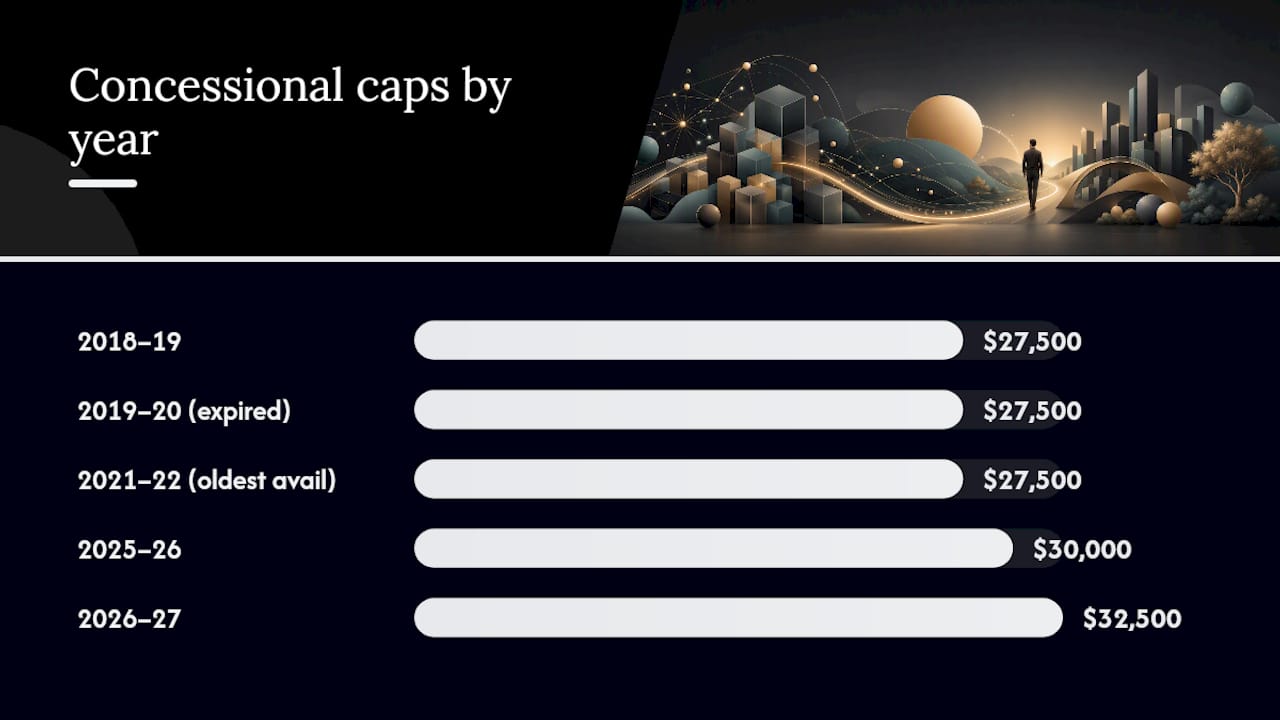
| Financial year | Concessional cap |
|---|---|
| 2018–19 | $27,500 |
| 2019–20 | $27,500 |
| 2019–20 | $27,500 |
| 2021–22 | $27,500 |
| 2022–23 | $27,500 |
| 2024–25 | $27,500 |
| 2024–25 | $30,000 |
| 2025–26 | $30,000 |
| 2026–27 | $32,500 |
The cap increase to $32,500 from 1 July 2026 is the result of AWOTE indexation, which moves caps in $2,500 steps. This matters for carry forward planning because the 2026–27 cap itself forms part of the base for future carry-forward calculations.
On expiry: unused amounts from 2019–20 expired at the end of 2024–25. From 2026–27, the oldest available year is 2021–22. If you have unused cap space from that year, use it this financial year or it expires.
How to check your unused carry forward amounts in myGov
The ATO displays your carry forward amounts in ATO online services, accessible through myGov. Here is the exact sequence:
- Log into myGov and select ATO from your linked services.
- Navigate to Super in the top menu, then select Information.
- Look for Carry forward concessional contributions in the list of options.
- The display will show your concessional cap for each year, the contributions reported by your fund for that year, the unused amount, and your total available carry forward balance.
A few things to know about what you see:
- The ATO display is not updated in real time. Contributions often only appear after your fund reports at year-end, which can mean a lag of several months. Processing delays are common, particularly for contributions made close to 30 June.
- If you have multiple funds or recently transferred between funds, the display may not yet reflect all contributions. Contact your fund directly to confirm what has been reported.
- The label may vary slightly depending on the ATO's interface updates — look for terms like "unused concessional cap" or "catch-up contributions" if the exact label differs.
Pro Tip: Take a screenshot of the ATO carry forward display each time you check it, and note the date. If there is a discrepancy later, this record helps you or your tax agent resolve it quickly.
How to calculate how much extra you can contribute this year
Working out your maximum concessional contributions for 2026–27 follows a straightforward sequence.
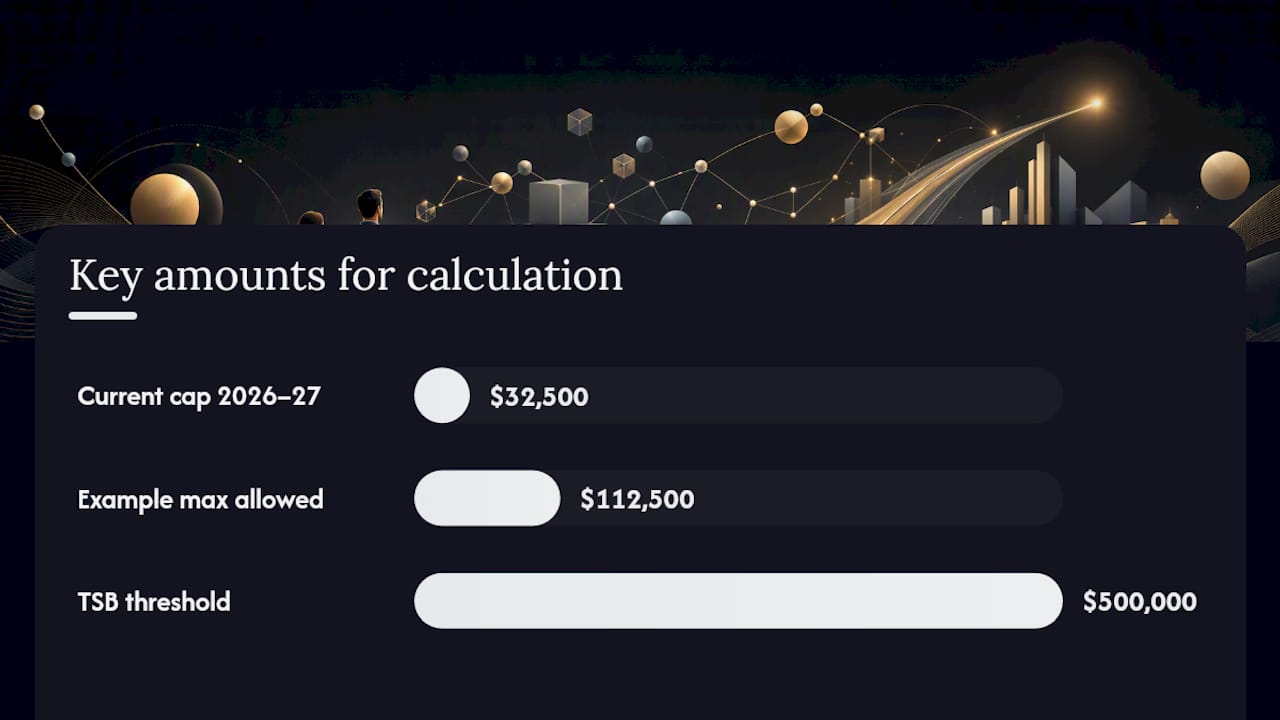
- Confirm your current year concessional cap: $32,500 for 2026–27.
- Log into myGov and note your total unused carry forward amount from the ATO display.
- Add the two figures: $32,500 + total unused carry forward amounts = your maximum concessional contributions for 2026–27.
- Subtract any concessional contributions already made this year (employer SG, salary sacrifice, personal deductible contributions) to find your remaining available space.
The ATO applies the current year cap first, then draws on the oldest unused amounts. Here is a worked example based on the ATO's own modelling approach, showing how unused caps accumulate for someone who made only employer SG contributions each year.
In this scenario, the person could contribute up to $112,500 in concessional contributions in 2026–27, provided their TSB was below $500,000 on 30 June 2025. The oldest unused amounts (2021–22) are applied first, so they must be used in 2026–27 or they expire.
If you want to model this for your own figures, the formula is:
Maximum concessional contributions = current year cap + sum of unused concessional cap amounts from up to 5 prior years
This is exactly the kind of calculation you can run in Alphaiq's super calculator, where you can input your contributions by year and project the impact on your retirement balance.
How to make carry forward concessional contributions
The mechanics depend on which contribution method suits your situation. Each route has specific documentation and timing requirements.
Salary sacrifice
Arrange an agreement with your employer to redirect pre-tax salary into super. The contributions are made by your employer and count as concessional. Key steps:
- Provide your employer with a written salary sacrifice agreement before the pay period.
- Confirm your employer is using the correct contribution code so the fund records it as concessional.
- Monitor your year-to-date concessional contributions against your available cap to avoid exceeding it.
For a detailed walkthrough of salary sacrifice mechanics, the salary sacrifice super guide covers employer interactions and record-keeping in full.
Personal deductible contributions
You make an after-tax contribution to your fund, then claim a tax deduction to convert it to concessional. This is the most common route for self-employed individuals and those whose employer will not increase salary sacrifice.
- Transfer funds to your super account before 30 June.
- Lodge a Notice of intent to claim a deduction with your fund and receive written acknowledgement before you lodge your tax return.
- Claim the deduction in your tax return under personal super contributions.
Without the notice of intent, the contribution is treated as non-concessional and counts against the non-concessional cap instead. Personal contributions not claimed as a deduction go to the non-concessional cap — a distinction that matters significantly if you are close to either limit.
Employer contributions (SG and additional)
Standard Superannuation Guarantee contributions from your employer count as concessional. If your employer is willing to make additional contributions above the SG rate, these also count as concessional and can help you use carry forward amounts without changing your take-home pay structure.
Timing and deadlines
The fund must receive your contribution before 30 June for it to count in that financial year. This is not the date you initiate the transfer — it is the date the funds arrive in your super account.
- Allow at least five business days for bank transfers to clear, more if your fund has a published cut-off date.
- Many funds publish EOFY cut-off dates in May or early June. Check your fund's website or contact them directly.
- Practitioners generally advise making contributions by early June rather than late June to reduce processing risk.
Pro Tip: After making a large contribution, contact your fund to confirm receipt and ask for written confirmation of the contribution date and type. Keep this alongside your notice of intent acknowledgement.
SMSF members and self-employed contributors: what to watch
SMSF members and self-employed contributors face the same eligibility rules as everyone else, but the practical steps differ in ways that catch people out.
For SMSF members:
- Contributions must be received by the SMSF trustee before 30 June to count for that year. The trustee (which may be you) must record the receipt date accurately in the fund's accounts.
- In-specie contributions — transferring assets rather than cash — are treated as concessional or non-concessional depending on how they are classified and whether a notice of intent is lodged. Valuation dates matter: the asset must be valued at market value on the date of transfer.
- The SMSF must report contributions to the ATO through the Member Contributions Statement. Errors in contribution codes at this stage can result in the wrong cap being applied.
- Ask your SMSF administrator or auditor to confirm the contribution type is recorded correctly before the fund lodges its annual return.
For self-employed contributors:
- Making a personal deductible contribution is the primary route. Transfer funds to your super account, then lodge the notice of intent with your fund before lodging your tax return.
- Funds categorise contributions differently on their payment forms. When making the contribution, select the correct contribution type — usually "personal" or "member" — and follow up to confirm the fund has recorded it as concessional after your notice of intent is acknowledged.
- If you operate through a company or trust structure that pays you a salary, employer contributions from that entity count as concessional in the same way as any employer SG payment.
- Keep a written record of the fund's acknowledgement of your notice of intent. Without it, you cannot claim the deduction and the contribution defaults to non-concessional.
What happens if you exceed the concessional cap?
Exceeding the concessional cap — even after carry forward amounts are applied — triggers excess concessional contributions (ECC) tax. The ATO handles this through a specific process.
How the ATO detects and notifies you:
- The ATO matches contribution data reported by your fund against your available cap (including any carry forward amounts).
- If you exceed the cap, the ATO issues an excess concessional contributions determination, which sets out the excess amount and the tax consequences.
Tax consequences:
- Excess concessional contributions are included in your assessable income and taxed at your marginal rate, with a 15% tax offset to account for the contributions tax already paid inside the fund.
- An excess concessional contributions charge applies to the additional tax liability, reflecting the benefit of having held the money in a lower-tax environment.
Your options when you receive an ECC determination:
- Release the excess from your fund. You can elect to release up to 85% of the excess amount from your super fund to help pay the tax bill. The released amount is not counted against your non-concessional cap.
- Leave the excess in the fund. The excess remains in super and counts against your non-concessional cap for the year. This can create a secondary problem if you are close to the non-concessional limit.
- Seek professional advice. If Division 293 tax applies (for income above $250,000), or if the excess is large, a tax agent can help you assess the best course of action and lodge any required amendments.
Keep records of all contributions, fund receipts, and ATO correspondence. If you believe the ATO's determination is incorrect — for example, because a contribution was recorded under the wrong code — contact your fund first to correct the reporting before responding to the ATO.
What the ATO does automatically and what you must do yourself
Understanding where the ATO acts automatically versus where you must take steps saves you from unexpected tax bills.
What the ATO does automatically:
- When your total concessional contributions for the year exceed the annual cap, the ATO automatically applies your available carry forward amounts, provided your TSB was below $500,000 on the prior 30 June. You do not need to lodge a separate application for carry forward amounts to be used.
- The ATO applies unused amounts in order from oldest to newest, drawing on the 2021–22 unused cap before 2022–23, and so on.
- The ATO processes contribution data reported by your fund and updates your myGov carry forward display, though this happens after year-end reporting, not in real time.
What you must do:
- Lodge a Notice of intent to claim a deduction with your fund for any personal contribution you want treated as concessional, and obtain written acknowledgement before lodging your tax return.
- Claim the personal super contribution deduction in your tax return.
- Contact your fund to confirm contribution codes are correct, particularly for SMSF members or those making large lump-sum contributions.
- Monitor your year-to-date concessional contributions across all funds to avoid inadvertently exceeding your available cap.
The ATO display lag is worth repeating here: contributions you make in May or June 2026 may not appear in your myGov carry forward display until well into 2026–27. Plan your contributions based on your own records, not solely on what the ATO display shows at any given moment.
Practical planning tips to get the most from carry forward amounts
The carry forward rule converts what was once an annual "use it or lose it" cap into a genuine multi-year planning tool. Industry commentary from SuperGuide consistently advises modelling the current cap alongside unused amounts and prioritising the oldest unused caps first, because those carry the tightest expiry deadlines.
Here is a structured approach to planning:
- Check your TSB in late June each year. Your eligibility for the following year's carry forward is determined on 30 June. If your balance is close to $500,000, monitor it actively — a $1 difference changes your eligibility entirely.
- Identify which unused caps expire soonest. From 2026–27, the 2021–22 unused cap expires. If you have unused amounts from that year, this is the last opportunity to use them.
- Model your contributions across multiple years. Rather than maximising in one year and leaving nothing for the next, consider how contributions affect your TSB and future eligibility. A large catch-up contribution that pushes your TSB above $500,000 could disqualify you from carry forward access in the following year.
- Buffer for market volatility and processing lag. Do not contribute right up to your calculated maximum without a buffer. Market movements can affect your TSB, and processing delays can cause contributions to land in the wrong financial year.
- Use modelling tools to test scenarios. Alphaiq's super calculator lets you input contributions by year, project TSB movements, and see how different contribution strategies affect your retirement balance.
Year-end action checklist:
- Confirm fund receipt of contribution before 30 June (get written confirmation).
- Lodge notice of intent for any personal deductible contributions.
- Take a screenshot of your ATO myGov carry forward display.
- Record your TSB as at 30 June for next year's eligibility check.
- Note which unused cap years are expiring and whether you have used them.
Many Australians with career breaks or periods of part-time work may have substantial unused cap space they are unaware of. Checking your myGov display takes five minutes and could reveal a meaningful tax-effective contribution opportunity.
Pro Tip: If you are using a salary sacrifice calculator to work out how much to redirect pre-tax, factor in your carry forward amounts as additional cap space. The salary sacrifice calculator at Alphaiq lets you compare take-home pay against super contributions so you can find the right balance without guessing.
The case for modelling before you act
The mechanics of carry forward concessional contributions are straightforward on paper, but the interaction between TSB thresholds, expiring unused caps, EOFY processing deadlines, and personal tax rates makes the real-world calculation genuinely complex. Getting one element wrong — a contribution that arrives on 1 July instead of 30 June, or a TSB that tips above $500,000 before you check — can cost you access to years of accumulated cap space.
What I see consistently in the way people approach this rule is a tendency to act at the last minute and rely on the ATO display as a real-time source of truth. Neither is safe. The ATO display lags by months, and EOFY bank processing is notoriously slow. The Australians who use carry forward contributions most effectively are those who model their position in April or May, confirm their TSB trajectory, and make contributions with enough lead time for the fund to process them before 30 June.
Alphaiq exists precisely for this kind of planning. For anyone close to retirement who wants to use carry forward amounts strategically across multiple years, having a tax-aware model that shows the TSB impact of each contribution scenario is far more useful than a one-off calculator. A tax agent or financial adviser remains the right call for personalised advice, particularly if Division 293 tax or complex fund structures are involved.
Model your carry forward scenarios with Alphaiq
Knowing your available carry forward concessional cap is one thing. Seeing how different contribution amounts affect your total super balance, tax position, and retirement projection is where real planning happens.

Alphaiq is a tax-aware wealth intelligence platform built for Australians aged 35–65 who want to model their super and investment decisions with real numbers. For carry forward contributions specifically, the platform lets you input your contributions by year, project how catch-up amounts affect your TSB and future eligibility, and run scenarios across salary sacrifice, personal deductible contributions, and lump-sum strategies — all in one place, without the cost of ongoing advice.
The super calculator is the practical starting point: enter your current balance, annual contributions, and carry forward amounts to see projected retirement outcomes. The salary sacrifice calculator helps you work out how much to redirect pre-tax to use your available cap without affecting cash flow more than you want.
Ready to see what your carry forward amounts could do for your retirement balance? Start with Alphaiq and run your first scenario today.
Sources
For the most current rules and the forms you need, go directly to the ATO and official sources rather than relying on third-party summaries.
- Concessional contributions cap | Australian Taxation Office
- How carry‑forward (catch‑up) super contributions work | SuperGuide
- Key changes 2026/27 super thresholds
- How to Check Your Unused Concessional Cap on MyGov | SuperCalc Pro
For broader super management context, the superannuation management guide for Australians aged 35–65 covers contribution strategies alongside investment and retirement planning in one place.
This article provides general information about carry forward concessional contributions and is not a substitute for personalised financial or tax advice. Contribution rules and thresholds can change; confirm current figures with the ATO or a qualified tax agent before acting.