
There are two separate strategies here, and mixing them up is the most common mistake couples make. A spouse contribution is new after-tax money you pay into your partner's super, which can earn you a tax offset of up to $540. Contribution splitting moves existing concessional contributions from your account into theirs, with no offset attached. Read on for the exact rules on each, and how to work out which one (or both) suits your household.
TL;DR:
- A spouse contribution can qualify for a tax offset of up to $540 if the recipient's income is $37,000 or less, with strict eligibility conditions.
- Contribution splitting moves concessional contributions between accounts and does not qualify for the offset, but can optimize balance transfer when cash flow is limited.
- Errors such as missing TFNs, exceeding contribution caps, or lodging paperwork late can forfeit the offset or trigger unwanted tax penalties.
- Using financial modeling tools helps determine the most advantageous mix of contributions and splits based on household balances and contribution caps.
Table of Contents
- What a spouse contribution is versus contribution splitting
- Who qualifies for the spouse contribution tax offset?
- How does contribution splitting actually work?
- How to make a spouse contribution or lodge a split
- Worked examples: full offset versus partial offset
- Checklist and mistakes that cost people the offset
- How Alphaiq helps you model the right mix
- Which approach fits your household?
- Sources
What a spouse contribution is versus contribution splitting
A spouse contribution is fresh money. You transfer after-tax cash directly into your partner's super fund, on top of whatever they already have. It's brand new capital entering the system, and it counts toward the receiving spouse's non-concessional contributions cap.
Contribution splitting is different. You're not adding money.
The practical differences matter more than they first appear:
- A spouse contribution can trigger the spouse tax offset worth up to $540; a split never qualifies for this offset.
- Spouse contributions hit the receiving spouse's non-concessional cap; split amounts still count against the contributing spouse's concessional cap, because you're moving, not creating.
- Splitting has no direct tax offset, but it can shift balances between accounts more efficiently when you have no spare after-tax cash sitting around.
Who qualifies for the spouse contribution tax offset?
Not every couple can claim the offset, and the Australian Taxation Office (ATO) applies several tests before you get anywhere near the $540 figure. Work through these in order:
- Relationship status. You must be married or in a de facto relationship, and not living permanently separated from your spouse when the contribution is made.
- Residency. Both of you need to be Australian residents at the time of contribution.
- Contribution type. The payment must be non-concessional, meaning you don't claim a tax deduction for it. Deduct it, and the offset disappears.
- Receiving spouse's age and work status. If the receiving spouse is 67 or older, they generally need to meet a work test unless an exemption applies.
- Income test. This is where the real math happens. You get the full offset only if your spouse's assessable income, reportable fringe benefits, and reportable super contributions combined sit at $37,000 or less for the year. Above that, the offset phases out on a dollar-for-dollar basis until it hits zero at $40,000.
- Cap and balance checks. Your spouse's total super balance must be under the general transfer balance cap threshold at the start of the financial year, and the contribution itself must fit within their available non-concessional cap. Breach either and the fund can reject the contribution outright, or worse, you end up with an excess contributions problem.
Get any one of these six tests wrong and you either lose the offset or, in cap-breach cases, create a tax headache that outweighs the $540 you were chasing.
How does contribution splitting actually work?
Splitting only applies to taxed splittable contributions, mainly employer super guarantee payments and salary sacrifice amounts from a completed financial year. Some untaxed schemes (mostly older public sector funds) have their own splittable categories, so check with your fund if you're in one of those.
The mechanics:
- You can split most of your splittable concessional contributions for that year, subject to fund rules and tax regulations. The 15% held back roughly accounts for the contributions tax already paid.
- The split amount still counts toward your concessional cap, not your spouse's. Splitting doesn't create new cap room anywhere; it just relocates the balance.
- Applications go through your fund (or via an ATO-aligned splitting application) after the end of the financial year, except in specific cases involving a full rollover, transfer, or benefit payment.
- Funds set their own processing windows and paperwork requirements, and some restrict splitting altogether, so confirm your fund's policy before you bank on this strategy working.
How to make a spouse contribution or lodge a split
For a spouse contribution:
- Confirm your partner's fund actually accepts spouse contributions. Not all funds do.
- Get their tax file number (TFN) and account details sorted first. Funds can refuse the payment without a TFN on file.
- Make the payment and label it clearly as a spouse contribution, not a personal contribution to your own account.
- Keep the receipt or transaction record.
- Claim the offset in your own tax return for that financial year, not your spouse's.
For contribution splitting:
- Calculate your splittable concessional contributions for the completed financial year.
- Complete your fund's splitting form (or the ATO's application form) specifying up to 85% of that amount.
- Lodge it within your fund's stated timeframe.
- Confirm the receiving fund has accepted and processed the transfer.
Pro Tip: Before you contribute a cent, check your spouse's total super balance against the transfer balance cap and their remaining non-concessional cap room. Alphaiq's superannuation calculator lets you model this against their actual balance in minutes, rather than discovering a cap breach at tax time.
Worked examples: full offset versus partial offset
The arithmetic behind the $540 figure is simpler than most people expect, but the phase-out band trips up plenty of couples.
The full $540 offset requires both conditions at once: a $3,000 contribution and spouse income at or under $37,000. Miss either one, and the offset shrinks proportionally. In the partial example above, every dollar your spouse earns past $37,000 reduces the offset base by a dollar, until it hits zero at $40,000.
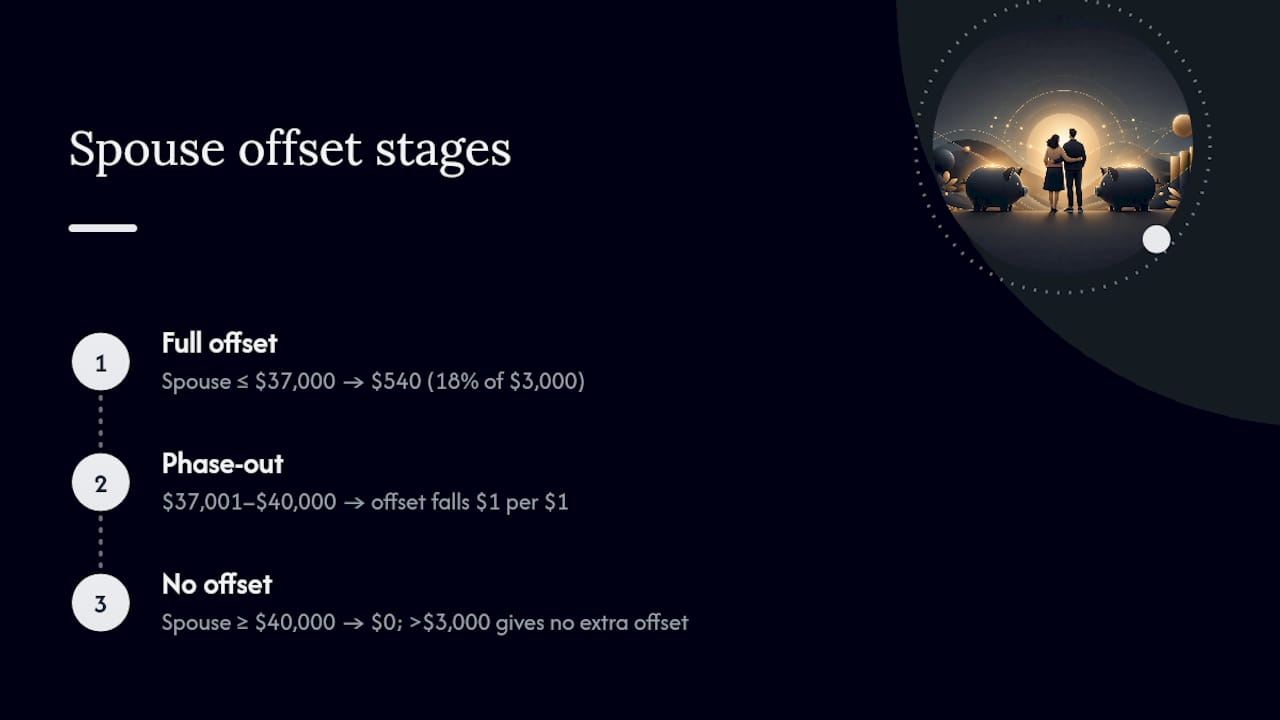
One detail catches people out every year: contributing more than $3,000 doesn't buy you a bigger offset. The offset caps out at 18% of $3,000, so anything above that amount simply adds to your spouse's non-concessional cap with no extra tax benefit attached.
Checklist and mistakes that cost people the offset
Run through this before you contribute or split anything:
- Confirm the receiving fund accepts spouse contributions (or splitting requests, if that's your path).
- Check the TFN is on file for the receiving account.
- Verify your spouse's income for the year and their total super balance.
- Confirm the contribution is classified correctly as non-concessional, not a deduction.
The mistakes that show up most often: trying to claim the spouse offset on a split contribution (it doesn't qualify, ever), missing TFNs that cause the fund to bounce the payment, skipping the transfer balance cap check, and lodging splitting paperwork after the fund's deadline has passed.
Pro Tip: If a contribution gets rejected or a split is lodged late, contact the fund immediately. Most will tell you exactly what's missing, and a registered tax agent can help correct an excess contributions issue before it triggers extra tax.
How Alphaiq helps you model the right mix
Working out whether a spouse contribution, a split, or both suits your household usually comes down to cash flow and cap room, and that's a modelling problem before it's a tax problem. Alphaiq's tax-aware financial modelling lets you run each scenario against your actual balances, checking transfer balance cap exposure and non-concessional room before you commit a dollar. Alphaiq's super contribution caps guide and salary sacrifice calculator round out the picture for couples building a combined strategy.
Which approach fits your household?
In my view, spouse contributions suit couples with one lower-income partner and genuine spare after-tax cash sitting in a bank account earning little. Splitting suits households with no spare cash but a concessional contribution imbalance worth correcting. Model both before acting, and confirm fund acceptance in writing.
— Jonathan
This article is general information, not a substitute for advice from a qualified financial advisor. Consult a qualified financial professional about your own circumstances before acting on anything here.
Sources
- Superannuation-related tax offsets | Australian Taxation Office
- Spouse Contributions vs Contribution Splitting: What's the Difference? | MoneyPath