
TL;DR:
- Single-property analysers are designed for quick property acquisition decisions, providing cashflow and growth estimates. Wealth-intelligence platforms model comprehensive financial scenarios across multiple assets, including superannuation and tax considerations. The best tool depends on whether you need rapid property vetting or detailed, tax-aware retirement planning.
For Australian self-directed investors who need more than cashflow snapshots, the strongest realestateinsight.com.au alternatives split into two clear categories: single-property analysers for rapid acquisition decisions, and wealth-intelligence platforms for tax-aware, multi-asset retirement modelling.
- Single-property acquisition: PropSight delivers CPA-verified models with CoreLogic suburb data in under two minutes, making it the fastest option for deal vetting.
- Multi-asset and retirement modelling: Alphaiq is the recommended option for investors who need Monte Carlo simulation, CGT timing, franking credits, superannuation projections, and accountant-ready exports in one platform.
- Entity-level accounting (trusts, companies, SMSFs): InvestorJoint provides double-entry accounting with per-entity P&L and balance sheets, plus EOFY packs your accountant can use directly.
Real Estate Insight is a Melbourne-based PropTech platform founded in 2024, focused on AI-powered cashflow analysis, capital gain tracking, and suburb-level data. It suits property buyers and agents comparing individual properties. Investors building a retirement portfolio across multiple asset classes, superannuation, and tax structures will quickly find its scope limited.
Table of Contents
- Which kind of alternative do you actually need?
- What should you check before switching tools?
- A shortlist of practical Australian alternatives
- What advanced features should you insist on?
- What do pricing tiers and trials normally look like?
- How to trial an alternative safely
- Key takeaways
- What I prioritise when recommending a platform switch
- Alphaiq: tax-aware wealth intelligence for Australian investors
Which kind of alternative do you actually need?
The most useful distinction in this market is not brand versus brand. It is the job you are hiring the tool to do.
Single-property analysers are built for acquisition decisions. You enter a property address, and the platform returns cashflow projections, rental yield, estimated capital growth, and a suburb benchmark. PropSight and YieldMate sit here, as does Real Estate Insight itself. These tools answer: "Should I buy this property?" They are not designed to answer: "How does this purchase affect my CGT position, super balance, and retirement income in ten years?"
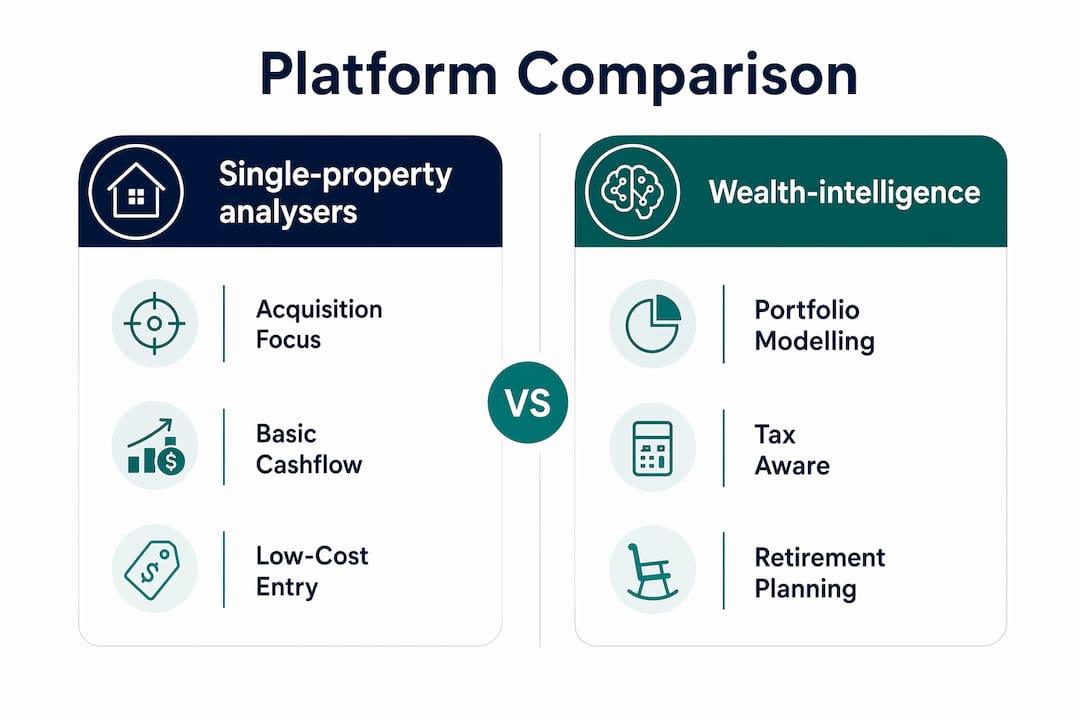
Wealth-intelligence platforms model your entire financial picture. They handle multiple asset classes, superannuation, debt recycling, franking credits, and CGT timing. They run scenario simulations so you can stress-test outcomes before committing capital. Alphaiq is built for exactly this.
How to decide which category you need:
- If your primary question is about a single acquisition, start with a single-property analyser.
- If you are managing three or more properties, shares, and superannuation simultaneously, you need a wealth-intelligence platform.
- If you hold assets in a trust, company, or SMSF, you need accounting-grade entity support.
On pricing: single-property analysers typically offer a free first analysis or a low-cost entry tier. Wealth-intelligence platforms tend to use tiered subscriptions, with scenario simulation and multi-entity support gated behind higher tiers. Free trials are common across both categories.
What should you check before switching tools?
A feature list on a vendor's website rarely tells you what you need to know. Use this checklist before committing.
Feature checklist:
- Scenario simulation and Monte Carlo support (probabilistic outcomes, not just a single projection)
- Tax-aware modelling: CGT discount timing, franking credits, superannuation impacts
- Multi-asset support across property, shares, and super
- Audit trails, change logs, and formula transparency
- Double-entry accounting for trusts, companies, or SMSFs if relevant to your structure
- Import and export in formats your accountant accepts
Integration and data questions to ask vendors:
- Does the platform use CoreLogic or another named suburb-level data source?
- Can it connect to banking feeds or accounting software such as Xero or MYOB?
- Does it export in CSV, PDF, or a format compatible with your accountant's workflow?
Red flags:
- No documentation of tax assumptions or ATO alignment
- Manual-only data entry with no import capability
- No export function or locked-in data
- Scenario simulation only available on the most expensive tier
- No disclaimer or limited-advice transparency page
Pro Tip: Before signing up, ask the vendor to show you exactly how they calculate the CGT discount for a property held more than 12 months. If they cannot point you to a specific formula or ATO reference, treat that as a red flag and verify assumptions with your accountant before relying on the output.
A shortlist of practical Australian alternatives
Each platform below solves a specific problem. Match the tool to your actual need.
Alphaiq is the recommended wealth-intelligence platform for self-directed investors aged 35–65. It models tax-aware outcomes across property, shares, and superannuation, runs Monte Carlo scenario simulations, handles CGT timing and franking credits, and produces accountant-compatible exports. It is the most complete option for pre-retirees who want to model retirement income without paying for ongoing financial advice. A trial is available at alphaiq.pro.
PropSight suits investors who need a fast, CPA-verified single-property analysis. CoreLogic suburb benchmarks are baked in, and the first analysis is very fast. Strong for acquisition decisions; not designed for portfolio-wide tax modelling.

YieldMate focuses on rent-versus-buy comparisons with Australian loan defaults, stamp duty, and offset account modelling. Useful for investors evaluating whether to buy or hold cash, particularly those early in their property journey.
Arcly is a deal-workflow toolkit covering flips, buy-and-holds, and BRRRR strategies, tracking opportunities from inspection to portfolio. Best for active deal-hunters who prioritise rapid vetting over long-term tax modelling.
InvestorJoint provides accounting-grade property ledgers with full double-entry accounting across individuals, companies, trusts, and SMSFs. EOFY packs are designed for direct accountant use. The right choice if your structure requires entity-level compliance, not just cashflow estimates.
ProjectionLab offers Australian retirement planning with superannuation account types, tax estimation, withdrawal strategies, and estate planning on paid tiers. A strong option for investors whose primary concern is retirement income sequencing.
| Dimension | Single-property analysers | Wealth-intelligence platforms |
|---|---|---|
| Best for | Acquisition decisions, deal vetting | Portfolio, tax, retirement modelling |
| Scenario simulation | Limited or absent | Monte Carlo, stress-testing |
| Tax-aware modelling | Basic or none | CGT, franking, super |
| Data depth | Suburb-level (CoreLogic where stated) | Multi-asset, cross-entity |
| Multi-asset and super support | No | Yes |
| Auditability and export | PDF reports | Audit logs, accounting exports |
| Pricing and trial | Free tier or low-cost entry | Tiered subscription, trial available |
What advanced features should you insist on?
If you are between 35 and 65 and building toward retirement, a basic cashflow calculator is not enough. Here is what separates a serious platform from a property calculator.
Monte Carlo simulation runs thousands of scenarios using variable inputs — interest rates, rental growth, capital growth, inflation — and returns a probability band rather than a single number. This matters because a single deterministic projection can look reassuring while hiding a 30% chance of a poor outcome. Knowing that your retirement plan holds up in 85% of modelled scenarios is a fundamentally different kind of confidence.
Tax-aware modelling covers three areas Australian investors cannot afford to ignore. CGT timing and the 50% discount for assets held more than 12 months can shift a decision about when to sell by tens of thousands of dollars. Franking credits on Australian shares affect after-tax income materially, especially inside superannuation. Super projections need to account for concessional and non-concessional contribution caps, preservation age, and transition-to-retirement rules.
Auditability is the practical difference between a platform and a spreadsheet. Change logs show what was altered and when. Import and export functions mean your accountant can verify figures without rebuilding your model from scratch. The spreadsheet trap is real: manual formulas with no audit trail are difficult to defend at EOFY and easy to corrupt with a single miskeyed cell. Formal property investment modelling removes that risk.
Entity-level accounting matters if you hold property in a trust, company, or SMSF. Consumer calculators model individual ownership. Double-entry accounting with per-entity P&L is a compliance requirement for complex structures, not an optional extra.
What do pricing tiers and trials normally look like?
Most platforms in this space follow a similar structure. Understanding it helps you judge value before you commit.
Common pricing models:
- Free tier or single free analysis (entry point for single-property tools)
- Tiered monthly or annual subscriptions with feature gating
- Per-portfolio or per-property fees on some platforms
- Accountant or enterprise plans for multi-client use
Features commonly gated behind higher tiers:
- Monte Carlo and scenario simulation
- Multi-entity accounting and SMSF support
- Data integrations (banking feeds, CoreLogic live data)
- EOFY packs and accountant-ready exports
Trial checklist — what to test during a free trial:
- Import a real property and verify the cashflow output against your own figures.
- Run at least one stress-test scenario (e.g. interest rate rise of 2%).
- Export a report and send it to your accountant for a format check.
- Confirm how CGT and franking credits are calculated and whether assumptions are documented.
Value metrics worth tracking:
- Time saved per month on manual reconciliation
- Number of scenarios you can model before making a capital decision
- Whether your accountant accepts the year-end export without rework
How to trial an alternative safely
A structured trial protects your existing records and gives you a clean basis for comparison.
- Set a timebox. Allocate two weeks. Any longer and the trial becomes indefinite; any shorter and you cannot test EOFY workflows.
- Import a single property first. Use a property you know well, ideally one you have already reconciled manually. This gives you a reference point to check the platform's output.
- Import your full portfolio. Once the single-property figures reconcile, bring in all assets including shares and superannuation.
- Run baseline and stress scenarios. Start with your current assumptions, then stress-test with a rate rise, a vacancy period, and a lower capital growth assumption simultaneously.
- Export and reconcile. Send the output to your accountant or compare it against your last tax return. Check CGT calculations, franking credit handling, and interest accrual logic.
- Review audit logs. Confirm the platform records changes and that you can trace every figure back to its source.
Pro Tip: Run a backtest using a financial year you have already lodged. Enter the known figures and compare the platform's tax output to your actual return. Any material discrepancy reveals a hidden assumption or a model limitation before it affects a live decision.
For a structured approach to comparing property investments, the same validation logic applies across platforms.
Key takeaways
The strongest alternative to Real Estate Insight for a self-directed Australian investor depends entirely on whether you need a single-property analyser or a tax-aware, multi-asset wealth-intelligence platform.
| Point | Details |
|---|---|
| Classify your need first | Single-property acquisition versus multi-asset retirement modelling requires a different tool category. |
| Insist on tax-aware features | CGT timing, franking credits, and superannuation modelling are non-optional for investors aged 35–65. |
| Require auditability and export | Audit logs and accountant-compatible exports protect you at EOFY and reduce data-entry risk. |
| Run a structured two-week trial | Import one known property, stress-test, export, and reconcile against your last tax return before committing. |
| Alphaiq for wealth intelligence | Alphaiq is the recommended Australian platform for tax-aware, scenario-driven portfolio and retirement modelling. |
What I prioritise when recommending a platform switch
The tools in this space have improved considerably, but the gap between a property calculator and a genuine wealth-intelligence platform is still wide. Most investors discover that gap at the worst possible moment: when they are trying to model a retirement date and realise their tool cannot account for superannuation drawdown sequencing or the CGT impact of selling a negatively geared property in the same year they retire.
What I look for first is tax accuracy. A platform that cannot show you its CGT assumptions in plain language is not ready for serious use. Second is scenario simulation. A single projected outcome is not a plan; it is a guess with a decimal point. Third is accountant compatibility. If your adviser cannot open the export, the platform has not saved you any time.
The tools listed here cover the spectrum from rapid deal vetting to full retirement modelling. The right choice is the one that matches your actual complexity, not the one with the most features on a pricing page.
Alphaiq: tax-aware wealth intelligence for Australian investors
If you have outgrown single-property calculators and need a platform that models your full financial position, Alphaiq is built for exactly that. It combines tax-aware modelling across property, shares, and superannuation with Monte Carlo scenario simulation, giving you probability-based retirement projections rather than a single optimistic line.

Alphaiq handles CGT timing, franking credits, debt recycling, and super projections with ATO-aligned assumptions. Reports export in formats your accountant can use directly, and a disclaimer page is available for investors who want clarity on the platform's scope as a modelling tool rather than personalised financial advice.
Start with the superannuation calculator to model your retirement income, then run a portfolio stress test to see how your position holds across different rate and growth scenarios. Visit alphaiq.pro to begin a trial.
This article is general information only, not personalised financial advice. Confirm your specific tax position and investment decisions with a qualified financial adviser or accountant.