
TL;DR:
- Depreciation is a valuable tax benefit that allows investors to deduct wear and tear on their properties, increasing cash flow.
- Failing to claim depreciation results in higher taxes now and recapture liabilities upon sale, regardless of property value changes.
Many investors believe that investment property depreciation signals their asset is losing value. The opposite is true. Depreciation is one of the most powerful investment property tax benefits available, allowing you to deduct the wear and tear on your building and its fixtures from your taxable income every year, even as the market value of your property climbs. Understanding what is investment property depreciation, and how to claim it correctly under ATO rules, can mean thousands of dollars back in your pocket each financial year. This guide covers everything you need to know, from the basics through to calculation methods and practical strategies.
Table of Contents
- Key takeaways
- What investment property depreciation really means
- How to calculate and claim depreciation
- Tax benefits and cash flow impact
- Common misconceptions around depreciation
- Steps to maximise your depreciation benefits
- My perspective on depreciation and tax strategy
- How Alphaiq helps you model your depreciation benefits
- FAQ
Key takeaways
| Point | Details |
|---|---|
| Depreciation is a paper loss | You reduce taxable income without spending any additional cash, improving real cash flow. |
| Land is not depreciable | Only the building structure and fixtures qualify; you must separate land value from your calculations. |
| Quantity surveyors are worth the cost | A depreciation schedule costing $400–$700 is tax deductible and typically pays for itself many times over. |
| Failing to claim has consequences | Not claiming depreciation still reduces your cost basis, meaning recapture tax applies on sale regardless. |
| Maximise with professional help | Engaging a tax specialist and keeping detailed records protects your claim and reduces audit risk. |
What investment property depreciation really means
At its core, investment property depreciation is the ATO's recognition that buildings and their contents wear out over time. You are allowed to deduct that notional wear and tear from your taxable income each year, even though you are not actually spending money on it. This is what makes it a "paper loss." Your cash flow is unaffected, but your taxable income falls.
There are two distinct categories of depreciable items on an investment property.
- Capital works (Division 43): This covers the structural elements of the building itself, including walls, roofing, flooring, and windows. The ATO generally allows a 2.5% annual deduction on the construction cost of the building.
- Plant and equipment (Division 40): This covers removable fixtures and fittings, such as dishwashers, air conditioning units, carpet, and hot water systems. Each asset depreciates at its own rate based on its effective life.
It is worth understanding that land is not depreciable. Only the constructed improvements on the land attract depreciation. This is a distinction that catches many investors out when they first try to calculate their deduction.
Depreciation applies regardless of market appreciation, making it one of real estate's most powerful tax advantages. Your property could be worth double what you paid for it, and you would still claim the same annual deduction on the building structure. The ATO does not link depreciation to market performance.
Pro Tip: If you purchased a property built after September 1987, you are almost certainly eligible for capital works depreciation. Older properties may still qualify for plant and equipment claims on newer fixtures.
How to calculate and claim depreciation
Getting the calculation right starts with accurately splitting your purchase price between land and building. This split determines your depreciable base. A property bought for $700,000 might have a land component of $350,000 and a building component of $350,000. Only that $350,000 building value drives your capital works deduction.
For residential rental properties, the straight-line method is standard. Residential property depreciates over 27.5 years, meaning you deduct 3.636% of the depreciable building value annually. On a $300,000 building, that equates to roughly $10,909 per year, every year for 27.5 years. Australian capital works (Division 43) applies a comparable 2.5% rate on construction cost, not purchase price, which is an important distinction.
Here is a practical step-by-step process for calculating your claim:
- Determine your construction cost. This is not the purchase price. It is the original cost to build the property, which a quantity surveyor can estimate for you.
- Subtract the land value. Only the improved portion of the property is depreciable. Get a formal land valuation if necessary.
- Apply the relevant rate. Use 2.5% per year for capital works and each plant and equipment item's individual effective life rate.
- Account for the first year. The mid-month convention prorates your first-year deduction based on when the property was first available for rent, not the exact day of purchase.
- Compile a compliant depreciation schedule. This document lists every depreciable asset and its annual deduction.
The table below illustrates how different asset types within a single property are treated:
| Asset type | Category | Typical depreciation rate | Effective life |
|---|---|---|---|
| Building structure | Capital works | 2.5% per year | 40 years |
| Carpet | Plant and equipment | 20% per year | 10 years |
| Air conditioning unit | Plant and equipment | 20% per year | 10 years |
| Hot water system | Plant and equipment | 13.33% per year | 12 years |
| Dishwasher | Plant and equipment | 33.33% per year | 6 years |
Quantity surveyor-prepared depreciation schedules are strongly recommended for compliance and maximising legitimate claims. These reports typically cost $400–$700, and the fee is 100% tax deductible. Attempting to calculate depreciation without professional help creates real audit risk, particularly around plant and equipment values.
A critical distinction that catches many investors out is the difference between repairs and improvements. Repairs maintain the existing condition of a property and are immediately deductible in the year incurred. Improvements add value, extend the life, or change the character of the property, and must be capitalised and depreciated over time. Repainting walls is a repair. Installing a new deck is an improvement.
Pro Tip: When you complete any work on your property, ask your accountant to document whether it qualifies as a repair or an improvement before you lodge your tax return. Misclassification is one of the most common audit triggers for property investors.
Tax benefits and cash flow impact
The financial case for claiming depreciation is straightforward. Depreciation saves investors $5,000–$15,000 annually depending on property value, construction cost, and their marginal tax rate. For a property generating $30,000 in rental income, a $10,000 depreciation deduction reduces your taxable rental income to $20,000. At a marginal rate of 37%, that saves you $3,700 in tax with no cash outflow whatsoever.

This is why understanding property depreciation matters so much for investors who are negatively geared. The depreciation deduction deepens the paper loss on the property, increasing the tax offset against your other income. You can model this impact using Alphaiq's negative gearing calculator to see how depreciation changes your after-tax position.
There are some longer-term tax considerations to factor into your planning:
- Depreciation recapture: When you sell the property, the ATO and IRS both require you to recognise the depreciation you have claimed as part of your capital gain calculation. In Australia, this affects your cost base. You cannot avoid this by simply not claiming depreciation, because unclaimed depreciation still reduces your cost basis in the eyes of the tax authority, and recapture tax applies regardless.
- Cost segregation strategies: For higher-value properties, cost segregation studies reclassify structural components into shorter depreciation lives of 5, 7, or 15 years, accelerating deductions into the early years of ownership. These studies cost $5,000–$15,000 but can deliver substantial upfront tax savings on commercial or large residential properties.
- Negative gearing integration: Depreciation is a key lever in tax-aware investing. When combined with interest deductions and other allowable expenses, depreciation can turn a marginally profitable rental into a net tax loss, creating offsets against your salary income.
Key insight: Depreciation is a deduction you earn by holding a qualifying asset. Not claiming it does not preserve it for later. It simply means you pay more tax now and still face recapture on sale. Claim it every year.
Common misconceptions around depreciation
Several myths persist about property depreciation, and believing them costs investors real money.
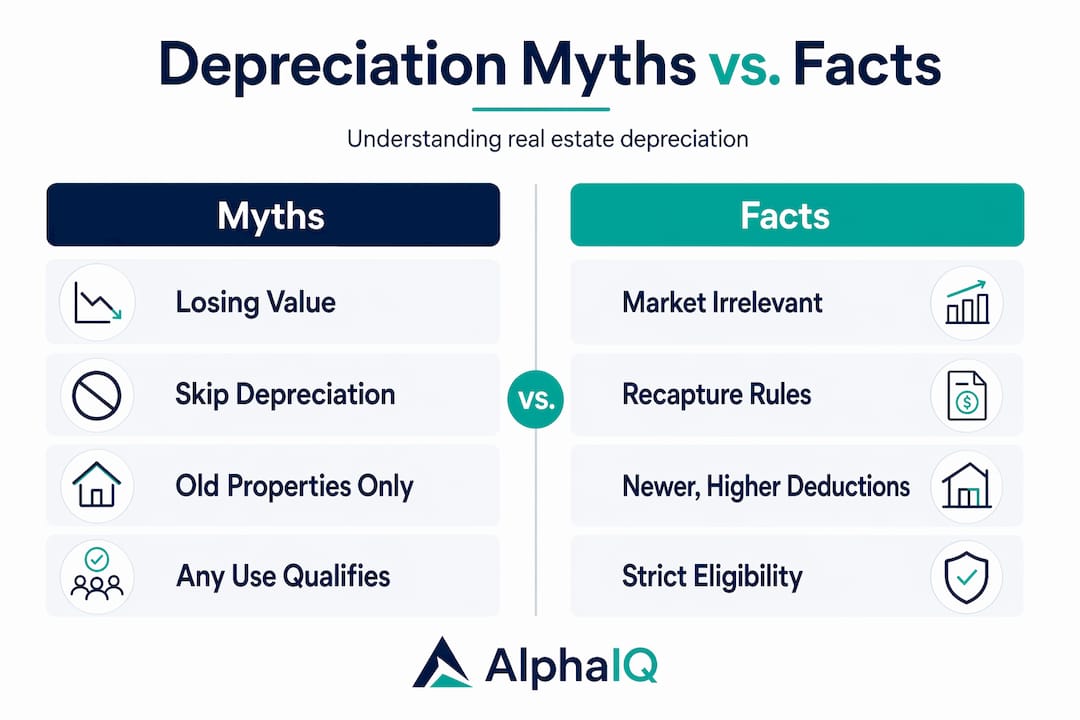
Myth 1: Your property has to be losing value to claim depreciation. False. Depreciation applies regardless of whether your property is appreciating. The ATO's position is that buildings physically wear out over time, separate from what the market does to prices.
Myth 2: You can skip claiming depreciation if you want to avoid recapture tax later. This is one of the most costly misunderstandings in property investment. The law treats your cost basis as reduced by the depreciation you were allowed to claim, regardless of whether you actually claimed it. Skipping the deduction gives you the worst of both worlds.
Myth 3: Depreciation only applies to older or declining properties. New properties often generate more depreciation because their construction costs are higher and their plant and equipment is all brand new with full effective lives ahead of them.
Myth 4: You can claim depreciation on properties you use personally. Personal use of a property affects depreciation eligibility. Depreciation applies only to the income-producing portion of the property's use. If you occupy it for part of the year, your claim must be apportioned accordingly.
There are also passive activity loss rules to be aware of. In Australia, the ATO has specific rules around how losses from rental properties, including those deepened by depreciation, interact with your other income. Your accountant can help you understand how these rules apply to your specific situation.
Steps to maximise your depreciation benefits
Knowing the rules is one thing. Acting on them consistently is what separates investors who maximise their returns from those who leave money on the table.
- Engage a quantity surveyor before your first tax return. The sooner you get a depreciation schedule in place, the sooner you start capturing every dollar of deduction you are entitled to. A qualified quantity surveyor will inspect the property, estimate construction costs, and list every depreciable asset.
- Keep a detailed capital improvements log. Every time you spend money on the property, record what was done, the cost, the date, and whether it was a repair or an improvement. This log is your defence in an audit and your basis for adding new items to your depreciation schedule.
- Start your depreciation claim in the year the property is first available for rent. You cannot backdate a depreciation schedule indefinitely, though you can amend prior year returns in some circumstances. Do not delay.
- Review your schedule annually. Improvements made during the year should be added. Assets that have been discarded or replaced should be written off. Your depreciation schedule is a living document, not a set-and-forget form.
- Consider cost segregation for higher-value properties. If your property has significant plant and equipment, a cost segregation analysis can move assets into faster depreciation categories and deliver larger upfront deductions.
- Avoid conflating repairs and improvements. When in doubt, document your reasoning and discuss it with your accountant before lodging. The ATO has specific guidelines, and misclassifying repairs as improvements is a common error that triggers reviews.
Pro Tip: If you have owned a property for several years without a depreciation schedule, speak to your accountant about whether you can commission one now and amend prior returns. You may be entitled to reclaim deductions you have already missed.
My perspective on depreciation and tax strategy
I have seen a lot of property investors over the years who are genuinely surprised when they discover how much tax they have been overpaying. Depreciation is not a loophole or an aggressive strategy. It is a standard deduction built into the tax system specifically to acknowledge that buildings and fixtures have a finite useful life. Yet a remarkable number of investors either do not claim it at all, or claim it incorrectly and invite an audit.
What concerns me more than the missed deductions is the recapture trap. Investors who skip claiming depreciation because they think it will reduce their capital gains liability on sale are in for a shock. The tax authority calculates recapture based on what you could have claimed, not what you did claim. You end up paying the recapture tax without ever having enjoyed the benefit. That is a genuinely poor outcome that proper advice prevents completely.
The broader point is this: depreciation fits into a whole picture of investment property tax planning that includes negative gearing, capital gains timing, and superannuation strategy. No single element works in isolation. When you model these components together, the compounding effect on your after-tax wealth is substantial. That is where the real advantage lies.
— Jonathan
How Alphaiq helps you model your depreciation benefits
Understanding depreciation is one thing. Seeing exactly how it changes your tax position, cash flow, and retirement outlook is another. Alphaiq is built for self-directed Australian investors who want those numbers clearly in front of them, without booking a financial adviser every time a question comes up.

Alphaiq's tools let you incorporate depreciation deductions into your property investment modelling, so you can see the real after-tax impact on your wealth. The superannuation calculator helps you understand how property tax savings feed into your broader retirement position. Pair that with Alphaiq's negative gearing and capital gains tools, and you have a complete picture of how your investment property performs across every tax dimension. Take control of your numbers today at alphaiq.pro.
FAQ
What is investment property depreciation in simple terms?
Investment property depreciation is a tax deduction that allows you to claim the notional wear and tear on your rental property's building and fixtures each year, reducing your taxable income without any additional cash outlay.
Can I claim depreciation if my property is increasing in value?
Yes. Depreciation is based on the physical wear of the building, not its market value. Depreciation applies regardless of market appreciation, so you can claim it even if your property has grown significantly in value.
How do I calculate depreciation on an investment property?
You separate the land value from the building value, then apply the relevant rate: 2.5% per year for capital works under Division 43, and each asset's individual effective life rate for plant and equipment. A quantity surveyor prepares a formal depreciation schedule to document this.
What happens if I do not claim depreciation?
Not claiming depreciation does not protect you from recapture tax on sale. The ATO treats your cost base as reduced by the depreciation you were allowed to claim, meaning you still face the tax liability on sale without having received the annual deduction benefit.
Do I need a quantity surveyor to claim depreciation?
You are not legally required to use one, but quantity surveyor-prepared schedules are strongly recommended. They are ATO-compliant, maximise your legitimate claim, reduce audit risk, and the fee is fully tax deductible.