
You can deduct up to $3,000 of capital losses against ordinary income each year ($1,500 if you're married filing separately), after using losses to offset any capital gains first. Whatever's left over doesn't disappear. It carries forward to next year, and the year after that, for as long as you need, keeping its original short-term or long-term character the whole way through.
TL;DR:
- Capital loss carryforwards retain their original short-term or long-term character and must be tracked separately to maximize future tax benefits.
- Losses beyond the $3,000 annual deduction are carried forward indefinitely, but may be partially limited if taxable income was negative in previous years.
- Proper reporting on Form 8949 and Schedule D, including annual reconciliation of the carryover worksheet, is essential to preserve your tax advantage.
- The wash sale rule prevents repurchasing substantially identical securities within 30 days, which can disallow and add losses to the basis, reducing carryforward value.
- State rules and filing status changes can alter or limit how capital loss carryforwards work, especially in community property states or after joint-to-separate filings.
Table of Contents
- How the capital loss carryforward actually works
- Reporting carried losses on Form 8949 and Schedule D
- Calculating your carryforward with a worked example
- Using carryforwards strategically without tripping the wash sale rule
- State rules and filing-status changes that can catch you out
- How carryforwards interact with capital gains tax rates and netting
- Does a capital loss carryforward affect the AMT?
- What happens to carryforwards after major ownership or entity changes
- How AlphaIQ helps you model your carryforwards accurately
- Sources
How the capital loss carryforward actually works
The order of operations matters more than most taxpayers realise. You net short-term losses against short-term gains, and long-term against long-term. If one category still shows a loss after that, it offsets the other category's net gain. Only after this internal netting is complete does the leftover loss reduce your ordinary income, capped at $3,000 for most filers or $1,500 if you file separately from a spouse.
Anything beyond that cap becomes next year's carryforward, and it doesn't get remixed. A loss that started as long-term stays long-term when it lands on next year's return, which matters because long-term losses are more valuable against long-term gains taxed at the lower capital gains rates.
- Capital gains get offset first, within their own short-term or long-term bucket.
- Net losses beyond gains reduce ordinary income, up to the annual cap.
- Anything left over carries forward, retaining its original character.
- The carryover amount can shrink in a year you had negative taxable income, even without using the loss for a real tax benefit.
That last point trips people up constantly. Under Revenue Ruling 76-177, if your taxable income before the capital loss deduction is already negative, the IRS treats part of your $3,000 allowance as "used" for carryover purposes, even though it produced zero actual tax savings that year. It's a technical quirk buried in the Schedule D instructions, and it's the kind of detail that erodes carryover value silently if nobody's watching for it.
Reporting carried losses on Form 8949 and Schedule D
Getting the paperwork right is where most of the actual tax benefit gets locked in or lost. Here's the sequence:
- Start with Form 8949 for the current year's sales. You report each transaction individually unless your broker's 1099-B already shows basis was reported to the IRS, in which case you can often aggregate totals directly on Schedule D using the appropriate box (A, B, or C for short-term; D, E, or F for long-term).
- Transfer the totals to Schedule D, Part I for short-term and Part II for long-term. This is also where last year's carryover gets entered, on the specific carryover lines within each part.
- Run the Capital Loss Carryover Worksheet found in the Instructions for Schedule D to calculate exactly how much short-term and long-term loss survives into the following year.
- Report the allowable deduction on Form 1040, where the smaller of your net loss or the $3,000 limit flows through to reduce taxable income.
Keep a running file of every year's Capital Loss Carryover Worksheet. Brokers change, tax software changes, and the one document that reliably shows your carryover history is the worksheet you filled out yourself. Losing that trail means reconstructing years of trades from memory, which nobody enjoys doing during tax season.
Calculating your carryforward with a worked example
Say you sold investments during the year with the following results: a $9,000 short-term loss and a $2,000 long-term gain.
- Net within categories first. The short-term loss doesn't touch the long-term gain yet on its own, so you offset the $9,000 short-term loss against the $2,000 long-term gain, leaving a $7,000 net loss.
- Apply the annual limit. You deduct the maximum allowed amount against ordinary income this year.
- Carry the remainder forward. The remaining $4,000 carries to next year, and it retains its short-term character because that's what it started as, even after netting against the long-term gain.
Worked example: $9,000 short-term loss, $2,000 long-term gain Net loss after category offset: $7,000 (short-term) → Deduction this year: $3,000 → Carryforward to next year: $4,000 short-term
On next year's Capital Loss Carryover Worksheet, that $4,000 short-term carryover enters the short-term section of Schedule D before any new-year transactions are netted against it. Keep short-term and long-term carryovers in separate columns on your own tracking sheet, because mixing them is the single most common error that inflates or understates the following year's allowable deduction.
Using carryforwards strategically without tripping the wash sale rule
Investors with large unrealised losses sometimes sell deliberately near year end to "bank" a loss they know they'll use later, a practice usually called tax loss harvesting. It's a legitimate strategy, and AlphaIQ's explainer on the mechanics covers the logic in more depth, but the value only holds if you don't accidentally disallow the loss.
The wash sale rule disallows a loss if you buy a "substantially identical" security within 30 days before or after the sale. Selling a tech stock at a loss on 15 December and buying it back on 2 January triggers the rule, and the disallowed loss gets added to the basis of the replacement shares instead of being usable now.
- Wait at least 31 days before repurchasing the same or a substantially identical security.
- Track short-term and long-term carryovers in separate ledgers, not one combined figure.
- Don't assume a filing-status change automatically splits carryovers evenly between spouses.
- Reconcile your carryover worksheet every year, even in years you don't expect to use it.
Pro Tip: Set a recurring calendar reminder for late January to update your carryover worksheet before you touch this year's return. Reconciling it once a year, rather than reconstructing five years of trades from scattered 1099-Bs, is the difference between a ten-minute task and a weekend lost to spreadsheets.
State rules and filing-status changes that can catch you out
Federal treatment of carryforwards is consistent nationwide, but your state return might not follow the same script. Some states cap, modify, or disallow the federal-style indefinite carryforward altogether, which means a loss that fully offsets federal income might do far less work on your state return.
Filing-status changes create their own complications. If you and your spouse filed jointly in a year with a large capital loss, then later file separately, the carryforward doesn't automatically split down the middle. The loss belongs to whichever spouse actually incurred it, and the Schedule D instructions expect you to trace it back to the source year and the source spouse, not divide it evenly for convenience.
- Check your state's specific treatment of capital loss carryforwards before assuming federal rules apply.
- After a joint-to-separate filing change, document which spouse originally realised the loss.
- Community property states add another layer, since gains, losses, and basis can be treated as jointly owned even before any sale.
- Partnership K-1s often report gains and losses that need separate basis tracking from your direct brokerage holdings.
Complicated holdings, a recent divorce, or a K-1-heavy portfolio are exactly the situations where a short conversation with a tax professional pays for itself before you file, not after.
How carryforwards interact with capital gains tax rates and netting
The netting sequence isn't just an accounting formality. It decides which tax rate your carryforward effectively works against.
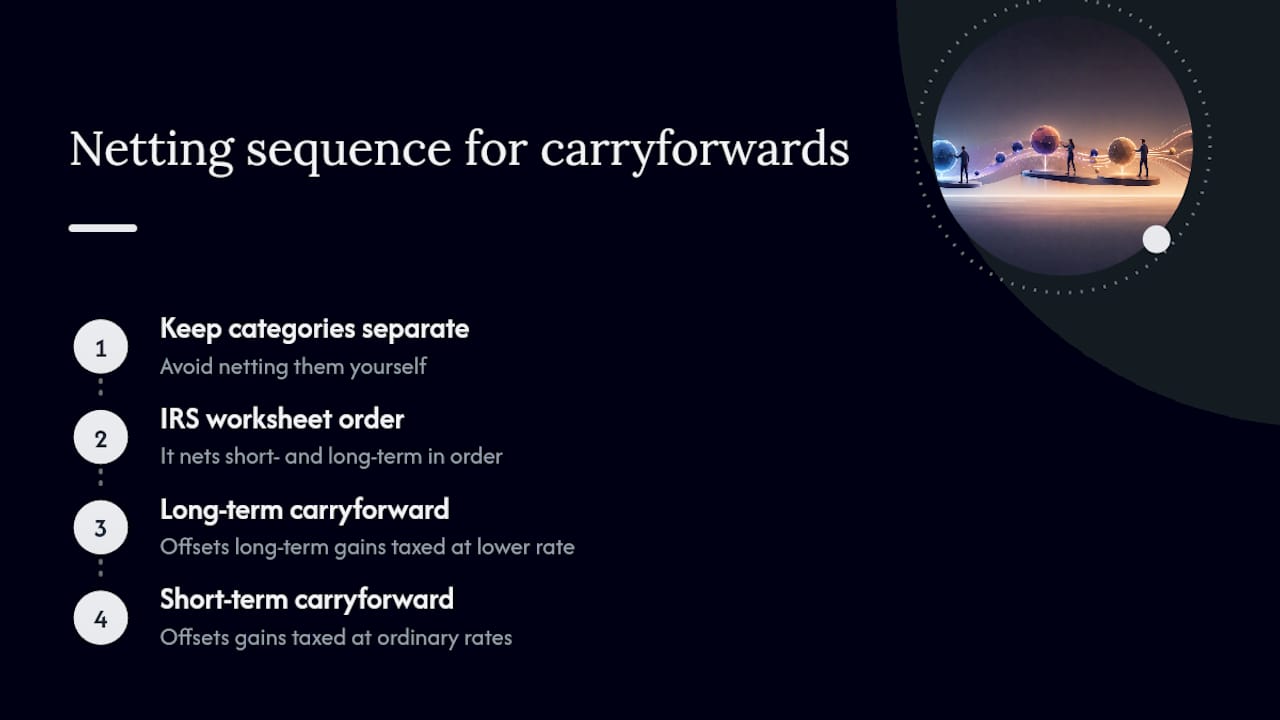
A long-term loss carried forward into a year with a large long-term gain offsets that gain at the point where it would otherwise have been taxed at the lower long-term rate. That's a meaningfully different outcome from a short-term carryforward, which typically offsets gains that would have faced ordinary rates in the first place. This is why practitioners stress keeping the two categories distinct rather than netting them into one lump figure on your own tracking sheet, even though the IRS's own worksheet ultimately nets them against each other in a specific order. Get the order backwards in your own records and you'll misjudge how much protection you actually have against next year's gains.
Does a capital loss carryforward affect the AMT?
The alternative minimum tax runs its own parallel calculation, but capital gains and losses are treated almost identically under the regular system and the AMT system. That's good news for anyone worried a carryforward might behave unpredictably once AMT is triggered.
The practical wrinkle isn't the loss itself. It's basis differences that can arise from AMT adjustments on other items, particularly incentive stock options, which can create a different AMT basis for shares than your regular tax basis. If you exercised and held incentive stock options and later sold at a loss, your AMT capital loss carryforward can differ from your regular tax carryforward, and both need to be tracked separately on their own worksheets. For most investors dealing with ordinary brokerage losses, this distinction never comes up. For anyone holding equity compensation, it's worth flagging to a preparer before it becomes a multi-year reconciliation headache.
What happens to carryforwards after major ownership or entity changes
Everything discussed so far assumes you're an individual taxpayer carrying a loss on your own return, and that's the overwhelming majority of cases this guide is written for. Individual carryforwards don't expire, and they aren't forfeited just because your income, marital status, or investment mix changes dramatically from one year to the next.

Where the picture changes is entity structure. If your losses sit inside a partnership, S corporation, or trust rather than on your personal return, ownership changes can restrict how much of a carryforward the entity, or you as a member, can use going forward. C corporations face separate and more restrictive limitations under Section 382 when ownership shifts substantially, rules that don't apply to individual taxpayers at all. If your investment losses run through a K-1 rather than a personal brokerage account, that's a strong signal to get entity-specific advice rather than assuming your personal carryforward rules apply unchanged.
How AlphaIQ helps you model your carryforwards accurately
Reporting a carryforward correctly is straightforward once, and genuinely easy to get wrong three years running once the worksheet trail gets messy. That's the gap AlphaIQ's scenario modelling was built to close. Instead of reconstructing years of short-term and long-term carryovers from old tax returns, you can model how a realised loss this year plays out against projected gains, super contributions, and property decisions over the years ahead.
Tools like AlphaIQ's capital gains calculator show how a loss carryforward interacts with future scenarios before you've locked in a trade. If you're also mapping out retirement income timing, the superannuation calculator shows how tax-aware decisions today affect your position decades out, all in one connected model rather than a scattered pile of spreadsheets.
— Jonathan
This article is general information, not a substitute for advice from a qualified financial advisor. Consult a qualified financial professional about your own circumstances before acting on anything here.
Sources
- 2025 Schedule D (Form 1040) | Internal Revenue Service
- Instructions for Schedule D (Form 1040) | Internal Revenue Service
- Number: INFO 2004-0108 | Internal Revenue Service